Journeys

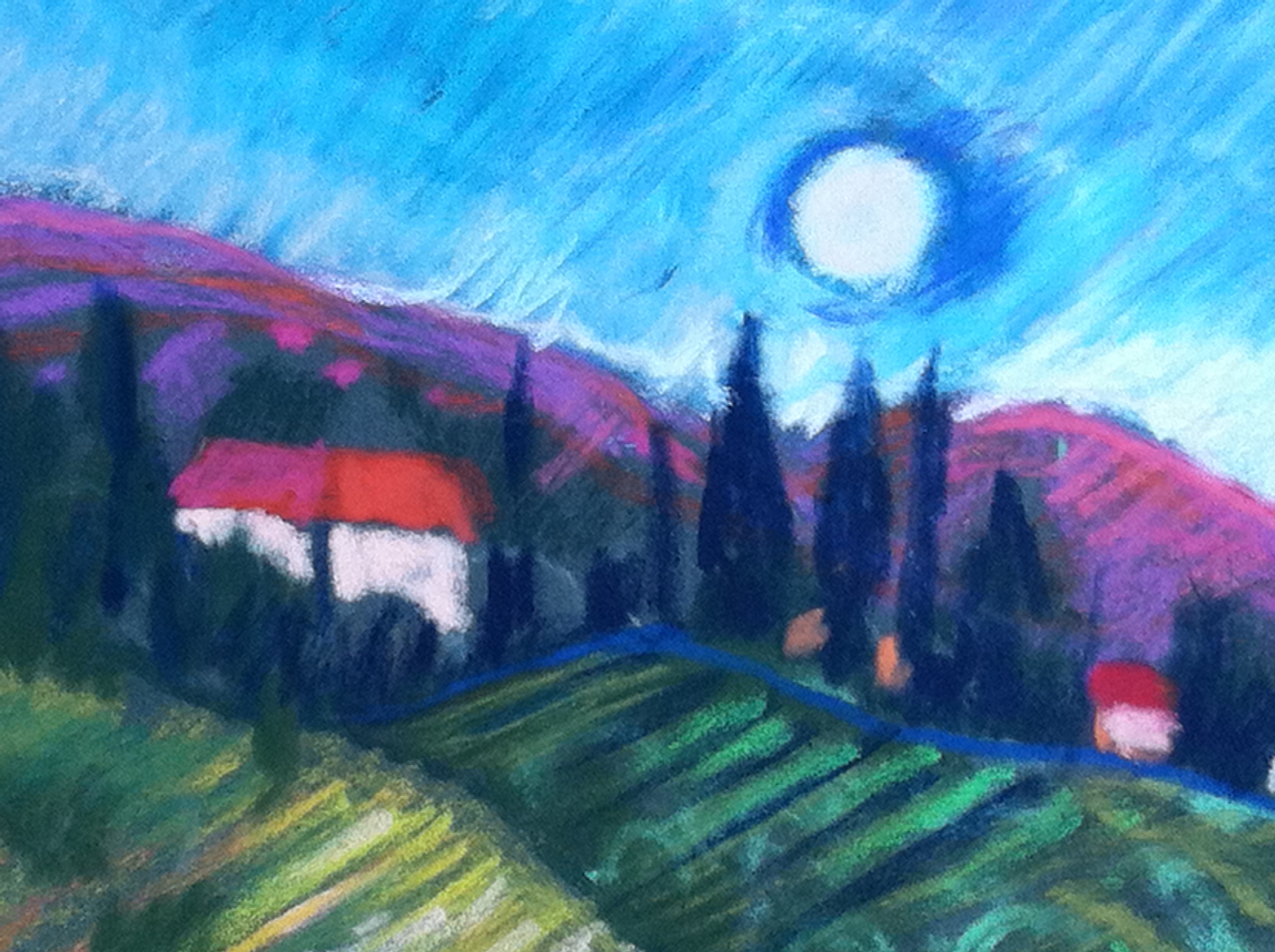
This week’s theme is inspired by this quote from Meher Baba:

“The experiences are so innumerable and varied that the journey appears to be interminable and the Destination is ever out of sight.  But the wonder of it is, when at last you reach your destination you find that you had never traveled at all! It was a journey from here to Here.”

Speaking of traveling, I see some Flying Dragons in our future.

And, because I’ll be traveling* at the end of the month, there are a few schedule changes students should be aware of:

Wednesday 25 July: 

Yiwen will be teaching my 6:15 PM class at Prajna in Belmont.

Friday 27 July: 

Terry Lesser will be teaching my 9:00 AM class at California Yoga Center.

My 10:30 class at Avenidas is cancelled.  We’ll have a make-up for the missed class in August.

Monday 30 July:

My 1:00 class at Avenidas is cancelled.  We’ll have a make-up for the missed class in August.

Monday Night Yin at California Yoga Center will not meet.

Tuesday 31 July:

Lisa Brill Robinson will be teaching my 9:00 AM class at California Yoga Center.

*I’m totally psyched!  I’m visiting Hawaii for the very first time where I’ll be teaching four mornings of yoga at a private event.


Weekly Inspiration and Class Schedule

“Do you know what it means to learn?  When you are really learning you are learning throughout your life and there is no one special teacher to learn from.  Then everything teaches you:  a dead leaf, a bird in flight, a smell, a tear, the rich and the poor, those who are crying, the smile of a woman, the haughtiness of a man.  You learn from everything, therefore there is no guide, no philosopher, no guru.  Life itself is your teacher, and you are in a state of constant learning.”

– Krishnamurti

Let life be your teacher.


Here’s my schedule of drop-in classes for the week:

  • Yin Yoga – Monday Night @7:30, California Yoga Center on Cowper in Palo Alto.
  • Slow Flow – Tuesday or Friday Morning @9:00, California Yoga Center in Palo Alto
  • Hatha for All Levels – Wednesday Night @6:15, Prajna, El Camino Real, Belmont

And for those of a certain demographic:

Take a look at the website for details on all these classes and more.


It’s Possible I’m a Fuddy-Duddy with No Sense of Humor…or Not

I am not the Poster Child for Perfection.  I have laughed at others’ misfortunes.  I have walked past the legless man begging for a bit of change (although, in fairness, today I bought him a chicken salad sandwich).  I have walked a block out of my way to avoid the Greenpeace kids in front of Whole Foods beseeching me to protect the environment.

Perfect? Me?  Not even close.

At times I am thoughtless and sometimes I speak before I’ve considered how my words might sound to another. In other words, I’m human.  I’m no more caring, compassionate or spiritual than my neighbor.  But, like my neighbor, I’m trying.  I’m trying to reflect on how my choices, my words and my actions impact the lives of those they reach.

And that’s why it has occurred to me that we might want to sit back and take a moment to contemplate how we use social media.

A well-intentioned friend who thought I would find it funny first delivered the joke to my inbox about a year ago.  About six months later, a new version of the same bad joke showed up, this time sent by a student.  And then, just a few days ago, a yoga teacher and friend whom I admire decided to post the joke on his Faeebook wall.

And that’s why I wish I’d spoken twelve months earlier.

I guess you’d consider the joke a sight gag.  On one side there are a series of photographs taken of yoga practitioners in various postures looking beautiful and calm and aligned.  These are juxtaposed by stolen images (I say stolen because it’s obvious the subjects did not know they were being photographed) of men who appear to be living rough. They may be drunk or on drugs.  They are all either sleeping or unconscious and their bodies have fallen in a way that mimics the postures being demonstrated by the yogis.  I don’t want to post a link.  If you’re curious Google “drunk yoga”.

My family was touched by alcoholism and drug dependency and maybe that’s why I can’t laugh.  I can’t laugh at something so cruel and heartless.  Something that demonstrates an unbelievable lack of compassion.

Then again, it could be that with all my imperfections I’m also a fuddy-duddy with no sense of humor.

Either way, maybe we should sit back and consider what we pass around on Facebook. How often have we reflexively shared a post, an image or a joke?  Do our posts speak to who we are?  Are they a reflection of how we relate to the world and to one another?  Do they add something to the dialogue or are they cheap shots?


Give a Little

“Therefore, without being attached to the fruits of activities, one should act as a matter of duty, for by working without attachment one attains the Supreme.”

Bhagavad-Gita, Chapter 3, Text 13


How Do We Live Our Yoga?

In the beginning, most of us are one quick namaste’ from the daily grind.  When class ends we roll up our mat, stack the studio bolsters and on our way out the door hope the parking meter has enough time remaining for a quick run to Starbucks before we head back to work.  There’s no time to embrace the yoga that is more than skin deep.  Forget the philosophy – we’re in it for the workout.  We want a toned body. Yoga Class is Tuesday from nine to ten in the morning. Everything else is life.

With dedicated practice, however, a subtle shift occurs. The edge between our yoga practice and “real” life blurs.  Yoga begins to follow us home.  We move deeper into our practice and yoga becomes a part of who we are.  When we embrace the notion that yoga has not only strengthened our bodies but has also strengthened our spirit then it’s time to ask again:

How do we live our yoga?

Step Off the Mat

In 2007 Seane Corne decided to move her yoga beyond the mat and confines of the studio walls when, along with Hala Khouri and Suzanne Sterling, she founded Off the Mat and Into the World. This inspiring organization embraces the philosophy of seva.  Selfless service.

According to their website Off the Mat’s mission is “to use the power of yoga to inspire conscious, sustainable activism and ignite grassroots social change.” Today, Off the Mat and Into the World has international scope.  It supports humanitarian efforts in Haiti with the Global Seva Challenge.  Off the Mat’s Empowered Youth Initiative believes a commitment to the next generation has a profound impact on social justice and environmental issues.  This year the initiative has programs focused on assisting urban youth in Los Angeles.  They also support community initiatives working for disadvantaged populations.

Think Creatively

One such community initiative is The Art of Yoga Project, located an hour south of San Francisco in leafy Palo Alto, California. Art of Yoga’s mission is “to lead teen girls in the California juvenile justice system toward accountability to self, others and community by providing practical tools to affect behavioral change.”

The Art of Yoga Project improves the lives of disadvantaged and incarcerated young women by nurturing their creativity while encouraging a daily yoga and mindfulness practice.

Transform Your Practice

The practice of yoga is a transformative experience.  But how many of us allow that transformation to move beyond our inner spirit?  What happens when we stop clinging to the yoga experience we love and allow it to touch the lives of those around us?  Supporting others’ lives through yoga will transform your own.  Mary Lynn Fitton, founder of The Art of Yoga Project, knows first hand the profound effect of selfless service. “Since starting The Art of Yoga Project my personal practice has deepened considerably,” she said. “Teaching the principles of yoga to incarcerated teen girls, who have had very difficult life experiences, has called all of us at the project to a higher standard. For example, since we are teaching the girls about satya, we are looking closer at how we’re living in our own truths, watching our speech, avoiding gossip.  Teaching the girls yoga principles keeps them alive and fresh in my mind so I have daily reminders of how I want to be in this world. I am thankful to the girls for that. They are such heroes to me as they shine through their tragic pasts. They inspire me to be ever grateful of my circumstances and to do as much as I can to relieve suffering. 

The Small Gestures Count

Founded in 1978 by Dr. Larry Brilliant in Berkeley, California, The Seva Foundation has restored eyesight to millions of people in Tibet, Nepal, Cambodia, Bangladesh and Africa.  In the process they have reduced the cost of cataract surgery to just $50.00.  As individuals, our small gestures may never match the scope of Off the Mat Into the World or The Art of Yoga Project, but we can still hold in our hearts this simple idea from the Seva FoundationTo become fully human we must translate our compassion and concern into useful service.

What is useful service?  For most it does not entail forming a non-profit.  Most of us will not have the opportunity to restore sight to the blind or teach yoga to groups of incarcerated young women.  But in our daily lives we can still bear witness to the power of selfless contribution.  Mary Lynn Fitton says,

“I am blessed by this work. I wish everyone could experience the joy, connection and fulfillment that comes to you through being a part of positive social change. And you don’t need to start a non-profit to make a difference; but do take the time to discover what really matters to you and carve out space in your life to contribute to that somehow. Start with having conversations that matter. Then set your intention to serve. The rest will come.

So how do I want to live my yoga?  In service.  One breath at a time.

This article originally appeared in Yoga Living Magazine.


This Week: Opening the Heart

“We are all here for a single purpose:  to grow in wisdom and to learn to love better.  We can do this through losing as well as through winning, by having and by not having, by succeeding or by failing.  All we need to do is show up openhearted for class.”

The quote is from Rachel Remen’s book Kitchen Table Wisdom and it will be our theme for classes this week.  It’s a laid back week for me.  Classes at Avenidas are on break until July 9th and my class at Prajna Yoga and Healing Arts is taking a break on July 4th, but you can still join me for some heart opening practice at California Yoga Center, where I’ll be teaching the following classes:

 Yin:  Monday 2nd July from 7:30-9 PM
Slow Flow:  Tuesday 3rd July and Friday 6th July from 9-10 AM

See you there!


Summer Class Updates

If you’ve been to my classes you’ll know that I love to “hang out” in the asana. 

I don’t believe in rushing, I don’t turn yoga into aerobic exercise, and the thought of practicing yoga in order to build a better backside is loathsome to me. 

So if you enjoy exploring the shape of a pose, feeling how the energy shifts as you change your alignment; if you enjoy testing your strength and flexibility while dialing down the stress – then I’m your guide.  My classes begin with two minutes of quiet reflection/meditation and end with savasana.

Seasons change and so does my teaching schedule. At least a little bit.

Here’s a summer update:

California Yoga Center

The Monday Evening Donation-Based Yin Class continues to meet from 7:30 to 9:00 PM at the Palo Alto Studio.  All equipment is provided.  Some understanding of Yin is helpful (you can find that here) but not necessary.  There is no class on Monday 30 July.

My Tuesday and Friday Iyengar-inspired Slow Flow meet from 9:00 to 10:00 AM at the Palo Alto Studio.  Please bring a yoga mat.  These class are Level I/II. $15 drop-in.  The class on Friday 27 July will be taught by Terry Lesser.  The class on Tuesday 31 July will be taught by Lisa Brill Robinson.

Prajna Yoga and Healing Arts

My Hatha Yoga Class meets on Wednesday from 6:15-7:30.  Please bring a yoga mat. There is no class on 4 July. The class on 25 July will be taught by Yiwen.

Avenidas

Registration for Summer Session, which begins on Monday 9 July, is still open.  I teach two classes at the senior center:  Monday at 1:00 and Friday at 10:30.  We’ll have seven class meetings over eight weeks, with no class on Friday 27 July or Monday 30 July. 

For further details on any of these classes check my website.


Reflexology – A Treat for the Feet

Português:

I’ve been an ITEC Certified Reflexologist for ten years.  The modality is a treat for anyone but especially perfect if you are in recovery from illness or surgery or simply have difficulty navigating the climb onto a massage table.  Reflexology can be done in your home from the comfort of your favorite chair.  A version of this article was published in Yoga Living Magazine in 2010.  Over the past few weeks I’ve been delighted to accept new Reflexology clients and for them I happily re-post this article.

My Feet Are Killing Me!

Really?  Maybe it’s the other way around.  Let’s face it.  Our feet are underappreciated.  They carry the weight of our bodies with nary a complaint.  We smoosh them into poorly fitted shoes that force our little phalanges into unnatural shapes. And then we stand on them for hours. We depend on our feet to keep us moving from home to work and then, at the end of the day, we increase the massive force of each footfall by slipping on a pair of running shoes and going for a jog on hard concrete.

And what thanks do they get?

Nada.

If they’re lucky we’ll give our toes a wee wiggle before bed.  Our feet deserve more.  Pedicures are pretty, but I’m talking about deep healing.  I’m talking about maintaining the health of our feet while supporting health and healing throughout the entire body.  I’m talking Reflexology.

Reflexology to the Rescue

Reflexology is a massage and pressure point technique applied to the sole of the foot similar in theory to acupressure massage and acupuncture.

I know – I bet you think you’re too ticklish. Who hasn’t suffered under the hands of an older sibling who, at some point during our childhood, took cruel delight in torturing us by tickling our toes, home to thousands of nerve endings?

But stimulating these nerve endings – with a firm and not ticklish touch – sends messages to corresponding areas of the body.  Reflexology calms the nervous system and supports our body in a way that restores equilibrium by stimulating sluggish energetic pathways while settling pathways that are overactive, thus providing an opportunity for the body to begin the healing process. Reflexology builds and sustains our reserves and enables us to cope with day-to-day stress triggers.  Regular reflexology treatments may also shorten our recovery time from major life upsets or illness.

A Brief History

Eastern cultures noticed the link between the health of our feet and general wellness thousands of years ago.  They didn’t call their work reflexology, and they hadn’t mapped out the foot reflexes, but they knew that regular massage and an appreciation for the feet supported overall vitality.

Reflexology as we know it today arrived more recently in the West – during the early part of the twentieth century – when Eunice Ingham developed the reflex ‘maps’ therapists are familiar with today.

The popularity of reflexology is on the rise as therapists and clients discover the intense effects working on the soles of the feet have on the rest of the body.  Reflexology is a gentle way for clients who are not comfortable disrobing for a full-body massage to receive the stress relieving benefits of touch therapy.

In the Zone

Reflexology divides the foot into ten vertical zones and three horizontal zones.  The zones act like a guide for the reflexologist – a ‘foot map’ of sorts.  In theory a blockage in one part of a zone correlates to a particular organ but also influences everything else in that zone.  Working the appropriate and specific foot reflex within the zone will stimulate subtle muscular contraction or release throughout the zone.

The zones of the feet are similar to the meridians used in acupuncture and acupressure.

As with acupuncture and acupressure, reflexology is a therapy that demonstrates the interrelationship between the different physiological systems as well as the mind, body and spirit.

Tell Me More…

A reflexology treatment lasts between forty-five minutes and an hour.  Unlike a full-body massage you’ll remain – except for your feet of course – fully clothed.  The therapist will begin by ‘greeting’ both feet, looking for any abnormalities, calluses or injuries.  It’s better to skip the toenail polish on the day of your treatment – your therapist will want to note any discoloration in the nail bed.  Finally, she’ll take a whiff.  An odor coming from the feet may point to a kidney or liver imbalance – but remember, reflexology is not a diagnostic tool.  An imbalance could indicate a temporary increase in life stress, an immune response to a virus or bacterium, or even a simple lack of attention to the diet.

So Far So Good – Then What Happens?

After several minutes of warming up, when you’re therapist has you floating in that wonderful place between sleep and bliss the real work begins.

Most reflexologists work one foot at a time, beginning with the right, although techniques will vary.  Some therapists have a light touch; others work more deeply. Both techniques are effective.

The reflexologist divides the foot into regions and systematically ‘thumb walks’ over each section.   The technique, where the outer edge of the thumb pad presses on the surface of the foot, allows the therapist to feel one small area at a time. The therapist can be very specific with her touch, stimulating reflex points with precision.

During this time she may feel a change in texture.  Sometimes areas that need work are indicated by small nodules beneath the skin that feel a little bit like grains of sand.  These are not harbingers of doom – they simply reflect a possible weakness. Your therapist will note these areas and either work on them immediately or go back to them toward the end of the treatment.

For example, if your immune system is compromised – if you’re coming down with a cold – your spleen reflex may feel a bit spongy or rough. She may work the area with more pressure or press additional ‘helper’ reflexes in order to soften or break up the nodule before moving on to another area of the foot.  She might also suggest aftercare – possibly including yoga asana – to strengthen a depleted immune system.

What Does it Feel Like?

The opening sequence of a treatment will feel very much like a typical foot massage. Your therapist may incorporate a few gentle stretches and joint manipulations that are beneficial to the circulatory system and conducive to relaxation. When the more specific aspects of the reflexology treatment begin you’ll feel the light pressure of thumb walking along a specific pathway on the foot. When your therapist finds an area of imbalance you may experience tenderness or irritation at that reflex point.

Some therapists will prefer to keep your head elevated.  This allows them to watch for the subtle changes in your expression as you respond to the treatment.  It’s important to communicate with your therapist – to tell her if something hurts, or if her touch is too strong – but sometimes during the treatment you’ll be too relaxed to speak.  Keeping your head elevated is the therapist’s way of keeping the lines of communication open.

General Aftercare

You will be encouraged to rest and relax following your treatment.  Find a quiet, still environment and sip water or herbal tea.  Allow the transition between your treatment and the return to ‘real’ life to be as gentle and easy as possible.

Reflexology is profoundly relaxing.  It soothes the nervous system and relieves stress.  While it does not offer a cure or a diagnosis, you can consider reflexology a conduit for greater healing.

While most treatments support general well being, a good therapist will be able to design a program that addresses specific concerns and conditions.  For instance, reflexology is excellent for digestive issues and sleep disturbances. It can also be of benefit for anyone suffering from chronic headaches and has been shown to provide relief from fibromyalgia. The truth is, reflexology has a positive effect on many chronic problems.  And while it isn’t a substitute for medical treatment, it is a powerful complement to an allopathic approach to illness.

A Home Treatment for Feet:

Use a golf ball to stimulate meridians and reflex points in the soles of the feet.  Soaking the feet in warm, scented water only adds to the treatment.

  • Place the golf ball on a folded towel (this will help keep it from rolling away from you).
  • Begin by resting the right foot on the ball at your diaphragm/solar plexus reflex.  This point is just below the ball of the foot, close to the midline.
  • Curling the toes down will stretch the top of the foot.
  • Hold this position for a few breaths.
  • When that feels complete, begin running the ball slowly up and down the foot, from the inside to the out.  Use firm but not painful pressure. Linger at any areas that may feel sensitive.  You can repeat this pattern as often as you like.
  • And then run the ball from side to side, working from the toes to the heel.  Again, stop and linger at any sensitive areas.
  • Repeat with the left foot.

Relieving Stress on the Road: 

A simple trick for calming down when stress attacks is finding the diaphragm/solar plexus point on the palm of your hand and applying a light pressure.  To find the point:

  • Relax the hand
  • Allow your left hand to fold gently and observe the creases in the palm.
  • They become well-defined and move towards one another.
  • The point where they are closest – just above the pad of the thumb and just below the space between the index and middle finger – that’s the general area of the solar plexus/diaphragm point.
  • Press into that spot gently with the pad of your right thumb.
  • Breathe in as you press.  Breathe out as you release.
  • Repeat several times, slowly and with self-awareness.
  • Repeat on the right side.

For more information about reflexology, or to find a reflexologist in your area visit these websites:

Reflexology Association of America: http://www.reflexology-usa.org/

American Reflexology Certification Board: www.arcb.net

Start Where You Are – Building a Home Practice, One Step at a Time

You might think you have no time for yoga outside of your once-a-week studio class.  Think again.  I’ve broken down your yoga practice into three sections – “Wake Up”, “Focus” and “Relax.” The sections correspond to morning, mid-day and evening.  Each should take no more than five to ten minutes.  You don’t have to do every pose listed in the section – choose what resonates and what you have time for.  Choose what feels good.  Stop if it feels bad.  Don’t rush.

These routines are very, very simple and exclude classic standing asanas (we’ll save that for later).  Still, it’s  not for someone brand new to yoga.  You should have enough beginning experience to be familiar with the movements.  Take your time and take care.  And remember to breathe.

Equipment:  Yoga mat, bolster or a firmly rolled blanket, a strap.  Anything else you may need for support.

“Wake Up – The Morning Routine”

 Begin Supine on Floor

Pelvic Rolls:  Inhale the tailbone toward floor; exhale the tailbone toward the ceiling.  You can add arm movements after the fourth or fifth cycle simple by taking the arms up and back on the inhale and bringing them down by your side on the exhale.

Knees to Chest: Alternate one knee at a time, extending the opposite leg.  Hold for several breaths and switch sides two or three times.

Windshield Wipers: Knees are bent and the feet about hip distance apart.  Drop the legs gently from one side to another.

Both Knees to Chest:  Hold the knees toward your chest for a few breaths and then allow the knees to move with the breath.  You’ll find they move away as you breath in.  You can tuck them tighter on the out breath.

Supported Bridge:

  • Place the bolster under the hips – keep the knees bent and the feet flat on the floor
  • Stay in supported bridge for a few breaths
  • Extend the legs along the floor and take the arms behind you if it’s comfortable – if this bothers your lower back return to supported bridge
  • Extend the legs toward the ceiling for a bit of an inversion
  • Bring one foot down at a time

Reclining Twist:

  • Cross the right knee over the left knee
  • Shift your hips to the right a few inches
  • Drop your knees to the left
  • Allow the right shoulder to drift toward the floor
  • Repeat on the other side

Table Top/Hands and Knees

Cat/Cow:  On the in breath lift the tail bone and face; on the out breath tuck the chin and the tailbone.

Downward Facing Dog:

  • Come to table top
  • Walk the hands a hand length forward and take them about shoulder width apart
  • Tuck your toes
  • Inhale the hips up
  • Exhale the heels down toward the mat
  • After five breaths step forward to a standing forward bend and then curl up slowly to a standing position

 Finish with any standing stretches that feel right – your body will know what to do. And then standing breath awareness.  I love “pancaking” both hands over my heart to feel the beat of my heart and the warm of my hands meeting one another.

“Focus for the Afternoon”

We begin seated in a chair

Neck Stretches: Move slowlyand hold each position for several breaths.  ‘Tease’ the stretch a bit to find what I like to call the ‘sweet spot’.

  • Right ear to right shoulder
  • Right ear toward right shoulder blade
  • Right ear toward right armpit
  • Repeat on left side

Chin to chest:  Allow the chin to drop to stretch the back of the neck.  Don’t force the position.

Shoulder Shrug:  Shrug shoulders to earlobes and hold (but don’t forget to breath); count three and then drop the shoulders.  Repeat three or four times.

For Your Ankles and Feet:

  • Cross the right knee over the left
  • Circle  the ankle ten times in each direction
  • Point and flex the foot three or four times
  • Repeat on the left side

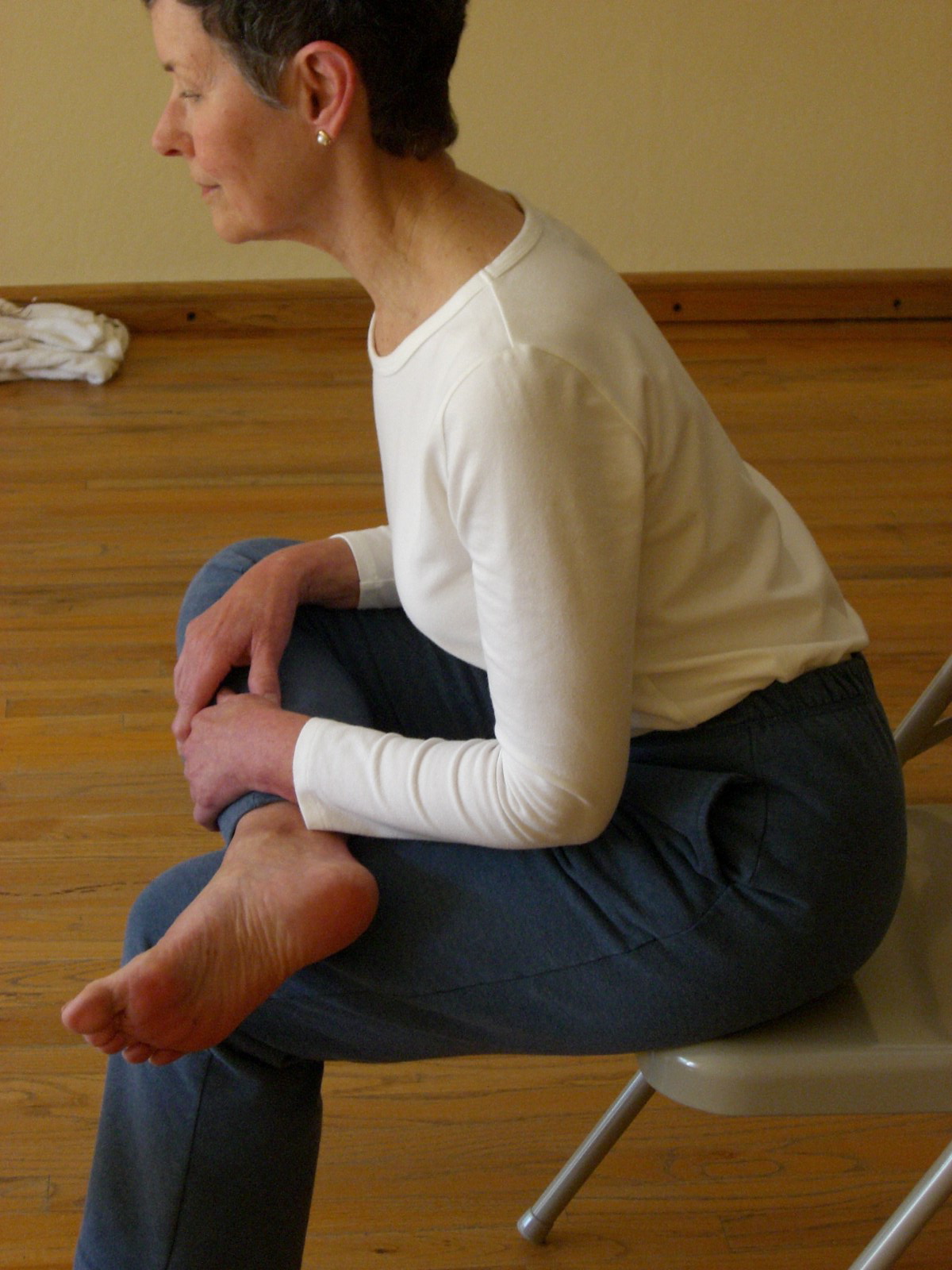
Piriformis Stretch:

  • Cross right ankle over left knee
  • Sit close to the edge of the chair
  • Hinge gently from the hip
  • The sensation should be in right hip
  • Repeat on left side

Seated Back Bend:

  • With your hips toward the edge of the chair place your hands on the seat of the chair behind the hips
  • Lift through the sternum
  • Think less about bending the lower back and more about opening the front of the body

Seated Twist:

  • Place your right hand on the left leg, left hand behind left hip, twisting to your left on the exhalation.
  • Breath in – lengthen the torso.
  • Exhale and settle into the twist.
  • Repeat on the other side.

Seated Forward Fold:

  • Sit toward the edge of the chair with your feet wide
  • Allow the spine to round forward until your upper torso is folded forward between your thighs
  • Hold for a few breaths and then inhale and curl up slowly

Standing

Standing Stretch with Flat Back:  Use the edge of your desk or the wall.  Stand about three feet away and hinge at the hips.  Let your hands rest on the desk, arms extended and legs perpendicular to the floor.

  • Bend right knee and drop right hip for stretch in left hip
  • Bend left knee and drop left hip for stretch in right hip

A standing stretch with a flat back is a great stretch for any time of day, anywhere. It’s particularly good if you’ve been standing all day – it brings a lightness to the feet and legs.

Wall Stretch:

  • Keep right foot about twelve inches from desk
  • Step left foot back about three feet
  • Hinge at hips, keeping hips level.
  • Allow your hands to rest on the desk or a wall for stability

With the right foot forward this will wake up the right hamstring and left calf.

Repeat on left side.

Shoulders:

  • Standing with feet hip distance and the arms by your side, turn the palms out and inhale the arms up.  Extend the fingers toward the ceiling and, if it’s comfortable for your neck, look up between the hands.
  • Turn the palms out and exhale the arms by your side.
  • Repeat three to five times.

Ideally the Focus practice ends with 5-minutes of seated meditation,

quiet reflection or breath awareness.

“Relax Yourself to Sleep”

 Seated on Floor in Easy Cross Legs

Seated Spine Stretch*:

  • Sit in easy cross legs with your hands on your knees.
  • Inhale – lift the chest toward the ceiling.
  • Exhale – hollow out the front of the body and round the spine to stretch between the shoulder blades
  • Inhale – lift the chest toward the ceiling
  • Exhale – fold forward

You can do this for as many cycles as you wish. I suggest beginning with at least three.

Seated Twist*:

  • Bring the right hand to the left knee
  • Place the left hand behind the left hip
  • Inhale – lengthen the torso
  • Exhale – twist to the left

Take a few breaths to move into your full expression of the pose and then settle into the twist for a bit. Avoid “cranking” into the twist by using your arm strength to pull the torso.  Repeat on the other side.

Lateral Stretch*:

  • Place the right hand on the floor next to the hip and then walk the fingers out until you begin to lean to the right.
  • You’ll notice the left hip is lifting from the floor.
  • Inhale – Bring the left arm up and over until it’s arching over the head.
  • Exhale – Press through the heel of the right hand in order to encourage the left hip to move toward the floor
  • Repeat on other side.

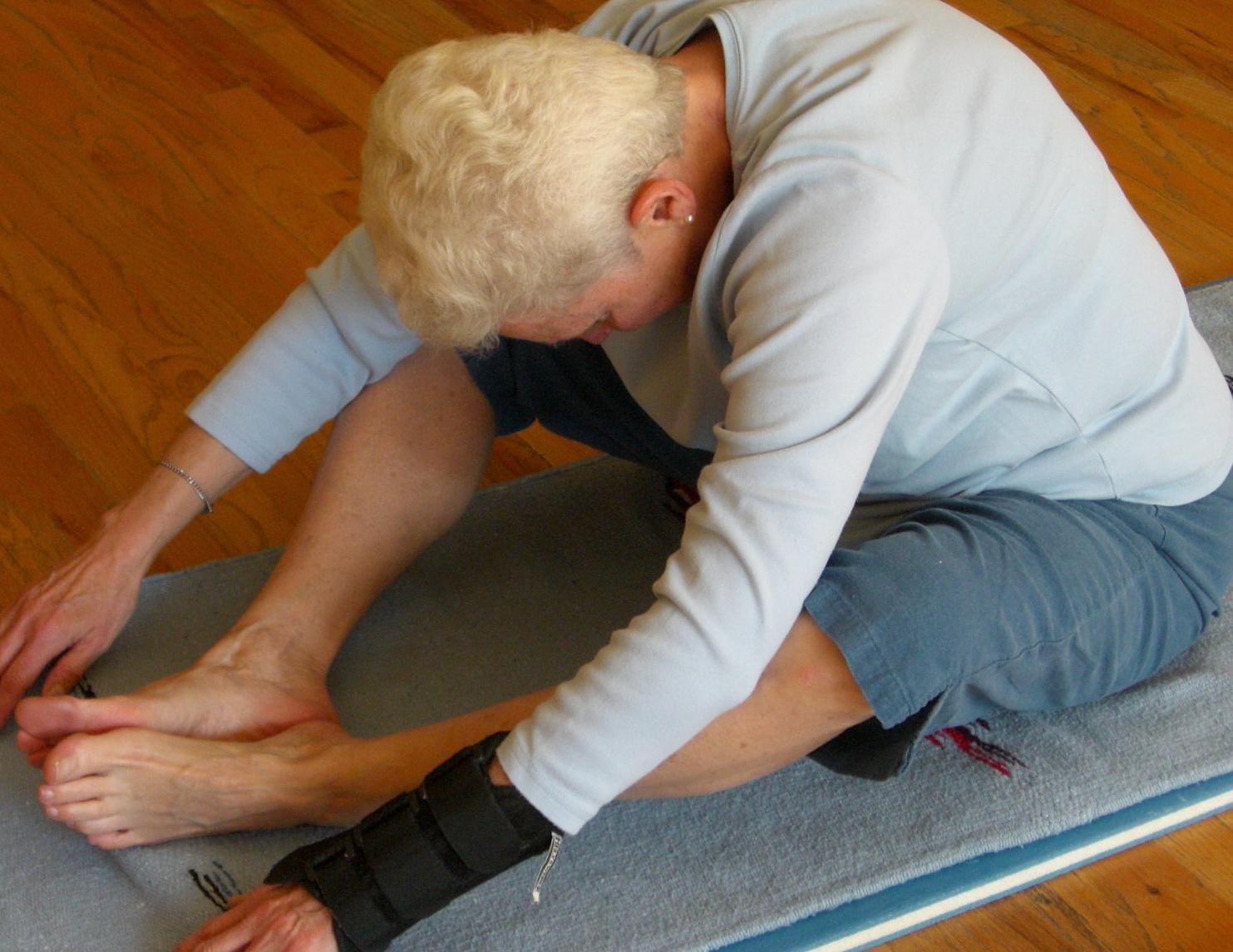
Forward Fold:

  • We want this to be as gentle as possible as this practice is supposed to a “winding down from the day” practice.
  • Sit with your legs in front of you, feet and knees slightly apart
  • Place the bolster underneath the knees
  • Round the torso forward
  • If you need to, use your hands to help support the torso but know that this forward fold is heavy and relaxed as opposed to a forced struggle.  Make it as gentle as possible and just trust that the spine is going to become more and more giving with each practice.

Supine on Floor

 Alternate the Knees in the Chest – just like you do in the morning practice

Hamstring/Hip Stretch– TAKE YOUR TIME WITH THIS!

  • Place a strap at the ball of the right foot.
  • Extend the leg toward the ceiling, opening the back of the knee and stretching through the heel.
  • Extend the left leg along the floor.  Stretch through the heel and point the toes toward the ceiling.
  • Take the strap in the right hand and drop the leg out to the right, rotating from the hip so the toes of the right foot point toward the floor.
  • Continue to work the foot toward the head to stretch the inner thigh.
  • Bring the leg back up and take the strap into the left hand.
  • Drop the leg a few inches toward the left to stretch the outside of the thigh.
  • Repeat with the left leg.

Knees to Chest and Windshield Wiper

Rest quietly in Savasana for ten minutes.

I need to thank teacher Kelly McGonigal for the Seated Spine Stretch, Seated Twist and Lateral Stretch in the “Relax Yourself to Sleep” section.  I first learned those movements from her at Avalon Yoga Center in Palo Alto, California.


Beware the YINJURY!

I couldn’t ignore the truth.  My hip was sore.  Real sore.  It was wince-inducing sore.  And while I limped in denial I began to hear stories similar to mine:  a recurring shoulder pain that increased after Yin practice; a wonky knee that ached the next day; a lower back that refused another forward fold.  All injuries reported by Yin Yoga students.

I refused to believe my beloved Yin was to blame.  It just had to be something else.  Yet, listening to these my students describe the course of events that led to their discomfort and considering my overstretched hip flexor with an objective mind the truth was obvious:  we had YINJURIES – the Yin equivalent to falling asleep in the tanning bed.  Sigh.

For a time the science of flexibility seemed to be changing like the wind.  When I trained as a sports massage therapist long held static stretches were all the rage.  Now the trend leans toward fast dynamic stretching.  I’m confused.  If science supports short and sharp stretches where does Yin fit in?  Does it hurt more than it helps?

I asked anatomist and philosopher Gil Hedley, circular strength training coach Michael Rook and personal trainer Steven Rice their opinion.

Gil offered this:

Virtually anything can be harmful or helpful.  That’s why it’s so important to pay attention to how you are feeling when you are doing something.  I’m no scientist, but I’ve overstretched and endured the consequences, and I’ve also relished the feeling of stretching and moving and enjoyed the benefits.  I personally believe that most anything you do over and over again represents a rut eventually, and like to change things up a bit myself.  While a practice is expanding you and your horizons, enjoy it.  When it becomes a tedium or mere repetition to satisfy a habit, move on.

There have been moments in my Yin practice when I’ve taken the poses almost ‘by rote’ – without thinking.  Without feeling.  Perhaps when we lose our mindfulness in the practice we open the door to injury?

Michael, who attended Paul Grilley Yin Teacher Training with me a few years ago, was frank in his opinion:

To be honest, I’m not surprised to hear about this.  The science is relatively clear that stretching before resistance training (some of my students attend Yin and then lift weights the following day) can harm performance and lead to injury.  Even more so before using kettle bells, I would say.  Personally, I don’t hold stretches for more than a minute (and it depends on the stretch).  There’s also a lot of deep flexion in many Yin poses that can play havoc with the lower back (if you’re posteriorly rotated).  Ultimately, all practices need to be tailored to the individual.

That sounds like obvious advice, but how often do teachers really attempt to do that?  In a large class that’s virtually impossible.  While it’s the instructor’s responsibility to guide the class safely, does it really come down to the individual listening to their body?

Michael then referred me to Charles Poliquin’s Blog and the Gymnastics Bodies website.

Finally, local trainer Steve “Mr. Science” Rice gave me this to chew on:

My understanding is that the ligaments should not be stretched as that will lead to joint laxity, and they don’t recover from that.  However it is also possible for the ligaments and capsule to get a bit glued together and need a bit of loosening.

Tendons of course are attached to muscles so I don’t know if they can be stretched separately.  A stretch will affect the tissue most willing to lengthen which is likely the muscle, and the length of a muscle is determined first of all by the brain. 

Traditional static stretching, like holding a yoga pose, has become depreciated in the sports world because it has been shown to decrease performance.  Current thinking emphasizes dynamic warm-up and mobility work.  End ROM (range of motion) positions are moved into and out of under control so the entire neuromuscular chain is engaged.  For example, instead of hanging in a forward bend with gravity pulling you down, walk and on each step do a high kick.  My stretches last no more than one or two seconds.

And then, just to inject a bit of controversy, Steven wrote:

Incidentally, Poliquin is a smart guy and leading fitness authority but also controversial in his interpretation of research.

So there you have it.  Static stretching out.  Dynamic stretching in.

Not so fast.  I love Yin not only for how it feels in my body but for how it soothes my spirit.  There’s no way I’m trading those five-minute dragonflies for some high kicks!  But here’s what I might do:

Offer my body more support in poses that are challenging for me.

  • Hold some poses for less time.
  • Avoid weight training for 24 hours after a Yin practice (I can assure you that won’t be a problem).
  • And then, more than anything, I’m going to listen.

Fitness trends emerge and fade, theories behind the science of flexibility change, our bodies cycle through movements that feel good and movements that don’t.

It seems that the only thing we can do is listen.


So You Just Got Your Yoga Teaching Certificate…NOW What Do You Do?

When you boiled it all down, the question my friend wanted an answer to was this:

“What do I do now?”

Deepa and I began Avalon Art and Yoga Center’s teacher training course in September 2011.  Six months and almost $3,000 dollars later we had a beautiful piece of paper to show the world that we were yoga teachers.

Hold up.  Actually, what we had was a piece of paper that said we’d completed the program.  The Avalon Teacher Training program is an intense and comprehensive six months of study.  It was worth my time and my money.  But when it was over, did the world have twenty-eight more yoga teachers?  I’m not sure.

It’s one thing to learn the techniques of teaching and another to know how to touch a student with words that describe the impact of a yoga practice or to provide support that make her feel safe.  Knowing how to instill confidence, knowing how to adjust a posture, knowing how to set the tone in the studio – it takes time and experience to develop those skills.  It takes an instinct that I’m not certain can be taught.  It’s a bit like learning that red and blue make purple.  Knowing how the color wheel works does not make you an artist.  And completing a teacher-training program does not make you a teacher.

The reality is I taught for many years before becoming a certified teacher. Instead of certification, I studied informally.  I read books and attended classes.  I asked questions.  I practiced.  I was a student for ten years before I began teaching.  I’m not suggesting the path to teaching I chose is better or even desirable.  There were holes in my “home study” yoga education I had a craving to fill.   What I’m trying to point out is that there are different paths, and maybe this push to collect certificates and to study with the flashiest Pop Star Yoga Idol (and after this past year we certainly know how quickly and how far yoga idols can fall) is blinding us to the truth that being a compassionate, effective and capable teacher takes more than a file cabinet of certificates.

So how important is that piece of paper?  I’m happy that after eighteen years I have certificates not only from Avalon but also from Paul Grilley’s Yin Teacher Training.  I could have continued to be a fine teacher without them, but they represent opportunity. They open doors.  If you choose – and for what it’s worth – your new certificate allows you to register with Yoga Alliance (which I’ve done).

But I’m through with formal training for the time being.  I’m happy to return to reading, talking with fellow teachers, attending classes in my neighborhood.  I’m happy to focus on my students and my teaching.

So how did I answer Deepa as she tried to decide what to do next?

I told her to take a step back.  I told her to find her teaching voice.

Your yoga voice – how you speak to students, the vocabulary you use to describe asana or pranyama or mudras or bandhas – it can’t be taught.  You have to find it and the only way to find it is to teach.

When you find your authentic voice as a teacher, that’s when you’ll begin to teach your truth.  And when you are teaching your truth you’ll know that the path you chose – the path that brought you here – it was the right one.

ps….Some people, by the way, are born to teach.  They’re naturals.  Deepa is one of them.  From mid-July she’ll be teaching at Downtown Yoga Shala in San Jose, California mornings and Friday evenings.  

As for me, I continue to teach my truth at California Yoga Center, Avenidas in Palo Alto and Prajna Yoga and Healing Arts in Belmont, California.  I also teach for Feinberg Medical Group and privately.