Harvest Follows Trust, Not Control

Harvest follows Trust.

I’m great at control.  Trust?  Not so much.  Surprised?  How could a yoga teacher not embrace all that life has to offer with an open heart and unending faith in the Universe?

Easy. I’m human.

Remember eight days ago, when I wrote “I can kick adversity’s ass”?  Well, I’m not really feeling it anymore.

A friend continues to remind me of Rumi’s words “the cure for the pain is in the pain.”  To be honest, I find deeper comfort here:

Oh soul, you worry too much.

You have seen your own strength.

You have seen your own beauty.

You have seen your golden wings.

Of anything else, why do you worry?

You are, in truth, the soul, of the soul, of the soul.

It’s a scary thing, relinquishing control, opening myself to the possibility of disappointment or failure.  But what can I do?  My choices are limited.  I can stagnate.  Keep living the life I am living.  Or I can hold tight to possibility, spread my wings and fly.


The Stories We Tell: Open Doors

We all have stories, don’t we?  Our stories shape us.  They direct us.  I was going to tell you a long-winded tale about how I came to teach yoga but to be honest – it’s a yawn fest.

Let’s cut to the chase:  there have been times in my life when I’ve shown strength and power.  There have been times when I’ve curled up into a ball, terrified.  It’s the human experience.  But I’ve always tried to pay attention to open doors.  In Donegal, when the door to yoga teaching opened, I stepped through.  I was almost two hundred pounds and had trouble reaching the top of Port Road in Letterkenny without stopping for breath.  I had never taught yoga before.

To prepare for my first class, I listened to my teacher’s voices.  My teachers taught with humor and compassion.  That’s how I wanted to teach.  I remembered how their kind words and gentle instruction brought me out of my head and into my body all those years earlier.  I remembered how they opened my heart and changed my perspective.  That was the kind of teacher I wanted to be.  I wanted to open hearts.

I arrived at the housing estate in Raphoe, helped to push back the living room furniture and listened as exhausted mothers chased their children outside to play.  And then, as six women stood in Tadasana, I asked them to close their eyes….

I never looked back.

My point is this.  I wasn’t afraid.  Nervous?  Oh, heck yeah.  But fearless, too.

We’re taught to make peace with the past, not to dwell in it.  We’re advised to not worry about a future we cannot predict.  We’re asked to flow in the present.

But how?  I guess it comes down to this:  we can’t be afraid to step through the open doors, even if we’re unable to see what’s on the other side.

If I can abandon my craving for control, if I can embrace the flow of the present, if I can charge blindly through the open doors, then maybe – just maybe – I’ll discover once again the girl who danced with arm flailing reckless abandon.


Fate, Faith and Free Will, Part II…sort of…

Donegal, Ireland

I don’t dance, but I remember dancing.  The last time I danced – and I mean really danced with full on arms flailing wild abandon – was in 1996 at a wedding reception in Dundalk, Ireland. I had been in Ireland for two years. The tuxedoed disc jockey, per my request and to the annoyance of everyone else, was playing Kula Shaker. I weighed a good one hundred ninety pounds at the time. And while I whirled my fat half-drunk dervish on the empty dance floor the rest of the wedding party laughed and chugged pints by the sidelines or slipped outside for a smoke until the Macarena was cued up for the fifteenth time.  Oh sure, there have been a few half-hearted attempts since then:  my awkward shuffle at Derek’s Halloween birthday party three years ago or that time the August before at the bar up in the City with Una and Forrest.

But reckless abandon?  Not even close.

When did I start taking myself so seriously?  When did I forget how to dance?

When fear snuck up on me and began to run my life.

Free Will

I have friends who like to tell me I was brave when I sold everything, packed up and moved to Ireland. There was nothing brave about it.  I was running away.  I had some half-cocked plan about being an artist, about reinventing myself, but the truth was that I was full of despair for the lack of direction in my life.  And that despair went back fifteen years to college, when I chose art over academia.  I loved art, but I loved books more.  I wanted to be a history major.  I was too afraid.

But doing something daring, like moving to a different country in my mid-thirties, would somehow make up for my fear of failure at eighteen.

I knew one person in Dublin, a scummy chef who chain-smoked Rothmans.  I arrived in Dublin on December 7th. It only took two weeks before I never wanted to see him again.  I was truly alone.  Free to become whomever I wanted.

I lived in a cheap hotel for a month and then found a ten by six-foot bedsit above a chippy on Parnell Street.  I began making crafts to sell at Mother Redcap’s Market. That’s the market near Christ Church, just up the hill from St. Patrick’s Cathedral.  Did you know Handel himself used the choir from St. Patrick’s for his début of the Messiah in 1742?

At the same time I found work as a coat check girl at Rumour’s Nightclub next to the Gresham Hotel on O’Connell Street.  I did not last.  But not long after I was hired by the National School of Art and Design as an artist’s model.  I had plenty of experience in California and it wasn’t long before my skills as a model were in demand.  But, after two years, I was done with Dublin.

I found my way from Dublin to Donegal.  For a time I made furniture with a boyfriend.  When that ended I took work at the local health food store.  I studied nutritional counseling, massage therapy and reflexology.  I taught yoga and I opened a clinic in the spare bedroom of my rented house.  That’s how all this began.  By my learning how to survive.

I also have friends who tell me that I was brave when, eleven years later, I packed everything up for a second time and moved back to California.  Again, I wasn’t being brave. I was admitting defeat.  Moving to Ireland had been an experiment.  As much as I love the friends I know there, Ireland was a mistake.  It was time to come back to the closest thing I had to a home.

I returned to California in late spring 2005 with some books, the clothes on my back, a few thousand dollars and a few new skills. I was a different woman.  The difficulties I had in Ireland somehow purged me of envy.  I knew how far I could fall and I was grateful to be alive. Rather than being burned by envy all I wanted now was to feel the heat of California sun on my bones. I was happy to be a witness to the success of friends I had not seen for more than a decade. And I had faith that after everything I had seen and done, fear would no longer rule my life.

It didn’t quite work out that way…


Fate, Faith & Free Will Part I: Or Maybe I’ll Just Keep My Nose to the Grindstone

Tarot from Piedmont, n° 0 (Ël fòl / The fool]

Image via Wikipedia

On Thursday afternoon I stepped out of character for an hour and had my Tarot cards read by Susan Levitt.  Susan has written several books on the Tarot, astrology and Feng Shui. In the early 1980’s I attended her workshops at the now defunct Two Sisters Bookshop, across from Stanford Park Hotel. In fact, for a time I dabbled in card reading myself.  But I could never get past thinking, “Seriously.  You’re telling me that the card I pull from the deck is my destiny?”

The answer to that, of course, is, “No.”  Maybe a card reading can offer some counsel, or maybe act as a guide.  Maybe it can gently usher someone toward the right path.  But rather than predicting the future, perhaps a card reading simply offers an interesting look at current conditions and how conditions might change based on the choices we make.

I chose to talk to Susan because I wanted confirmation.  Reassurance.  Proof.  Oh, let’s face it.  I wanted answers.  In the end, I did not hear what I wanted to hear.  But I was given plenty to think about.

So today I’m asking myself:  what is the difference between believing in the power of a deck of cards and the power of what most folks call God?  Because I don’t know that I believe in cards, but I do believe that there is an Energy in the Universe that is bigger than me.  I have Faith.  I believe in pre-determined Fate. And I know there’s a strong chance I’ve screwed up what was meant to be my Fate with a little bit of errant Free Will.

Quite often I find myself wondering what life would have been like had I not gone to Ireland.  In 1994, the year I left for my decade long Odyssey, I was a sullen woman consumed by envy.  I wanted what everyone around me seemed to have:  Love and connection.  Success.  Family.  A home.  I believed if I moved away from what fed my envy, I would find the life I craved.

It didn’t quite work out that way.

Part Two:  Hanged Men, Magicians and Learning to Yield to the Situation (no, not THAT Situation!)


To Sleep, Perchance to Dream

Good Question…

I was introducing a group of Spanish-speaking clients at the pain clinic where I teach yoga to the power of Yin.  A young man dressed in baggy jeans and a baseball jacket gingerly attempted to find a twist that challenged him yet did not aggravate the injury to his lower back.  He positioned a small bolster under his left thigh, relaxed and closed his eyes.  A moment later, through his interpreter, he asked me,

“Where is the mind supposed to go in these poses?”

The question, considering his lifetime practice of yoga amounted to approximately sixty-two minutes, was remarkable.

How was I going to answer without delving too deep, too soon, into all the possibilities?

I told him that in some practices we focus on the breath, or gaze toward a particular point, but in Yin we can close our eyes and free the mind to travel, and that each new position might bring up a different set of emotions or memories.

And then I confessed that there have been times during my Yin practice when I’ve entered the trance state I like to call “napping”.  Seriously.  While Yin’s startlingly challenging stretches are percolating into my connective tissue, I’m dozing.  Sometimes I can even fit in a thirty-second dream.

Speaking of Dreams…

Shortly before I woke this morning I had one of those weird “what does it all mean” sort of dreams.  Listening to someone tell the story of a dream is a bit like having to sit through four hundred photographs of Uncle Mort’s week in the Poconos.  But stick with me.  This gets good.

It was the sort of dream our subconscious constructs to help us find answers.

I’m teaching yoga to a group of people dressed for Carnivale. Every one is wearing a mask.  I can only identify one or two people and even then only based on their ‘energy’.  The scene is disordered and chaotic but not upsetting.

I am told I’ve been diagnosed with a serious illness.  To be healed, I must take the medicine handed to me in an ornate bottle. But I don’t want anyone to discover that I am ill so I hide the bottle.  Meanwhile, we’re all going on a journey and all my students are packing suitcases and gathering tickets and it’s happy mayhem.  In the excitement, the medicine gets lost in my baggage.

And then Max, one of the felines I’m currently taking care of, jumped on my chest, woke me up and I never discover if I take the medicine or if I’m able to leave on the journey.  The last thing I remember in the dream is accidentally handing over a fifty-dollar bill as a tip, realizing my mistake, taking it back and replacing it with ten dollars.  Odd.  I’m usually more generous.

That dream is going to settle over me for the rest of the day like a satisfying film.  I can still feel the mood of the dream – the tiny moments and the colors – all dark shimmering blues and silver.

I’m open to your interpretations, but I think the one thing that can heal me becoming lost in my baggage is pretty telling…

On that note, just to tie some loose ends from previous posts and to take a few tentative steps into the future:

  • No, I still haven’t canceled my cable.  Yet.  I will.
  • I’m no longer vibrating.  My beating heart has stilled. I feel more grounded than I have in months (although you might disagree when you read further).
  • I enjoyed my last day with the critique group.  I read a personal essay about how difficult it has been to process the reunion I had with my mother in September and how, when my heart was finally open to needing a mother, she wanted to talk about the weather.  Pete cried.  Terry and Henry said, “That’s the best thing you’ve ever written.” Terry added, “Submit it.  Now.”   I came home, cleaned up the formatting, wished it well and sent it off to a few magazines.  Fingers crossed.
  • I’m looking forward to the Thai Massage I’ve scheduled for Friday.  Thai Massage is a bit like having yoga given to you.  I’m pretty desperate for some bodywork.  Can’t wait.
  • And now, for the  You’re Doing WHAT? moment.  In the pursuit of new experiences, to satisfy my curiosity and to venture outside my normal comfort zone, I’m having my Tarot Cards read today.  Yep. It’s all right.  Go ahead.  Even I’m rolling my eyes.
Like a Pig in Muck

That’s me.  Wallowing in sorrow like a pig in muck.  That’s what I’ve been doing.  Well, you know what?  My life isn’t about wallowing; it’s about joy.  The past ten days have seen me in a sorry state.  But why?  The weeks before that – beginning as far back as early January – were spectacular. Nothing extraordinary was happening.  I just felt good.  You know – the sort of good that makes every mountain of struggle an easy molehill. That kind of good.  Anything was possible.  And it kept getting better.

Until it all came to a screeching halt about ten days ago.

The Universe gave me a wee nibble of how exceptional life could be.  I was holding the most wonderful gift.  But as I stood there, wondering what to do next, in total disbelief that this was happening to me, the Universe reached down, snatched the treasure out of my hands and said, “Oops, sorry dear.  Did you think that was for you?  Sorry for the mistake, love, but you can’t have this.”

The Universe is a real tease.  (I’d prefer to use slightly saltier language right about now but it’s not my style.)

Hence the wallowing.

But what’s a chronic optimist to do?  Here’s the thing:  I can kick adversity’s ass.  My ability to put a positive twist on circumstances has driven my more pragmatic friends to drink.  I’ve been labeled a Pollyanna, naïve, vulnerable and, on occasion, just plain stupid.  I expect the best to happen.  Always.

It’s a curse.  There should be a ten-step program for people like me.

Because when the best doesn’t happen, when the errant curve ball I didn’t see coming slams into my chest at one hundred and ten miles per hour, it hurts like hell.

Still, I can only give myself so much wallow time.  As far as I’m concerned it’s better that I let my heart hold on to how wonderful it was to hold the gift at all rather than blacken it with all this feeling sorry for myself baloney.

At least that’s what I keep telling myself.

Besides, we really don’t know how these things are going to turn out.  Anything could happen.  Right?  Right.

On another note entirely this article in the latest Newsweek – the one with my beloved George Clooney on the cover – expresses my concerns about the development of Yoga in the West.

And when this article showed up on my Facebook feed I had to respond:

There is enough competition in life.  Enough opportunity to feel not good enough.  To feel a failure.  That is not why I practice Yoga.  I practice Yoga to open my spirit to possibility and to fill my heart with joy.  I practice Yoga to recover and to return to a place of peace when my life feels broken.

And sometimes, even a chronic optimist’s life feels broken.


Potential

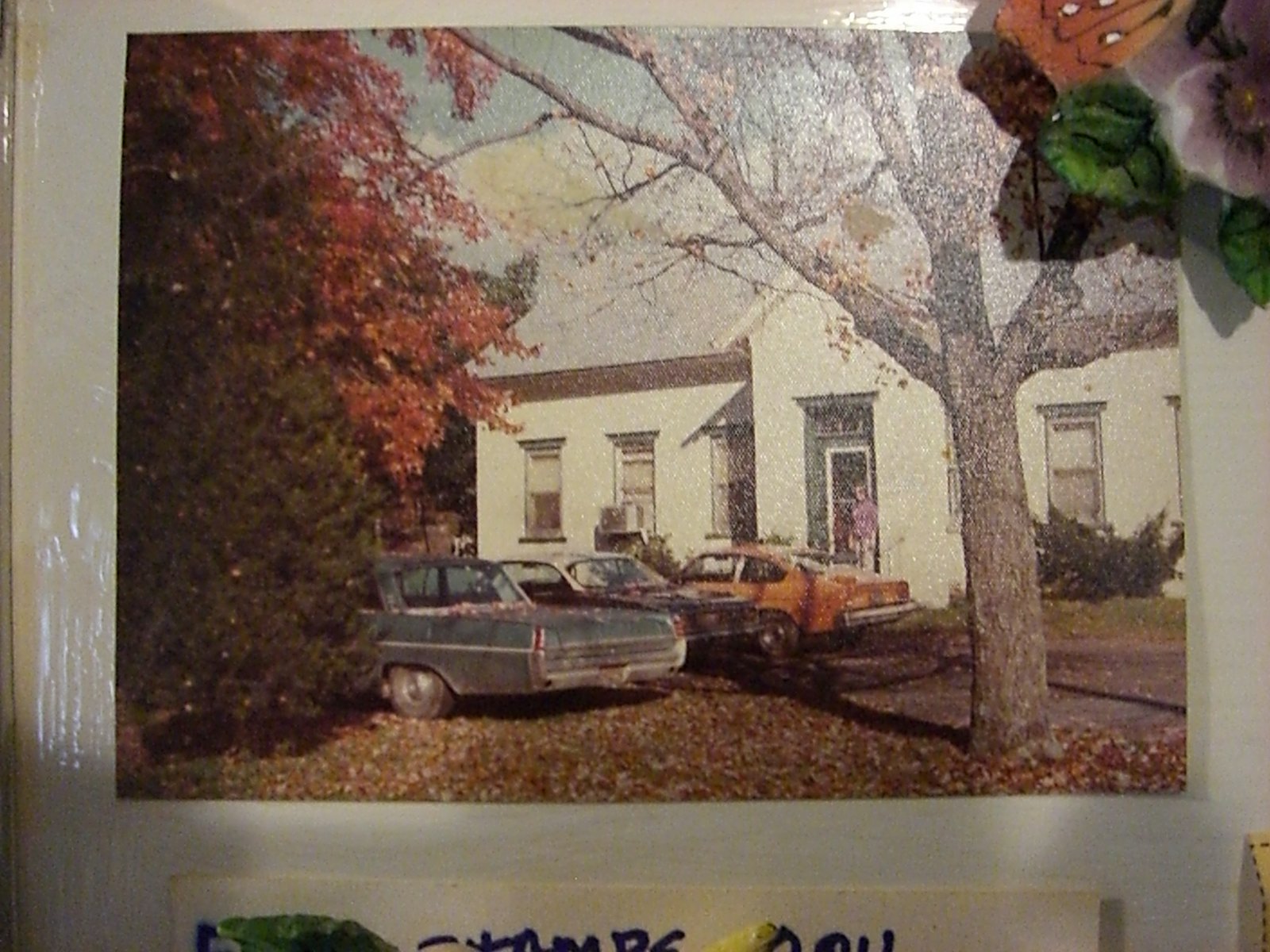
On my mom's fridge: a photo of house I lived in as a child.

I don’t know what to say about the past month.  I’m pretty thrilled February is barreling right into March.

I broke up with my critique group this week.  It had been fomenting for months, but I couldn’t find the courage.  Each time I summoned the strength to leave, someone else would drop out or move or drift away and I would feel the guilt of their leaving strong enough to enroll for another eight weeks.  Now that I’ve finally let go, I’m wondering what not having five fresh pages to share each Wednesday afternoon will do to my writing.

It wasn’t your typical critique group.  We didn’t see one another’s work until the day we met, and then we had fifteen minutes – sometimes twenty depending upon who was in attendance – to read and receive comments.  My strategy was to bring in about five minutes of reading so I could receive ten minutes of review.  Others in the group enjoyed spending most of their time reading, with little time for feedback.

You can see how one might become frustrated.

At the end of the day, though, the group gave me discipline.  And developing discipline is priceless.  I wouldn’t have a novel length manuscript under my belt if our leader Terry Galanoy hadn’t said, “That’s a good idea.  I want five pages next Wednesday.”  Classic critique may have been pretty thin, but encouragement and support was heaped upon me.  I’ll miss them.

In February I received my Get Out of Jail Free Card.  This is more difficult to explain.  I guess I had one of those experiences that cast a sliver of light on a very dusty part of my soul.   I had an awakening, of sorts.  A door opened.  That’s a good thing.  But if you’re old enough to remember the opening sequence of the 1960’s classic “Get Smart” then you know that behind the open door is…another door.  In other words, I have an awful lot of work to do on myself before my Get Out of Jail Free Card is valid.  I reckon a good couple of years.  But when that final door opens – it will be well worth the work and the wait.

At my penultimate meeting with the critique group, the only other women attending that day asked me, “What is your theme?” The men were staying shtum as the scene I had read was about a protagonist’s first menstruation.

I couldn’t answer her.  I hemmed and hawed until at last she answered for me.

“You are the sum total of your experiences.  Or not.  There has to be room for potential.”

I am the sum total of my experiences.  Or not.


Faith, Strength and Losing Control

On the Tuesday morning that I cried in the shower, something very freeing happened.  I let go of the rules I had imposed upon myself and gave myself permission to write about anything I wanted – simply for the joy of putting “pen to paper” as it were.  (Except, of course, it’s rare anyone actually puts pen to paper these days.  Maybe I should have said, ‘fingers to keyboard’).

I don’t believe I was aware of how immobilizing my good intentions were.  The truth is facing the tables I had created to chart my progress only charted failure.  I could never meet the high expectations I had set for myself. They had to go.

I know there are plenty of writers, teachers and life coaches who would suggest I’m making a terrible mistake.  That if I don’t have a plan – if I can’t see a clearly defined goal – then I have no chance of reaching it.  I’m willing to take that risk.

Besides, I do have a goal.  It’s simple: be a better writer.

You’re right.  It’s a goal that can’t be quantified.  I won’t be able to – in five weeks or five months or five years – announce to the world “I’ve done it.  I am now a Better Writer.”  It will require faith.  And it will require that I let go.  I have to believe that if relinquish control of the flow chart that took over my life and instead find the strength to build a deep and unshakable foundation of discipline – if I write every day, relentlessly, without fail, about anything I want – then I will learn how to write.  I will be a better writer.  Goal.

As much as I would like, someday, to have those other things – a book to call my own and an audience who want to read it – I must consider this time in my career as a writer a precious gift.  This is my time to explore, to make mistakes, to discover if I have an affinity for fiction or personal essay.  It’s my time to provide myself the space to discover who I am as a writer.

And that’s what I’m going to do.


Why Do We Write?

Why do we write?  Because we have a story to tell. Sometimes it’s a true story; sometimes it’s a story clinging to our heart desperate for liberation.

A friend says to me “You must tell your story” and I’m not certain what he means.  He says, “You have a facility for writing” and recounts the opening to a manuscript I’ve been struggling with since last year.  But that isn’t my story.  It’s just something I made up.  Something that has some tenuous association with the truth.

So why do we write?

Twelve days ago I stood in my shower and began to cry. The tears fell spontaneously.  They fell without warning.  I wasn’t sad.  In fact, I was standing on the precipice of happy. But still the tears spilled down my face, merged with Palo Alto’s municipal water supply and joined the wastewater on its way to be cured and returned to San Francisquito Creek.

I began to realize that my tears were a mix of elation for the decision my heart had made without my asking and mourning for the goals I hadn’t achieved.  I was liberated.  I was a failure.

It used to be different.  I wanted to write.  That’s all.  I didn’t think about writing a best seller, receiving a huge advance or being chosen for Oprah’s Book Club.  I wanted to write because it brought me joy. I wrote because it filled a void.  It was a way to clarify – an outlet.  And I loved the challenge.

I took a few classes and created a few blogs before I settled on the one you’re reading. I wrote a few articles for the local paper.  I wrote a manuscript that could, with a little polish, become a novel. No small achievement.

I dove deep and was amazed at how long I could hold my breath.  I charged into study and schedules and goals.  I wrote without thinking.  I wrote without feeling.  I dreamed of maybe, one day, having a book I could hold in my hand and saying, “I wrote this.”

And then things got ugly.  I forgot about the joy. I forgot about how crafting a decent sentence makes me giddy and the magic that happens when a character takes over and becomes the boss of these tired, typing fingers. I forgot about plot, structure and setting all in the race to be there first. But the truth is, I’ll never be there first.

That Tuesday, standing in my shower, finally craving air, I broke the surface and gasped for breath.

It wasn’t working.

The five o’clock alarms.  The word count goals.  The platform building.  The hollow dreams.  It wasn’t working.

I wanted to write.  This wasn’t writing.  It was micro-managing.

I put away all the tables that charted word counts, blogs posted and queries sent to magazine editors.  I closed the file on long-range goals, short-term goals and the list of forty-five writing goals I needed to achieve – today – while teaching classes and visiting clients.  I gave notice to my critique group – the six people with whom I shared every Wednesday afternoon for the past three years.

And I went back to basics.  I pulled out John Gardner’s On Becoming a Novelist.  I opened Janet Burroway’s Writing Fiction.

And then, finally relieved of the burden of high expectations, I began.

I write.  I will continue to write.   It is how I will tell my story.


Free to a Good Home: My Brief Career as a Volunteer Journalist

Last month a local non-profit organization asked me to do a little ‘volunteer writing’.  You know how it is – we’ve all done it, right?  We’ve been writing for years – maybe decades – but because we don’t have the Pulitzer we expected by age twenty-five and can’t add ‘MFA’ to the back of our name, we consider ourselves ‘hobbyists’.  Out on a lark.  Playing around.

Two little 800-word biographies of a local artist and a local volunteer.  What could be so hard about that?  A cakewalk.  Of course I said ‘yes’.

Never again.

Don’t get me wrong.  I’m not saying “no” to volunteering – non-profits depend on volunteers. I’m just saying “no” to volunteer writing. Ask me to be a clown, to serve meals, to read aloud – I’m there.  But don’t ask me to write.

I’d heard this sentiment before (watch this video of Harlan Ellison) but I didn’t understand.  And I still didn’t understand when I sailed through the first biography without a hitch.  Then it was time to interview my second subject.  I had my first inkling things wouldn’t sail as smoothly when – unaware that it was I who was doing him the favor – my subject arrived fifteen minutes late for our interview.  A few days later, after sending him a rough draft of the article, his email reply opened with “thank you for your efforts”. My efforts?

For some reason, that bugged me.  It bugged me bad.

The individual had some suggestions, which – despite having my hackles up – I was open to.  Some of his suggestions added depth to the story and clarified a rambling anecdote. But the three-hundred word quote explaining his thoughts on a life well lived? Not so grateful.

Still, I made the changes and submitted both articles ahead of schedule.  And waited.  Not a word.  From anyone.  I waited five days and then sent another email.  And waited.  Finally, confirmation arrived that the articles had indeed been received and only needed minor editing. Oh, and by the way, thank you.

And thus ended my very brief career as a volunteer journalist.

Am I being too sensitive? Probably.

But here’s the lesson I learned.  I will continue to work for a good cause.  But I will not give away the very same talents I use every day to pay my rent and put food on my table.

As a writer or visual artist, how do you feel when you’re asked to give your talent away?