Comfort

I enjoy Caitlin Kelly’s Broadside blog. Kelly is the author of Malled and Blown Away and, as a journalist, has written for the Financial Times, the New York Times and Forbes. And every Monday morning, without fail, I can count on finding Broadside in the dozen or so emails that have landed during the night.

Tiny treasures: a bag of vintage buttons and century old sewing needles.

What I enjoy about Broadside is Caitlin Kelly’s concise, sweet, simplicity. She has a way of taking quiet moments from her own life and writing about them in a way that makes her readers feel as if she’s writing each one a personal letter. Kelly is not maudlin nor does she over-romanticize stories from her life. She writes with touching economy and clarity that’s easy to read with my morning coffee. And more often than not what she chooses to share resonates because I either have been or am ready to go through a similar experience. I’m certain it’s because we are about the same age and life events tend to align, but sometimes I can’t help but say, ‘dang girl, you too?’.

For example, in a recent Broadside Kelly wrote about a small inheritance she received from her mother with whom she was estranged. The inheritance included a large pastel of Kelly’s great-grandmother and a small framed sampler – the embroidered alphabet grey with age. Having never received an inheritance, she found comfort and continuity in having these objects around her. And then she asked her readers, ‘what brings you comfort?’.

Many things, of course, bring comfort. A good meal. A loving partner. The purrs of your feline purr baby or the unconditional happiness of your canine best friend.

But other things – other circumstances – bring me comfort, too. I find comfort in surrounding myself with objects that have a history and the energetic imprint of the people from whom they were received. In fact, from where I sit this morning, I’m surrounded by things given to me by others: the painting on my wall, the brass lamp, the sofa and chairs, the tea chest and pillows, the porcelain box and the ceramic vase. Everywhere I look I’m reminded of friends that feel more like family and am I filled with love.

I wasn’t always so blessed. I’ve lived what I might describe as an IKEA-like existence. Easy to assemble, sometimes quick to fall apart, ready to go at a moment’s notice. No matter where life took me I managed to get there with as few boxes as possible. With as little excess weight as possible. 

There are a few things, of course, that managed to stay with me through my many moves. I still have the capo I was given fifty years ago when I played 12-string guitar. I still have the little plastic box that held my guitar picks. I have a few of my picks from those days, too. But these things don’t speak to who I am. They speak to a time in my life when I borrowed my roommate Sissy’s Gunne Sax dresses, which were always a size too small. They speak to a time when I rode shotgun in Mike’s green Chevy Nova from our college campus in Crete, Nebraska to a shopping mall’s fern bar in Lincoln where we’d unpack our guitars and sing Dan Fogleberg songs. 

I love that I have that old capo and those guitar picks even though I no longer have the guitar. It’s nice to have a few things that hold the memory of moments decades old. But what do I have that tells the story of who I am and why does knowing who I am – where I came from – bring comfort?

Over this past weekend I drove five hours north on Interstate 81 to clear out the books and tchotchkes and photographs and furniture that filled every square inch of storage locker 2011 at the East Penn Self Storage emporium in Trexlertown, Pennsylvania. These things were the remnants of my mother’s life and had been collecting dust and bugs and spiders for four years. My mother was still alive when I sold her trailer; when I threw away her sofa and shoved her clothing into a collection locker I found in the parking lot of the Walmart off of Hamilton Avenue. She didn’t know that I needed to do that; that she wasn’t going home. And I didn’t tell her. Instead I saved what I thought was important. Furniture that had been in the family for a few generations. The dog tags she wore when she joined the Women’s Army Corp. Family photos, marriage certificates and divorce decrees. A complete set of the Harvard Classics. I saved a wooden 12-inch ruler advertising a long since closed life insurance company headquartered in Pittsburg. And her knitting needles. I really wanted her knitting needles. 

What I saved has little monetary value. Not the ugly Edwardian pendulum clock that stopped working before I was born nor the yellowed newspaper clippings my mother taped onto lined binder pages, her perfect Palmer penmanship taking note of why and how and who. I saved them anyway.

I don’t need these things. And while friends who, like me, are approaching the middle of their seventh decade choose to downsize I’m choosing the opposite. I’m gathering. Surrounding myself with a collection that others might describe as junk but to me is a treasure that exists to remind me of a time long past and a place that no longer exists.

It’s important for me to do this because it connects me to a history and to people I never knew but who gave me my nose, my blue eyes and my propensity for weight gain. These strangers whose blood is in my veins also gave me a passion for art and music. A love of nature. Keeping my great-grandmother’s writing desk and my great-aunt’s crocheted doilies honors my history. It honors them. I know the fragile aperitif glasses, the shell shaped plate from Japan and the lustreware casserole dish in which my grandma made my favorite corn pie could be gone in an instant. And after the sorrow of loss passed my life would be the same. Every new day people move through the loss of the things that remind them of who they are and I know how lucky and how blessed I am and I understand the impermanence of this jumbled collection of artifacts that until Sunday were covered in grime in a storage locker five hours up the road. But having these things around me now helps me feel less lost in this world; less like an uncertain, aimless wanderer and more like a woman secure in who she is and how she came to be.

And that brings me comfort.


Baby, I Can Drive My Car

This morning I noticed that the color of the woods are slowly turning as the leaves offer their first hint that season’s change is coming soon. A few days ago a new fawn joined the family of deer that enjoy an evening snack outside our door. And last week I drove to the Lowe’s in Waynesboro all by myself.

That’s a bigger deal than you think.

Like any sixteen-year-old growing up in rural Pennsylvania I loved the freedom that having my drivers license represented. But I don’t know that I ever loved driving. It was a skill I needed if I wanted to get from home to Becky’s house, or choir rehearsal, or to Bake Oven Knob. I was never afraid of driving but it was less of a joy and more of a necessary chore. It always made me a little nervous.

I didn’t become afraid of driving until four years ago when my black Honda CRV, with me behind the wheel, was rammed from behind at a red light and totaled on Oregon Expressway just a minute away from my former home in Palo Alto. After that accident, an accident in which I was not injured, being in a car left me hyper-vigilant, white knuckled and close to panic. It was almost tolerable when I was behind the wheel but deepened when I was a passenger. Behind the wheel I had some control. As a passenger all control was relinquished. 

This fear had a huge and controlling impact on my life. I missed art exhibits in San Francisco I was desperate to see. I turned down party invitations and gatherings with friends. I said ‘no’ to going to the movies. I avoided almost every event where driving was involved even when my heart wanted something different. But to go anywhere required time for me to prepare mentally. 

There were exceptions, of course. A two-hour drive with a friend to attend an art workshop was doable because I had time to talk myself down from the edge. I had support from my friend who commiserated with my fear and who assured me that the SUV she was driving was an indestructible tank. And then there was the drive Ben and I made up the Pacific coast to Sea Ranch. The deep anxiety I experienced navigating the twisty, fog shrouded road on the final leg of our journey there was the price I paid for an exceptionally beautiful weekend on the sunlit ocean’s edge.

But this was no way to live. I was determined to leave my fear behind in California. I was not going to allow my fear of driving to control my life in Virginia. 

About a month ago I made my first trip to the Harris Teeter Market two miles down Rockfish Gap from our new home. And even though when I leave Harris Teeter I have to make a left hand turn onto what can sometimes be a somewhat busy two-lane road, I survived. I’ve been going to Harris Teeter a few times a week ever since. Even when we don’t need anything. Just for the practice. 

My next challenge arrived ten days ago when Ben needed to catch the train to DC. He offered to Uber to the station but I insisted we take the car. I wanted the challenge of navigating my way home. I could do that. Or I could shake off a little fear. I chose the latter and set Waze for the nearest Whole Foods. And again, I survived. I also survived two days ago when his train arrived back in Charlottesville and I was there to meet him. I can’t remember the last time I was there to meet Ben after a business trip. I didn’t know how much I missed doing that.

Remember when you were sixteen and you passed your drivers test? That’s how going to Whole Foods, doing the food shopping and then driving the twenty minutes home felt to me. That’s how finding my way to the train station felt. That’s how going to Dollar General and then all the way to Waynesboro felt. Such simple, ordinary things. Still, it was as if someone was handing me the literal car key to my freedom. That someone was me.

I still have some ways to go. I haven’t driven to Charlottesville ‘proper’ or navigated finding parking near the Pedestrian Mall. But I know that I will. There are too many things I want to do. Too many experiences I no longer want to put on hold. 

Do you have a fear you’ve been trying to shake? What steps could you take to begin letting go of that fear?


Tell Your Joyful Story

Our experiences shape us. Define who we are. Our experiences influence our perspective on life. And the stories we keep of these experiences are important to share. Sharing stories from our life with others builds deep connections that otherwise may have never been made.

That’s what drew me to Guided Autobiography (GAB) and that’s why I lead 6-week Guided Autobiography workshops four times a year.

But there’s a problem with Guided Autobiography. The themes we are presented with more often than not lead us to explore in 800 words or less moments that are sad or heartbreaking. And while sharing our heartbreak helps us to process the event that caused our heartbreak, for our September session of Guided Autobiography I’ve decided we’re going to take a different approach.

We’re going to process our moments of joy. Because those moments, too, shape our perspective on life. Our next GAB workshop will offer themes that encourage us to recall experiences that made us happy. That brought us joy. Experiences that surprised us with a positive outcome.

There are a few spaces left in our Guided Autobiography: Lean into Joy workshop. The workshop begins on Thursday, September 15th from 2-3:30 PM PT/5-6:30 PM ET. Registration is as simple as an email. Tuition is on a sliding scale between $60-$120. Once I receive payment via check or PayPal you’ll receive GAB’s Zoom link.

Our past is filled with profound experiences that shaped us into the people we are today. Isn’t it time to remember the joyful ones?

A short video we more details about Guided Autobiography plus one of my essays written for GAB.

Finding Awe

There’s a wooded area across the street from our kitchen door. I like to stand on the patio while the coffee brews in the morning, or in the evening after dinner, to see if the deer have arrived. They like to eat the grass and weeds that surround a small pond and I love to watch. I hope I never stop being delighted when I see them.

Annular Eclipse, Pyramid Lake, Nevada 2012

One evening last week when I stepped outside to look for the mother deer and her fawn, the sound of cicadas and croaking frogs was so loud I called Ben to listen with me. It sounded like a symphony of bugs and amphibians tuning their instruments before a concert. I hope I never grow accustomed to their music.

There are bats where we live. On our first week here we saw dozens over our house. They were dining on flying insects and then dancing through the sky to find their next juicy mortal. We haven’t seen that many at once since, but now and again I’ll see one or two grabbing a snack. It surprises me every time. I hope seeing a bat in the sky above my house never stops surprising me.

These experiences create a sense of wonderment and awe in me. And for that I’m grateful because sometimes it feels like we’ve lost our ability to be awed. Sometimes it feels like we’re too distracted by the noise of the world or too jaded by the onslaught of constant information to find time for quiet moments of awe.

But these moments of awe are beneficial to our well being. The sense of awe we feel when we’re gazing at a star filled sky, for instance, or witnessing an eclipse, creates in us a sense of ‘small self’ and deepens our sense of connection with others.

What experiences elicit awe in you?


Being Strong. Being Gentle.

This morning I’m thinking about what it means to be strong. How do we balance owning our strength – our physical and our emotional strength – with keeping a gentle, nurturing heart? It seems easier somehow to be strong for others, doesn’t it? To care for others. How do we care for ourselves? Are we strong advocates for ourselves when we need to be? Are we gentle with ourselves when gentleness is required? Can we say ‘no’? Can we ask for help?

Sometimes, when I’m facilitating a yoga class, I get into my head. I begin to think I’m not doing enough. That I’m not challenging students with more difficult asana or sequences. That everyone is thinking, ‘not this again’. When I fall far enough into my head I like to tell myself I’m a fraud.

Is there something in your life that triggers similar negative self-talk?

After a bit of wallowing I remember that I am not the only yoga teacher in the world and yet an amazing group of individuals continue to show up for my classes. And then I remember how long I’ve been teaching and how much I’ve studied and how those years have created a specific approach and a specific philosophy that I embrace. My gentle heart catches me and I remember how strong I am.

Wouldn’t it be great if we always felt strong? If our gentle heart always caught us before we trip and fall?

In my practice this week, on and off the mat, my intention is to do less but to feel more. I want to notice when I’m moving through life from a place of owning my strength but I also want to notice when I need to treat myself with gentleness. In other words, I want to pay attention.

How will you pay attention this week?


Touching Life: Change Takes Patience

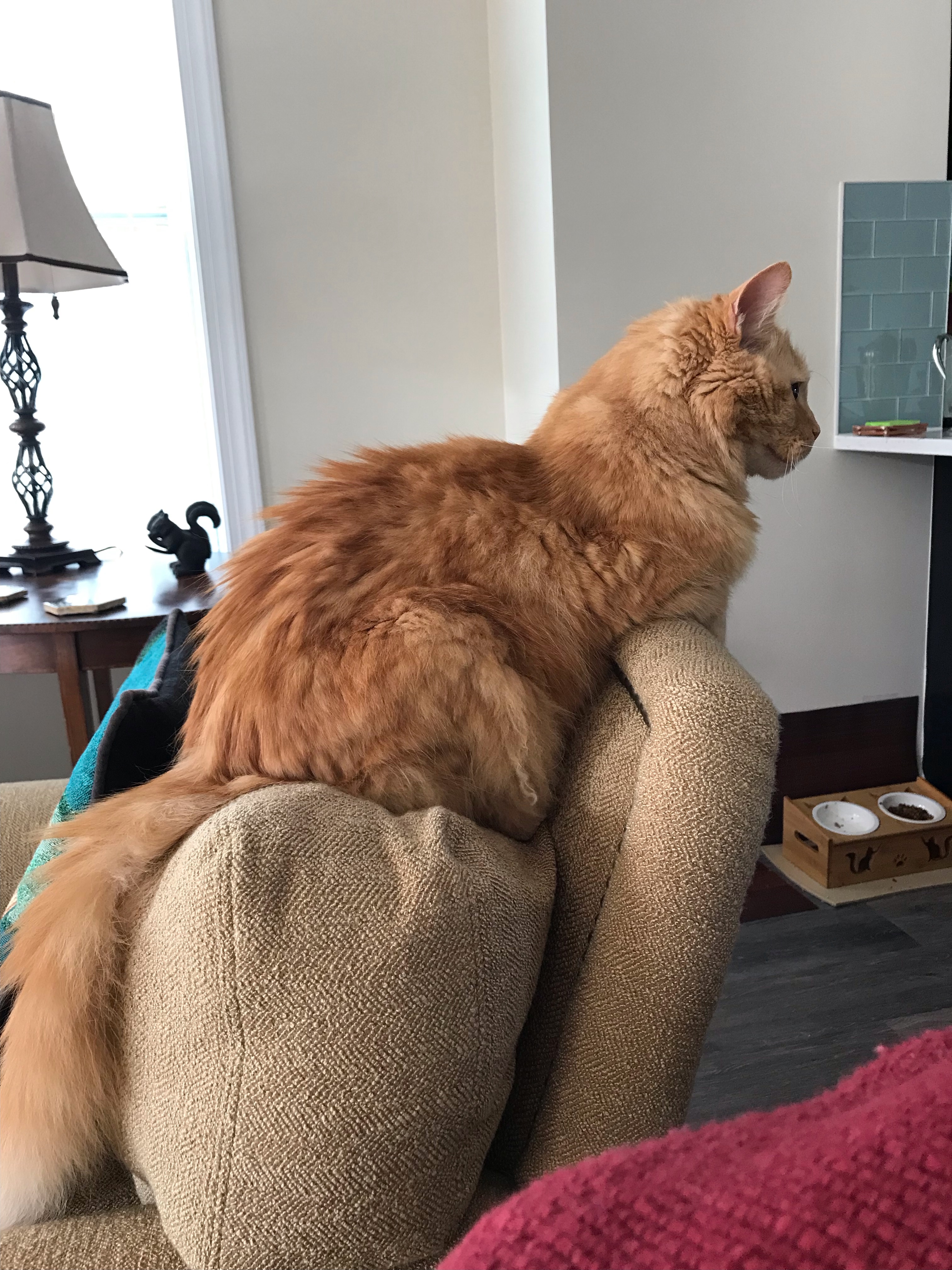
Bruce the Cat is living his best life.

I can’t say the same for his favorite human companion. It’s been a wonderful and an exhausting month but I won’t feel at home until my brain can shift its thinking from ‘I moved to Virginia’ towards ‘I live in Virginia’. My body is here but my energy is somewhere over a cornfield in Iowa and until the two can meet this sense of being unmoored will stay with me. It’s as if there’s a glitch and my spirit is biding its time somewhere in the air between California and Crozet, like a little spinning rainbow waiting for the new software update to download. But that’s what a move is like, isn’t it? The body and the spirit need space to forge their alignment. Until then, balance and equilibrium is off kilter. Just ask my Vrksasana.

Change takes time. We know that. It might be a cross country move, a bad habit we’re trying to break or a new perspective we’re trying to find. Change takes time. And if we don’t see change for what it is – an opportunity to practice patience – then the disappointment we feel when the new conditions we’re expecting don’t arrive fast enough can mess with our head. It has definitely messed with mine. This past month – in between the excitement and moments of joy – I’ve been irritable and frustrated. I’ve lost focus. I’ve had trouble sleeping. To be clear, I haven’t once questioned our decision to relocate but the firm grip I had on the vision for my life and the purpose I knew was mine has slipped away. I don’t yet know who I am in this new home. And my brain won’t be able to transition to ‘I live in Virginia’ until all the things I can’t seem to find – including me – are found.

Change has its own rhythm. It’s own schedule. 

I need to take to heart the words I write. Change is an opportunity to practice patience.

Which means I need to stop worrying about the damaged refrigerator sitting like a monolith in the middle of my kitchen and take joy in the truth that there’s a new, undamaged refrigerator in its place. By next week it the broken monolith will be gone. By next week shelves for the garage will arrive and trying to find the car won’t require navigating a maze of cardboard. After that the boxes still unpacked will be open. And after that we’ll have a few chairs for the patio and will be able to enjoy hot tea in the cool mornings as the sun rises. I’ll begin to learn how I fit in this new place, this new world.

Until then I will continue to repeat the mantra ‘Change is an opportunity to practice patience’. And the first place I will practice patience is with myself.


Touching Life: Notes from the New Homestead

On Saturday our red CRV was filled with flattened cardboard boxes, bubble wrap, assorted other papers and questionable plastics. After an eighteen mile drive we had arrived at the McIntire Recycling Center, where Ben and I met a man named John.

John knew everything about recycling and was eager to show us what from our bounty of trash we could distribute among his many large green crushing machines and what would be coming home with us, destined for landfill. He taught us, for example, about what plastics are useful to the composite deck making industry: ‘if it stretches and doesn’t stick to itself they can use it..’. So our bubble wrap and bread bags were a ‘go’ but the mountains of cling film the movers wrapped our furniture in were, unfortunately, a ‘no’

This was a very hands on, prepare to do the hard work, old school recycling experience that forced Ben and I to consider how much we consume and to reflect on the environmental cost of our move across the country. It was hot and sticky work that was eye opening and, with all that we learned, sorta fun in that ‘I can’t wait to get home to take a shower’ sorta way. 

Home for Ben, Bruce the Cat and me is now a pre-planned suburbia, the end townhome in a short row of townhomes that wiggle uphill like caterpillars enjoying a juicy nasturtium leaf toward our ever blooming ‘town center’. And if you’re old enough to remember ‘little boxes made of ticky tacky’ then you get the idea. But we love where we are. We are surrounded by mountains and wooded trails. The view from our kitchen deck looks toward a thick forest that is bound on one side by bright single family homes and a crisp white cement walkway. The difference between the two conditions – one put in order by man and the other by nature – is a constant reminder of our impact on the earth. And somehow it is teaching Ben and I to be better caretakers.

A few evenings ago, just before dusk, I was looking out from my kitchen toward the shadowed woods and saw a slim, young deer enjoying a meal of wild weeds and flowers as she made her way down the grassy verge between the sidewalk and the forest. I called Ben over and as we watched we saw the deer’s fawn – not more than a few days old, all spots and gangly legs – run to catch up to its mother. We watched as they made their way around the pond to disappear back into the thick brush. Another reminder that Ben and I are temporary stake holders. Interlopers.

When we first arrived at our new home we noticed that we had some tenants already living in a vent on the back patio. Two Eastern bluebirds had built a nest and were nurturing their newly hatched brood. A few days after our furniture arrived the bluebirds lost one of their young when it fell from the nest. The next day they lost another. But the parents continued to fly back and forth, feeding what children remained a constant stream of grubs and grasshoppers.

Until Saturday. 

I found Bruce the Cat staring through the glass door in a state of high excitement and agitation. I was happy that Bruce had something to entertain him until I realized what was happening. On the patio was a disaster of Hitchcockian proportions. Two dozen sparrows perched on our railing, harassing the bluebirds. Their last two fledglings had been pulled from the nest and were now writhing on the patio floor. At this point they had feathers but I don’t think they knew how to fly. Their suffering and distress was horrifying. In a panic, one fledgling ran and fell off the patio and down a full story to the earth below. The parents continue to fight off the attacking sparrows to protect their last remaining baby while the sparrow spectators watched in what I imagined was bloodthirsty glee.

When it became obvious that there was nothing more to see the sparrows disappeared. But the parents were still in distress and the young bird was still suffering. Ben and I did not know what to do. Put it out of its misery? Wait for the inevitable? What we decided to do was to cut a hole in the end of a shoe box to create a shelter for the baby bird. We covered the shoebox with a plastic bag and built a sort of dam in front of the box with a rolled towel in order to keep out the rain.

What happened next was astounding. Within an hour the parents were feeding their last offspring an endless meal of grubs and grasshoppers again. Ben and I feel privileged that we were able to witness this remarkable process of feeding, healing and protection for two days. 

Today the box looked undisturbed but there was no sign of the fledgling’s parents. When an hour went by and there was still no activity I ventured out and looked in the box. 

It was empty.

I need to begin this week believing that we saved that young bluebird’s life and that at dawn, with encouragement from its parents, the fledgling spread its wings and took flight. That might not be true but it’s what I need to believe.

I have one more story to share.

On Sunday afternoon Ben and I thought dinner at the Thai restaurant just a five minute walk away would be nice. Delicious food. Friendly service. A mojito that will knock your socks off. What could go wrong?

An hour earlier it had rained. As we enjoyed our drunken noodles and tum yum soup the sky was still grey but there were slices of sunshine. It was only after we paid our bill that the clouds turned black and ominous. We began our short walk home in faltering sunlight. A block later we stayed just two steps ahead of the thick plops of water that began to follow us down the sidewalk. It was less like rain and more like a slow leak in an old ceiling. We were still confident we would make it home. Besides, we had umbrellas. As if they were going beat back the onslaught about to happen.

Just past the roundabout the skies ripped open. And I mean ripped opened. We ran, we screamed, we laughed, we submitted to the inevitable. Ben’s flat cap blew from his head at the same time that our umbrella turned inside out. We ran back to catch the hat before it was lost to the deluge. By the time we reached our doorstep there was not one square inch that wasn’t soaked. It was magical.

I can’t remember having so much fun in the rain.

Over this past week I’ve touched life in ways I never have never touched life before.


I’m a Coach. Don’t Roll Your Eyes.

When I began my training with International Coach Academy (ICA) at the beginning of the pandemic (and isn’t it odd how we now tell time according to COVID?) we were asked to find peer coaches with whom we would practice our developing skills. One of my peer coaches – who I’ll name Jane – was close to graduating from the sixteen-month program. I found Jane’s coaching prowess intimidating. She possessed limitless self-belief and her blinding confidence glowed like a pulsating aura. What Jane lacked was empathy. She didn’t notice that my habit of comedic self-deprecation is the tactic I use to disguise my fear of failure. It was both her loss and mine.

Before my peer coaching relationship with Jane began, I believed coaching was easy. I had no doubt that I was going to sail through ICA’s intensive program without breaking a sweat. But the opposite was proving true. Coaching is a skill that takes practice and dedication to master and I was struggling. Jane was blind to my struggle. When she told me that 80% of the individuals who graduate from a coaching program never become professional coaches, she didn’t see the movie reel of my life as a coach burst into flames. She couldn’t know that the committee in my head, my little saboteurs that run around with needles to poke holes in my hopes and dreams, never once thought to tell me I could be in the 20% who succeed. And so, when I graduated from ICA I didn’t shout my achievement from the rooftops. It was more of a whisper. And these days, despite my excellent training, I use my coaching skills on the sly. No one even notices. What a shame.

Newly minted coaches are encouraged to practice with peer coaches. I have two that I see on a regular basis. We use our time together to refine our skills and to share experiences. Most recently we’ve been trying to determine why, as bright and well trained individuals, we find it so difficult to ‘sell’ our services.

Part of our struggle is found in the knowledge that, like yoga, life coaching is an unregulated industry. And although coaches have a strong governing body – the International Coaching Federation – for there is no incentive to jump over the many rigorous hoops required to earn accreditation through the ICF when the truth is that anyone who attends a weekend long ‘coach training’ workshop can then hang out a shingle. For that reason, if you are interested in finding a coach, it’s important to review their qualifications in the same way that you might want to know how long your yoga instructor has been practicing and where she did her teacher training.

Another industry problem is the myth that working with a life coach is a luxury only the self-indulgent can afford. While it’s true that some coaches bill at a rate per hour that is so high as to be offensive, others offer their services on a sliding scale or are willing to negotiate payment options. 

Some parts of the health and wellness industry view the coaching industry as nothing more than an interloper riding the coattails of licensed mental health professionals. But coaching is not therapy. Coaching does not examine the past. It begins in the present moment and builds a scaffolding of accountability and action to support the client’s journey forward. It is a grounding, effective technique with which we can navigate and overcome the obstacles that prevent us from achieving our goals and living by values that, for us, carry heart and meaning. Coaching shifts perspective. It helps us to become ‘unstuck’. 

As a coach, I facilitate your journey toward the clarity required to find all the possible paths that will lead you to the future you envision. I create space for you to uncover and to shift the long held limiting beliefs that prevent you from bringing your best self fully into focus.

Coaching is client led. The relationship can be thought of like this: 

Imagine you and I are on a road trip together. I’m your coach, sitting in the passenger seat. You are behind the wheel. You are choosing the destination and the road we’ll take to get there. Along the way you might discover a different road and maybe even a different destination. My job is to help you find your way around roadblocks and to navigate detours. I help you determine for yourself if the choices you are making and the journey you are creating are coming from a place of authenticity aligned with who you are and who you hope to be.

There was a time when I reacted to the words ‘life coach’ with a Pavlovian eye roll – even when becoming a coach was tickling my intuitive heart. Now I understand how coaching works. I understand the skill and the techniques involved. I’ve experienced coaching’s magic. The way it can bring lost ambitions, goals and values back into focus.

Have you lost focus? Do you feel stuck? If you have an important decision to make or a habit you would either like to break or create – let a coach climb into the passenger seat. You’ll be happy you did.

International Coaching Week is happening soon. What better time to try coaching?


Growing Freer

I’ve been thinking about balance.

At the start of the pandemic, which now feels a lifetime ago, I decided that my new found spare time offered me room to begin running again. It didn’t matter that over the previous two decades I moved no faster than a brisk walk. In college I ran to relieve the stress of studies and an unhappy marriage. After college and well into my thirties I ran because when I ran I felt strong and invincible. I wanted to feel that way again. And so I made my preparations. I researched the best shoes for my finicky feet and purchased what I could afford. I found websites and apps with titles like Running for Women, Running for Seniors and Running for Senior Women. I downloaded training schedules and created a list of routes to run and calculated the distances. It didn’t take long for me to graduate from brisk walk to shuffle to an actual jog and in those first weeks I looked forward to a healthy body, a clear mind and the lean, organized structure to my life that I craved.

And then a broken side walk came between my toe and my hopes. While my knees and my thumbs healed I considered giving up. A few months later, when I had a second hard fall, I did give up. 

Falling down was not a rare occurrence when I was a child. My mom would tease, You can trip over thin air, she’d say. When I was in sixth grade one of our teachers who was fresh out of college watched me stumble my way through a tangle of classroom chairs and then, dripping sarcasm, joked about my ‘grace’. It’s funny how we remember these things and not our moments of actual grace. To be fair, it’s true that my knees were skinned more often than not throughout my childhood. But I don’t believe it was because I was clumsy or awkward. I was too busy thinking about the next adventure to notice where I was going. My head was always a million miles ahead of my feet.

And I didn’t think too much about having skinned knees when I was a kid. I always bounced back up, brushed myself off, stuck a bandaid on my scrapes and moved on with life.

But last year the cracks in the sidewalk that sent me flying caught me by surprise. I didn’t bounce back like I did when I was a girl. Something was different. For the first time the trust I had in my body, that all would be well, was questioned. For the first time I found myself afraid of the future and the changes my body would continue to go through as I aged. 

When I stopped catastrophizing about a future that is a mystery to me and began to think clearly I realized that there was plenty I could do now to improve my strength and my balance. How I take care of my body now will inform how my body thrives in the future. I can eat more vegetables. Especially cruciferous ones. I can take Vitamin D. I can add more weight bearing exercises to my routine to keep my bones strong. I can remember that physical balance can be practiced. And then I can make sure to include standing balance poses to my yoga practice.

I don’t really have a formal game plan. It doesn’t mean that I don’t care or that I’m not working toward my healthy future. It means I’m letting go of some of the anxiety I hold about the future. Over the last few weeks I’ve realized that a balanced body goes hand-in-hand with a balanced mind. And to keep a healthy, balanced mind I need to remain present with what is rather than focused on what might be. I can smile more. I can reach out to friends more often. I can immerse myself in the things that I love like art and reading and cooking. 

And I can remember that sometimes we sing the body electric’. Sometimes we fall down. 

This Pablo Neruda poem appeared in my Facebook feed this morning along with this advice: we are growing freer…not older.

You Start Dying Slowly

You start dying slowly

if you do not travel,

if you do not read,

If you do not listen to the sounds of life,

If you do not appreciate yourself.

You start dying slowly

When you kill your self-esteem;

When you do not let others help you.

You start dying slowly

If you become a slave of your habits,

Walking everyday on the same paths…

If you do not change your routine,

If you do not wear different colors

Or you do not speak to those you don’t know.

You start dying slowly

If you avoid to feel passion

And their turbulent emotions;

Those which make your eyes glisten

And your heart beat fast.

You start dying slowly

If you do not change your life when you are not satisfied with your job, or with your love,

If you do not risk what is safe for the uncertain,

If you do not go after a dream,

If you do not allow yourself,

At least once in your lifetime,

To run away from sensible advice.”

– Pablo Neruda


Truffles, Baseball Caps & Judgement

During the pandemic a friend of mine eschewed the sourdough bandwagon and instead  mastered chocolate truffle making. His truffles are exquisite. Velvety smooth, they’re indulgent but somehow never ‘too much’. Some of the truffles he makes are elegant and traditional – little spheres of creamy chocolate rolled in cocoa or hazelnut. Others are playful and wear coats of chocolate sprinkles or crystalized ginger. All are simply perfect. 

Sunflowers

I’m thinking about truffles, COVID and politics this morning. Is it just me or does it feel like we’ve figured out how to live with COVID? At least in the the San Francisco Bay Area where vaccination rates are high, infection rates are low and people lean toward wearing masks indoors. New variants don’t hold Omicron’s power to terrorize and we’ve figured out how to enjoy social occasions with groups larger than two again. We’ve even mastered Zoom.

But I’m still baffled by anti-vaxxers. Early on, when vaccines first became available, a friend explained why she would remain un-vaxed: “I take vitamins, I exercise and I’m in good health. And I did my own research.” In hindsight I wish I’d replied, “I bet a lot of people said that before they ended up on a ventilator” but I was too flummoxed. More recently – during the peak of Omicron – a friend invited me to lunch. They excused their lack of vaccination this way, “I’m not going to catch COVID and even if I did, I’m going to die anyway.” Sigh. 

This, believe it or not, brings me back to truffles. 

My truffle making buddy and I meet – vaxed, boosted and, now that mandates have softened, carrying a mask just in case – every few weeks for coffee. If his ganache hasn’t broken I’m presented with an elegant box purchased from Etsy and filled with little yummy bites of joy. 

Today’s truffle was rolled in finely crushed Oreo biscuit and black salt.  The addition of salt added an unexpected and nuanced sophistication to the cookie crumble.  I enjoyed it with a cup of Earl Grey. The morning was pretty much like the truffle – delightful. The sun was shining and people were happily filling bags with produce from the nearby farmer’s market or standing in a long, chatty queue at the dim sum market stall across the street. Even the cafe’s usually grumpy owner was wearing his frown upside down. A few tables away sat a group of four middle-aged friends and a dog. One of the men – slightly older with a thick, grey beard – was wearing a light brown baseball cap with the message ‘Biden Failed Us’ embroidered in gold on the crown.  

To say I found it triggering is an understatement. But not for the reasons you think. Free speech, after all, is a human right.

But in today’s political atmosphere wearing a hat that is guaranteed to provoke feels unnecessary to me. It feels ugly. Selfish in the same way that, unless you are exempt for health or religious reasons, not being vaccinated is selfish. It’s an easy way to be loud without opening your mouth. To look like you are well informed when really you’re more like the Great Oz when he’s revealed to be less of a wizard and more of a fraud. 

I know nothing about the man with the hat and maybe, if I’d asked him, he would have explained with clarity his position. Yet I let his silly hat drag me kicking toward a mental space I find myself locked in more often than I would like. 

Judgement. 

It’s been a messy two years. An exhausting two years. And just when we thought we could see daylight again the world has fallen into a frightening state of chaos. 

I’ve been accused of being a Pollyanna and the accusations are true. I am a card carrying, dyed-in-the-wool Pollyanna. But I believe with all my heart that we have a light within us and this is the time to shine. We shine our light by thinking about how our decisions impact the lives of others. We need to consider how our choices – down to the hat we choose to wear – should lift people up rather than tear them down.  We need to speak with care. We need to own our beliefs but share them with compassion, not vitriol. 

We need to stop being mean.

And above all else, we need more truffles.