We Have a Date! Samyama will Open its Doors in March

IMG_1656

Samyama Yoga Center, the new studio in Midtown, Palo Alto that I’ve been harping about for the past six months has Grand Opening Date officially set in stone. Following a celebratory Grand Opening Party on Saturday the 9th and an Open House on Sunday the 10th, classes will begin on (drum roll, please):

Monday the 11th of March

(Update…Our opening date has had to be pushed back a few weeks.  No, we won’t be opening on March 11th but when we DO open, and it won’t be long after our original date, Midtown will light up with Yoga Joy!  We’ll keep you posted…)

I’ll still be teaching:

Gentle Morning Flow:  Tuesday and Thursday from 7-8:30 AM

Yin Flow:  Fridays from 1:30-2:45 PM

   Hatha:  Saturdays from 4:00 to 5:30

    If you haven’t checked out the Samyama Facebook page yet, click here.

      Give us a look and then give us a ‘like’.


Let’s Talk About Yin. Yes, again.

English: Tension lines of the human skin. They...

English: Tension lines of the human skin. They follow the main fibres of the connective tissue of skin.

While we’re at it, let’s talk about anatomy, too. And whether or not a yoga teacher needs to study anatomy and physiology…

I was having coffee last week with Anirudh Shastri and John Berg. Both are much admired and deeply loved teachers in the Bay Area. In January John’s dream will be a reality when Samyama opens its doors in Midtown Palo Alto. I am so proud John found me and asked me to teach at Samyama. I’m proud to be part of a faculty that includes – besides John and Shastri – Louis Jackson, Annika Williams, Hilary Easom, Amy Rogg, Clive Beavis and Lindsey Amrein. We are not only a team of teachers but a family. We meet regularly and support each others’ practice and teachings as strongly as we hold our vision of Samyama. We all chose different paths and somehow still managed to arrive at the same place. How wonderful is that? Eight individuals. Amazing journeys. Same vision. Different stories.

Here’s my story about why I believe the study of anatomy is important for any yoga teacher:

I didn’t go to medical school. I attended massage school. It was a good school and the anatomy was fast, furious and hard taught. I learned the names of the muscles and the names of the bones. I learned the origins and attachments. I looked at fake plastic skeletons and the living limbs of my bodywork clients and my yoga students. But until I saw these photographs I didn’t know. Until I studied with this couple and then this man I didn’t know. I didn’t know that for fifteen years I was teaching an alignment-focused style of yoga and assumed my students’ inability to move deeply into any particular posture was the fault of a ‘tight’ muscle. I never considered the important contribution bones and connective tissue make toward how we move and how we feel. How we experience asana.

It seems obvious. It feels like it is something I should have known all along. But I didn’t. It’s my continued study of anatomy that has provided an insight I didn’t have when I began teaching.

One of my responsibilities as a yoga teacher – particularly a teacher who loves introducing beginning students to the profound joy of an asana practice – is to keep you safe. Knowing the difference between a femur and a tibia helps me do that. Describing the sacroiliac joint and understanding fascia helps me do that. No, my classes are not a lesson in human anatomy. But sometimes it’s more efficient – more precise – to name a muscle in the body rather than indicate an area on the body.

In-depth study of anatomy has changed my teaching. I will agree – it’s not for everyone. But it turned me from an alignment-centric cookie cutter teacher into one who focuses less on the aesthetics of alignment and more on helping each student have their own, ever-changing, safe, unique life-affirming asana experience.

Shastri was about halfway through his coffee and John had probably finished his tea when the discussion turned to Yin and connective tissue.

Yin – like any style of yoga – can provide something different depending on what time of the day you practice and what your intention is for your practice.

Yin Yoga shifts our awareness away from yang’s contracting strength and power to soft and melting expansion. Contraction and expansion are neither positive nor negative. They are states our body experiences as we move through life. Yin Yoga restores but should not be considered the style of yoga we call Restorative. Yin Yoga is challenging but many of the challenges differ from the ones we find in classic Hatha Yoga.

Physiologically, Yin Yoga stresses connective tissue. These tissues include fascia, tendon, ligament and bone. Because we hold yin poses for time, the practice also offers a deep release to the nervous system. It feels intuitively wrong to consider stressing our joints, but done with right intention the practice results in greater stability and fluid flexibility. Consider this – we don’t correct crooked teeth (yin tissue) with a blow from a hammer. We use orthodontia – a long, slow and sometimes uncomfortable technique that realigns and corrects. That is Yin Yoga in a nutshell.

When I take yin in the morning my muscles are cool. They’ve not woken up. They’re at their shortest. This is the time when my yin focus is less on the benefits to the nervous system and more on the gifts to the connective tissue. My cold muscles won’t “steal” the stretch away from the connective tissue. The stretch/stress is not diluted by muscles that are warm enough to accept a deep fold or twist. The practice is more challenging to me in the morning because my body is cool and my ego is bruised. In the morning I cannot sink into the same deep and calming positions I can explore with an evening yin practice. The morning yin practice is sometimes frustrating but teaches acceptance and mindfulness. And it reminds us not only to be humble in our practice but to have a sense of humor.

But Yin Yoga is not all about the connective tissue.

When I practice Yin Yoga in the evening my intention shifts from the effects on the body to those on the spirit. In the evening our muscles, warm from a day full of movement and work, will absorb some of the effort saved for the connective tissue in the morning. But experiencing yin’s long-held poses in the evening calms the mind and prepares the body for sleep. Many of my students have told me the evenings they attend class are the evenings they know they’ll have the week’s best nights sleep.

Yin is a style of yoga that nurtures balance. For the yogi whose practice emphasizes power, strength and endurance Yin Yoga may feel too slow or too easy. With time and an open mind, however, even the most ardent Bikram devotee’ will recognize the grace, challenge and benefits of Yin’s quiet beauty.

As for me, I need both. I love a strong, contracting Yang practice just as deeply as I love a cool, quiet and expansive evening of Yin. That’s what balance is all about.


How the Faux-Grinch Made Christmas All Her Own

yogaI’m not really a Grinch. I’m just one of those folks who love winter not for the shiny tinsel but because their’s nothing quite as cozy as a cold winter day burrowed under the blankets with a few good books and a hot toddy.

Too much burrowing, however, does not a festive yogi make.

This year I’ve decided to celebrate the season doing what I love. Yoga.

And I hope you’ll join me. Over the holidays I’ll be teaching these four classes at the California Yoga Center:

Monday 24 December – Christmas Eve

7:00 – 8:30’ish PM (please note earlier start time)

Yin Yoga

Donation Based

Tuesday 25 December – Christmas Day

9:00 – 10:30 AM (please note extra half hour)

Hatha Flow

$18 drop-in

Monday 31 December – New Year’s Eve

7:00 – 8:30’ish PM (please note earlier start time)

Yin Yoga

Donation Based

Tuesday 1 January – New Year’s Day

9:00 – 10:30 AM (please note extra half hour)

Hatha Flow

$18 drop-in

CYC Students – Please note the time change on the Yin Yoga class.  We’ll be starting at 7:00 and NOT 7:30.  Also note the extra half hour added to the morning classes.  

I think we deserve a longer savasana on Christmas Day and New Year’s Day.  Don’t you?


The Pen Collector

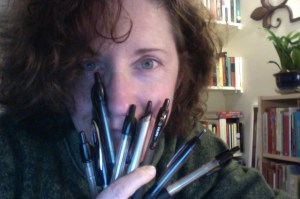
Just a few of my several dozen pens.

Just a few of my several dozen pens.

The thing about tolerating a cold is that in between blowing the nose and hacking up phlegm balls, you have quite a bit of time for thinking.

On November 19th a cold took hold at 38,000 feet over the Pacific when a stranger a few rows behind let loose with a wet and righteous sneeze. At the time I remember calmly telling myself, “I’m going to get that.” Repeated slaps to the forehead while silently screaming “NO NO NO NO you idiot WHAT were you thinking?!?!” were not enough to talk my immune system down from the inevitable and, sure enough, on the evening of Tuesday the 20th while watching a DVD with my friend, I began to cough.

By the following morning I had a full-blown excuse for staying in bed with the duvet tucked tight for the next seven days.

But, like I said, it gave me time to think. Perhaps it was feverish delirium, but the one thing I thought most about were the two flowerpots full of pens I keep on the right hand corner of my desk next to the twelve spiral notebooks I keep stacked at attention in the event I should have just one brilliant thought worth noting (there at least a dozen more notebooks awaiting active duty in a dresser drawer). “Why on earth,” I muttered, “do I have so many pens and notebooks?”

I’m a pen snob. I prefer an ultra fine Pilot G2 gel point in black. They have good glide.

I’m not as picky about my spiral notebooks, although I prefer the 9 ½ by 7 inch Callbers. Yes, I have a couple of those fancy black notebooks – the one Hemingway preferred – but I’m afraid of them. They’re a bit too pretty. I wouldn’t dare deface them with my chicken scratch – even with a black inked ultra fine Pilot G2 gel point.

Yes, I recognize my obsession with notebooks and pens is a symptom of something more troubling.

When I recovered from my cold I took a good look around me. In my medicine cabinet were six different brands of hair ointment all promising to do the same thing for my curls. In my closet? Sixteen pairs of shoes. There are three more pairs in a basket by my front door. Four tubes of toothpaste. Five brands of antiperspirants. An assortment of travel sized bottles of shampoo, conditioner and moisturizer.

You see where I’m going with this. I feel a little New Year’s challenge coming on.

I’m going to try to survive 2013 without making any new purchases.

Before you think I’ve gone around the twist, here are the guidelines:

Obviously I will need to pay rent, purchase food, gas for my car, electricity. I will also be spending money on books and tuition this year as well as airfare for a trip back East.

What I won’t allow myself to buy is any item bought to replace an item that I already have and that is still in good working order. I can only replace personal care items like soap, shampoo, deodorant and moisturizer when what I have is within a use or two of running out.

No new pens or notebooks.

No new clothes or shoes – I have more than I need.

But what about entertainment? Meals out? The occasional over-priced coffee?

I’m not trying to live the life of an ascetic. I still want to live well and enjoy life fully. I will set a budget over the next few days to accommodate life’s little frills.

This is a simple exercise in mindfulness. Ours is a greedy and wasteful society. I want to pay better attention to how much I waste and what I truly need.

Anyone care to join me?


Samyama


The term samyama refers to the combined practice of dharana (concentration), dhyana (meditation) and samadhi (union). It is a technique we can utilize to cultivate deeper understanding of the qualities of an object or a person or a concept. It’s said that the yogi who successfully practices samyama will experience the lightness of being freed from the mental constructs – the kleshas – that bind us to the ‘real world’. In other words, samyama liberates us from obstacles, hindrances, troubles and suffering.

Samyama is also the name of the new yoga studio opening in Midtown, Palo Alto in October (just in time for Diwali).

Samyama isn’t your ordinary yoga studio. It’s one man’s vision manifested. To read the history of how Samyama began, click here.

Two months ago John Berg and I met for coffee at Philz – John’s office until the new one is built. The following week he invited me to teach at Samyama. I’ll be joining local yoga master Anirudh Shastri plus Louis Jackson, Annika Williams, Hillary Easom and Bethany Sala. One or two others have yet to be confirmed but the truth is John is keeping the teaching staff small for a reason – he’s not creating a yoga mini-mart with 48 available flavors . He’s creating a yoga home.

And I can’t wait to move in.


It’s Possible I’m a Fuddy-Duddy with No Sense of Humor…or Not

I am not the Poster Child for Perfection.  I have laughed at others’ misfortunes.  I have walked past the legless man begging for a bit of change (although, in fairness, today I bought him a chicken salad sandwich).  I have walked a block out of my way to avoid the Greenpeace kids in front of Whole Foods beseeching me to protect the environment.

Perfect? Me?  Not even close.

At times I am thoughtless and sometimes I speak before I’ve considered how my words might sound to another. In other words, I’m human.  I’m no more caring, compassionate or spiritual than my neighbor.  But, like my neighbor, I’m trying.  I’m trying to reflect on how my choices, my words and my actions impact the lives of those they reach.

And that’s why it has occurred to me that we might want to sit back and take a moment to contemplate how we use social media.

A well-intentioned friend who thought I would find it funny first delivered the joke to my inbox about a year ago.  About six months later, a new version of the same bad joke showed up, this time sent by a student.  And then, just a few days ago, a yoga teacher and friend whom I admire decided to post the joke on his Faeebook wall.

And that’s why I wish I’d spoken twelve months earlier.

I guess you’d consider the joke a sight gag.  On one side there are a series of photographs taken of yoga practitioners in various postures looking beautiful and calm and aligned.  These are juxtaposed by stolen images (I say stolen because it’s obvious the subjects did not know they were being photographed) of men who appear to be living rough. They may be drunk or on drugs.  They are all either sleeping or unconscious and their bodies have fallen in a way that mimics the postures being demonstrated by the yogis.  I don’t want to post a link.  If you’re curious Google “drunk yoga”.

My family was touched by alcoholism and drug dependency and maybe that’s why I can’t laugh.  I can’t laugh at something so cruel and heartless.  Something that demonstrates an unbelievable lack of compassion.

Then again, it could be that with all my imperfections I’m also a fuddy-duddy with no sense of humor.

Either way, maybe we should sit back and consider what we pass around on Facebook. How often have we reflexively shared a post, an image or a joke?  Do our posts speak to who we are?  Are they a reflection of how we relate to the world and to one another?  Do they add something to the dialogue or are they cheap shots?


Give a Little

“Therefore, without being attached to the fruits of activities, one should act as a matter of duty, for by working without attachment one attains the Supreme.”

Bhagavad-Gita, Chapter 3, Text 13


How Do We Live Our Yoga?

In the beginning, most of us are one quick namaste’ from the daily grind.  When class ends we roll up our mat, stack the studio bolsters and on our way out the door hope the parking meter has enough time remaining for a quick run to Starbucks before we head back to work.  There’s no time to embrace the yoga that is more than skin deep.  Forget the philosophy – we’re in it for the workout.  We want a toned body. Yoga Class is Tuesday from nine to ten in the morning. Everything else is life.

With dedicated practice, however, a subtle shift occurs. The edge between our yoga practice and “real” life blurs.  Yoga begins to follow us home.  We move deeper into our practice and yoga becomes a part of who we are.  When we embrace the notion that yoga has not only strengthened our bodies but has also strengthened our spirit then it’s time to ask again:

How do we live our yoga?

Step Off the Mat

In 2007 Seane Corne decided to move her yoga beyond the mat and confines of the studio walls when, along with Hala Khouri and Suzanne Sterling, she founded Off the Mat and Into the World. This inspiring organization embraces the philosophy of seva.  Selfless service.

According to their website Off the Mat’s mission is “to use the power of yoga to inspire conscious, sustainable activism and ignite grassroots social change.” Today, Off the Mat and Into the World has international scope.  It supports humanitarian efforts in Haiti with the Global Seva Challenge.  Off the Mat’s Empowered Youth Initiative believes a commitment to the next generation has a profound impact on social justice and environmental issues.  This year the initiative has programs focused on assisting urban youth in Los Angeles.  They also support community initiatives working for disadvantaged populations.

Think Creatively

One such community initiative is The Art of Yoga Project, located an hour south of San Francisco in leafy Palo Alto, California. Art of Yoga’s mission is “to lead teen girls in the California juvenile justice system toward accountability to self, others and community by providing practical tools to affect behavioral change.”

The Art of Yoga Project improves the lives of disadvantaged and incarcerated young women by nurturing their creativity while encouraging a daily yoga and mindfulness practice.

Transform Your Practice

The practice of yoga is a transformative experience.  But how many of us allow that transformation to move beyond our inner spirit?  What happens when we stop clinging to the yoga experience we love and allow it to touch the lives of those around us?  Supporting others’ lives through yoga will transform your own.  Mary Lynn Fitton, founder of The Art of Yoga Project, knows first hand the profound effect of selfless service. “Since starting The Art of Yoga Project my personal practice has deepened considerably,” she said. “Teaching the principles of yoga to incarcerated teen girls, who have had very difficult life experiences, has called all of us at the project to a higher standard. For example, since we are teaching the girls about satya, we are looking closer at how we’re living in our own truths, watching our speech, avoiding gossip.  Teaching the girls yoga principles keeps them alive and fresh in my mind so I have daily reminders of how I want to be in this world. I am thankful to the girls for that. They are such heroes to me as they shine through their tragic pasts. They inspire me to be ever grateful of my circumstances and to do as much as I can to relieve suffering. 

The Small Gestures Count

Founded in 1978 by Dr. Larry Brilliant in Berkeley, California, The Seva Foundation has restored eyesight to millions of people in Tibet, Nepal, Cambodia, Bangladesh and Africa.  In the process they have reduced the cost of cataract surgery to just $50.00.  As individuals, our small gestures may never match the scope of Off the Mat Into the World or The Art of Yoga Project, but we can still hold in our hearts this simple idea from the Seva FoundationTo become fully human we must translate our compassion and concern into useful service.

What is useful service?  For most it does not entail forming a non-profit.  Most of us will not have the opportunity to restore sight to the blind or teach yoga to groups of incarcerated young women.  But in our daily lives we can still bear witness to the power of selfless contribution.  Mary Lynn Fitton says,

“I am blessed by this work. I wish everyone could experience the joy, connection and fulfillment that comes to you through being a part of positive social change. And you don’t need to start a non-profit to make a difference; but do take the time to discover what really matters to you and carve out space in your life to contribute to that somehow. Start with having conversations that matter. Then set your intention to serve. The rest will come.

So how do I want to live my yoga?  In service.  One breath at a time.

This article originally appeared in Yoga Living Magazine.


This Week: Opening the Heart

“We are all here for a single purpose:  to grow in wisdom and to learn to love better.  We can do this through losing as well as through winning, by having and by not having, by succeeding or by failing.  All we need to do is show up openhearted for class.”

The quote is from Rachel Remen’s book Kitchen Table Wisdom and it will be our theme for classes this week.  It’s a laid back week for me.  Classes at Avenidas are on break until July 9th and my class at Prajna Yoga and Healing Arts is taking a break on July 4th, but you can still join me for some heart opening practice at California Yoga Center, where I’ll be teaching the following classes:

 Yin:  Monday 2nd July from 7:30-9 PM
Slow Flow:  Tuesday 3rd July and Friday 6th July from 9-10 AM

See you there!


Summer Class Updates

If you’ve been to my classes you’ll know that I love to “hang out” in the asana. 

I don’t believe in rushing, I don’t turn yoga into aerobic exercise, and the thought of practicing yoga in order to build a better backside is loathsome to me. 

So if you enjoy exploring the shape of a pose, feeling how the energy shifts as you change your alignment; if you enjoy testing your strength and flexibility while dialing down the stress – then I’m your guide.  My classes begin with two minutes of quiet reflection/meditation and end with savasana.

Seasons change and so does my teaching schedule. At least a little bit.

Here’s a summer update:

California Yoga Center

The Monday Evening Donation-Based Yin Class continues to meet from 7:30 to 9:00 PM at the Palo Alto Studio.  All equipment is provided.  Some understanding of Yin is helpful (you can find that here) but not necessary.  There is no class on Monday 30 July.

My Tuesday and Friday Iyengar-inspired Slow Flow meet from 9:00 to 10:00 AM at the Palo Alto Studio.  Please bring a yoga mat.  These class are Level I/II. $15 drop-in.  The class on Friday 27 July will be taught by Terry Lesser.  The class on Tuesday 31 July will be taught by Lisa Brill Robinson.

Prajna Yoga and Healing Arts

My Hatha Yoga Class meets on Wednesday from 6:15-7:30.  Please bring a yoga mat. There is no class on 4 July. The class on 25 July will be taught by Yiwen.

Avenidas

Registration for Summer Session, which begins on Monday 9 July, is still open.  I teach two classes at the senior center:  Monday at 1:00 and Friday at 10:30.  We’ll have seven class meetings over eight weeks, with no class on Friday 27 July or Monday 30 July. 

For further details on any of these classes check my website.


Start Where You Are – Building a Home Practice, One Step at a Time

You might think you have no time for yoga outside of your once-a-week studio class.  Think again.  I’ve broken down your yoga practice into three sections – “Wake Up”, “Focus” and “Relax.” The sections correspond to morning, mid-day and evening.  Each should take no more than five to ten minutes.  You don’t have to do every pose listed in the section – choose what resonates and what you have time for.  Choose what feels good.  Stop if it feels bad.  Don’t rush.

These routines are very, very simple and exclude classic standing asanas (we’ll save that for later).  Still, it’s  not for someone brand new to yoga.  You should have enough beginning experience to be familiar with the movements.  Take your time and take care.  And remember to breathe.

Equipment:  Yoga mat, bolster or a firmly rolled blanket, a strap.  Anything else you may need for support.

“Wake Up – The Morning Routine”

 Begin Supine on Floor

Pelvic Rolls:  Inhale the tailbone toward floor; exhale the tailbone toward the ceiling.  You can add arm movements after the fourth or fifth cycle simple by taking the arms up and back on the inhale and bringing them down by your side on the exhale.

Knees to Chest: Alternate one knee at a time, extending the opposite leg.  Hold for several breaths and switch sides two or three times.

Windshield Wipers: Knees are bent and the feet about hip distance apart.  Drop the legs gently from one side to another.

Both Knees to Chest:  Hold the knees toward your chest for a few breaths and then allow the knees to move with the breath.  You’ll find they move away as you breath in.  You can tuck them tighter on the out breath.

Supported Bridge:

  • Place the bolster under the hips – keep the knees bent and the feet flat on the floor
  • Stay in supported bridge for a few breaths
  • Extend the legs along the floor and take the arms behind you if it’s comfortable – if this bothers your lower back return to supported bridge
  • Extend the legs toward the ceiling for a bit of an inversion
  • Bring one foot down at a time

Reclining Twist:

  • Cross the right knee over the left knee
  • Shift your hips to the right a few inches
  • Drop your knees to the left
  • Allow the right shoulder to drift toward the floor
  • Repeat on the other side

Table Top/Hands and Knees

Cat/Cow:  On the in breath lift the tail bone and face; on the out breath tuck the chin and the tailbone.

Downward Facing Dog:

  • Come to table top
  • Walk the hands a hand length forward and take them about shoulder width apart
  • Tuck your toes
  • Inhale the hips up
  • Exhale the heels down toward the mat
  • After five breaths step forward to a standing forward bend and then curl up slowly to a standing position

 Finish with any standing stretches that feel right – your body will know what to do. And then standing breath awareness.  I love “pancaking” both hands over my heart to feel the beat of my heart and the warm of my hands meeting one another.

“Focus for the Afternoon”

We begin seated in a chair

Neck Stretches: Move slowlyand hold each position for several breaths.  ‘Tease’ the stretch a bit to find what I like to call the ‘sweet spot’.

  • Right ear to right shoulder
  • Right ear toward right shoulder blade
  • Right ear toward right armpit
  • Repeat on left side

Chin to chest:  Allow the chin to drop to stretch the back of the neck.  Don’t force the position.

Shoulder Shrug:  Shrug shoulders to earlobes and hold (but don’t forget to breath); count three and then drop the shoulders.  Repeat three or four times.

For Your Ankles and Feet:

  • Cross the right knee over the left
  • Circle  the ankle ten times in each direction
  • Point and flex the foot three or four times
  • Repeat on the left side

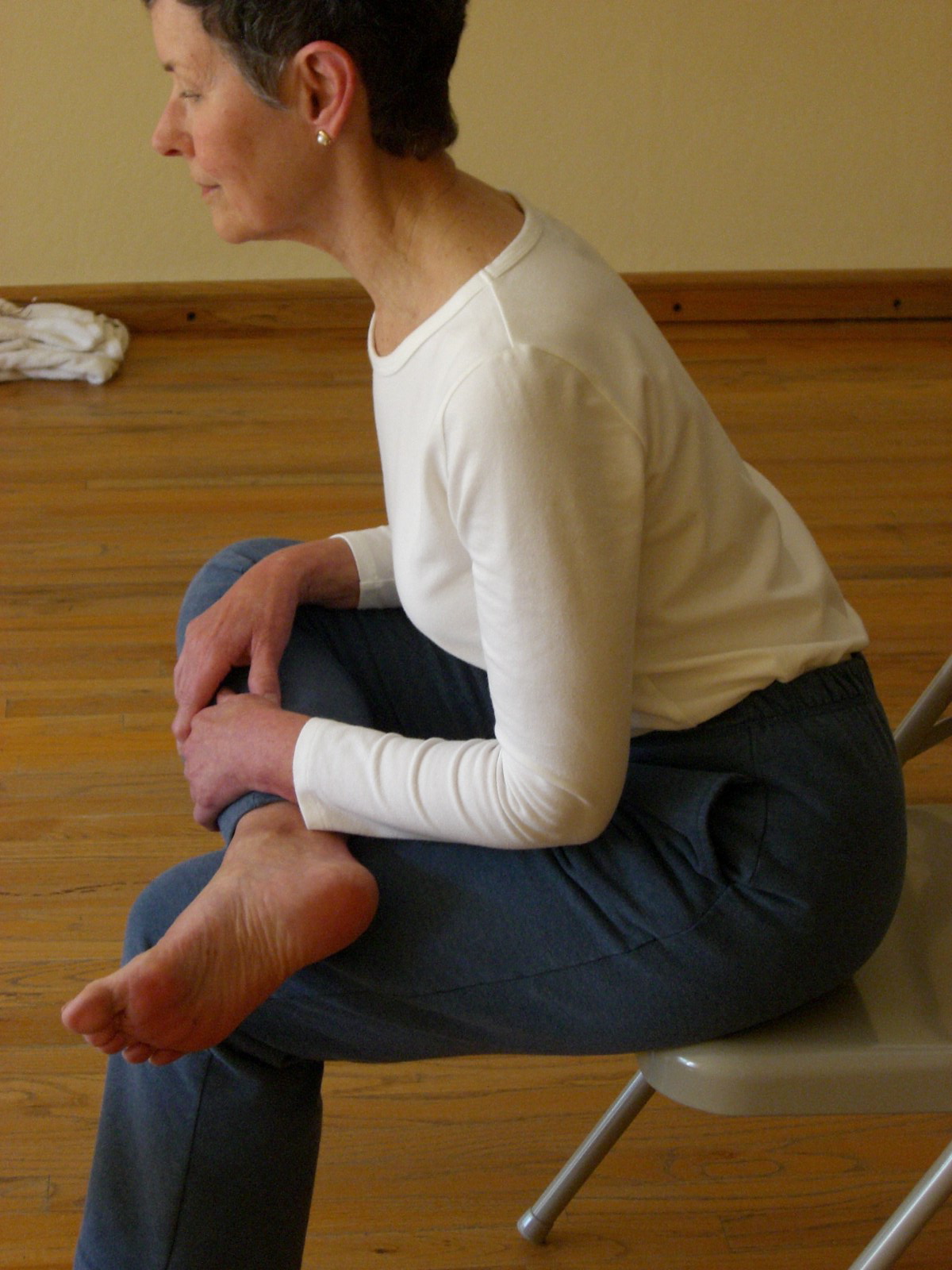
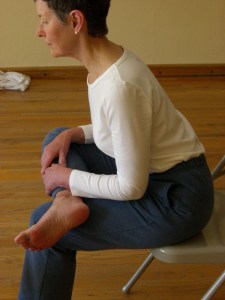
Piriformis Stretch:

  • Cross right ankle over left knee
  • Sit close to the edge of the chair
  • Hinge gently from the hip
  • The sensation should be in right hip
  • Repeat on left side

Seated Back Bend:

  • With your hips toward the edge of the chair place your hands on the seat of the chair behind the hips
  • Lift through the sternum
  • Think less about bending the lower back and more about opening the front of the body

Seated Twist:

  • Place your right hand on the left leg, left hand behind left hip, twisting to your left on the exhalation.
  • Breath in – lengthen the torso.
  • Exhale and settle into the twist.
  • Repeat on the other side.

Seated Forward Fold:

  • Sit toward the edge of the chair with your feet wide
  • Allow the spine to round forward until your upper torso is folded forward between your thighs
  • Hold for a few breaths and then inhale and curl up slowly

Standing

Standing Stretch with Flat Back:  Use the edge of your desk or the wall.  Stand about three feet away and hinge at the hips.  Let your hands rest on the desk, arms extended and legs perpendicular to the floor.

  • Bend right knee and drop right hip for stretch in left hip
  • Bend left knee and drop left hip for stretch in right hip

A standing stretch with a flat back is a great stretch for any time of day, anywhere. It’s particularly good if you’ve been standing all day – it brings a lightness to the feet and legs.

Wall Stretch:

  • Keep right foot about twelve inches from desk
  • Step left foot back about three feet
  • Hinge at hips, keeping hips level.
  • Allow your hands to rest on the desk or a wall for stability

With the right foot forward this will wake up the right hamstring and left calf.

Repeat on left side.

Shoulders:

  • Standing with feet hip distance and the arms by your side, turn the palms out and inhale the arms up.  Extend the fingers toward the ceiling and, if it’s comfortable for your neck, look up between the hands.
  • Turn the palms out and exhale the arms by your side.
  • Repeat three to five times.

Ideally the Focus practice ends with 5-minutes of seated meditation,

quiet reflection or breath awareness.

“Relax Yourself to Sleep”

 Seated on Floor in Easy Cross Legs

Seated Spine Stretch*:

  • Sit in easy cross legs with your hands on your knees.
  • Inhale – lift the chest toward the ceiling.
  • Exhale – hollow out the front of the body and round the spine to stretch between the shoulder blades
  • Inhale – lift the chest toward the ceiling
  • Exhale – fold forward

You can do this for as many cycles as you wish. I suggest beginning with at least three.

Seated Twist*:

  • Bring the right hand to the left knee
  • Place the left hand behind the left hip
  • Inhale – lengthen the torso
  • Exhale – twist to the left

Take a few breaths to move into your full expression of the pose and then settle into the twist for a bit. Avoid “cranking” into the twist by using your arm strength to pull the torso.  Repeat on the other side.

Lateral Stretch*:

  • Place the right hand on the floor next to the hip and then walk the fingers out until you begin to lean to the right.
  • You’ll notice the left hip is lifting from the floor.
  • Inhale – Bring the left arm up and over until it’s arching over the head.
  • Exhale – Press through the heel of the right hand in order to encourage the left hip to move toward the floor
  • Repeat on other side.

Forward Fold:

  • We want this to be as gentle as possible as this practice is supposed to a “winding down from the day” practice.
  • Sit with your legs in front of you, feet and knees slightly apart
  • Place the bolster underneath the knees
  • Round the torso forward
  • If you need to, use your hands to help support the torso but know that this forward fold is heavy and relaxed as opposed to a forced struggle.  Make it as gentle as possible and just trust that the spine is going to become more and more giving with each practice.

Supine on Floor

 Alternate the Knees in the Chest – just like you do in the morning practice

Hamstring/Hip Stretch– TAKE YOUR TIME WITH THIS!

  • Place a strap at the ball of the right foot.
  • Extend the leg toward the ceiling, opening the back of the knee and stretching through the heel.
  • Extend the left leg along the floor.  Stretch through the heel and point the toes toward the ceiling.
  • Take the strap in the right hand and drop the leg out to the right, rotating from the hip so the toes of the right foot point toward the floor.
  • Continue to work the foot toward the head to stretch the inner thigh.
  • Bring the leg back up and take the strap into the left hand.
  • Drop the leg a few inches toward the left to stretch the outside of the thigh.
  • Repeat with the left leg.

Knees to Chest and Windshield Wiper

Rest quietly in Savasana for ten minutes.

I need to thank teacher Kelly McGonigal for the Seated Spine Stretch, Seated Twist and Lateral Stretch in the “Relax Yourself to Sleep” section.  I first learned those movements from her at Avalon Yoga Center in Palo Alto, California.