A Year at McGuffey’s: The Artist Statement

I love writing artist statements for other artists. I hate writing artist statements about my own work. It’s torture. How do I put into words the story I am wanting to tell through line and shape and form? How do I find the language to describe the process by which I chose a particular color? A specific texture? How can I describe what the work means to me when I’m not yet certain I know?

It’s not easy.

Visual art transcends the written word. Art is its own language. A language that is difficult to translate.

In the middle of July our Incubator group was tasked with writing personal artist statements for the McGuffey website. For the past few weeks I fought with mine. It finally came together yesterday. I submitted my three hundred and fifty nine words and hoped for the best. I tried to be concise and tried to avoid all the things I dislike about most artist statements. That being said, ‘ash of memory’ was a darling I could not kill. Here’s what I wrote:

Fail better. Samual Beckett’s words of advice are Mimm Patterson’s goal for her year as an Incubator Artist at McGuffey Art Center. Mimm, who moved from California to Crozet in 2022, is a mixed-media artist, writer and trauma-informed yoga therapist. She is also someone who knows failure. 

“In my thirties, before I moved to Ireland, I worked as an artist” she says. In the 1990’s Mimm was the quintessential struggling artist in the San Francisco Bay Area. “I survived but I didn’t thrive. I think I lacked the self-belief required to create from a place of authenticity. I wasn’t brave enough to be vulnerable. But now I possess a grounded sense of purpose and the tenacity that comes with decades of life experience. I won’t feel shattered if I fail. I’ll feel stronger knowing that I tried.”  

Mimm’s work is informed by the belief that truth is malleable. Once we understand that our own truth is unfixed – that it is determined by the perspective from which it is viewed – we are able to reconcile our past with our perception of the present. 

This concept is critical to her current work, an exploration of her family and the dark mark its ash of memory has left on Mimm like an inky fingerprint that can’t be washed away.

“In some ways my new work is a practice of self-study. When my mother and I reunited after twenty years of estrangement I learned my family’s history for the first time. When she passed in 2019 she left behind several thick volumes of photographs and documents dating back to the mid-nineteenth century. I am learning who I am and how I came to be through these images and the stories they tell.”

Over the next year she hopes to share those stories through a body of work that inspires connection and shines with clarity and resonance. 

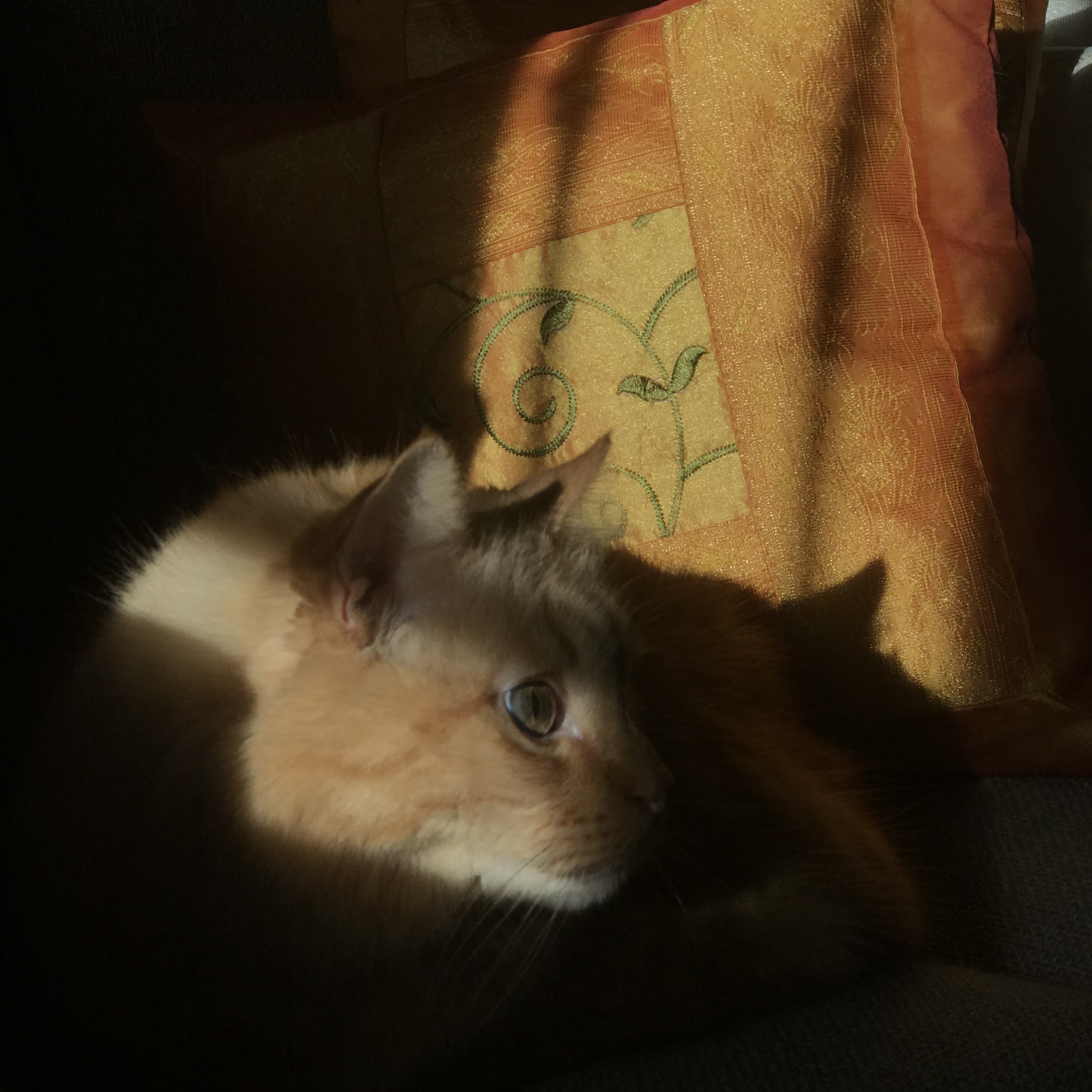
Mimm holds a BA in Studio Art and Education and a MFA in Transpersonal Psychology. She is an ICF certified coach as well as a SoulCollage® and Guided Autobiography facilitator. Mimm shares her new home in Crozet with her partner Ben and their twenty-year-old cat Bruce.


A Year at McGuffey’s Art Center: A Body of Work, Everyday Distractions and…Squirrel!

One of the distractions – a cuff bracelet made from the silk fabric Ben brought home from India.

When Ben returned from India in January, he brought with him half a suitcase of stunning silk remnants, trimmings and buttons. At the time I thought I might use the fabric and findings to make drawstring bags embellished with embroidery and beading. But I overestimated my machine sewing skillset and underestimated the difficulty in manipulating the slippery, fraying nature of silk. And so the fabric was neatly folded and stacked in a basket while I waited, frustrated and disappointed, for my ability to catch up to the demands of the material. 

Instead I satisfied my creative itch with coiled basketry and hand stitching. I made a few kumihimo braids and continued to play with image transfers. I tripped from one technique to another like a dog uncertain of which squirrel to chase. Yesterday I attended a fantastic  encaustic workshop with Karen Eide at McGuffey Art Center and I’m considering an online weaving course through Fiber Arts Takes Two with Harriet Goodall that begins in September.

All squirrels. Wonderful, fun, enlightening, creative squirrels. Squirrels that might be useful as I press forward. Or they might sploot and cool down my fevered creative energy. If there was a way to ignore the squirrels – the distractions – in order to stay focused, less impulsive and more intentional I don’t know it it would be useful. Maybe the distractions are good – even the splooting squirrel distractions.

But over the next eleven months, as one of six Incubator Artists at McGuffey’s, I need to create a cohesive body of work as part of our final group exhibit in June 2024. With that in mind, do I need to stop chasing squirrels?

An encaustic collage created with Karen Eide’s guidance over the weekend.

An artist’s body of work traces in color, form, line and texture the artist’s creative journey. Piet Mondrian is a good example. You know him for his iconic red, yellow and white grid paintings. Maybe his Broadway Boogie Woogie. But look at his earliest paintings of trees. Or his gingerpot. And we begin to see the process. The conviction. The exploring and the questioning.

An artist’s body of work can also be a gathering together of color, form, line and texture that contains the artist’s creative response to a chosen theme, specific experience or period of time. A reflection of sorts. An epilogue. Kansas City artist Mark Kielkulki is a good example. His works on paper are grouped almost as chapters in the story of his painting life. At the same time, when you look at his overall body of work, no matter how many themes he chooses to explore, there are underlying motifs that speak to isolation, Wes Anderson-esque oddities and shifting perspectives.

Thirty years ago I created a series of manipulated photographs based on Milan Kundera’s The Unbearable Lightness of Being. Later I created another series featuring Jim Morrison of The Doors and the Fourteen Stations of the Cross. I was young and cocky, insecure and envious. I was in a race against time and a duel to the death with every other young artist. I was desperate to look the part of the artist, more interested in the external experience and eager to provoke. I’m grateful that, as far as I know, this work no longer exists. 

Because this time around feels different. I want my body of work to evoke. Not provoke. I don’t care what I look like and I’m eager to encourage rather than envy the five other much younger women who are will be my studio-mates at McGuffey’s this year.

I’m looking inward, not outward, this time. Maybe that’s why I should embrace the squirrels who come along to distract me. They offer me moments of peace. Of reflection. They give me space to consider the story I want to tell in the body of work I am creating.


A Year at McGuffey’s: My New Tribe

Ben and I are days away from our first anniversary in Virginia. We’ve been here for one full tour around the sun. And yet I’m still settling. Still moving furniture around. Still figuring out the best cabinet for our pots and pans. Still looking for connection. For my Virginia tribe and community.

The final decade of the California life I left behind changed my destiny in ways I couldn’t imagine. It made this move possible. I met my beloved Ben and adopted my beloved feline Bruce. I cyber-stalked John Berg until he invited me to teach at Samyama. And it’s there I matured as a teacher and as a human. It’s there that I found a family of friends. A group of like-minded souls. We laugh together, commiserate together and attempt to navigate the journey of life and the practice of yoga one ardha chandrasana at a time.

And somehow, through births, deaths, illnesses, weddings, divorces, menopause, high school graduations, moves not only across the country but to the other side of the world, our community holds itself together. We even made it through a pandemic that put our lives on hold. Thank goodness for technology because it helped us navigate COVID. The shutdown is history and yet we are still signing in to Zoom and still showing up for ourselves and for one another three days a week to share asana practice. It blows my mind. 

In some ways the strength of my California Tribe makes finding connection here in Virginia less important. In some ways it makes finding connection here more difficult. Why make the effort when everyone I care about is one text, one email or one Zoom click away? Do I even need a new tribe? A new community? And if the answer to that question is ‘yes’ does it mean I need to surrender the community I already have or can the two co-exist?

We create community to build social connection. To know that we belong somewhere. Our tribe anchors us to the place where we began and at the same time supports us when it is time to take flight. We need community in order to find fulfillment within a group of individuals with whom we share similar attitudes, values and aspirations.

And so – yes – I need to find community here, in Virginia. And also – yes – it can coexist with the community that I love in California and to which I already belong.

I knew the move to Virginia would afford me more time to breathe life back into my artist self and reacquainting myself with her has been revelatory. I didn’t know how much I missed being able to tell my story through a visual medium. But isn’t creating art a solitary practice? Where does an artist go to find her tribe?

One morning in late March while searching for something else on the internet (isn’t always that way?) I found McGuffey Art Center’s Incubator Program. McGuffey’s has been thriving in an old brick school leased from the City of Charlottesville and a few blocks from the city’s famed pedestrian mall since the 1970’s. The Incubator Program, now in its ninth year, offers emerging artists shared studio space at a reduced rate while supporting their growth as artists through exhibitions, networking and education. The morning I found McGuffey’s I also discovered that applications for the 2023-2024 Incubator Program were due that weekend. I didn’t waste any time and without overthinking or second guessing myself I submitted an application.

I’ll be picking up the keys to my studio this weekend. It’s a very competitive program and I am proud to say that I am one of six artists chosen.

Does this mean that I’ve found a new tribe? We’ll find out.


Delicious

This week marked the start of our first Guided Autobiography session of 2023. Our first theme? Delicious.

It’s my grandmother’s kitchen that I remember. 

Pastel drawing by the wonderful Lewis Silvers.

My grandmother, Pauline Barber Roth, was a good grandmother. That being said, Pauline hated my grandfather, her husband Robert, with whom she bickered on a daily basis. One could also assume Pauline hated her only child Barbara, my mother, with whom she shared the burden of my grandfather’s protracted illness and death and on whom Pauline counted after her tender, overworked knees could no longer carry the weight of her very short, very rotund body. What might be closer to the truth, however,  is that rather than hating her child, it was the circumstances of Barbara’s life that Pauline hated. Because once Barbara discovered that the curves of her body were her currency, she used her hips and breasts and thighs to purchase what she thought she wanted in a way that startled and embarrassed Pauline’s Christian sensibilities; that muffled Pauline’s compassion for her daughter like a too-long steamed Christmas pudding wrapped in tight swaths of wet, sticky cheesecloth and kitchen string.

My grandmother Pauline loved her church, which was the Trinity United Church of Christ on the corner of Linden Street in Allentown, Pennsylvania. The century old brick church had a steeple and real bells – not pre-recorded – and steps leading parishioners to two over-sized bright red doors that opened not to heaven but to a dark vestibule and then into the church’s dusty, Shalimar soaked sanctuary. Trinity United Church of Christ was one city block from Pauline’s narrow, two-story row home at 123 Poplar Street and it didn’t matter if her faith was real or imagined – Pauline waddled to the church in search of communion with God every Sunday morning. Quite often her youngest grandchild, whom Pauline also loved, skipped by her side. That grandchild was me.

Pauline demonstrated her love for me by keeping me very well fed. When I visited for the weekend – which happened quite often because my parents’ country band had weekend gigs in bars throughout the greater Lehigh Valley – she made sure to have tins of my favorite lace cookies baked to soft perfection. Or maybe tollhouse cookies made with M&Ms instead of chocolate chips. In the autumn we melted Kraft caramels over a double boiler and shoved popsicle sticks into apples to candy them. In spring, before Easter, we rolled coconut cream confections into thumb-sized egg shapes and dipped them into dark chocolate. And in mid-winter we mashed left over boiled potatoes with powdered sugar to make a dough. We rolled the dough into a thin and narrow rectangle on Saran Wrap stretched across grandma’s oilskin table cloth. After that a thick layer of Skippy Peanut Butter was spread on top of the potato dough which was then shaped into a long cigar and sliced into little pinwheel bites of sweet goodness. 

There is no question as to how I came to have such an insatiable sweet tooth.

More than the sweets, however, my grandma prepared for me lunches and dinners that make my mouth water almost sixty years later.

After the walk home from church, opening the screen door from the back porch into the kitchen guaranteed being met by the steamy aroma of pork loin in the pressure cooker. Sunday dinner was almost always pork loin served with sauerkraut, mashed potatoes, and a side salad made of English cucumber sliced paper thin, white onion sliced the same and dressed in nothing more than vinegar and a shake of black pepper.

But it was Saturday lunch that I loved the most. That was when I asked for anything I wanted and I only ever wanted  two things: either a minute steak sandwich or a bacon, lettuce and tomato sandwich. 

Minute steaks are very thin and lean and prone to being overcooked but with my grandma as chef that never happens. While I sit at her kitchen table reading Archie comics she begins by frying onions in her cast iron pan until they are brown and crisp around the edges. As they finish she pushes them aside with her spatula and adds the steaks. In the few minutes it takes for the meat to brown she pulls a bun from under the broiler that has been toasting open faced and dresses it with horseradish and ketchup that has been mixed together in a bowl. She layers one half of the onions, a thin slice of provolone cheese, the warm minute steaks, another slice of cheese and more onion then closes the sandwich, slices it on the diagonal and sets it on a plate in front of me with a small glass of 7-Up. The horseradish and ketchup make my mouth pucker. The cheese has melted and pulls away in strings when I take a bite. Juice from the steak  and greasy onions runs between my fingers. There’s nothing better. Nothing.

On warm and humid summer days I lean toward tomato, bacon and lettuce sandwiches. Grandma makes hers with three slices of toasted white Wonder Bread, a slather of Miracle Whip on each one, crisp iceberg lettuce from the fridge, tomatoes that taste like the sun and strips of bacon fried so they are neither too soft and fatty nor too stiff and crackling. She cuts the sandwich into quarters and pierces each quarter with a toothpick to hold everything together. The dance of warm, salty bacon, acid from the tomato, tart mayonnaise and cool, sweet lettuce is a level of deliciousness that my young mind can’t comprehend or put into words.

If I had known that my last weekend at my grandma’s house was going to be my last, or that the last lace cookie in the tin was the very last lace cookie, or that I would never be able to master Grandma Pauline’s pork loin or corn pie or potato candy or BLT I might have paid more attention. But a child doesn’t know about paying attention, or that things end. Besides, it never feels final, those last times together in the kitchen. Looking back I can see it was more like a slow fading away. 


Journaling Does Not Require Washi Tape

It’s the cusp of 2023 and the algorithms know me too well. They know that this is the time of year when I demonstrate a personal weakness. The time of year when I will spend hours if not days searching for the journal and calendar that will change my life. The algorithms have logged my clicks and so now, as the year races towards its end, photo essays of the hike you took with your family or that tearful video of the little boy receiving a puppy for his birthday are being replaced by scrolls of ecstatic people thrilled that what they hold in their arms is the journal that will fuel their productivity and help them become the version of themselves that they see in their mind’s eye. Over the years these journals have seduced me with their assurance that in exchange for my hard-earned $39.95 plus shipping and handling they’ll send me the key to achieving all my goals. All I need is a few rolls of washi tape and a dozen fine point markers in rainbow colors. 

I spent the first half of 2022 packing for our move and what I found in the dusty recesses of our storage locker were half-a-decade’s worth of Bullet*, Wellness, Productivity and Law of Attraction journals in various sizes, colors and bindings. Most began the year that I acquired them on solid footing but by late February were abandoned like a New Year’s Resolution that made little sense in the first place.

The lesson that I had to learn – that I finally learned – is that these pseudo-magical journals are nothing more than spiral-bound sheets of paper with calendar dates, faint horizontal lines and the occasional affirmation or Mary Oliver quote printed in pretty pastels and sandwiched between jewel-toned embossed vegan leather. They are nothing more than little naked emperors ruling kingdoms of dreamers.

It turns out that all the color-coding and tracking and planning and washi-taping takes too much time. I mean it really takes time. Time that might be better spent doing what we want to do rather than doodling about what we want to do.

This doesn’t mean writing down our dreams and goals and aspirations is a bad thing. It isn’t. Journaling is a contemplative act. With practice and commitment it becomes a ritual that supports our mental health by helping us to process our past, shift our perspective and plan for our future. Writing down the vision of the life we see for ourselves is like drawing the road map that will lead us to our destination. Even as the vision we have for ourselves morphs and changes. Even as we are blocked by obstacles and dead ends. Journaling is a way of discovering how to navigate through unexpected difficulties. Keeping track of the goals we aspire to and the steps that will take us to those goals holds us accountable. It also provides that clarity we need to determine when our set goals no longer have heart and meaning. Seeing the seven days of the week laid out before us reminds us to take time for self care. To make certain we’ve given thought to holding sacred the present moment and the relationships we have with others that mean so much.

But don’t let any slick online advertisement convince you that it’s their product that provides the one true way of journaling, increasing productivity or keeping track of what day of the week it is. If you believe that putting pen to paper will bring clarity to your intentions then what you need is simple. You need a pen, some paper and some time alone.

And so…

I pull out a notebook and my favorite ultra fine point pen and write ‘2023’ at the top of the first page. I begin to think about this new group of twelve months we launch in a few hours. I don’t want to write a list of resolutions. But I need to put down on paper a written sketch of sorts for my life in 2023. I decide a theme for the year will provide focus and without too much hesitation choose, ‘grounded wellness’. What that means is allowed to unfold as the new year progresses. What is your theme for this coming year?

I divide my life into four quarters: health, wealth, my creative heart and my loving heart. If you divided your life into four quarters what would that look like? In each quarter I take note of what is important to me…fitness…writing a will and health directive…committing to the art workshops I’ve enrolled in as an act of self-care…building and maintaining community…being open to love and friendship…remembering that I am a good person doing my best. What’s important to you?

When I finish I have a broad list of objectives to complete that need to be set in stone and ideas to embrace that are more fluid.

On the next page I write, ‘Practical Goals for 2023’ because I’m nothing if not practical. These goals are a list of ‘action items’ for the year. A breakdown of the objectives and ideas that I was able to determine for the four quarters of my life. This list is a cross between a guideline and a series of goal posts. If I want to create, if I want to write and if I want to continue to teach yoga with any small amount of success then the action items on this list need to happen. Do you have a list of ‘action items’ that you want to see complete?

But it’s all a bit overwhelming. So I break it down even further, until everything is bite-sized. Until everything feels doable. If there’s something you’re stuck on, what can you do to break it into bite sized chunks?

From here it’s easy to find order and clarity. I write the word ‘January’ at the top of the next page and ask myself, ‘what needs to be done?’.

What needs to be done? What do I need to do in order to move forward in my life in a way that is profound, life affirming, celebratory and self-actualizing? What do I need to do in order to be a positive force in the world?

And to think I did it all without spending $39.95 plus shipping and handling! With no washi tape! No color coordinating! Venting about algorithms in this post took WAY longer than creating my 2023 Journal. We’ll see how it’s all working for me in February but I have high hopes.

In the meantime, I’m wishing all of you a very happy 2023. May you find heart and meaning in all that you do.

*full disclosure: I actually appreciate and still employ some of the organizational tips learned during my ‘Bullet Journaling’ phase…


Tell Your Joyful Story

Our experiences shape us. Define who we are. Our experiences influence our perspective on life. And the stories we keep of these experiences are important to share. Sharing stories from our life with others builds deep connections that otherwise may have never been made.

That’s what drew me to Guided Autobiography (GAB) and that’s why I lead 6-week Guided Autobiography workshops four times a year.

But there’s a problem with Guided Autobiography. The themes we are presented with more often than not lead us to explore in 800 words or less moments that are sad or heartbreaking. And while sharing our heartbreak helps us to process the event that caused our heartbreak, for our September session of Guided Autobiography I’ve decided we’re going to take a different approach.

We’re going to process our moments of joy. Because those moments, too, shape our perspective on life. Our next GAB workshop will offer themes that encourage us to recall experiences that made us happy. That brought us joy. Experiences that surprised us with a positive outcome.

There are a few spaces left in our Guided Autobiography: Lean into Joy workshop. The workshop begins on Thursday, September 15th from 2-3:30 PM PT/5-6:30 PM ET. Registration is as simple as an email. Tuition is on a sliding scale between $60-$120. Once I receive payment via check or PayPal you’ll receive GAB’s Zoom link.

Our past is filled with profound experiences that shaped us into the people we are today. Isn’t it time to remember the joyful ones?

A short video we more details about Guided Autobiography plus one of my essays written for GAB.

Finding Awe

There’s a wooded area across the street from our kitchen door. I like to stand on the patio while the coffee brews in the morning, or in the evening after dinner, to see if the deer have arrived. They like to eat the grass and weeds that surround a small pond and I love to watch. I hope I never stop being delighted when I see them.

Annular Eclipse, Pyramid Lake, Nevada 2012

One evening last week when I stepped outside to look for the mother deer and her fawn, the sound of cicadas and croaking frogs was so loud I called Ben to listen with me. It sounded like a symphony of bugs and amphibians tuning their instruments before a concert. I hope I never grow accustomed to their music.

There are bats where we live. On our first week here we saw dozens over our house. They were dining on flying insects and then dancing through the sky to find their next juicy mortal. We haven’t seen that many at once since, but now and again I’ll see one or two grabbing a snack. It surprises me every time. I hope seeing a bat in the sky above my house never stops surprising me.

These experiences create a sense of wonderment and awe in me. And for that I’m grateful because sometimes it feels like we’ve lost our ability to be awed. Sometimes it feels like we’re too distracted by the noise of the world or too jaded by the onslaught of constant information to find time for quiet moments of awe.

But these moments of awe are beneficial to our well being. The sense of awe we feel when we’re gazing at a star filled sky, for instance, or witnessing an eclipse, creates in us a sense of ‘small self’ and deepens our sense of connection with others.

What experiences elicit awe in you?


Neurographic Drawing

At the start of the year I set the intention of building a writing practice that would allow me to post every two weeks. I created a spread sheet of topics around these obvious themes: yoga, coaching and craft. I hoped I would have the strength and energy (and the technical prowess) to have a brief video accompany the posts I wrote about aspects of our yoga practice. I managed one video, but my posts over the past six months have been consistent. Not what I intended, but consistent. Until now.

Writing, like yoga or art, is a practice that requires our presence. We have to show up. And I find it difficult to show up for writing practice when my brain is full. And right now my brain is full. My beloved and I are three weeks away from a major life transition – our move to the ‘other coast’. Our home has become a storage unit filled with boxes and I’m obsessed with worry about how Bruce – our amazing, elderly, deaf ginger cat – will manage the flight to Virginia and how he will adjust to a new home. There are so many details that need to be attended to that there is no room in my brain for putting words down on a page.

And don’t even mention my preoccupation with…well…everything else.

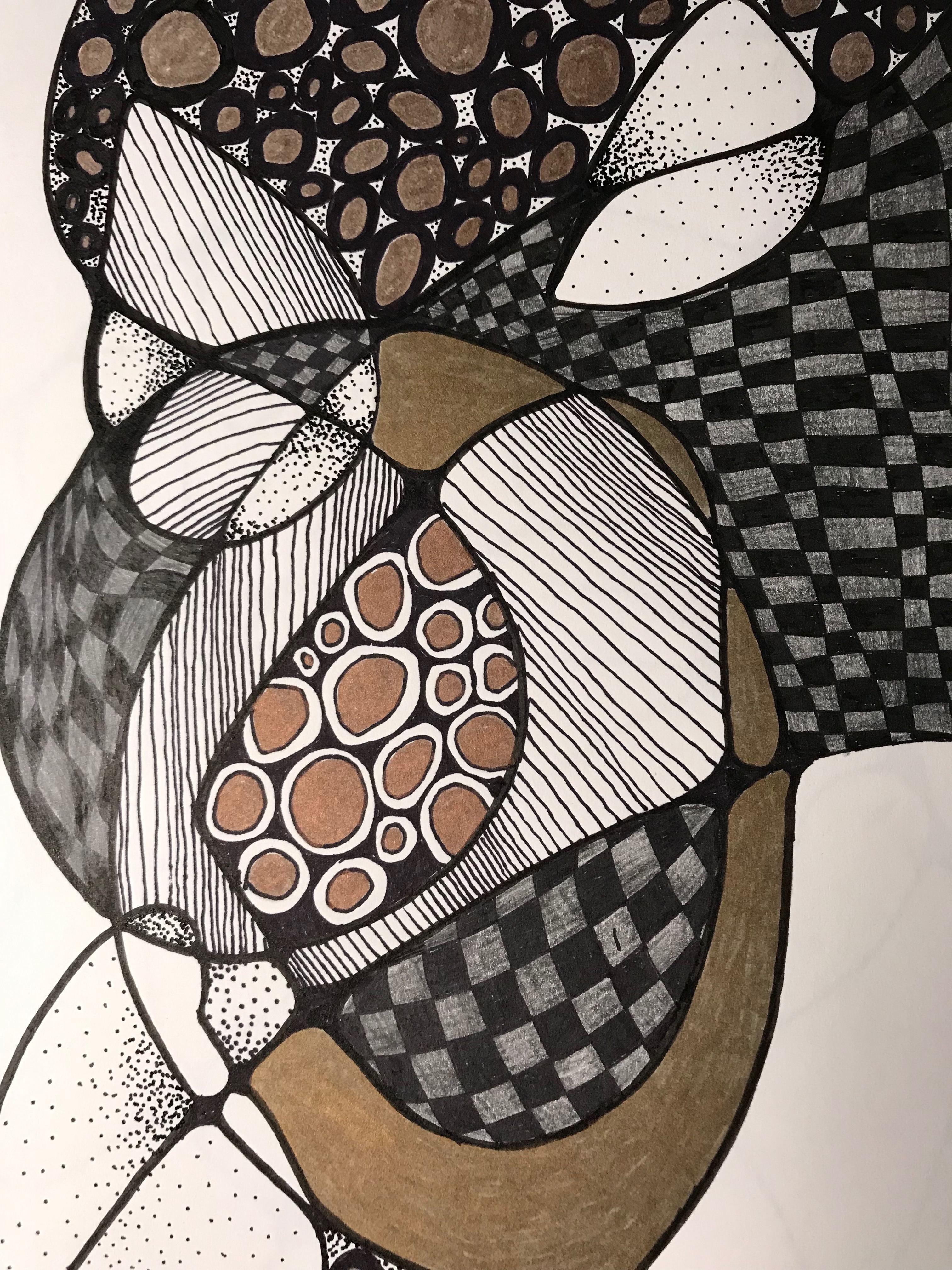
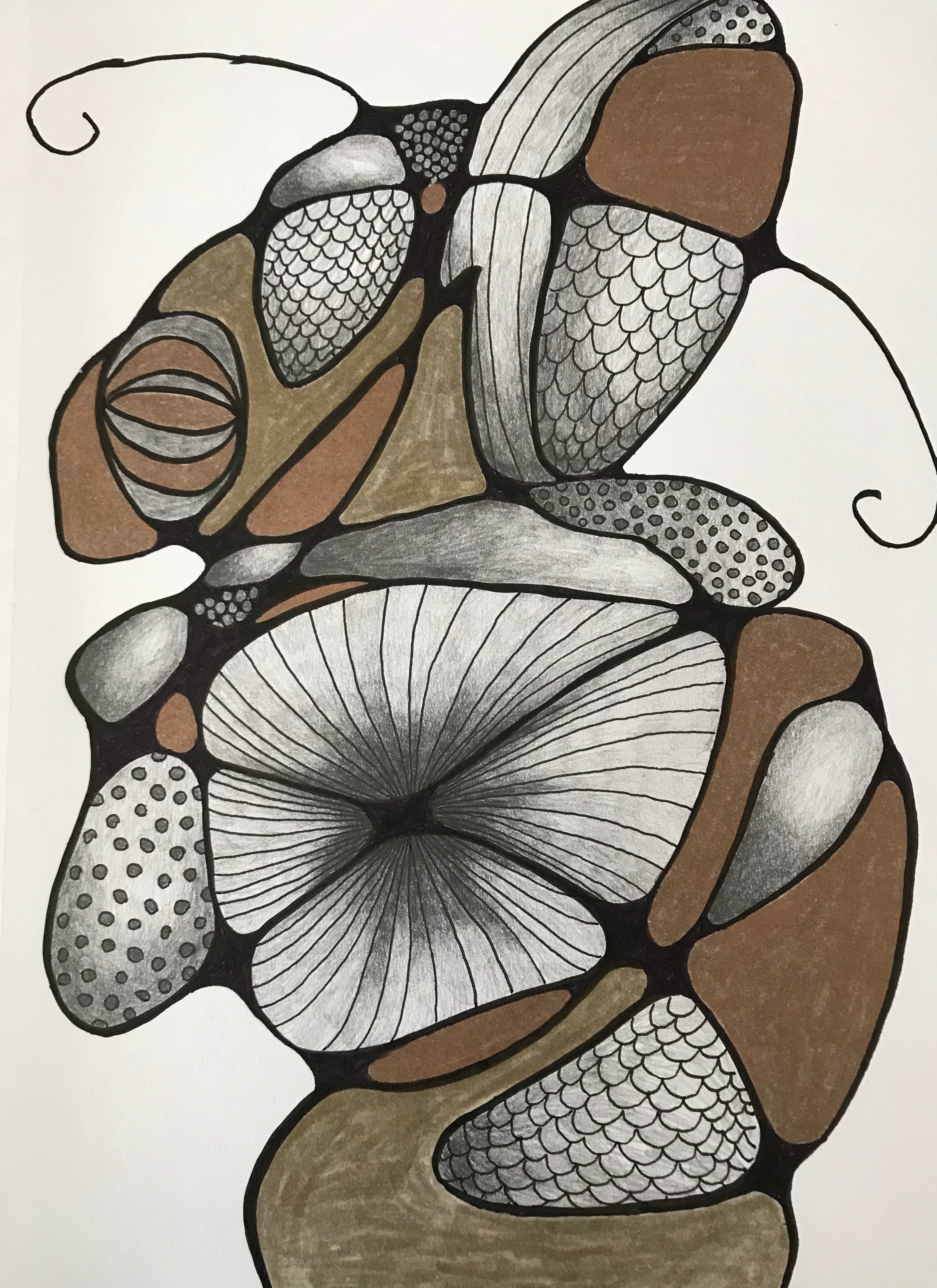
And so I’ve decided to draw. My art supplies are packed and so all I have to work with are a few sharpies and a mechanical pencil. But that’s all I need for neurographic drawing. The technique, a distant cousin to SoulCollage®, begins with just a thought. A quiet thought, a few shapes and a single line. So simple and yet it doesn’t take long before my energy settles. The jumbled words and racing thoughts become quiet, and I’m lost in the shapes I’ve drawn. I’m lost in the moment, which is a nice place to rest.


I’m a Coach. Don’t Roll Your Eyes.

When I began my training with International Coach Academy (ICA) at the beginning of the pandemic (and isn’t it odd how we now tell time according to COVID?) we were asked to find peer coaches with whom we would practice our developing skills. One of my peer coaches – who I’ll name Jane – was close to graduating from the sixteen-month program. I found Jane’s coaching prowess intimidating. She possessed limitless self-belief and her blinding confidence glowed like a pulsating aura. What Jane lacked was empathy. She didn’t notice that my habit of comedic self-deprecation is the tactic I use to disguise my fear of failure. It was both her loss and mine.

Before my peer coaching relationship with Jane began, I believed coaching was easy. I had no doubt that I was going to sail through ICA’s intensive program without breaking a sweat. But the opposite was proving true. Coaching is a skill that takes practice and dedication to master and I was struggling. Jane was blind to my struggle. When she told me that 80% of the individuals who graduate from a coaching program never become professional coaches, she didn’t see the movie reel of my life as a coach burst into flames. She couldn’t know that the committee in my head, my little saboteurs that run around with needles to poke holes in my hopes and dreams, never once thought to tell me I could be in the 20% who succeed. And so, when I graduated from ICA I didn’t shout my achievement from the rooftops. It was more of a whisper. And these days, despite my excellent training, I use my coaching skills on the sly. No one even notices. What a shame.

Newly minted coaches are encouraged to practice with peer coaches. I have two that I see on a regular basis. We use our time together to refine our skills and to share experiences. Most recently we’ve been trying to determine why, as bright and well trained individuals, we find it so difficult to ‘sell’ our services.

Part of our struggle is found in the knowledge that, like yoga, life coaching is an unregulated industry. And although coaches have a strong governing body – the International Coaching Federation – for there is no incentive to jump over the many rigorous hoops required to earn accreditation through the ICF when the truth is that anyone who attends a weekend long ‘coach training’ workshop can then hang out a shingle. For that reason, if you are interested in finding a coach, it’s important to review their qualifications in the same way that you might want to know how long your yoga instructor has been practicing and where she did her teacher training.

Another industry problem is the myth that working with a life coach is a luxury only the self-indulgent can afford. While it’s true that some coaches bill at a rate per hour that is so high as to be offensive, others offer their services on a sliding scale or are willing to negotiate payment options. 

Some parts of the health and wellness industry view the coaching industry as nothing more than an interloper riding the coattails of licensed mental health professionals. But coaching is not therapy. Coaching does not examine the past. It begins in the present moment and builds a scaffolding of accountability and action to support the client’s journey forward. It is a grounding, effective technique with which we can navigate and overcome the obstacles that prevent us from achieving our goals and living by values that, for us, carry heart and meaning. Coaching shifts perspective. It helps us to become ‘unstuck’. 

As a coach, I facilitate your journey toward the clarity required to find all the possible paths that will lead you to the future you envision. I create space for you to uncover and to shift the long held limiting beliefs that prevent you from bringing your best self fully into focus.

Coaching is client led. The relationship can be thought of like this: 

Imagine you and I are on a road trip together. I’m your coach, sitting in the passenger seat. You are behind the wheel. You are choosing the destination and the road we’ll take to get there. Along the way you might discover a different road and maybe even a different destination. My job is to help you find your way around roadblocks and to navigate detours. I help you determine for yourself if the choices you are making and the journey you are creating are coming from a place of authenticity aligned with who you are and who you hope to be.

There was a time when I reacted to the words ‘life coach’ with a Pavlovian eye roll – even when becoming a coach was tickling my intuitive heart. Now I understand how coaching works. I understand the skill and the techniques involved. I’ve experienced coaching’s magic. The way it can bring lost ambitions, goals and values back into focus.

Have you lost focus? Do you feel stuck? If you have an important decision to make or a habit you would either like to break or create – let a coach climb into the passenger seat. You’ll be happy you did.

International Coaching Week is happening soon. What better time to try coaching?


New Guided Autobiography Series

I never know where to begin when it’s time to write about Guided Autobiography. I always want to let you know that it’s not a writing class – even though each week you’ll be writing. And I always want to describe the impact Guided Autobiography has on those who join – but it’s difficult to find the words. 

Guided Autobiography, I guess, is about processing. It’s about looking at the events of our lives. It’s about finding again those lost experiences that may have been the catalyst for profound change in our lives. 

And it’s about sharing those moments. Which is the best thing about Guided Autobiography – the friendships that are deepened and made all the more rich as we learn from one another’s stories.

Our Guided Autobiography meetings follow the same format each week: 

  • We begin with a check-in – a casual chat about the successes and the struggles we endured or celebrated during our writing week. This typically involves howls of laughter.
  • As our check-in winds down I introduce the writing theme for the following week. James Birrin developed his Guided Autobiography program around twelve life themes and the questions that accompany each theme as a means to stimulate our memory. When I was a fledgling GAB facilitator I followed those themes and questions to the letter. But as I gained confidence I did what most GAB facilitators do and developed my own themes and questions. Themes can run the gamut from how we developed trust in ourself or others, moments in our lives that became turning points, or the experiences we’ve had around failure or loss.
  • After the theme is introduced I offer a five minute break but no one ever wants to take a break so we jump right into reading.
  • The essays we write are about 800 words – two pages. And it’s important that we try our best to keep to this limit. Once read, as a group we don’t offer a critique of the writing. What we offer instead is encouragement and support. We might ask questions to know more details in the story. On more than one occasion tears have been shed by all of us.
  • When we have finished our readings we close the class with a final discussion about the following week’s theme.

And that, for the curious, is Guided Autobiography in a nutshell.

Our next 6-week Guided Autobiography session begins Thursday, March 31st at 2:00 PM.

Tuition is on a sliding scale from $60-$120, payable through PayPal.

To register, a simple email will do.

Once I receive payment you’ll receive our Zoom invite.

Class size is small – no fewer than four, no more than eight.