Day One. Reading, Writing and Meditation

I’ll be the first to admit that I lean a bit toward the odd.  In a good way I hope, but still.  I allowed myself one last moment with Jimmy Fallon (“I Gotta Have More Cowbell!”) and then broke the news to Hulu:

“I think I need a break.”

“Did I do something wrong?”

“No, Hulu – it’s not you.  It’s me.”

“You want to spend more time with Facebook, don’t you?  I know the two of you are tweeting.”

“No – that’s not it at all, Hulu!  It’s just that…well…it’s just that I want to…”

“You want to what?  Go on, Mimm.  Tell me.”

“I want to read.”

“What do you mean you want to read?”

“You know.  Books.”

“Is this a joke?”

“No, Hulu, it’s true.  I want to read books. I have a goal.  Eight books in six weeks.”

“Don’t make me laugh.  You’ll never do it.  Two days from now when the latest episode of Glee is available you’ll come crawling back.”

“I don’t think so, Hulu.  Not this time.”

At that point I said good night.  I thought I heard a sniffle as I closed the laptop, and then I set my alarm, rolled to my side and went to sleep.

Today I determined that all eight books amounted to about 2300 pages.  I have thirty-six days to make it from cover to cover on all of them.  That means reading at least sixty-three pages per day.  No problem.  I hope.

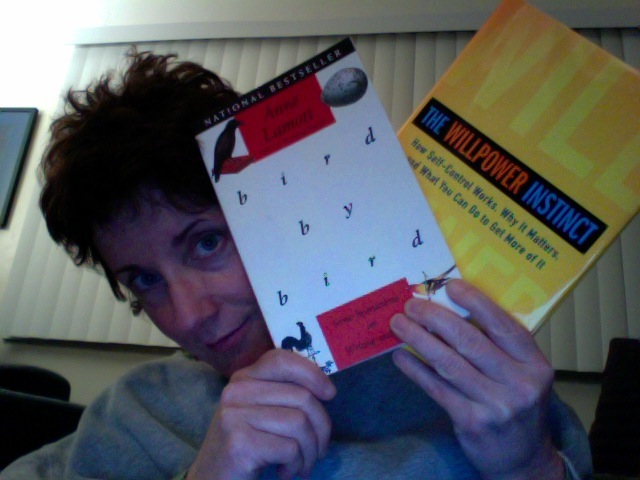
I’ve begun with Kelly McGonigal’s The Willpower Instinct.  Even though I had dipped into the book earlier, I decided to begin at the beginning.  Here’s what I discovered today:

It turns out my recent commitment to meditation is doing more than creating a calmer Mimmsy.  Meditation is helping my brain to build grey matter in the prefrontal cortex and other regions of the brain that support self-awareness.  In other words, my meditation practice strengthens my will power and bolsters any skill that involves self-control.  Like reading.

In addition to Kelly’s book I’ve decided to read a chapter per day of Bird by Bird, the wonderful book about our writing life by Anne Lamott.  Today I read the introduction.  I’ll leave you with a Wendell Berry poem, The Wild Rose.  Written for his wife but used by Anne to describe how writing feels to her sometimes – like a person – “the person who,” Anne writes, “after all these years, still makes sense to me.”

Sometimes hidden from me

in daily custom and in trust,

so that I live by you unaware

as by the beating of my heart,

Suddenly you flare in my sight,

a wild rose blooming a the edge

of thicket, grace and light

where yesterday was only shade,

And once again I am blessed, choosing

again what I chose before.


The Buzzy Challenge (or how I plan to conquer my addiction to Hulu)

It pains me to confess the following:  Until I cancelled my Comcast cable bundle and handed over my television to Goodwill Industries I was guilty of watching, on average, twenty-one hours of television per week.  Three hours each day.  Every day.

What on earth was I doing?  That’s an easy one to answer.  I was anesthetizing myself.

When I emerged from my cathode-ray-tube-induced-coma last September I had every intention of using the extra twenty-one hours I had given myself to write the next great bestseller while training for a marathon in between playing live sets at Angelica’s in Redwood City.

So far none of that has happened.  But it’s not all bad news.  I’ve spent more time nurturing my creative side with the found object assemblage work I love.  I attend a yoga class on an almost regular basis.  I dance more and of course there’s the meditation practice.

But what about the other ten hours?

Unfortunately, I’ve discovered Hulu.

It began innocently enough with a few Jon Stewart clips.  That led to an unquenchable yearning for Jimmy Fallon musical numbers (did you see him and Bruce sing “Whip My Hair”???)  Jimmy, of course, was just one steep and slippery slope away from the latest episodes of Glee and then Parenthood and then Grey’s and now I’m even getting my geek on by watching the ultimate in brain candy – The Big Bang Theory.

I need an intervention.

I need a Buzzy Sherman Challenge.

Buzz and I worked for the Sunnyvale School District as well as the city’s Parks and Recreation Program in the early 1980’s.  Buzz was into self-improvement and since I thought he was the best thing since sliced bread, I was into self-improvement, too.  Buzz was the kind of guy who would take off for four days without telling anyone, ride his bike to Yosemite, return safe and act as if it was a perfectly natural thing to do.

We liked to hand one another challenges. When I began to jog for exercise he challenged me to take my mileage from twenty to thirty miles per week.  In exchange he would ride Highway 9 twice a week.  Another time he offered to read as many books as he could in one month if I became a vegetarian for the month.  Or maybe I had to give up chocolate.  It was so long ago I don’t remember.

They seem a little silly now but I loved our challenges.  I loved competing with myself and I loved being accountable to Buzzy.

But of course he and I lost track of one another decades ago and I traded my hard competitive edge for something more nurturing when I found Yoga.

Still, if it’s a challenge that’s required to keep myself from surfing Hulu (did I mention the birth of Bones’ baby is imminent?) then it’s a challenge I’ll set.

And here it is.

I’m going to take the next six weeks – give or take a few days – to read eight books.  I’ll begin with Kelly McGonigal’s new book The Willpower Instinct:  How Self-Control Works, Why it Matters and What You Can do to Get More of It.  The advice she offers may help me negotiate the next few thousand pages.  After that, and in no particular order, I’m going to read:

 The Gospel According to Zen – First published in 1970 the book is described as “an extraordinarily ecumenical collection of readings in the new consciousness of post-Christian man, with commentaries by Erich Fromm, DT Suzuki, Alan Watts, J. Krishnamurti and others.”

A Gate at the Stairs – A novel by Lorrie Moore.

Haslam’s Valley – A collection of short stories and essays by Gerald Haslam.

Anne Lamott’s Bird by Bird: Some Instructions on Writing and LifeWasn’t I supposed to read this…um…ten years ago?

The Emperor of All Maladies: A Biography of Cancer by Siddhartha Mukherjee.

Patti Smith’s biography about her life with Robert Mapplethorpe Just Kids.

Last but not least, Old Friend from Far Away.  This is Natalie Goldberg’s book on memoir writing.  I was going to read Writing Down the Bones but chose this one instead.

I think I have it all covered – fiction, non-fiction, short story, novel, essay, self-help, biography, philosophy. I’ve already dipped into The Emperor and Bird by Bird but both books have been buried in the pile by my bed for so long I may begin both again from page one and so don’t consider it cheating.

The challenge begins as soon as this is posted and the glass of wine is poured.  Wish me luck.


Negative Space

I’m captivated by negative space.

The space that isn’t the thing:  the blue between the branches of a bare winter tree, the angles drawn by a box of pencils spilled atop a desk, the shapes that fall between the shadows of a picket fence on a summer sidewalk.  Negative space.  The space that isn’t the thing.  The space that connects.

Sometimes it happens that during our yoga practice the asana becomes a single intention.  A shape to hold in passive static until we decide – or someone decides for us – that it is time to move.

This can happen if we’re practicing a slow flow or lightening quick vinyasa.   The shape becomes the goal.  There’s a rhythm and a reason for our wanting to be there. When I arrive at my full expression of the asana I’m practicing I’ve arrived at someplace familiar.  Someplace balanced.  Home.

But what about the negative space?  What about the space between the shapes our bodies sketch? What about the movements we create as we shift toward trikonasana or sirsasana? And what about the breaths we draw around that movement?  Shouldn’t the journey we take to create the asana be considered, too?

As you practice this week notice the negative space.  Connect with the space that isn’t the thing.


The Care and Feeding of Your Spirit

If you do anything for yourself this year, let it be that you give yourself just one thing.  I’m not talking about a new car or a pair of shoes.  I don’t mean a night out.

What I mean is this:  give yourself that one thing that feeds your spirit like nothing else can.  And give yourself that gift as often as possible.

If I ask you now, “What is that one thing?  What is the one thing that feeds your spirit?” Do you have an answer?  Do you know?

Back in the 1980’s when I lived in Mountain View a morning walk at Shoreline to watch burrowing owls warming themselves against the rocks as they faced the rising sun warmed me, too.  Those were the days when yoga was a simple asana practice – the days before I understood the depth of yoga.

I walked the path at Shoreline almost every day.  Early in the morning, before anyone else and while remnants of dawn still hung on the water.  But I needed to have a reason for being there or else I wouldn’t make the effort.  Fitness. Weight loss.  Exercise.  There had to be a reason.  A walk at Shoreline was something to tick off my “to do” list for the day.  Another chore.

And then I moved a few miles up the road, my work schedule changed, and walks at Shoreline became less frequent and were finally forgotten.

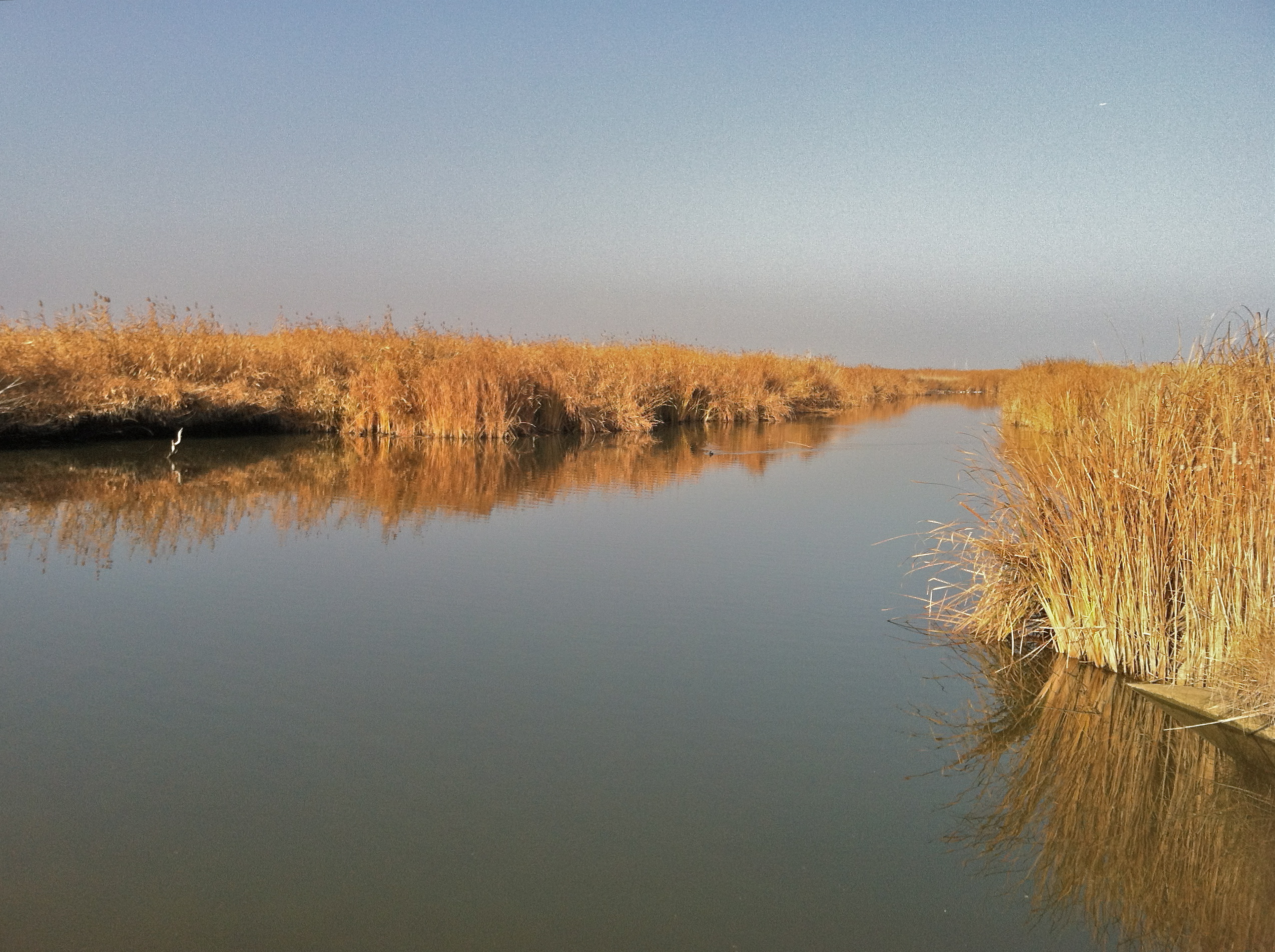
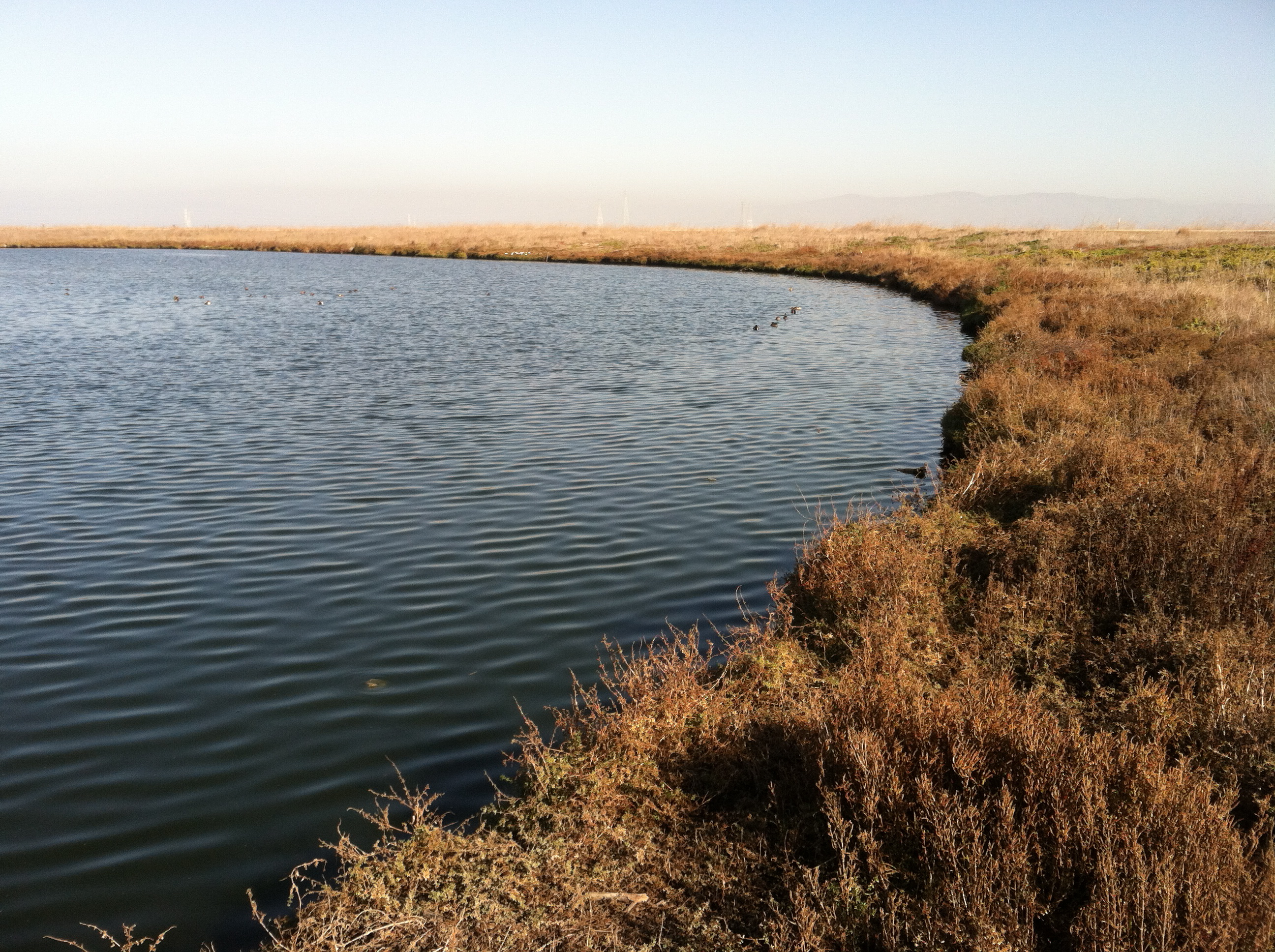
A few months ago I returned to Shoreline.  This time around it’s different.  I walk at Shoreline a two or three times each week because I walk at Shoreline.  That’s it.  My spirit feels embraced at Shoreline. The flat horizontal lines of the landscape and the calm water soothe me.  I feel nourished.  After a walk along water’s edge I’m ready to walk back into the remainder of my work day.

If you do anything for yourself today find that thing.  Find that one thing that feeds your spirit.


2011 in review

The WordPress.com stats helper monkeys prepared a 2011 annual report for this blog.

Here’s an excerpt:

A New York City subway train holds 1,200 people. This blog was viewed about 4,800 times in 2011. If it were a NYC subway train, it would take about 4 trips to carry that many people.

Click here to see the complete report.


Rainbows and Light and the Absence of Free Will

1990 photograph of Pluto and Charon. Taken by ...

I want to blame Pluto.

Not Uncle Walt’s golden and gloriously floppy-eared animated canine of indeterminate breed.  Nope.  I mean the recently demoted former planet, now dwarf planet, Pluto.

According to my favorite stargazing Texan Pluto teased its way into my sign back in 1995 a few weeks before I sold everything I owned and took off for my “lost decade” in Ireland with little more than an overstuffed duffel bag and a guitar.  Now, sixteen years later, cold little Pluto has hemmed, hawed and finally committed to leaving the astrological sign of Sagittarius.  I’d like to say “don’t let the door hit you on the way out” and “good luck, Capricorns!” but can I really blame a lump of rock a couple dozen astronomical units away from sunny California for events over the last twelve months?  Given that an astronomical unit is about 92 million miles it seems unlikely.

Then again, 2011 was the year when the thinkers among us speculated that free will doesn’t exit.  Of course, philosophers have always pondered the nature of free will, but for one moment in 2011 the existence of free will garnered more water cooler buzz than a Hollywood tartlet’s lip plumped wedding.

So who knows?  If I had no choice over my choices, then perhaps it was a rock 2 billion miles away that provided all the entertainment the previous twelve months.

Personally, though, I’m putting my money on the absence of free will.  I know.  It sits in my craw kind of funny, too. But isn’t it liberating to discover we’re not the general contractor of our lives?  Knowing that the control we believe we have doesn’t exist eliminates any need for goals or resolutions.  We can stop struggling.  There’s no need to swim upstream.

Surrendering a belief in free will doesn’t mean I’m waving a white flag and crawling under the duvet for the remainder.  On the contrary, the absence of free will has a clarifying effect.  The intentions I’ve set for my life seem certain and reasonable.  Moving toward those intentions in the absence of control makes their achievement all the more precious.

The absence of free will makes all that yoga talk about ‘Being Present’ and ‘Embracing the Now’ sparkle.  If we don’t have free will, then it follows we should be content with this perfect moment because we are exactly where we are meant to be.  If that place is dark and frightening – and sometimes it is – know that things change.  And if that place is light and wondrous? Know that things change.  Embrace it all.


What About the Space Between ‘Here’ and ‘There’?

English: Wall sculptures at Ellora Caves. A sc...

Image via Wikipedia

In between Downward Dogs my client Bob told me that to celebrate his 70th birthday this autumn he and his wife were going to take a trip around the world.

A trip around the entire world!

I immediately thought of all the places I’d like to see:  the Burj Khalifa in Dubai, the Grand Viaduc du Millau designed by Norman Foster, the South Island of New Zealand, Uluru (Ayers Rock), Petra, Prague and thanks to recent photographs posted by a friend the Ellora Caves in India.  Closer to home I’d like to visit the Grand Canyon, Yosemite and the state of Maine and Montana, too…

We moved from Downward Dog to Child’s Pose and I asked Bob where he planned to go.  He rattled off a few places:  Shanghai, London and Paris. The way he named cities seemed strangely nonchalant. I handed him a bolster and we moved into a supported Fish Pose.

“Aren’t you missing a pretty big chunk of the world?”

Bob laughed and explained,

“It’s not about where we’re going, Mimm, it’s about how we’re getting there.”

My client is a plane geek.  Bob will celebrate his 70th birthday by taking a seat in all the aircraft he’s every wanted to fly in, including the new Airbus A380.  And he wants to use his Frequent Flyer Miles, too.  We laughed and I asked Bob to take a reclining twist.  He complained, of course (“You want me to do what?“), and then we laughed again.

The twist was released and we held our knees to our chests.  Quiet at last,  I thought about what Bob said:

It’s not about where we’re going; it’s about how we’re getting there.

Maybe life is really all about the space between here and there.


Follow the Signs: Reconsidering the Resolution

There was a time I was the Queen of Setting Goals.  I had rigid lists, sub-lists and categories:  goals for writing, goals for yoga, goals for saving money.  A five-year-plan and – always – the goal to lose ten pounds.  A complex map for my life.  A set of instructions to follow.

That’s how this year began.  With a list of detailed plans.  Such plans.  All typed neatly, printed on bright white paper, color coded and taped to my linen closet door.  I reviewed them each day and charted my progress: word counts, workouts, submissions and queries. I knew where I had been and where I was headed.  Didn’t I?  Of course I did – it was right there in black and white on my linen closet door.

That lasted about six weeks.  I stopped looking at my linen closet door around the beginning of February.  By late spring they were history.

I thought I had failed.  The truth is I hadn’t learned the lesson.


Yesterday I was in Sunnyvale, headed back to Palo Alto.  It was the morning of the day after Christmas.  Traffic

A historical marker situated along El Camino Real.

was light and I drove north on El Camino Real.  I was content to let my CRV stroll the six miles back home, even if I hit every red light.  Until I reached the intersection of Highway 237. On a whim, I turned right.

For those of you who know the area this is no big deal.  Unless you also know me.  When I’m driving I don’t do “whims.”  The car doesn’t move unless I know where I’m going.  I need to see that the path ahead is clear.  Last September the suggestion that I should drive an unfamiliar car, on an unfamiliar freeway following an unknown route was enough to turn me into a woman on the verge of a nervous breakdown.  So turning right on 237 was a very big deal indeed.

And guess what happened?

I followed the signs, avoided heading toward Milpitas and sure enough, after taking the Middlefield exit and turning left on Ferguson I found Central Expressway – a faster, easier way to my home.

I know.  It was a simple thing, turning right on 237 instead of driving straight ahead.  But it revealed a big truth.  Narrowing our focus to a list of resolutions taped to a closet door has nothing to do with life.

There will be no list this year.  This year I have only one resolution.

This year I’m going to follow the signs and find my way home.


Eknath Easwaren’s Passage Meditation

At first I was put off by Eknath Easwaran’s Passage Meditation.  The prose was too anecdotal, the advice too simple.  The book was for beginners.  Didn’t I already know all of this?  I wanted the answers to my deeper questions, not a parable on the hectic pace of life.

But because I promised my meditation teacher I would finish the book, I continued to read. And once I tucked my ego and arrogance away (and admitted I am a beginner!) I discovered that this book is a gem of subtle yet powerful insights.

Embracing a daily meditation practice requires discipline that, quite honestly, isn’t easy for me to summon.  I keep trying.  There are rare mornings when finding my seat and watching my breath feels like my natural state.  As if this is how it has always been and always will be.  On most mornings, however, the clarity and stillness I’m looking for spends most of the thirty minutes competing with random thoughts about clients, classes and topics for my next blog post.  On these days I sit, I breathe, I wait and then, when the timer sounds, I smile.  Have I failed?  No.  I showed up.  And as long as I continue to show up I know that eventually the days I feel meditation is my natural state will outnumber the days when stillness has to compete with my chattering mind.

Tonight I was reading about the power of thoughts and control of the senses.  Easwaran writes that this is our goal:


When we stimulate the senses unduly, vitality flows out through them like water from a leaky pail, leaving us drained physically, emotionally and spiritually.  Those who indulge themselves in sense stimulation throughout their lives often end up exhausted, with an enfeebled will and little capacity to love others.  But when we train the senses we conserve our vital energy, the very stuff of life.  Patient and secure within we do not have to look to externals for satisfaction.  No matter what happens outside – whether events are for or against us, however people behave towards us, whether we get what pleases us or do not – we are in no way dependent. 

Then it is that we can give freely to others; then it is that we can love.


Initially I thought I’d write that Passage Meditation is a simple book.  It feels like a simple book.  But once the heart and mind are open to its teaching, it becomes a rich and layered set of ideas that will move us forward in our practice.


This Present Moment: Adventures in Meditation and the Arrival of a Mantra

English: All Solutions By Yogi Tamby Chuckrava...

Image via Wikipedia

It began with the purchase of my iPhone, this new bad habit.  The cold weather, this cold apartment and my laptop encouraged me.  I began to love curling up under the blanket and surfing in the hour before sleep.  And if I woke in the night, which I do sometimes, I’d pick up the phone or the computer and surf again.  When the harp sounded on my iPhone alarm in the morning, guess what?  Out came the laptop.  I just needed to know if Matt’s gig in Oxford was a success, if it was snowing in Michigan or if I could chat with a friend in Nevada I’ve never met.

Don’t get me wrong – I’ve a stack of books next to my bed, too.  And sometimes I even read them.  I jest.  Of course I read.  Since ditching the cable and television I’ve had plenty of time to read.  But it’s clear to me this new bad habit is filling the gap those ten-year-old episodes of “That 70’s Show” once held.

If I really want to quiet Monkey Mind and to have a life long, transformative meditation practice, then I need to break this new bad habit and begin a new good habit.

Here’s where I’ve gone wrong:

Rather than dedicating the same time each day to practice, I’ve been fitting it in when I can – four or five days a week, ten or twenty minutes at a time.  The only dedicated periods of meditation are the forty-five minutes a friend of mine and I take prior to a yoga class we attend and the hour of practice I enjoy on Thursday evenings with a local Daoist Meditation Group (I’m new to this group and have only attended twice.  Still, it feels as though I’ll continue indefinitely).

I don’t want meditation in my life as something I practice on a whim.  Meditation should be who I am, not something that simply hovers around me.

Fortunately, I have a mentor who is gently guiding me in the right direction.  He’s the teacher who recommended Eknath Easwaran’s Passage Meditation to me – a book I’m now recommended to anyone who is on a path similar to mine.

Last night my mentor gave me the gift of a mantra.  He said it would change my life.  He said it would settle me (how did he know I was unsettled?) and that if I repeated this mantra each day very soon nothing would ever again ruffle my feathers (how did he know my feathers were ruffled?).

Seriously.  All that from one word? Almost less than a word – my mantra is one single syllable. He’s telling me one single sound can change my life?

I surfed before sleep last night.  And when I dreamed about earthquakes I woke and checked the USGS website.

But when my iPhone’s harp began to play this morning I swung around, placed my feet flat on the floor and set the timer for thirty minutes.  I let my hands rest on my lap, right hand nestled in the left with my thumbs touching and I closed my eyes.  And then, for one hundred and eight rounds, I began to repeat…