Start Where You Are – Building a Home Practice, One Step at a Time

You might think you have no time for yoga outside of your once-a-week studio class.  Think again.  I’ve broken down your yoga practice into three sections – “Wake Up”, “Focus” and “Relax.” The sections correspond to morning, mid-day and evening.  Each should take no more than five to ten minutes.  You don’t have to do every pose listed in the section – choose what resonates and what you have time for.  Choose what feels good.  Stop if it feels bad.  Don’t rush.

These routines are very, very simple and exclude classic standing asanas (we’ll save that for later).  Still, it’s  not for someone brand new to yoga.  You should have enough beginning experience to be familiar with the movements.  Take your time and take care.  And remember to breathe.

Equipment:  Yoga mat, bolster or a firmly rolled blanket, a strap.  Anything else you may need for support.

“Wake Up – The Morning Routine”

 Begin Supine on Floor

Pelvic Rolls:  Inhale the tailbone toward floor; exhale the tailbone toward the ceiling.  You can add arm movements after the fourth or fifth cycle simple by taking the arms up and back on the inhale and bringing them down by your side on the exhale.

Knees to Chest: Alternate one knee at a time, extending the opposite leg.  Hold for several breaths and switch sides two or three times.

Windshield Wipers: Knees are bent and the feet about hip distance apart.  Drop the legs gently from one side to another.

Both Knees to Chest:  Hold the knees toward your chest for a few breaths and then allow the knees to move with the breath.  You’ll find they move away as you breath in.  You can tuck them tighter on the out breath.

Supported Bridge:

  • Place the bolster under the hips – keep the knees bent and the feet flat on the floor
  • Stay in supported bridge for a few breaths
  • Extend the legs along the floor and take the arms behind you if it’s comfortable – if this bothers your lower back return to supported bridge
  • Extend the legs toward the ceiling for a bit of an inversion
  • Bring one foot down at a time

Reclining Twist:

  • Cross the right knee over the left knee
  • Shift your hips to the right a few inches
  • Drop your knees to the left
  • Allow the right shoulder to drift toward the floor
  • Repeat on the other side

Table Top/Hands and Knees

Cat/Cow:  On the in breath lift the tail bone and face; on the out breath tuck the chin and the tailbone.

Downward Facing Dog:

  • Come to table top
  • Walk the hands a hand length forward and take them about shoulder width apart
  • Tuck your toes
  • Inhale the hips up
  • Exhale the heels down toward the mat
  • After five breaths step forward to a standing forward bend and then curl up slowly to a standing position

 Finish with any standing stretches that feel right – your body will know what to do. And then standing breath awareness.  I love “pancaking” both hands over my heart to feel the beat of my heart and the warm of my hands meeting one another.

“Focus for the Afternoon”

We begin seated in a chair

Neck Stretches: Move slowlyand hold each position for several breaths.  ‘Tease’ the stretch a bit to find what I like to call the ‘sweet spot’.

  • Right ear to right shoulder
  • Right ear toward right shoulder blade
  • Right ear toward right armpit
  • Repeat on left side

Chin to chest:  Allow the chin to drop to stretch the back of the neck.  Don’t force the position.

Shoulder Shrug:  Shrug shoulders to earlobes and hold (but don’t forget to breath); count three and then drop the shoulders.  Repeat three or four times.

For Your Ankles and Feet:

  • Cross the right knee over the left
  • Circle  the ankle ten times in each direction
  • Point and flex the foot three or four times
  • Repeat on the left side

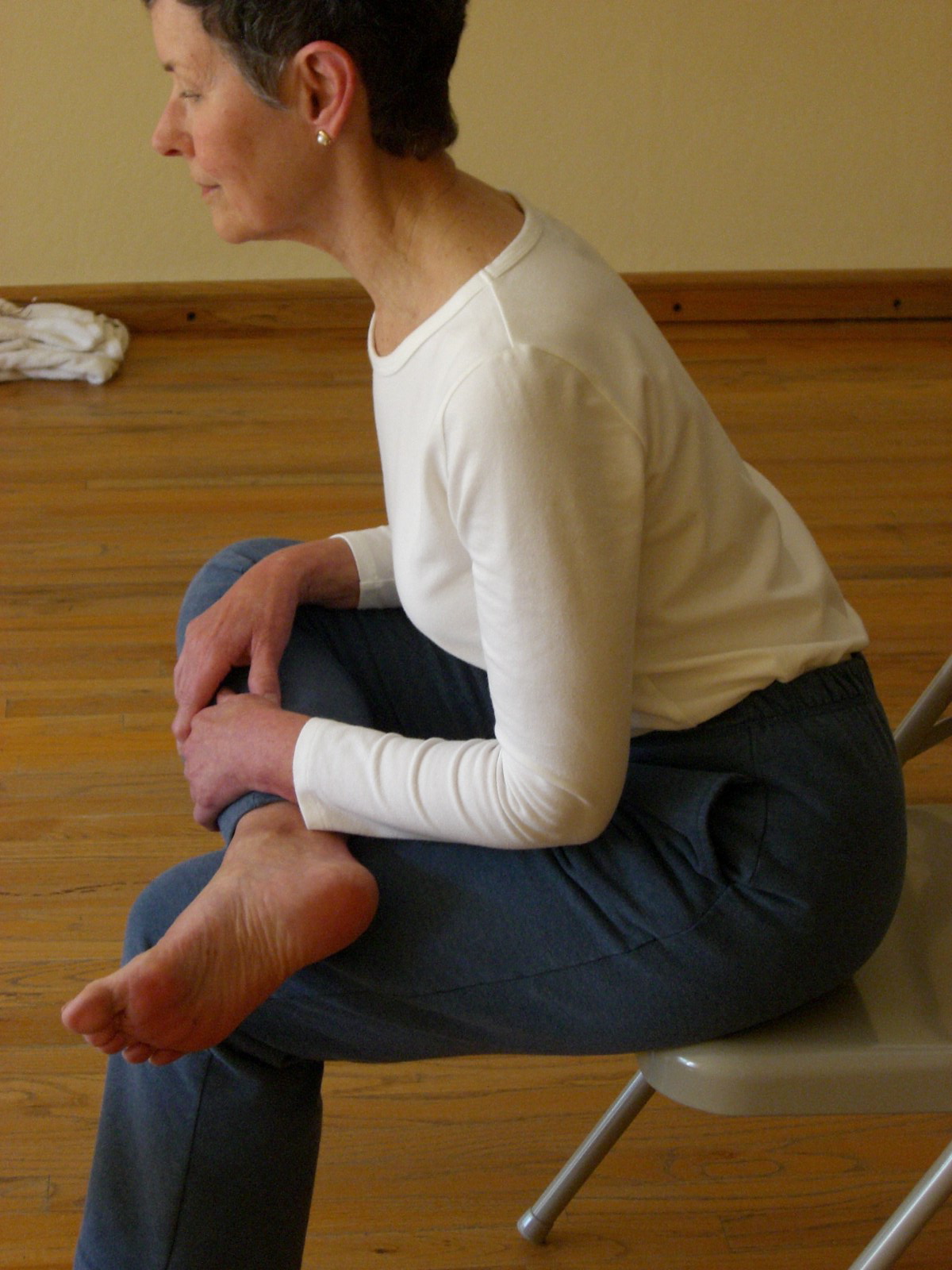
Piriformis Stretch:

  • Cross right ankle over left knee
  • Sit close to the edge of the chair
  • Hinge gently from the hip
  • The sensation should be in right hip
  • Repeat on left side

Seated Back Bend:

  • With your hips toward the edge of the chair place your hands on the seat of the chair behind the hips
  • Lift through the sternum
  • Think less about bending the lower back and more about opening the front of the body

Seated Twist:

  • Place your right hand on the left leg, left hand behind left hip, twisting to your left on the exhalation.
  • Breath in – lengthen the torso.
  • Exhale and settle into the twist.
  • Repeat on the other side.

Seated Forward Fold:

  • Sit toward the edge of the chair with your feet wide
  • Allow the spine to round forward until your upper torso is folded forward between your thighs
  • Hold for a few breaths and then inhale and curl up slowly

Standing

Standing Stretch with Flat Back:  Use the edge of your desk or the wall.  Stand about three feet away and hinge at the hips.  Let your hands rest on the desk, arms extended and legs perpendicular to the floor.

  • Bend right knee and drop right hip for stretch in left hip
  • Bend left knee and drop left hip for stretch in right hip

A standing stretch with a flat back is a great stretch for any time of day, anywhere. It’s particularly good if you’ve been standing all day – it brings a lightness to the feet and legs.

Wall Stretch:

  • Keep right foot about twelve inches from desk
  • Step left foot back about three feet
  • Hinge at hips, keeping hips level.
  • Allow your hands to rest on the desk or a wall for stability

With the right foot forward this will wake up the right hamstring and left calf.

Repeat on left side.

Shoulders:

  • Standing with feet hip distance and the arms by your side, turn the palms out and inhale the arms up.  Extend the fingers toward the ceiling and, if it’s comfortable for your neck, look up between the hands.
  • Turn the palms out and exhale the arms by your side.
  • Repeat three to five times.

Ideally the Focus practice ends with 5-minutes of seated meditation,

quiet reflection or breath awareness.

“Relax Yourself to Sleep”

 Seated on Floor in Easy Cross Legs

Seated Spine Stretch*:

  • Sit in easy cross legs with your hands on your knees.
  • Inhale – lift the chest toward the ceiling.
  • Exhale – hollow out the front of the body and round the spine to stretch between the shoulder blades
  • Inhale – lift the chest toward the ceiling
  • Exhale – fold forward

You can do this for as many cycles as you wish. I suggest beginning with at least three.

Seated Twist*:

  • Bring the right hand to the left knee
  • Place the left hand behind the left hip
  • Inhale – lengthen the torso
  • Exhale – twist to the left

Take a few breaths to move into your full expression of the pose and then settle into the twist for a bit. Avoid “cranking” into the twist by using your arm strength to pull the torso.  Repeat on the other side.

Lateral Stretch*:

  • Place the right hand on the floor next to the hip and then walk the fingers out until you begin to lean to the right.
  • You’ll notice the left hip is lifting from the floor.
  • Inhale – Bring the left arm up and over until it’s arching over the head.
  • Exhale – Press through the heel of the right hand in order to encourage the left hip to move toward the floor
  • Repeat on other side.

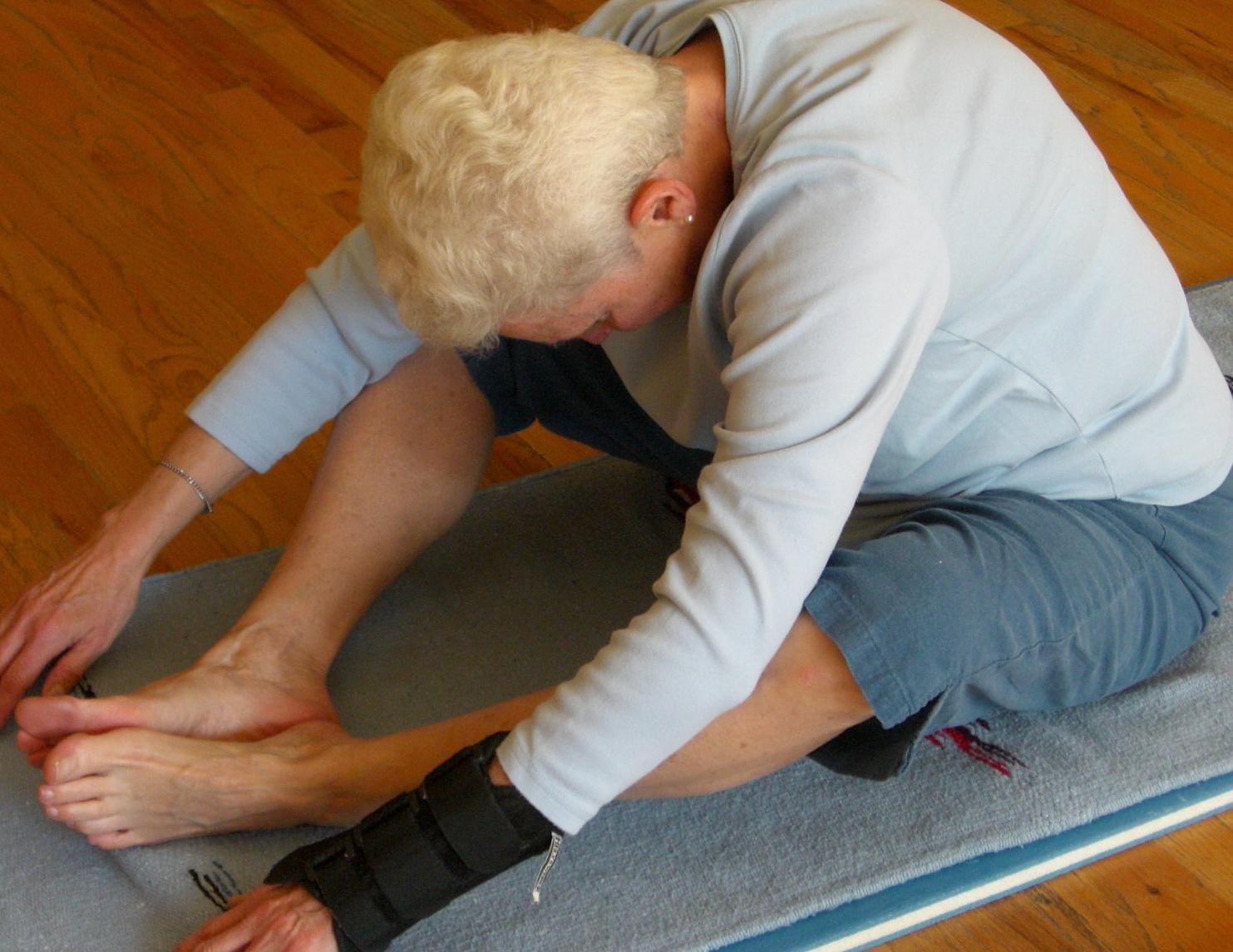
Forward Fold:

  • We want this to be as gentle as possible as this practice is supposed to a “winding down from the day” practice.
  • Sit with your legs in front of you, feet and knees slightly apart
  • Place the bolster underneath the knees
  • Round the torso forward
  • If you need to, use your hands to help support the torso but know that this forward fold is heavy and relaxed as opposed to a forced struggle.  Make it as gentle as possible and just trust that the spine is going to become more and more giving with each practice.

Supine on Floor

 Alternate the Knees in the Chest – just like you do in the morning practice

Hamstring/Hip Stretch– TAKE YOUR TIME WITH THIS!

  • Place a strap at the ball of the right foot.
  • Extend the leg toward the ceiling, opening the back of the knee and stretching through the heel.
  • Extend the left leg along the floor.  Stretch through the heel and point the toes toward the ceiling.
  • Take the strap in the right hand and drop the leg out to the right, rotating from the hip so the toes of the right foot point toward the floor.
  • Continue to work the foot toward the head to stretch the inner thigh.
  • Bring the leg back up and take the strap into the left hand.
  • Drop the leg a few inches toward the left to stretch the outside of the thigh.
  • Repeat with the left leg.

Knees to Chest and Windshield Wiper

Rest quietly in Savasana for ten minutes.

I need to thank teacher Kelly McGonigal for the Seated Spine Stretch, Seated Twist and Lateral Stretch in the “Relax Yourself to Sleep” section.  I first learned those movements from her at Avalon Yoga Center in Palo Alto, California.


Beware the YINJURY!

I couldn’t ignore the truth.  My hip was sore.  Real sore.  It was wince-inducing sore.  And while I limped in denial I began to hear stories similar to mine:  a recurring shoulder pain that increased after Yin practice; a wonky knee that ached the next day; a lower back that refused another forward fold.  All injuries reported by Yin Yoga students.

I refused to believe my beloved Yin was to blame.  It just had to be something else.  Yet, listening to these my students describe the course of events that led to their discomfort and considering my overstretched hip flexor with an objective mind the truth was obvious:  we had YINJURIES – the Yin equivalent to falling asleep in the tanning bed.  Sigh.

For a time the science of flexibility seemed to be changing like the wind.  When I trained as a sports massage therapist long held static stretches were all the rage.  Now the trend leans toward fast dynamic stretching.  I’m confused.  If science supports short and sharp stretches where does Yin fit in?  Does it hurt more than it helps?

I asked anatomist and philosopher Gil Hedley, circular strength training coach Michael Rook and personal trainer Steven Rice their opinion.

Gil offered this:

Virtually anything can be harmful or helpful.  That’s why it’s so important to pay attention to how you are feeling when you are doing something.  I’m no scientist, but I’ve overstretched and endured the consequences, and I’ve also relished the feeling of stretching and moving and enjoyed the benefits.  I personally believe that most anything you do over and over again represents a rut eventually, and like to change things up a bit myself.  While a practice is expanding you and your horizons, enjoy it.  When it becomes a tedium or mere repetition to satisfy a habit, move on.

There have been moments in my Yin practice when I’ve taken the poses almost ‘by rote’ – without thinking.  Without feeling.  Perhaps when we lose our mindfulness in the practice we open the door to injury?

Michael, who attended Paul Grilley Yin Teacher Training with me a few years ago, was frank in his opinion:

To be honest, I’m not surprised to hear about this.  The science is relatively clear that stretching before resistance training (some of my students attend Yin and then lift weights the following day) can harm performance and lead to injury.  Even more so before using kettle bells, I would say.  Personally, I don’t hold stretches for more than a minute (and it depends on the stretch).  There’s also a lot of deep flexion in many Yin poses that can play havoc with the lower back (if you’re posteriorly rotated).  Ultimately, all practices need to be tailored to the individual.

That sounds like obvious advice, but how often do teachers really attempt to do that?  In a large class that’s virtually impossible.  While it’s the instructor’s responsibility to guide the class safely, does it really come down to the individual listening to their body?

Michael then referred me to Charles Poliquin’s Blog and the Gymnastics Bodies website.

Finally, local trainer Steve “Mr. Science” Rice gave me this to chew on:

My understanding is that the ligaments should not be stretched as that will lead to joint laxity, and they don’t recover from that.  However it is also possible for the ligaments and capsule to get a bit glued together and need a bit of loosening.

Tendons of course are attached to muscles so I don’t know if they can be stretched separately.  A stretch will affect the tissue most willing to lengthen which is likely the muscle, and the length of a muscle is determined first of all by the brain. 

Traditional static stretching, like holding a yoga pose, has become depreciated in the sports world because it has been shown to decrease performance.  Current thinking emphasizes dynamic warm-up and mobility work.  End ROM (range of motion) positions are moved into and out of under control so the entire neuromuscular chain is engaged.  For example, instead of hanging in a forward bend with gravity pulling you down, walk and on each step do a high kick.  My stretches last no more than one or two seconds.

And then, just to inject a bit of controversy, Steven wrote:

Incidentally, Poliquin is a smart guy and leading fitness authority but also controversial in his interpretation of research.

So there you have it.  Static stretching out.  Dynamic stretching in.

Not so fast.  I love Yin not only for how it feels in my body but for how it soothes my spirit.  There’s no way I’m trading those five-minute dragonflies for some high kicks!  But here’s what I might do:

Offer my body more support in poses that are challenging for me.

  • Hold some poses for less time.
  • Avoid weight training for 24 hours after a Yin practice (I can assure you that won’t be a problem).
  • And then, more than anything, I’m going to listen.

Fitness trends emerge and fade, theories behind the science of flexibility change, our bodies cycle through movements that feel good and movements that don’t.

It seems that the only thing we can do is listen.


So You Just Got Your Yoga Teaching Certificate…NOW What Do You Do?

When you boiled it all down, the question my friend wanted an answer to was this:

“What do I do now?”

Deepa and I began Avalon Art and Yoga Center’s teacher training course in September 2011.  Six months and almost $3,000 dollars later we had a beautiful piece of paper to show the world that we were yoga teachers.

Hold up.  Actually, what we had was a piece of paper that said we’d completed the program.  The Avalon Teacher Training program is an intense and comprehensive six months of study.  It was worth my time and my money.  But when it was over, did the world have twenty-eight more yoga teachers?  I’m not sure.

It’s one thing to learn the techniques of teaching and another to know how to touch a student with words that describe the impact of a yoga practice or to provide support that make her feel safe.  Knowing how to instill confidence, knowing how to adjust a posture, knowing how to set the tone in the studio – it takes time and experience to develop those skills.  It takes an instinct that I’m not certain can be taught.  It’s a bit like learning that red and blue make purple.  Knowing how the color wheel works does not make you an artist.  And completing a teacher-training program does not make you a teacher.

The reality is I taught for many years before becoming a certified teacher. Instead of certification, I studied informally.  I read books and attended classes.  I asked questions.  I practiced.  I was a student for ten years before I began teaching.  I’m not suggesting the path to teaching I chose is better or even desirable.  There were holes in my “home study” yoga education I had a craving to fill.   What I’m trying to point out is that there are different paths, and maybe this push to collect certificates and to study with the flashiest Pop Star Yoga Idol (and after this past year we certainly know how quickly and how far yoga idols can fall) is blinding us to the truth that being a compassionate, effective and capable teacher takes more than a file cabinet of certificates.

So how important is that piece of paper?  I’m happy that after eighteen years I have certificates not only from Avalon but also from Paul Grilley’s Yin Teacher Training.  I could have continued to be a fine teacher without them, but they represent opportunity. They open doors.  If you choose – and for what it’s worth – your new certificate allows you to register with Yoga Alliance (which I’ve done).

But I’m through with formal training for the time being.  I’m happy to return to reading, talking with fellow teachers, attending classes in my neighborhood.  I’m happy to focus on my students and my teaching.

So how did I answer Deepa as she tried to decide what to do next?

I told her to take a step back.  I told her to find her teaching voice.

Your yoga voice – how you speak to students, the vocabulary you use to describe asana or pranyama or mudras or bandhas – it can’t be taught.  You have to find it and the only way to find it is to teach.

When you find your authentic voice as a teacher, that’s when you’ll begin to teach your truth.  And when you are teaching your truth you’ll know that the path you chose – the path that brought you here – it was the right one.

ps….Some people, by the way, are born to teach.  They’re naturals.  Deepa is one of them.  From mid-July she’ll be teaching at Downtown Yoga Shala in San Jose, California mornings and Friday evenings.  

As for me, I continue to teach my truth at California Yoga Center, Avenidas in Palo Alto and Prajna Yoga and Healing Arts in Belmont, California.  I also teach for Feinberg Medical Group and privately.


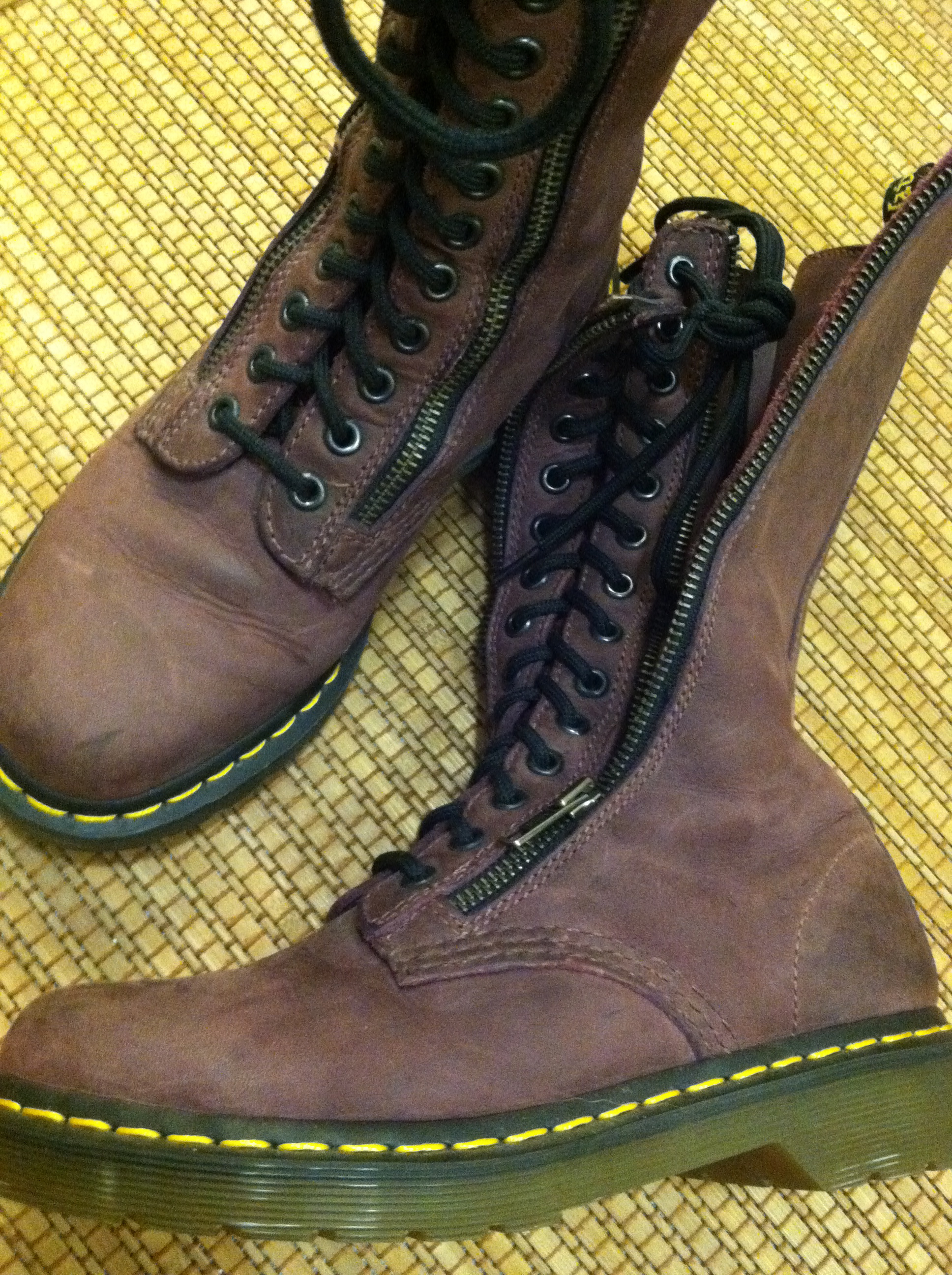
Heart, Soul and Purple Doc Marten Boots

I prefer to not surround myself with too much stuff.  I hesitate to put down roots and hold the belief that I can pack up and take off at a moment’s notice.  A friend tells me I’m looking for something that I haven’t found.  I’m more inclined to think I suffer from chronic commitment issues and spiritual claustrophobia.

And so I clear my closet of clothes not worn for years.  I purge the shelves of books rarely opened and cull the desk of knick-knacks whose sole purpose for existing is to catch dust.

With the space around me cleared, so somehow is my heart.  Yet what I’ve done is create a fleeting illusion of space that requires tender care.  Only mindful vigilance will prevent a new collection of bits and bobs from building a jumbled barrier that distracts and blocks my path.

It has been one hundred and eighty days since my last hefty donation to Goodwill. Pride in accomplishment allowed my guard to drop.    The space around me has filled. As a consequence, so has my spirit.  It’s time.   Time to plunge into the mess.  Time to choose.  Time to let go.  Again.

The questions I’m asking are simple.  What do I need for my life to have heart and meaning?  How many layers do I have to strip away before I find Truth?

I am beginning to realize that my constant craving to pare back the physical layers is not enough.  Taking away the stuff around me – breaking down the barriers – isn’t enough.  Maybe my friend is right.  Maybe I am looking for something.  But I won’t find it in the space where my purple Doc Marten boots used to be.


Fessin’ Up and Clearing the Decks

My…ahem…tens of readers will know that over the past few months I’ve attempted to take a proactive approach to self-improvement.  Improving one’s ‘Self’ is unique to each individual.  Some folks want to abandon bad habits; others look to be more social.  If you read THIS post or THIS one, you’ll remember that I wanted to let go of my addiction to Hulu.  Having already given my television to Goodwill I had slipped into the bad habit of watching Hulu from bed with the laptop perched on my belly. I hoped the hours formerly spent glued to the boob tube would now be spent reading.  I went so far as to challenge myself to read one book per week.

I also wanted to create a meditation practice.

Now that winter has turned to spring, how am I doing?  Just fine.  Thanks for asking.

It took a bit of negotiation with my psyche and more than a little self-compassion, but I’m doing just fine.

My 21-hours per week television/Hulu addiction is down to about two or three hours per week (unless I’m house sitting – who can ignore a flat screen TV the size of a wall and surround sound???)

Did I read all the books I wanted to read?  No.  But I’m reading.  All the time.  But a little necessity called work prevented me from maintaining the breakneck pace I set for myself.

The meditation practice is blossoming.  Establishing a good habit is a process of repetition.  For several weeks I struggled to remember to practice.  But then the corner was turned and now I miss it when my practice slips.  And it does slip.

Last week was one of those weeks when I fell off the wagon.  Nothing prevented me from enjoying my regular daily mediation except the story I was spinning in my head about being overwhelmed and overworked.  A few days into my lapsed practice a friend turned to me and said, “You haven’t been meditating.”

How could he have noticed?  How could he not have noticed?

I slipped back into regular practice the next day.

We make choices about how we want to live our lives.  We set goals, we plot a course.  We hope.

And then life happens.  Extraordinary, brilliant, tragic, wonderful life.

Sometimes we fall.  Sometimes we need to change course.  But always we pick ourselves back up and head into the wind.  And then we soar.

And that’s how I’m doing.

ps…in my quest to crush my writer’s block I’ve given an old blog a new name:  Your Daily Prompt.  If you’re a writer – even if you’re not – take a look.


Home Sweet Home

House sitting is a little bit like grand parenting (not that I have any experience being a grandparent, but I can imagine).  What I mean is that I move into a home, look after the fine furnishings, the houseplants and the mail.  I lovingly care for the cat, dog, or Koi in question and then – after a few days or a few weeks – I hand it all back.

House sitting is also a bit discombobulating.

Returning home over the weekend after my last extended gig, I believe I felt as disoriented and jet-lagged as the homeowners.  I had grown accustomed to their lovely house, the big kitchen, and the shaded deck where I shared meals with my friend.

It became very comfortable.

And now I’m back in the apartment that I am of course very grateful for but I have to admit – it feels pretty small.  It’s taken me a few days to figure out how to live in the space again.  I can’t remember where my “things” are, and I can’t figure out why I have so much stuff crammed into 200-square-feet.

It’s time to clear the decks.

I want to peel back the layers of detritus – the physical and psychic debris that litters my path and slows the journey.


The Baffling Case of the Rigid Mimm Day

I had the day marked on my calendar.  Sunday the 4th of March.  Mimm Day.  My first day of freedom.  No teacher training.  No dog sitting.  No private clients.  I was commitment free for the first time in months.  Come hell or high water I was going to celebrate and it was going to be perfect.

The day I planned included an early morning drive to Santa Cruz with a friend.

After a few hours of Dance Church at the 418 Project we take a leisurely stroll downtown until we find the perfect café where we enjoy a quiet brunch.  A table is waiting for us under the shade of a tree with the sunlight filtered to shield our eyes but not so much that it can’t keep us warm.  My friend reaches down and pulls a book from his grey backpack and with our second cup of tea we take turns reading to one another.  We’re generous with our tip – a compensation for keeping the café table too long. We continue our stroll and find an old record shop around the corner or maybe a shop full of bric-a-brac to bury ourselves in for a bit before making our way to a pristine beach that, miraculously, is empty except for an older couple and their two Golden Retrievers. The sound of the gulls, the crashing waves and the solar warmth of the sand lulls us to sleep just long enough to refresh but not so long as to make us cranky when we wake.

Another bite to eat and then a drive home along Highway 1 with a few stops to enjoy the view of a setting sun as the credits roll…

Mimm Day.  My perfect day.

But on designated Mimm Day I opened my eyes and discovered the alarm clock had never been set and we were already two hours too late to attend Dance Church. I cried like a ten-year-old who had slept through Christmas.  It was only 9:30 but the day, as far as I was concerned, was ruined.  And if I was wrong – if the day wasn’t really ruined – I was still going to nurture my disappointment and bad temper.  I didn’t get what I wanted and I was too swept up into the movie I had written in my head about what Mimm Day was supposed to be that I couldn’t see that the day was still perfect.  It was sunny and warm, it was a gorgeous morning – there was plenty of day left.  And I was still free to do whatever I wanted.

But I couldn’t see it.   I was blind to what I had right in front of me: my best friend, a blue sky and eight more hours of sunlight.

How many times are we guilty of placing emotional importance on an unpredictable future?  How often do we trip over ourselves reaching for paper tigers and ghosts that we can never hold and that never live up to the movies we make in our mind?

I’ve been reading to my students from Sharon Salzberg’s book Lovingkindness:  The Revolutionary Art of Happiness.  She writes:

When we become lost in desire, we are put firmly into the framework of linear time.  We become focused on getting what we do not yet have or on keeping what we do have.  We become oriented toward the future.  To be caught in this concept of linear time brings us to what in Buddhist teachings is called bhava, or becoming, always falling into the next moment.  It is as if before each breath ends, we are leaning forward to grasp at the next breath.

On March 4th I leaned so far forward I fell flat on my face.

Thinking about the future is not a bad thing.  But clinging to an ideal of what I believe the future should be does not allow room for change or perspective.  It leaves no room for living.

And isn’t it time to live a little?


Avalon Teacher Training Program

This past Sunday marked the end of my six-month teacher-training course at Avalon Yoga Studio in Palo Alto, California. While I don’t often speak for a couple dozen or so other people (at least not all at once) I believe it’s a safe bet they’re as ecstatic as I am to see the return of a weekend for the first time since the beginning of September. I’d be lying, however, if I didn’t confess there is a part of me that will miss the gathering – the friends I made, the philosophies I embraced and the moments that tested and challenged me.

The teacher training at Avalon is unique.  Where other programs train to a certain method or school, the comprehensive 200-hour program at Avalon introduces participants to the major styles of modern yoga.  Guest instructors lead us in sessions of Iyengar, Jivamukti, Restorative, Dharma Mittra and more.

The program places a heavy emphasis on recent scholarly research that suggest the asana practice we believed was thousands of years old is actually a 20th century construct.  Not everyone is ready to accept this radical re-thinking of our discipline’s history.  For me, however, knowing Surya Namaskar arrived at the beginning of the last century and not centuries before brings a sense of relief. Understanding how asana practice evolved gives me permission to participate in the evolution.

The program also offers an examination of the yogic texts.  Most of us won’t be scholars on the subject but yoga teachers should at least be familiar with the Sutra’s, the Gita, Pradapika and Upanishads.   Fortunately, the teaching at Avalon made the philosophy of the ancient texts relevant to our hectic 21st century.

The Avalon faculty is a diverse group. Standouts for me are psychologist and author Kelly McGonigal, yoga historian Mark Singleton, restorative yoga doyenne Judith Hanson Lasater and musician Girish.  We can’t forget beloved local Iyengar instructor Shastri and Jivamukti dynamo Giselle Mari. Although Jivamukti doesn’t resonate with me, Giselle is an amazing teacher full of life and energy. She even softened my hard-edged opinion about the use of music during asana practice.

Avalon Studio Owner and Director of the Teacher Training Program Steve Farmer is a generous man.  During the duration of the training participants are invited to attend any yoga class at Avalon for free.  He encourages us to build our teaching skills by inviting us to teach free classes for the community at the Avalon studio.

All this is great.  Without a doubt the Avalon Teacher Training Program is an excellent educational opportunity. But like most teacher training programs it is not without its flaws.

I entered the program with a beginner’s mind and eighteen years of teaching experience.  I wanted to learn.  But there is an art to teaching people how to teach and I found too many guest lecturers did not have that skill.  While they are more than able to teach yoga blind folded with two hands tied behind their back, they don’t have the skill set for teaching people how to teach. I found this frustrating, and a bad attitude began to crowd out my beginner’s mind.

And while the opportunity to practice our teaching skills through the free community classes is a generous one, someone with limited prior teaching experience might find the prospect too intimidating to consider.  My feeling is that the program should offer more opportunities to teach in the classroom right from the start and that those teaching moments should include a peer review.

I am not the only one who feels in-class teaching time was too limited.  The issue was discussed in an open forum on our last day of class.  Steve easily agreed and is working to add more teaching peer reviews.

The Avalon Teacher Training Program is not perfect, but do I recommend the program?

Absolutely.  Without a doubt.  It’s the best non-residential yoga teacher-training program I’ve seen.

Why?

It happened about four months into the training. One of my long time students approached me after class.  She said, “You know, Mimm, I’ve always enjoyed your classes.  But something’s changed. It’s your teaching.  You’ve become a better teacher.”

Wow.

My first thought was “after eighteen years it’s about time.”

But then I realized that despite the moments when my beginner’s mind failed and arrogance overwhelmed me; even when I wore my bad attitude like a heart on my sleeve, I still learned. When I disagreed with an instructor, my faith in what I believe yoga is grew stronger.  And when the words I heard resonated in my heart – which was often – I learned even more.

The Avalon Teacher Training Program stretched my teaching wings.  It pushed, encouraged and enlightened me.  My confidence as a teacher has grown but more than that I now know with unstinting certainty there is room for the style of asana practice I embrace in the continuing evolution of modern yoga.  And I have the Avalon Teacher Training Program to thank for that.


A Clean, Well Lighted Place for Yoga

ImageI prefer answers to questions about things we can only feel to have at least a toe-hold in science.  But that’s just me.  My geeky half has a cynical side.

So when I attended Yiwen Chang’s Thai Massage Workshop at Prajna Yoga and Healing Arts Studio in Belmont, California and heard the human rights lawyer to my left ask, “What is the scientific evidence for the energy channels you’ve mentioned?” I pricked up my ears and smiled.  This was going to get interesting.

I don’t know why I expected Yiwen, the owner and director of Prajna, to fluster and stutter before brushing the question under her yoga mat with a few stock phrases about ‘staying present’ and being ‘one with the universe’.  Maybe it was my own propensity towards flustering in the face of a student’s challenging inquiry.  In any case, I steeled myself to witness an epic fail.

Instead Yiwen cited research by Dr. Hiroshi Motoyama, the founder of the California Institute for Human Science.  She made a polite but strong case for the existence of meridians and then moved on.

That’s when I knew I was in the right place.  That’s when I knew what Yiwen had created in Prajna Yoga and Healing Arts was something different.  Something special.

Prajna is Sanskrit for the wisdom that embraces an intuitive response to the true nature of reality.  With prajna in mind, Yiwen has created a studio that provides the space to nurture our inner intelligence.  She’s created a clean, well-lit place for yoga and healing.

Prajna Yoga and Healing Arts is an easy studio to be in.  Its warmth is inviting and its simplicity refreshing.  Located in the Belmont Business Center at 1601 El Camino Real (take the Holly Street exit from 101), the studio is easy to find and even better – there is ample parking.

The check-in area is just inside the front door.  There’s a large treatment room to the left where Yiwen offers bodywork.  To the right is an open space dedicated to personal reflection and meditation.  Next to that are several benches with cushion seats where students can enjoy a cup of tea and quiet conversation.  A small changing area is available directly across from the practice studio.

And then there’s the practice space itself.  Filled with soft natural light from filtered skylights and east facing windows, the room’s energy is welcoming, quiet and calm.

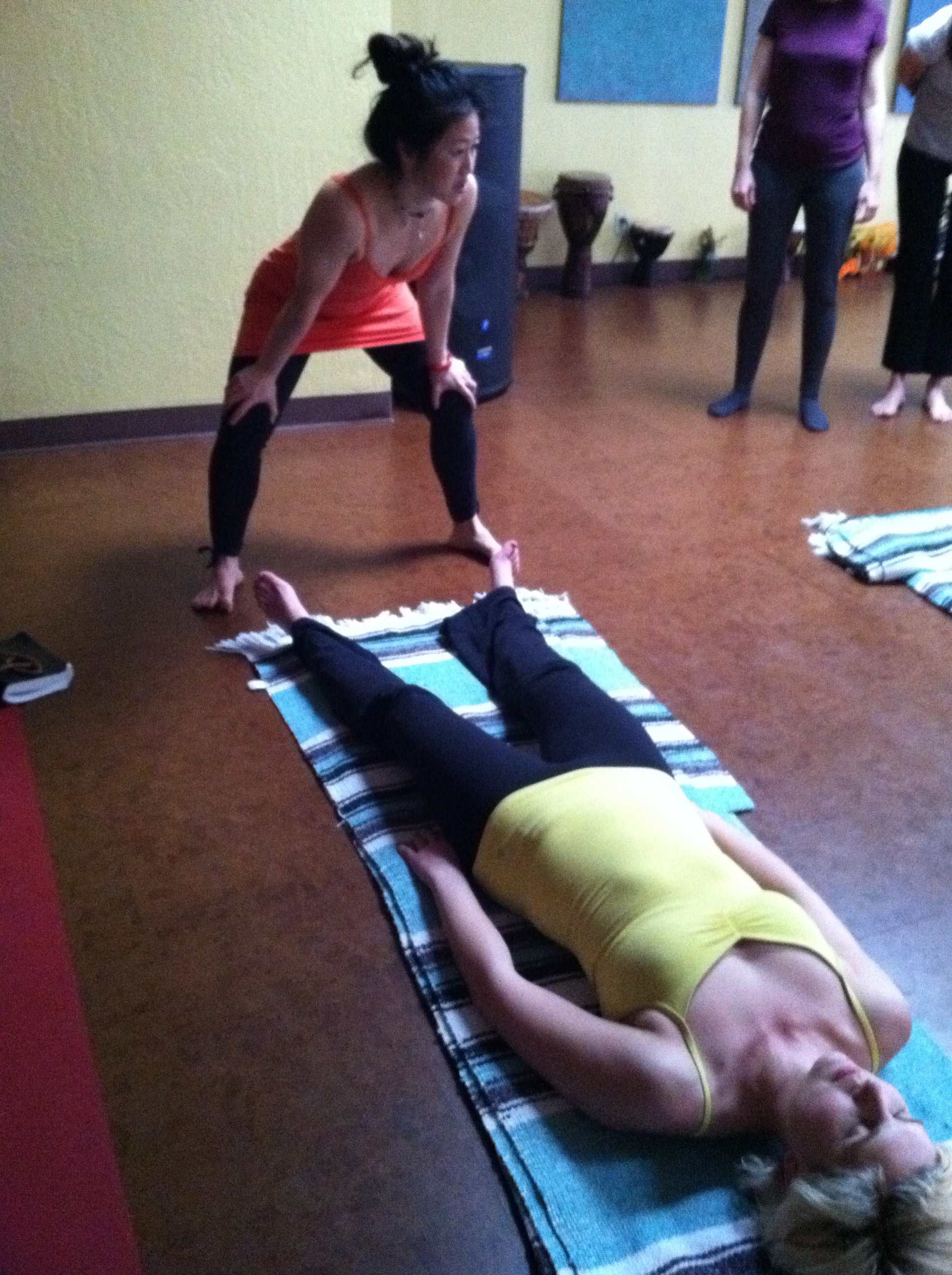
Twelve of us rolled out mats and gathered props for the afternoon workshop. Thai Massage is one of my favorite therapeutic modalities.  The technique is akin to facilitated stretching. The therapist eases the client’s clothed body into gentle positions that lengthen, compress and ultimately draw out tension and soothe the nervous system.  Pressure point massage techniques contribute to the experience. 

It takes years to become proficient in the finer nuances of Thai Massage, but Yiwen’s intention for Imagethe workshop was to teach a minimal introduction to the basics.  She hoped we’d leave with enough information and confidence to give a simple Thai Massage treatment to friends and family.

We settled in quickly and within minutes were taking turns pushing, prodding and bending our very willing partners.  Taking turns giving and receiving every few minutes prevented anyone from slipping into ‘massage coma’. 

Yiwen is an intuitive and generous teacher with a lovely, healing energy.  As we practiced she knew when to offer help and when to stand back to observe.  If there was a downside to the workshop it’s that three hours wasn’t long enough.  Watching Yiwen teach, it was clear she had much more to offer.  I hope she considers teaching a Thai Massage, Part II Workshop soon.

If you’re looking for a yoga studio that gives you the feeling that you’ve come home, visit Prajna Yoga and Healing Center.

Check out Prajna’s class schedule here: http://www.prajnacenter.com/

This post, I’m very happy to say, originally appeared on YogaStage.


Perfectionism: The Voice of the Oppressor

Cover of "Bird by Bird: Some Instructions...

I don’t know that I could have picked two better books to read simultaneously.  If Kelly McGonigal’s The Willpower Instinct is the brain of the operation, then Anne Lamott’s Bird by Bird is the heart.

I know everyone has already read Bird by Bird.   Most likely in 1994, when it was published. I was a little busy that year.  Plus, I have a stubborn streak and if someone says to me, Oh, you’ve just got to read this book! (or see this movie, or meet that person), I won’t.  Just to be stubborn.  It took me twenty years to see E.T. the Extraterrestrial.

Still, even if you loved Bird by Bird when you read it seventeen years ago chances are you’ve forgotten why. I’ll remind you:

Here are Anne Lamott’s thoughts on perfectionism:

Perfectionism is the voice of the oppressor, the enemy of the people.  It will keep you cramped and insane your whole life, and it is the main obstacle between you and a shitty first draft.  I think perfectionism is based on the obsessive belief that if you run carefully enough, hitting each stepping-stone just right, you won’t have to die.  The truth is that you will die anyway and that a lot of people who aren’t even looking at their feet are going to do a whole lot better than you, and have a lot more fun while they’re doing it.

Meanwhile, back on the pages of Kelly McGonigal’s The Willpower Instinct we find studies that support Anne’s heartfelt commentary and advice on how to relinquish the desire to be perfect.  Kelly explains why offering compassion and forgiveness to ourselves instead of layering on the guilt for our missteps strengthens our ability to see the big picture. 

I didn’t expect Bird by Bird to make me smile as often as it has.  And I didn’t expect The Willpower Instinct to be so easy to take.  I expected an overly sweet Bird by Bird to have me in a literary sugar coma by page forty, but Anne Lamott’s practical advice is seasoned with just the right enough bite to balance the moments that bring tears to your eyes.

I thought Kelly McGonigal’s book would be like any other book I’ve read about goal setting.  I thought I’d be writing lists, repeating affirmations and by the end of the day – with few items on the list accomplished – calling myself a failure.

The truth is, Kelly’s book is about forgiveness. It’s about settling down.  Giving yourself a break.  And she has all the scientific evidence we need to see why this is important.

My intention was to break my Hulu habit by reading eight books in six weeks.  That’s not going to happen.  Why?  Because I chose an astoundingly unrealistic goal.  That’s typical of me and, according to McGonigal, typical for many of us.  But don’t blame Hulu. While I haven’t severed my attachment to Hulu completely (a once-a-week, twenty-two minute dose of The Big Bang Theory after a long day is medicinal) I’m certainly no longer sliding down a steep slippery slope toward a self-inflicted Hulu-lobotomy.

A more realistic goal is four books in six weeks.  Today Bird by Bird returns to the bookshelf.  The Willpower Instinct, however, is staying out.  Now that I’ve read it from cover to cover my intention is to go back and read it again – this time actively working through the exercises provided.  I’ll keep you posted how all that works out.

The book I’m beginning today is John Green’s The Fault in Our Stars. No, it wasn’t on my original list. I’ve chosen this young adult novel because I’m working on a young adult novel (yes, again). The book has a bit of buzz on it and I’m looking forward to digging in.

Next time:  An update on the meditation practice I committed to in January or A Funny Thing Happened on the Way to Whole Food’s Meat Counter