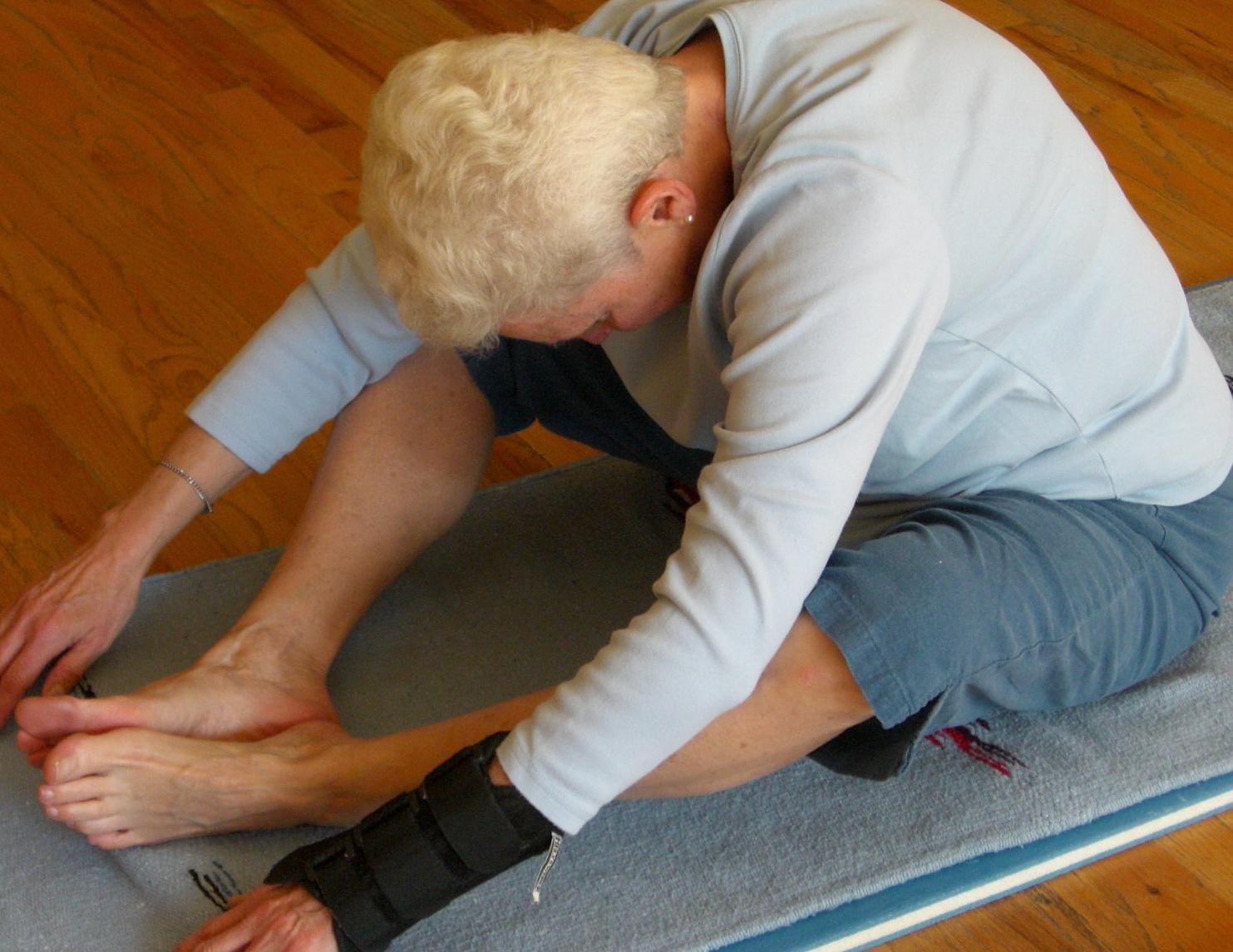
Beware the YINJURY!

I couldn’t ignore the truth.  My hip was sore.  Real sore.  It was wince-inducing sore.  And while I limped in denial I began to hear stories similar to mine:  a recurring shoulder pain that increased after Yin practice; a wonky knee that ached the next day; a lower back that refused another forward fold.  All injuries reported by Yin Yoga students.

I refused to believe my beloved Yin was to blame.  It just had to be something else.  Yet, listening to these my students describe the course of events that led to their discomfort and considering my overstretched hip flexor with an objective mind the truth was obvious:  we had YINJURIES – the Yin equivalent to falling asleep in the tanning bed.  Sigh.

For a time the science of flexibility seemed to be changing like the wind.  When I trained as a sports massage therapist long held static stretches were all the rage.  Now the trend leans toward fast dynamic stretching.  I’m confused.  If science supports short and sharp stretches where does Yin fit in?  Does it hurt more than it helps?

I asked anatomist and philosopher Gil Hedley, circular strength training coach Michael Rook and personal trainer Steven Rice their opinion.

Gil offered this:

Virtually anything can be harmful or helpful.  That’s why it’s so important to pay attention to how you are feeling when you are doing something.  I’m no scientist, but I’ve overstretched and endured the consequences, and I’ve also relished the feeling of stretching and moving and enjoyed the benefits.  I personally believe that most anything you do over and over again represents a rut eventually, and like to change things up a bit myself.  While a practice is expanding you and your horizons, enjoy it.  When it becomes a tedium or mere repetition to satisfy a habit, move on.

There have been moments in my Yin practice when I’ve taken the poses almost ‘by rote’ – without thinking.  Without feeling.  Perhaps when we lose our mindfulness in the practice we open the door to injury?

Michael, who attended Paul Grilley Yin Teacher Training with me a few years ago, was frank in his opinion:

To be honest, I’m not surprised to hear about this.  The science is relatively clear that stretching before resistance training (some of my students attend Yin and then lift weights the following day) can harm performance and lead to injury.  Even more so before using kettle bells, I would say.  Personally, I don’t hold stretches for more than a minute (and it depends on the stretch).  There’s also a lot of deep flexion in many Yin poses that can play havoc with the lower back (if you’re posteriorly rotated).  Ultimately, all practices need to be tailored to the individual.

That sounds like obvious advice, but how often do teachers really attempt to do that?  In a large class that’s virtually impossible.  While it’s the instructor’s responsibility to guide the class safely, does it really come down to the individual listening to their body?

Michael then referred me to Charles Poliquin’s Blog and the Gymnastics Bodies website.

Finally, local trainer Steve “Mr. Science” Rice gave me this to chew on:

My understanding is that the ligaments should not be stretched as that will lead to joint laxity, and they don’t recover from that.  However it is also possible for the ligaments and capsule to get a bit glued together and need a bit of loosening.

Tendons of course are attached to muscles so I don’t know if they can be stretched separately.  A stretch will affect the tissue most willing to lengthen which is likely the muscle, and the length of a muscle is determined first of all by the brain. 

Traditional static stretching, like holding a yoga pose, has become depreciated in the sports world because it has been shown to decrease performance.  Current thinking emphasizes dynamic warm-up and mobility work.  End ROM (range of motion) positions are moved into and out of under control so the entire neuromuscular chain is engaged.  For example, instead of hanging in a forward bend with gravity pulling you down, walk and on each step do a high kick.  My stretches last no more than one or two seconds.

And then, just to inject a bit of controversy, Steven wrote:

Incidentally, Poliquin is a smart guy and leading fitness authority but also controversial in his interpretation of research.

So there you have it.  Static stretching out.  Dynamic stretching in.

Not so fast.  I love Yin not only for how it feels in my body but for how it soothes my spirit.  There’s no way I’m trading those five-minute dragonflies for some high kicks!  But here’s what I might do:

Offer my body more support in poses that are challenging for me.

  • Hold some poses for less time.
  • Avoid weight training for 24 hours after a Yin practice (I can assure you that won’t be a problem).
  • And then, more than anything, I’m going to listen.

Fitness trends emerge and fade, theories behind the science of flexibility change, our bodies cycle through movements that feel good and movements that don’t.

It seems that the only thing we can do is listen.

So You Just Got Your Yoga Teaching Certificate…NOW What Do You Do?

When you boiled it all down, the question my friend wanted an answer to was this:

“What do I do now?”

Deepa and I began Avalon Art and Yoga Center’s teacher training course in September 2011.  Six months and almost $3,000 dollars later we had a beautiful piece of paper to show the world that we were yoga teachers.

Hold up.  Actually, what we had was a piece of paper that said we’d completed the program.  The Avalon Teacher Training program is an intense and comprehensive six months of study.  It was worth my time and my money.  But when it was over, did the world have twenty-eight more yoga teachers?  I’m not sure.

It’s one thing to learn the techniques of teaching and another to know how to touch a student with words that describe the impact of a yoga practice or to provide support that make her feel safe.  Knowing how to instill confidence, knowing how to adjust a posture, knowing how to set the tone in the studio – it takes time and experience to develop those skills.  It takes an instinct that I’m not certain can be taught.  It’s a bit like learning that red and blue make purple.  Knowing how the color wheel works does not make you an artist.  And completing a teacher-training program does not make you a teacher.

The reality is I taught for many years before becoming a certified teacher. Instead of certification, I studied informally.  I read books and attended classes.  I asked questions.  I practiced.  I was a student for ten years before I began teaching.  I’m not suggesting the path to teaching I chose is better or even desirable.  There were holes in my “home study” yoga education I had a craving to fill.   What I’m trying to point out is that there are different paths, and maybe this push to collect certificates and to study with the flashiest Pop Star Yoga Idol (and after this past year we certainly know how quickly and how far yoga idols can fall) is blinding us to the truth that being a compassionate, effective and capable teacher takes more than a file cabinet of certificates.

So how important is that piece of paper?  I’m happy that after eighteen years I have certificates not only from Avalon but also from Paul Grilley’s Yin Teacher Training.  I could have continued to be a fine teacher without them, but they represent opportunity. They open doors.  If you choose – and for what it’s worth – your new certificate allows you to register with Yoga Alliance (which I’ve done).

But I’m through with formal training for the time being.  I’m happy to return to reading, talking with fellow teachers, attending classes in my neighborhood.  I’m happy to focus on my students and my teaching.

So how did I answer Deepa as she tried to decide what to do next?

I told her to take a step back.  I told her to find her teaching voice.

Your yoga voice – how you speak to students, the vocabulary you use to describe asana or pranyama or mudras or bandhas – it can’t be taught.  You have to find it and the only way to find it is to teach.

When you find your authentic voice as a teacher, that’s when you’ll begin to teach your truth.  And when you are teaching your truth you’ll know that the path you chose – the path that brought you here – it was the right one.

ps….Some people, by the way, are born to teach.  They’re naturals.  Deepa is one of them.  From mid-July she’ll be teaching at Downtown Yoga Shala in San Jose, California mornings and Friday evenings.  

As for me, I continue to teach my truth at California Yoga Center, Avenidas in Palo Alto and Prajna Yoga and Healing Arts in Belmont, California.  I also teach for Feinberg Medical Group and privately.


Fessin’ Up and Clearing the Decks

My…ahem…tens of readers will know that over the past few months I’ve attempted to take a proactive approach to self-improvement.  Improving one’s ‘Self’ is unique to each individual.  Some folks want to abandon bad habits; others look to be more social.  If you read THIS post or THIS one, you’ll remember that I wanted to let go of my addiction to Hulu.  Having already given my television to Goodwill I had slipped into the bad habit of watching Hulu from bed with the laptop perched on my belly. I hoped the hours formerly spent glued to the boob tube would now be spent reading.  I went so far as to challenge myself to read one book per week.

I also wanted to create a meditation practice.

Now that winter has turned to spring, how am I doing?  Just fine.  Thanks for asking.

It took a bit of negotiation with my psyche and more than a little self-compassion, but I’m doing just fine.

My 21-hours per week television/Hulu addiction is down to about two or three hours per week (unless I’m house sitting – who can ignore a flat screen TV the size of a wall and surround sound???)

Did I read all the books I wanted to read?  No.  But I’m reading.  All the time.  But a little necessity called work prevented me from maintaining the breakneck pace I set for myself.

The meditation practice is blossoming.  Establishing a good habit is a process of repetition.  For several weeks I struggled to remember to practice.  But then the corner was turned and now I miss it when my practice slips.  And it does slip.

Last week was one of those weeks when I fell off the wagon.  Nothing prevented me from enjoying my regular daily mediation except the story I was spinning in my head about being overwhelmed and overworked.  A few days into my lapsed practice a friend turned to me and said, “You haven’t been meditating.”

How could he have noticed?  How could he not have noticed?

I slipped back into regular practice the next day.

We make choices about how we want to live our lives.  We set goals, we plot a course.  We hope.

And then life happens.  Extraordinary, brilliant, tragic, wonderful life.

Sometimes we fall.  Sometimes we need to change course.  But always we pick ourselves back up and head into the wind.  And then we soar.

And that’s how I’m doing.

ps…in my quest to crush my writer’s block I’ve given an old blog a new name:  Your Daily Prompt.  If you’re a writer – even if you’re not – take a look.


The Baffling Case of the Rigid Mimm Day

I had the day marked on my calendar.  Sunday the 4th of March.  Mimm Day.  My first day of freedom.  No teacher training.  No dog sitting.  No private clients.  I was commitment free for the first time in months.  Come hell or high water I was going to celebrate and it was going to be perfect.

The day I planned included an early morning drive to Santa Cruz with a friend.

After a few hours of Dance Church at the 418 Project we take a leisurely stroll downtown until we find the perfect café where we enjoy a quiet brunch.  A table is waiting for us under the shade of a tree with the sunlight filtered to shield our eyes but not so much that it can’t keep us warm.  My friend reaches down and pulls a book from his grey backpack and with our second cup of tea we take turns reading to one another.  We’re generous with our tip – a compensation for keeping the café table too long. We continue our stroll and find an old record shop around the corner or maybe a shop full of bric-a-brac to bury ourselves in for a bit before making our way to a pristine beach that, miraculously, is empty except for an older couple and their two Golden Retrievers. The sound of the gulls, the crashing waves and the solar warmth of the sand lulls us to sleep just long enough to refresh but not so long as to make us cranky when we wake.

Another bite to eat and then a drive home along Highway 1 with a few stops to enjoy the view of a setting sun as the credits roll…

Mimm Day.  My perfect day.

But on designated Mimm Day I opened my eyes and discovered the alarm clock had never been set and we were already two hours too late to attend Dance Church. I cried like a ten-year-old who had slept through Christmas.  It was only 9:30 but the day, as far as I was concerned, was ruined.  And if I was wrong – if the day wasn’t really ruined – I was still going to nurture my disappointment and bad temper.  I didn’t get what I wanted and I was too swept up into the movie I had written in my head about what Mimm Day was supposed to be that I couldn’t see that the day was still perfect.  It was sunny and warm, it was a gorgeous morning – there was plenty of day left.  And I was still free to do whatever I wanted.

But I couldn’t see it.   I was blind to what I had right in front of me: my best friend, a blue sky and eight more hours of sunlight.

How many times are we guilty of placing emotional importance on an unpredictable future?  How often do we trip over ourselves reaching for paper tigers and ghosts that we can never hold and that never live up to the movies we make in our mind?

I’ve been reading to my students from Sharon Salzberg’s book Lovingkindness:  The Revolutionary Art of Happiness.  She writes:

When we become lost in desire, we are put firmly into the framework of linear time.  We become focused on getting what we do not yet have or on keeping what we do have.  We become oriented toward the future.  To be caught in this concept of linear time brings us to what in Buddhist teachings is called bhava, or becoming, always falling into the next moment.  It is as if before each breath ends, we are leaning forward to grasp at the next breath.

On March 4th I leaned so far forward I fell flat on my face.

Thinking about the future is not a bad thing.  But clinging to an ideal of what I believe the future should be does not allow room for change or perspective.  It leaves no room for living.

And isn’t it time to live a little?


Negative Space

I’m captivated by negative space.

The space that isn’t the thing:  the blue between the branches of a bare winter tree, the angles drawn by a box of pencils spilled atop a desk, the shapes that fall between the shadows of a picket fence on a summer sidewalk.  Negative space.  The space that isn’t the thing.  The space that connects.

Sometimes it happens that during our yoga practice the asana becomes a single intention.  A shape to hold in passive static until we decide – or someone decides for us – that it is time to move.

This can happen if we’re practicing a slow flow or lightening quick vinyasa.   The shape becomes the goal.  There’s a rhythm and a reason for our wanting to be there. When I arrive at my full expression of the asana I’m practicing I’ve arrived at someplace familiar.  Someplace balanced.  Home.

But what about the negative space?  What about the space between the shapes our bodies sketch? What about the movements we create as we shift toward trikonasana or sirsasana? And what about the breaths we draw around that movement?  Shouldn’t the journey we take to create the asana be considered, too?

As you practice this week notice the negative space.  Connect with the space that isn’t the thing.


The Care and Feeding of Your Spirit

If you do anything for yourself this year, let it be that you give yourself just one thing.  I’m not talking about a new car or a pair of shoes.  I don’t mean a night out.

What I mean is this:  give yourself that one thing that feeds your spirit like nothing else can.  And give yourself that gift as often as possible.

If I ask you now, “What is that one thing?  What is the one thing that feeds your spirit?” Do you have an answer?  Do you know?

Back in the 1980’s when I lived in Mountain View a morning walk at Shoreline to watch burrowing owls warming themselves against the rocks as they faced the rising sun warmed me, too.  Those were the days when yoga was a simple asana practice – the days before I understood the depth of yoga.

I walked the path at Shoreline almost every day.  Early in the morning, before anyone else and while remnants of dawn still hung on the water.  But I needed to have a reason for being there or else I wouldn’t make the effort.  Fitness. Weight loss.  Exercise.  There had to be a reason.  A walk at Shoreline was something to tick off my “to do” list for the day.  Another chore.

And then I moved a few miles up the road, my work schedule changed, and walks at Shoreline became less frequent and were finally forgotten.

A few months ago I returned to Shoreline.  This time around it’s different.  I walk at Shoreline a two or three times each week because I walk at Shoreline.  That’s it.  My spirit feels embraced at Shoreline. The flat horizontal lines of the landscape and the calm water soothe me.  I feel nourished.  After a walk along water’s edge I’m ready to walk back into the remainder of my work day.

If you do anything for yourself today find that thing.  Find that one thing that feeds your spirit.


Rainbows and Light and the Absence of Free Will

1990 photograph of Pluto and Charon. Taken by ...

I want to blame Pluto.

Not Uncle Walt’s golden and gloriously floppy-eared animated canine of indeterminate breed.  Nope.  I mean the recently demoted former planet, now dwarf planet, Pluto.

According to my favorite stargazing Texan Pluto teased its way into my sign back in 1995 a few weeks before I sold everything I owned and took off for my “lost decade” in Ireland with little more than an overstuffed duffel bag and a guitar.  Now, sixteen years later, cold little Pluto has hemmed, hawed and finally committed to leaving the astrological sign of Sagittarius.  I’d like to say “don’t let the door hit you on the way out” and “good luck, Capricorns!” but can I really blame a lump of rock a couple dozen astronomical units away from sunny California for events over the last twelve months?  Given that an astronomical unit is about 92 million miles it seems unlikely.

Then again, 2011 was the year when the thinkers among us speculated that free will doesn’t exit.  Of course, philosophers have always pondered the nature of free will, but for one moment in 2011 the existence of free will garnered more water cooler buzz than a Hollywood tartlet’s lip plumped wedding.

So who knows?  If I had no choice over my choices, then perhaps it was a rock 2 billion miles away that provided all the entertainment the previous twelve months.

Personally, though, I’m putting my money on the absence of free will.  I know.  It sits in my craw kind of funny, too. But isn’t it liberating to discover we’re not the general contractor of our lives?  Knowing that the control we believe we have doesn’t exist eliminates any need for goals or resolutions.  We can stop struggling.  There’s no need to swim upstream.

Surrendering a belief in free will doesn’t mean I’m waving a white flag and crawling under the duvet for the remainder.  On the contrary, the absence of free will has a clarifying effect.  The intentions I’ve set for my life seem certain and reasonable.  Moving toward those intentions in the absence of control makes their achievement all the more precious.

The absence of free will makes all that yoga talk about ‘Being Present’ and ‘Embracing the Now’ sparkle.  If we don’t have free will, then it follows we should be content with this perfect moment because we are exactly where we are meant to be.  If that place is dark and frightening – and sometimes it is – know that things change.  And if that place is light and wondrous? Know that things change.  Embrace it all.


What About the Space Between ‘Here’ and ‘There’?

English: Wall sculptures at Ellora Caves. A sc...

Image via Wikipedia

In between Downward Dogs my client Bob told me that to celebrate his 70th birthday this autumn he and his wife were going to take a trip around the world.

A trip around the entire world!

I immediately thought of all the places I’d like to see:  the Burj Khalifa in Dubai, the Grand Viaduc du Millau designed by Norman Foster, the South Island of New Zealand, Uluru (Ayers Rock), Petra, Prague and thanks to recent photographs posted by a friend the Ellora Caves in India.  Closer to home I’d like to visit the Grand Canyon, Yosemite and the state of Maine and Montana, too…

We moved from Downward Dog to Child’s Pose and I asked Bob where he planned to go.  He rattled off a few places:  Shanghai, London and Paris. The way he named cities seemed strangely nonchalant. I handed him a bolster and we moved into a supported Fish Pose.

“Aren’t you missing a pretty big chunk of the world?”

Bob laughed and explained,

“It’s not about where we’re going, Mimm, it’s about how we’re getting there.”

My client is a plane geek.  Bob will celebrate his 70th birthday by taking a seat in all the aircraft he’s every wanted to fly in, including the new Airbus A380.  And he wants to use his Frequent Flyer Miles, too.  We laughed and I asked Bob to take a reclining twist.  He complained, of course (“You want me to do what?“), and then we laughed again.

The twist was released and we held our knees to our chests.  Quiet at last,  I thought about what Bob said:

It’s not about where we’re going; it’s about how we’re getting there.

Maybe life is really all about the space between here and there.


Eknath Easwaren’s Passage Meditation

At first I was put off by Eknath Easwaran’s Passage Meditation.  The prose was too anecdotal, the advice too simple.  The book was for beginners.  Didn’t I already know all of this?  I wanted the answers to my deeper questions, not a parable on the hectic pace of life.

But because I promised my meditation teacher I would finish the book, I continued to read. And once I tucked my ego and arrogance away (and admitted I am a beginner!) I discovered that this book is a gem of subtle yet powerful insights.

Embracing a daily meditation practice requires discipline that, quite honestly, isn’t easy for me to summon.  I keep trying.  There are rare mornings when finding my seat and watching my breath feels like my natural state.  As if this is how it has always been and always will be.  On most mornings, however, the clarity and stillness I’m looking for spends most of the thirty minutes competing with random thoughts about clients, classes and topics for my next blog post.  On these days I sit, I breathe, I wait and then, when the timer sounds, I smile.  Have I failed?  No.  I showed up.  And as long as I continue to show up I know that eventually the days I feel meditation is my natural state will outnumber the days when stillness has to compete with my chattering mind.

Tonight I was reading about the power of thoughts and control of the senses.  Easwaran writes that this is our goal:


When we stimulate the senses unduly, vitality flows out through them like water from a leaky pail, leaving us drained physically, emotionally and spiritually.  Those who indulge themselves in sense stimulation throughout their lives often end up exhausted, with an enfeebled will and little capacity to love others.  But when we train the senses we conserve our vital energy, the very stuff of life.  Patient and secure within we do not have to look to externals for satisfaction.  No matter what happens outside – whether events are for or against us, however people behave towards us, whether we get what pleases us or do not – we are in no way dependent. 

Then it is that we can give freely to others; then it is that we can love.


Initially I thought I’d write that Passage Meditation is a simple book.  It feels like a simple book.  But once the heart and mind are open to its teaching, it becomes a rich and layered set of ideas that will move us forward in our practice.


This Present Moment: Adventures in Meditation and the Arrival of a Mantra

English: All Solutions By Yogi Tamby Chuckrava...

Image via Wikipedia

It began with the purchase of my iPhone, this new bad habit.  The cold weather, this cold apartment and my laptop encouraged me.  I began to love curling up under the blanket and surfing in the hour before sleep.  And if I woke in the night, which I do sometimes, I’d pick up the phone or the computer and surf again.  When the harp sounded on my iPhone alarm in the morning, guess what?  Out came the laptop.  I just needed to know if Matt’s gig in Oxford was a success, if it was snowing in Michigan or if I could chat with a friend in Nevada I’ve never met.

Don’t get me wrong – I’ve a stack of books next to my bed, too.  And sometimes I even read them.  I jest.  Of course I read.  Since ditching the cable and television I’ve had plenty of time to read.  But it’s clear to me this new bad habit is filling the gap those ten-year-old episodes of “That 70’s Show” once held.

If I really want to quiet Monkey Mind and to have a life long, transformative meditation practice, then I need to break this new bad habit and begin a new good habit.

Here’s where I’ve gone wrong:

Rather than dedicating the same time each day to practice, I’ve been fitting it in when I can – four or five days a week, ten or twenty minutes at a time.  The only dedicated periods of meditation are the forty-five minutes a friend of mine and I take prior to a yoga class we attend and the hour of practice I enjoy on Thursday evenings with a local Daoist Meditation Group (I’m new to this group and have only attended twice.  Still, it feels as though I’ll continue indefinitely).

I don’t want meditation in my life as something I practice on a whim.  Meditation should be who I am, not something that simply hovers around me.

Fortunately, I have a mentor who is gently guiding me in the right direction.  He’s the teacher who recommended Eknath Easwaran’s Passage Meditation to me – a book I’m now recommended to anyone who is on a path similar to mine.

Last night my mentor gave me the gift of a mantra.  He said it would change my life.  He said it would settle me (how did he know I was unsettled?) and that if I repeated this mantra each day very soon nothing would ever again ruffle my feathers (how did he know my feathers were ruffled?).

Seriously.  All that from one word? Almost less than a word – my mantra is one single syllable. He’s telling me one single sound can change my life?

I surfed before sleep last night.  And when I dreamed about earthquakes I woke and checked the USGS website.

But when my iPhone’s harp began to play this morning I swung around, placed my feet flat on the floor and set the timer for thirty minutes.  I let my hands rest on my lap, right hand nestled in the left with my thumbs touching and I closed my eyes.  And then, for one hundred and eight rounds, I began to repeat…