Journeys

This week’s theme is inspired by this quote from Meher Baba:

“The experiences are so innumerable and varied that the journey appears to be interminable and the Destination is ever out of sight.  But the wonder of it is, when at last you reach your destination you find that you had never traveled at all! It was a journey from here to Here.”

Speaking of traveling, I see some Flying Dragons in our future.

And, because I’ll be traveling* at the end of the month, there are a few schedule changes students should be aware of:

Wednesday 25 July: 

Yiwen will be teaching my 6:15 PM class at Prajna in Belmont.

Friday 27 July: 

Terry Lesser will be teaching my 9:00 AM class at California Yoga Center.

My 10:30 class at Avenidas is cancelled.  We’ll have a make-up for the missed class in August.

Monday 30 July:

My 1:00 class at Avenidas is cancelled.  We’ll have a make-up for the missed class in August.

Monday Night Yin at California Yoga Center will not meet.

Tuesday 31 July:

Lisa Brill Robinson will be teaching my 9:00 AM class at California Yoga Center.

*I’m totally psyched!  I’m visiting Hawaii for the very first time where I’ll be teaching four mornings of yoga at a private event.


Reflexology – A Treat for the Feet

Português:

I’ve been an ITEC Certified Reflexologist for ten years.  The modality is a treat for anyone but especially perfect if you are in recovery from illness or surgery or simply have difficulty navigating the climb onto a massage table.  Reflexology can be done in your home from the comfort of your favorite chair.  A version of this article was published in Yoga Living Magazine in 2010.  Over the past few weeks I’ve been delighted to accept new Reflexology clients and for them I happily re-post this article.

My Feet Are Killing Me!

Really?  Maybe it’s the other way around.  Let’s face it.  Our feet are underappreciated.  They carry the weight of our bodies with nary a complaint.  We smoosh them into poorly fitted shoes that force our little phalanges into unnatural shapes. And then we stand on them for hours. We depend on our feet to keep us moving from home to work and then, at the end of the day, we increase the massive force of each footfall by slipping on a pair of running shoes and going for a jog on hard concrete.

And what thanks do they get?

Nada.

If they’re lucky we’ll give our toes a wee wiggle before bed.  Our feet deserve more.  Pedicures are pretty, but I’m talking about deep healing.  I’m talking about maintaining the health of our feet while supporting health and healing throughout the entire body.  I’m talking Reflexology.

Reflexology to the Rescue

Reflexology is a massage and pressure point technique applied to the sole of the foot similar in theory to acupressure massage and acupuncture.

I know – I bet you think you’re too ticklish. Who hasn’t suffered under the hands of an older sibling who, at some point during our childhood, took cruel delight in torturing us by tickling our toes, home to thousands of nerve endings?

But stimulating these nerve endings – with a firm and not ticklish touch – sends messages to corresponding areas of the body.  Reflexology calms the nervous system and supports our body in a way that restores equilibrium by stimulating sluggish energetic pathways while settling pathways that are overactive, thus providing an opportunity for the body to begin the healing process. Reflexology builds and sustains our reserves and enables us to cope with day-to-day stress triggers.  Regular reflexology treatments may also shorten our recovery time from major life upsets or illness.

A Brief History

Eastern cultures noticed the link between the health of our feet and general wellness thousands of years ago.  They didn’t call their work reflexology, and they hadn’t mapped out the foot reflexes, but they knew that regular massage and an appreciation for the feet supported overall vitality.

Reflexology as we know it today arrived more recently in the West – during the early part of the twentieth century – when Eunice Ingham developed the reflex ‘maps’ therapists are familiar with today.

The popularity of reflexology is on the rise as therapists and clients discover the intense effects working on the soles of the feet have on the rest of the body.  Reflexology is a gentle way for clients who are not comfortable disrobing for a full-body massage to receive the stress relieving benefits of touch therapy.

In the Zone

Reflexology divides the foot into ten vertical zones and three horizontal zones.  The zones act like a guide for the reflexologist – a ‘foot map’ of sorts.  In theory a blockage in one part of a zone correlates to a particular organ but also influences everything else in that zone.  Working the appropriate and specific foot reflex within the zone will stimulate subtle muscular contraction or release throughout the zone.

The zones of the feet are similar to the meridians used in acupuncture and acupressure.

As with acupuncture and acupressure, reflexology is a therapy that demonstrates the interrelationship between the different physiological systems as well as the mind, body and spirit.

Tell Me More…

A reflexology treatment lasts between forty-five minutes and an hour.  Unlike a full-body massage you’ll remain – except for your feet of course – fully clothed.  The therapist will begin by ‘greeting’ both feet, looking for any abnormalities, calluses or injuries.  It’s better to skip the toenail polish on the day of your treatment – your therapist will want to note any discoloration in the nail bed.  Finally, she’ll take a whiff.  An odor coming from the feet may point to a kidney or liver imbalance – but remember, reflexology is not a diagnostic tool.  An imbalance could indicate a temporary increase in life stress, an immune response to a virus or bacterium, or even a simple lack of attention to the diet.

So Far So Good – Then What Happens?

After several minutes of warming up, when you’re therapist has you floating in that wonderful place between sleep and bliss the real work begins.

Most reflexologists work one foot at a time, beginning with the right, although techniques will vary.  Some therapists have a light touch; others work more deeply. Both techniques are effective.

The reflexologist divides the foot into regions and systematically ‘thumb walks’ over each section.   The technique, where the outer edge of the thumb pad presses on the surface of the foot, allows the therapist to feel one small area at a time. The therapist can be very specific with her touch, stimulating reflex points with precision.

During this time she may feel a change in texture.  Sometimes areas that need work are indicated by small nodules beneath the skin that feel a little bit like grains of sand.  These are not harbingers of doom – they simply reflect a possible weakness. Your therapist will note these areas and either work on them immediately or go back to them toward the end of the treatment.

For example, if your immune system is compromised – if you’re coming down with a cold – your spleen reflex may feel a bit spongy or rough. She may work the area with more pressure or press additional ‘helper’ reflexes in order to soften or break up the nodule before moving on to another area of the foot.  She might also suggest aftercare – possibly including yoga asana – to strengthen a depleted immune system.

What Does it Feel Like?

The opening sequence of a treatment will feel very much like a typical foot massage. Your therapist may incorporate a few gentle stretches and joint manipulations that are beneficial to the circulatory system and conducive to relaxation. When the more specific aspects of the reflexology treatment begin you’ll feel the light pressure of thumb walking along a specific pathway on the foot. When your therapist finds an area of imbalance you may experience tenderness or irritation at that reflex point.

Some therapists will prefer to keep your head elevated.  This allows them to watch for the subtle changes in your expression as you respond to the treatment.  It’s important to communicate with your therapist – to tell her if something hurts, or if her touch is too strong – but sometimes during the treatment you’ll be too relaxed to speak.  Keeping your head elevated is the therapist’s way of keeping the lines of communication open.

General Aftercare

You will be encouraged to rest and relax following your treatment.  Find a quiet, still environment and sip water or herbal tea.  Allow the transition between your treatment and the return to ‘real’ life to be as gentle and easy as possible.

Reflexology is profoundly relaxing.  It soothes the nervous system and relieves stress.  While it does not offer a cure or a diagnosis, you can consider reflexology a conduit for greater healing.

While most treatments support general well being, a good therapist will be able to design a program that addresses specific concerns and conditions.  For instance, reflexology is excellent for digestive issues and sleep disturbances. It can also be of benefit for anyone suffering from chronic headaches and has been shown to provide relief from fibromyalgia. The truth is, reflexology has a positive effect on many chronic problems.  And while it isn’t a substitute for medical treatment, it is a powerful complement to an allopathic approach to illness.

A Home Treatment for Feet:

Use a golf ball to stimulate meridians and reflex points in the soles of the feet.  Soaking the feet in warm, scented water only adds to the treatment.

  • Place the golf ball on a folded towel (this will help keep it from rolling away from you).
  • Begin by resting the right foot on the ball at your diaphragm/solar plexus reflex.  This point is just below the ball of the foot, close to the midline.
  • Curling the toes down will stretch the top of the foot.
  • Hold this position for a few breaths.
  • When that feels complete, begin running the ball slowly up and down the foot, from the inside to the out.  Use firm but not painful pressure. Linger at any areas that may feel sensitive.  You can repeat this pattern as often as you like.
  • And then run the ball from side to side, working from the toes to the heel.  Again, stop and linger at any sensitive areas.
  • Repeat with the left foot.

Relieving Stress on the Road: 

A simple trick for calming down when stress attacks is finding the diaphragm/solar plexus point on the palm of your hand and applying a light pressure.  To find the point:

  • Relax the hand
  • Allow your left hand to fold gently and observe the creases in the palm.
  • They become well-defined and move towards one another.
  • The point where they are closest – just above the pad of the thumb and just below the space between the index and middle finger – that’s the general area of the solar plexus/diaphragm point.
  • Press into that spot gently with the pad of your right thumb.
  • Breathe in as you press.  Breathe out as you release.
  • Repeat several times, slowly and with self-awareness.
  • Repeat on the right side.

For more information about reflexology, or to find a reflexologist in your area visit these websites:

Reflexology Association of America: http://www.reflexology-usa.org/

American Reflexology Certification Board: www.arcb.net

Fessin’ Up and Clearing the Decks

My…ahem…tens of readers will know that over the past few months I’ve attempted to take a proactive approach to self-improvement.  Improving one’s ‘Self’ is unique to each individual.  Some folks want to abandon bad habits; others look to be more social.  If you read THIS post or THIS one, you’ll remember that I wanted to let go of my addiction to Hulu.  Having already given my television to Goodwill I had slipped into the bad habit of watching Hulu from bed with the laptop perched on my belly. I hoped the hours formerly spent glued to the boob tube would now be spent reading.  I went so far as to challenge myself to read one book per week.

I also wanted to create a meditation practice.

Now that winter has turned to spring, how am I doing?  Just fine.  Thanks for asking.

It took a bit of negotiation with my psyche and more than a little self-compassion, but I’m doing just fine.

My 21-hours per week television/Hulu addiction is down to about two or three hours per week (unless I’m house sitting – who can ignore a flat screen TV the size of a wall and surround sound???)

Did I read all the books I wanted to read?  No.  But I’m reading.  All the time.  But a little necessity called work prevented me from maintaining the breakneck pace I set for myself.

The meditation practice is blossoming.  Establishing a good habit is a process of repetition.  For several weeks I struggled to remember to practice.  But then the corner was turned and now I miss it when my practice slips.  And it does slip.

Last week was one of those weeks when I fell off the wagon.  Nothing prevented me from enjoying my regular daily mediation except the story I was spinning in my head about being overwhelmed and overworked.  A few days into my lapsed practice a friend turned to me and said, “You haven’t been meditating.”

How could he have noticed?  How could he not have noticed?

I slipped back into regular practice the next day.

We make choices about how we want to live our lives.  We set goals, we plot a course.  We hope.

And then life happens.  Extraordinary, brilliant, tragic, wonderful life.

Sometimes we fall.  Sometimes we need to change course.  But always we pick ourselves back up and head into the wind.  And then we soar.

And that’s how I’m doing.

ps…in my quest to crush my writer’s block I’ve given an old blog a new name:  Your Daily Prompt.  If you’re a writer – even if you’re not – take a look.


Home Sweet Home

House sitting is a little bit like grand parenting (not that I have any experience being a grandparent, but I can imagine).  What I mean is that I move into a home, look after the fine furnishings, the houseplants and the mail.  I lovingly care for the cat, dog, or Koi in question and then – after a few days or a few weeks – I hand it all back.

House sitting is also a bit discombobulating.

Returning home over the weekend after my last extended gig, I believe I felt as disoriented and jet-lagged as the homeowners.  I had grown accustomed to their lovely house, the big kitchen, and the shaded deck where I shared meals with my friend.

It became very comfortable.

And now I’m back in the apartment that I am of course very grateful for but I have to admit – it feels pretty small.  It’s taken me a few days to figure out how to live in the space again.  I can’t remember where my “things” are, and I can’t figure out why I have so much stuff crammed into 200-square-feet.

It’s time to clear the decks.

I want to peel back the layers of detritus – the physical and psychic debris that litters my path and slows the journey.


A Clean, Well Lighted Place for Yoga

ImageI prefer answers to questions about things we can only feel to have at least a toe-hold in science.  But that’s just me.  My geeky half has a cynical side.

So when I attended Yiwen Chang’s Thai Massage Workshop at Prajna Yoga and Healing Arts Studio in Belmont, California and heard the human rights lawyer to my left ask, “What is the scientific evidence for the energy channels you’ve mentioned?” I pricked up my ears and smiled.  This was going to get interesting.

I don’t know why I expected Yiwen, the owner and director of Prajna, to fluster and stutter before brushing the question under her yoga mat with a few stock phrases about ‘staying present’ and being ‘one with the universe’.  Maybe it was my own propensity towards flustering in the face of a student’s challenging inquiry.  In any case, I steeled myself to witness an epic fail.

Instead Yiwen cited research by Dr. Hiroshi Motoyama, the founder of the California Institute for Human Science.  She made a polite but strong case for the existence of meridians and then moved on.

That’s when I knew I was in the right place.  That’s when I knew what Yiwen had created in Prajna Yoga and Healing Arts was something different.  Something special.

Prajna is Sanskrit for the wisdom that embraces an intuitive response to the true nature of reality.  With prajna in mind, Yiwen has created a studio that provides the space to nurture our inner intelligence.  She’s created a clean, well-lit place for yoga and healing.

Prajna Yoga and Healing Arts is an easy studio to be in.  Its warmth is inviting and its simplicity refreshing.  Located in the Belmont Business Center at 1601 El Camino Real (take the Holly Street exit from 101), the studio is easy to find and even better – there is ample parking.

The check-in area is just inside the front door.  There’s a large treatment room to the left where Yiwen offers bodywork.  To the right is an open space dedicated to personal reflection and meditation.  Next to that are several benches with cushion seats where students can enjoy a cup of tea and quiet conversation.  A small changing area is available directly across from the practice studio.

And then there’s the practice space itself.  Filled with soft natural light from filtered skylights and east facing windows, the room’s energy is welcoming, quiet and calm.

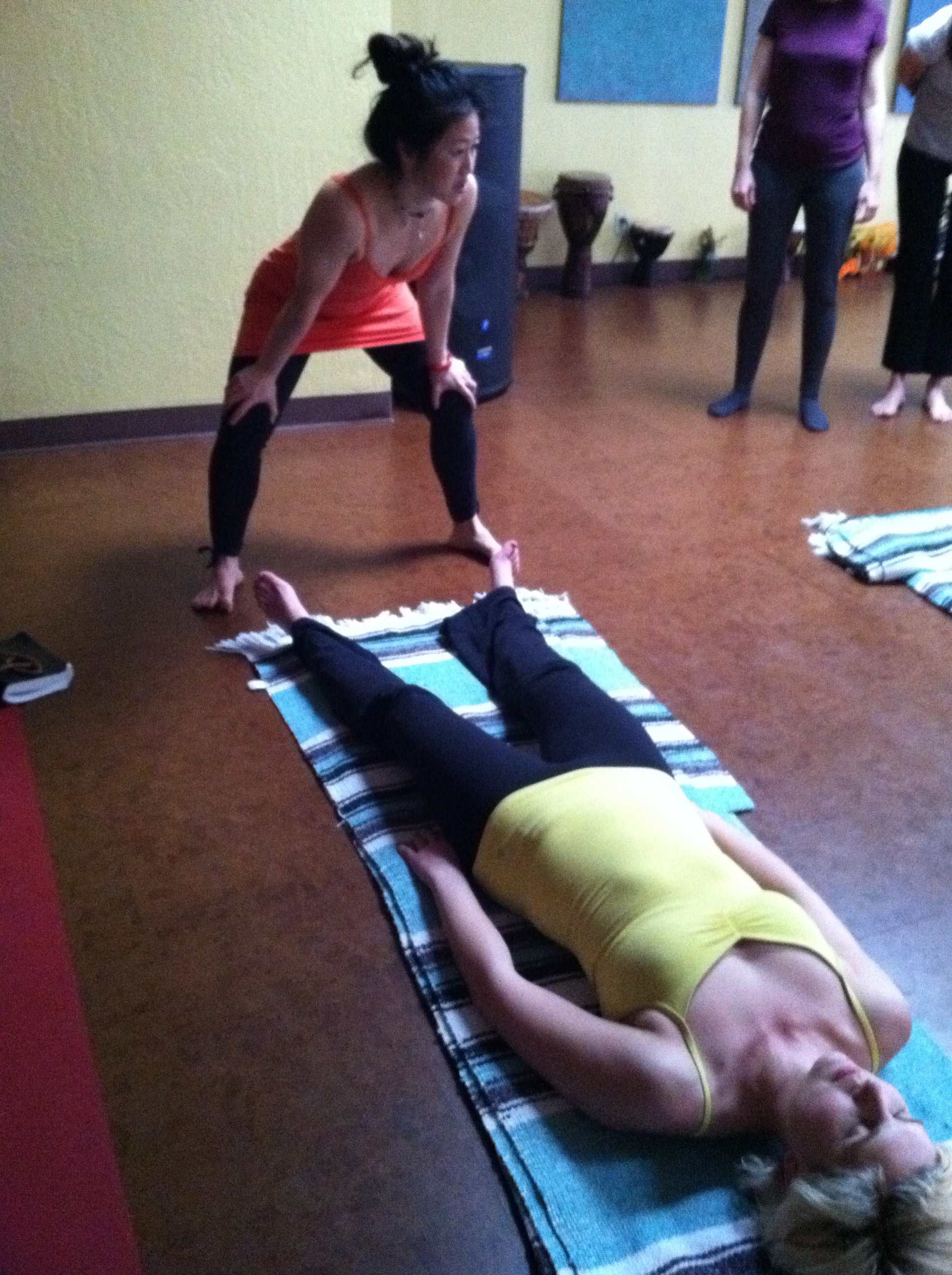
Twelve of us rolled out mats and gathered props for the afternoon workshop. Thai Massage is one of my favorite therapeutic modalities.  The technique is akin to facilitated stretching. The therapist eases the client’s clothed body into gentle positions that lengthen, compress and ultimately draw out tension and soothe the nervous system.  Pressure point massage techniques contribute to the experience. 

It takes years to become proficient in the finer nuances of Thai Massage, but Yiwen’s intention for Imagethe workshop was to teach a minimal introduction to the basics.  She hoped we’d leave with enough information and confidence to give a simple Thai Massage treatment to friends and family.

We settled in quickly and within minutes were taking turns pushing, prodding and bending our very willing partners.  Taking turns giving and receiving every few minutes prevented anyone from slipping into ‘massage coma’. 

Yiwen is an intuitive and generous teacher with a lovely, healing energy.  As we practiced she knew when to offer help and when to stand back to observe.  If there was a downside to the workshop it’s that three hours wasn’t long enough.  Watching Yiwen teach, it was clear she had much more to offer.  I hope she considers teaching a Thai Massage, Part II Workshop soon.

If you’re looking for a yoga studio that gives you the feeling that you’ve come home, visit Prajna Yoga and Healing Center.

Check out Prajna’s class schedule here: http://www.prajnacenter.com/

This post, I’m very happy to say, originally appeared on YogaStage.


2011 in review

The WordPress.com stats helper monkeys prepared a 2011 annual report for this blog.

Here’s an excerpt:

A New York City subway train holds 1,200 people. This blog was viewed about 4,800 times in 2011. If it were a NYC subway train, it would take about 4 trips to carry that many people.

Click here to see the complete report.


Eknath Easwaren’s Passage Meditation

At first I was put off by Eknath Easwaran’s Passage Meditation.  The prose was too anecdotal, the advice too simple.  The book was for beginners.  Didn’t I already know all of this?  I wanted the answers to my deeper questions, not a parable on the hectic pace of life.

But because I promised my meditation teacher I would finish the book, I continued to read. And once I tucked my ego and arrogance away (and admitted I am a beginner!) I discovered that this book is a gem of subtle yet powerful insights.

Embracing a daily meditation practice requires discipline that, quite honestly, isn’t easy for me to summon.  I keep trying.  There are rare mornings when finding my seat and watching my breath feels like my natural state.  As if this is how it has always been and always will be.  On most mornings, however, the clarity and stillness I’m looking for spends most of the thirty minutes competing with random thoughts about clients, classes and topics for my next blog post.  On these days I sit, I breathe, I wait and then, when the timer sounds, I smile.  Have I failed?  No.  I showed up.  And as long as I continue to show up I know that eventually the days I feel meditation is my natural state will outnumber the days when stillness has to compete with my chattering mind.

Tonight I was reading about the power of thoughts and control of the senses.  Easwaran writes that this is our goal:


When we stimulate the senses unduly, vitality flows out through them like water from a leaky pail, leaving us drained physically, emotionally and spiritually.  Those who indulge themselves in sense stimulation throughout their lives often end up exhausted, with an enfeebled will and little capacity to love others.  But when we train the senses we conserve our vital energy, the very stuff of life.  Patient and secure within we do not have to look to externals for satisfaction.  No matter what happens outside – whether events are for or against us, however people behave towards us, whether we get what pleases us or do not – we are in no way dependent. 

Then it is that we can give freely to others; then it is that we can love.


Initially I thought I’d write that Passage Meditation is a simple book.  It feels like a simple book.  But once the heart and mind are open to its teaching, it becomes a rich and layered set of ideas that will move us forward in our practice.


More Monkey Mind: Finding Clarity in the Muck

It would be fair to say that over the past few days my life has begun to resemble a lamentably bad country and western song:

“My boyfriend left and the car won’t start.  My battery’s dead, I gots a broke down heart…”

So cue the violins.  Stuff happens.  Here’s the thing.  Yesterday I wrote about how Monkey Mind will mess with your head by encouraging you to re-live your mistakes in an endless Groundhog Day-esque loop.

But that’s not her only talent.

When I stepped out the door this morning I expected today to be like most Wednesdays:  I should have been on the road to see clients in Saratoga by 8:15, back to Palo Alto for a 12:45 appointment, up the road for two back to back classes, home for dinner, out to the studio to teach the 7:30 class, home to bed.

But when I slipped the key into the ignition and heard the glurg, glurg, glurg of an engine that had no intention of delivering me to my appointed rounds, Monkey Mind took her cue and started chattering:

“Oh, it’s probably the starter.  Do you have any idea how much that is going to cost?  You’ll probably have to cancel all your clients today…and tomorrow…maybe even Friday!  Your clients won’t want to see you again.  You’re too unreliable.  And you’ll have to call a tow truck.  Do you know how hard it is to call a tow truck?  And that will cost money, too.  Do you have any money?  You don’t have money, do you? Oh and don’t forget about rental car you’ll need while yours is being repaired.  You might as well kiss your savings goodbye…”

And so on.  My little Monkey Mind bounced from one scenario to another – all of them bad.  It would have been easy to just submit to the chatter and allow myself to become more and more wound up, anxious and frustrated.  I mean, that’s what we do, right?  Life hands us a bit of unpleasantness and we give in to it.  We listen to Monkey Mind.

Not so fast.  Maybe we don’t listen to Monkey Mind.  Maybe we see through Monkey Mind’s games and choose an alternative course.

This morning I gave Ms. Monkey about ten minutes of my time before I sat down, closed my eyes and took a few breaths.  And then I found the number for Honda Care’s roadside service.  I rang and the tow truck arrived within thirty minutes.  The driver charged my battery.  I drove to my dealership and purchased a replacement.  Yes, I missed my clients in Saratoga but the rest of the day went pretty much according to plan.

So stick that banana in your pipe and smoke it, Monkey Mind!

I’m not going to try to convince you that today is one of my better days.  But it’s far from the crisis my chattering Monkey Mind wanted to create.  It’s just been a day.  One simple, human day.

Like most habits we are trying to build or break, creating a daily meditation practice is a process full of ups and downs.  I always understood that part of the process was being diligent about setting aside time each to practice.  But I also need to welcome opportunities that allow me to weave what I’m learning into the fabric of my day-to-day life.

When we step back from the muck occasionally thrown our way and examine our lives from the edge rather than the center it becomes clear that the work we’re doing is powerful and transformative.

I know that Monkey Mind will always be lurking.  But today I discovered that she’s no match for me.


Cleaning, Chaos and Attachment: Adventures in Meditation

When life seems out of control I do the only reasonable thing.  I clean and organize my apartment. And when I say clean and organize, I mean it. Knick-knacks and clothes are bagged for donation to Goodwill.  Books are boxed for re-sale at Book Buyers in Mountain View.  Every surface is scrubbed and dusted and then furniture is moved in the hope of creating the perfect Feng Shui flow.  This last time I went so far as to cancel my cable and donate my television to charity.  It seems the only way I can reclaim control is to pare down my life to little more than the bare necessities.

When there’s nothing left to clean and if I remain desperate for more control, I update my calendars. I have three calendars – the calendar on my laptop, the hardcopy I keep in the event of a computer meltdown and the calendar on my iPhone (which of course is supposed to sync with my laptop but I haven’t sorted that out yet). I’m embarrassed to admit that all three calendars are color-coded.

If I continue to feel unsettled I start with the lists.  I write shopping lists, goals for the immediate and the far away future and a list of day-to-day chores.

I keep at it until I’ve lulled myself into believing that I’ve created order from chaos.  Of course, instead of feeding my compulsive nature by focusing all my energies on the external environment I could be creating the control and calm I crave by – wait for it (smacks palm of hand on forehead)meditating.

And while I’m preparing for meditation by hanging out in Adho Mukha Savasana I could ask myself the right question – what is the turmoil I’m experiencing within all about?

The sense of impending calamity I feel from time to time boils down to my talent for creating unreasonable attachments to events out of my control.  The more I sense the loss of control, the more I attempt to cling to the story I have in my mind of how my life should be. But clinging to a story is like trying to grab vapor.  You can’t, can you?

The truth is, I can clean and clean until my knuckles are raw but that will bring me no closer to the control I crave.  If I truly want control, then I have to relinquish my desire for it and instead embrace the gift of clarity that a growing meditation practice offers.  I need to understand that we can only control our response to the events around us – not the events themselves.


A Tale of Two Families…and Me

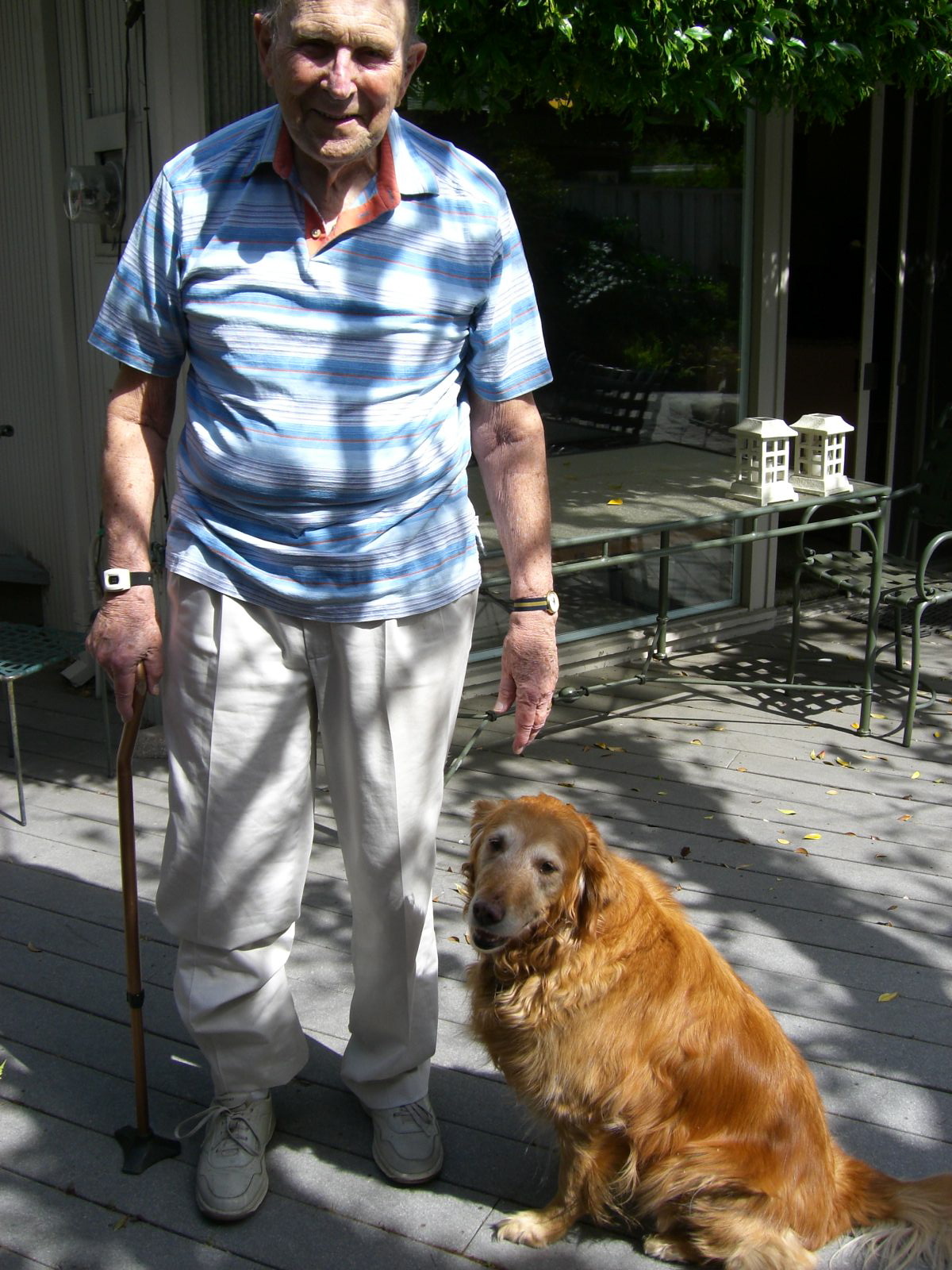
Tom and Thea, 2009

In the autumn of 1939 there was a heat wave in Northern California.  By September temperatures approached one hundred degrees. As the Bay Area sweltered, Hitler invaded Poland, New York prepared to play Cincinnati in the World Series and the minimum wage rose to thirty cents per hour.

Bill and Tom, beginning their freshman year at UC Berkeley, met for the first time that autumn on board a train traveling across the San Francisco – Oakland Bay Bridge.  Trains did that in 1939.

Seventy-three years later and the boys in that train car are now old men. Bill is tall and shockingly handsome for a man of ninety. Tom walks slowly, but his Irish/Italian eyes still sparkle.  Especially when the stock market is bullish.   He’ll be ninety-one this next May.

Tom and Bill teased one another, as young men will, when each fell in love.  While Tom wooed a beautiful girl on a picnic in the Berkeley hills Bill found love in San Francisco when he met a feisty blond.  The sweethearts married, and Tom’s brunette bride Isabel became best friends with Bill’s gorgeous Bobbie.

Both men served during World War II. Tom was an officer on a Navy tanker in the Pacific.  Bill was an infantryman in Europe who landed in Normandy not long after D-Day and entered Dachau two weeks after it was liberated.

After the war, their homes, one a shiny Eichler the other a rambling Craftsman and only a few miles apart, quickly filled with children. At last count there were eighteen grandchildren and two great-grandchildren.

From time to time the families gather together for simple meals of crusty bread, Bobbie’s cherished homemade soup and bottles of Yellow Tail wine.  They gather to celebrate.  But when Bobbie and Bill lost their eldest and Tom lost his beloved Isabel, they gathered to mourn.

All from a friendship that began when two boys headed to Berkeley on the same train in 1939.

I met the couples and their children four years ago, before Isabel passed.  I was astounded their friendship could be measured in decades as my close friendships are only measured in years.  In fact, I don’t know that there will ever be another time when friendships begun by happenstance will endure seven decades of war, love, marriages, births, and deaths.

Of course I’m grateful to be a few mouse clicks from friends I knew in high school.  But that was almost forty years ago.  What do we have in common except memories?

I look at the lives of these two couples and all the good people they’ve brought into the world and I’m nostalgic for a way of life I’ve never experienced.  Our lives move artificially fast and in the frenzied wake intimacy borne of a shared meal or a family gathering is lost. We flit around the world and we forget people.  We forget moments.  We forget.

So strong is my craving for connection and the setting down of roots that I almost lost a friendship this week.  For me, it would have been a horrible loss.  The lesson I’ve learned from the past few days is that clinging to your idea of something is like trying to hold on to smoke.  It’s impossible.  I will never have the life-long love of Bobbie and Bill, Tom and Isabel.  I won’t have children, or grandchildren.  But there’s no doubt I will have love, connection and intimacy.  It’s possible I already do, but I’m too attached to what I believe those words should mean that I haven’t noticed they’ve been re-defined for the twenty-first century.