What Do Gardening, Health & Art Have in Common? Kinds of Kindness.

There was a time when the level of happiness I felt in a day was determined by the number I saw on the scale upon weighing myself each and every morning. As I aged I saw the futility and ridiculousness of that ritual and stopped weighing myself. For many years I lived without a scale in the house. If I’m being truthful, however, to this day, on those rare occasions when I do check in on my weight the number I see still has the power to set my mood.

Something similar happens when I am in my studio. If the work is going well then I’m all smiles. If I’m struggling with the materials, or if I’m certain I’ve ruined a new piece I was enamored with just the day before, I question why I even bother. Then there’s the mental baggage that accompanies me when I’m headed to the studio. If by chance I open that baggage and spill it’s contents then navigating my studio and doing the work my heart wants me to do is made more difficult by the messy mental stumbling blocks I’ve placed in my way. Like my ever-present impostor syndrome, for example. Or the envy I sometimes feel for another artist – their gorgeous work, their incredible success. And when there is envy, shame for feeling envious is not far behind.  

As I write these thoughts I can look out the window and see that the team of gardeners we’ve hired have arrived. It will take some time to clear out decades of overgrowth, to repair a stone wall and to remove the non-native ivy climbing the trunks of our trees. But when the work is finished I will begin to prepare one small bed at the base of the largest tree for planting in spring. Which reminds me of something someone told me a few weeks ago. They told me that gardening is not a project, it’s a process. Indeed.

Two and a half decades ago I joined Weight Watchers and lost sixty unnecessary pounds. I lost the weight so quickly that I gained more than a few gallstones and a nasty case of disordered eating but we can save that story for another day. The mistake I made at the time was thinking of my weight loss journey as a project. And once those pounds were dropped the project was complete. Silly me.

Three years ago, when we moved to Virginia, I was determined to find the artist I abandoned when the need to have a steady income was more urgent than the need to create. Somehow the universe felt my determination and opened a few doors for me. She built a solid foundation for me when I was accepted into the Incubator Program at McGuffey Art Center in Charlottesville.

In 2023 I took on the year-long residency at McGuffey as a project. Show up. Do the work. Exhibit the work. Sell the work. Repeat. What was I thinking?

Gardening is not a project, it’s a process. Holding on to good health is not a project, it’s a process. Creating art that resonates is not a project, it’s a process. I guess it follows, then, that life is not a project. It’s a process. 

It’s a process that begins with kindness. Being kind to my home. Planting seeds. Nourishing the earth beneath my feet. Hard and rewarding work. Being kind to others. Admitting when I’ve made mistakes or when my words have hurt someone. Showing gratitude for deep friendships. Remembering anniversaries and birthdays.

But being kind to my breathing heart? Being kind to my creative heart? That can be challenging.

Manifesting kindness towards myself when I’ve spent seven decades judging and comparing myself to my wealthier friends, to the skinny models I see in magazines, to the artists that speak with eloquence and passion about their work is a struggle. Maybe it requires breaking the habits that keep my self-care and kindness at bay.

Maybe it begins with embracing the truth that the process – whether it’s planting a garden, celebrating good health or creating art  – doesn’t run in a straight line. It meanders and curls and doubles back on itself and then forges ahead. It moves around obstacles, plows through roadblocks, climbs metaphorical mountains and charges down steep hills like a child on a Schwinn Stingray Chopper, bugs in her teeth from smiling too much and bright colored vinyl ribbons dancing from the handlebars.

Each moment of the journey – the bumps, the stumbles, the thrills and delights – they all require different kinds of kindness. Sometimes I have to be forgiving. Sometimes I have to be honest. Sometimes I need to put my nose to the grindstone and sometimes I need to rest. Figuring that out is exasperating. And kinda fun.

Don’t forget…Practically Twisted is disappearing in a few months. If you appreciate my musings, join me at Mimm Patterson Art.


Moving Day

Note: I’ll be shutting down my WordPress site in a few months. If you signed up to receive my little posts – thank you! If you would like to keep up with my art, my online yoga classes or just the ups and downs of life, please visit my new Squarespace website.

Some people thrive under pressure and chaos. But I’m one of those people who prefer order. I like routine. I perform best when there’s a place for everything and everything is in its place. This isn’t limited to the objects I choose to keep around me. I need a place for my thoughts and feelings, my reactions to the world around me. I need a place for unfinished conversations, my hopes and my fears.

The home we loved. Until we didn’t.

Order is a little tricky to find right now. My beloved and I moved house over the weekend. We’ve downsized and our new home – a late 1990’s duplex on the other side of town – is lovely but it is also much smaller than the townhome we left. And it lacks a garage which is, of course, the space in every house that collects the detritus of life. That being said, our new home is much larger than the five hundred square foot condo we shared in California with our dearly departed cat Bruce (naturally Bruce took over most of the real estate). We lived there for almost a decade – even through the pandemic – so if we managed that small space I’m certain that with a bit of determination and perhaps more than a little compromise we’ll manage this space, too.

Besides, trading square footage on a high trafficked main street for a quiet cul-de-sac and a back garden was an easy choice. Right now that back garden is more a dense carpet of weeds and broken branches but you ought to see what it looks like in my mind’s eye.

But it hasn’t been an easy move. Is any move easy? This one – just two miles down the road – has been one of the most difficult I’ve experienced. My beloved agrees. It doesn’t make us less grateful. We’re just aware that the last few months haven’t been easy.

I’m reluctant to blame age and more inclined to blame circumstances that are too boring to get into. Let’s just say, for the time being, chaos and clutter reign supreme.  No matter. We both know that it won’t always be like this. At some point order will be restored.

I hope.

I hope because I have a solo exhibit in four months and then another just five months later and of course I’m excited and grateful but after a week away from the studio the deep unease of slow rising panic was beginning to overwhelm me. 

But today, after seven long days, I got back to the work. And in doing the work I found a place for my thoughts and feelings, my reactions to the world around me. I found a place for my hopes and fears.

My beloved and I will be living with a few more weeks worth of chaos and clutter in our new home but for now, for me, a little bit of order has been restored. 


On Seeing the Infinite

Moving northwest at midnight, seven strangers and two friends in a rented van. Driving into a pitch black wilderness with the southern cross as guide, we are bound together by faith that some force beyond our knowing will take us to the place where a tribe has gathered.

We find them on a hillside. There are hours still to wait. 

It begins at dawn. The orange sun rises behind the Queensland Hills. And then it slips behind the moon. It seems so simple to write these words: the sun slips behind the moon.

But in that moment – that singular moment – spirit is made visible. The universe becomes a sanctuary of peace.

No one can speak. The rhythmic click of shutters that sound like mechanical crickets continues to record the celestial sorcery but in my ecstasy they no longer register. As the world falls dark birds call to one another, confused. Sandy termite mounds turn red in the changing light. The air falls on my skin cool and moist.

We cry. Or at least some of us cry. We open our hearts to the truth of the cosmic order and our own insignificance. Or at least a few of us do.

And then the sun slips out from behind the moon and we take our first new breath. I expect my life to be different now. I expect my life to be different now that I’ve witnessed the infinite. That perfect black hole in the sky. Except I know it won’t be. This was an illusion. It’s only the moon. It’s been the moon all along.


Brucie

The Stoics remind us to contemplate our death each day. I contemplate Bruce the Cat’s.

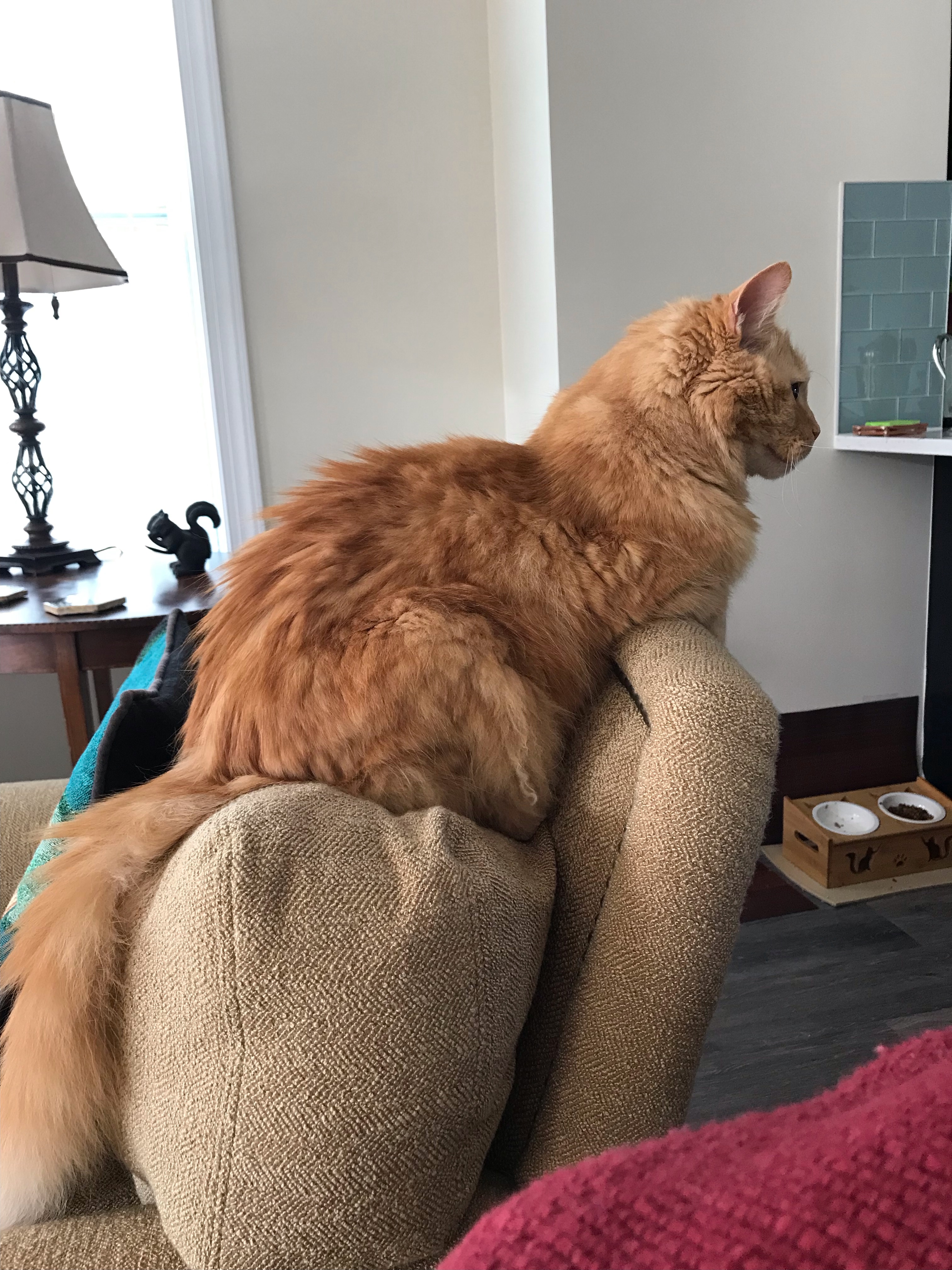
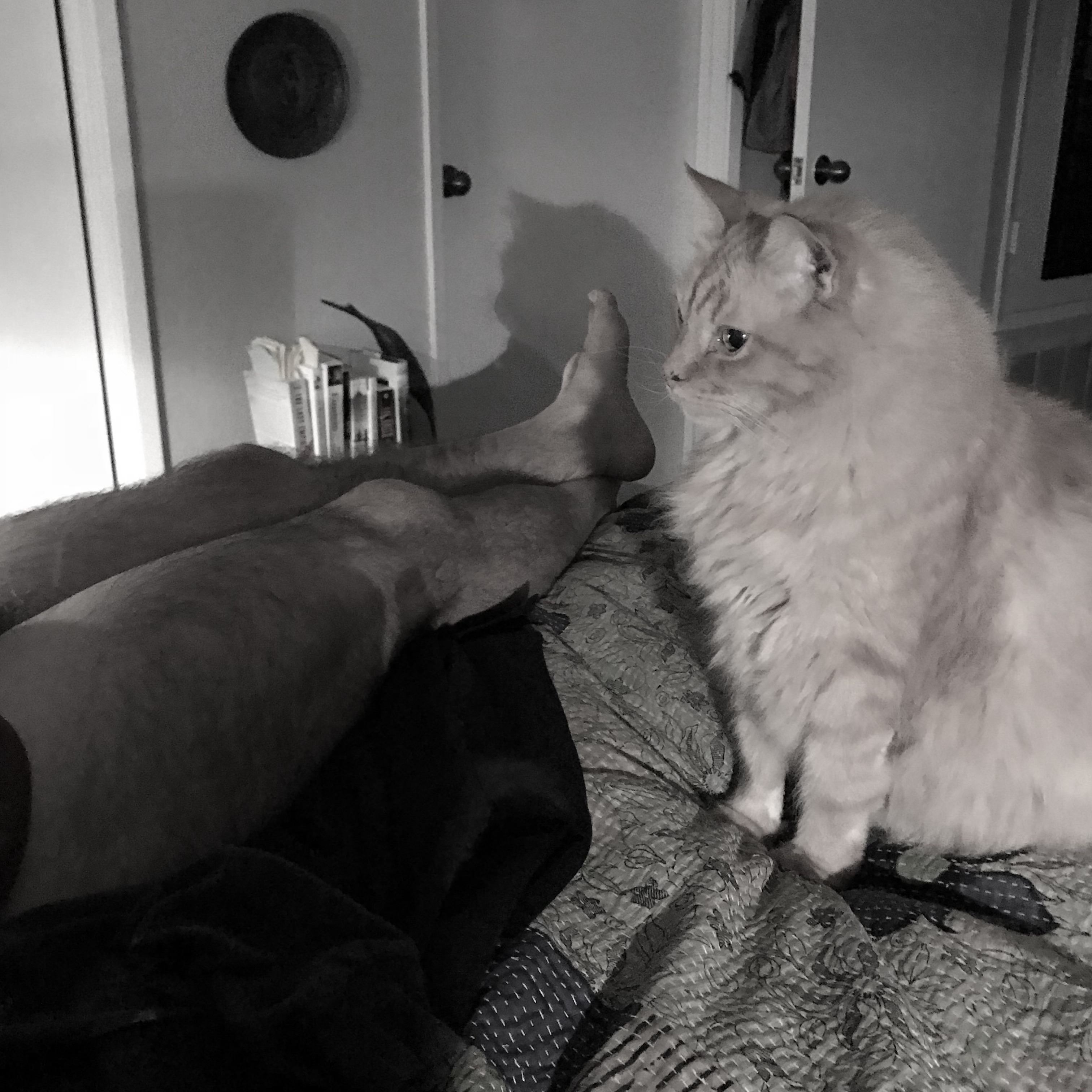
Bruce the Cat turned twenty-one in September. I’ve known him since he was fourteen, when his previous human companion passed away and Bruce came to live with me and Ben. Over the years, and especially since our move to Virginia almost two years ago, Bruce and I have developed a morning routine. He wakes me sometime between 5:00 and 5:30 AM. I follow him down the stairs into the kitchen. He stands by the door to be let out onto our porch, where he searches in vain for a nibble of the mint or Thai basil I grow in pots during the summer. But it’s gone now, pulled out just after the first frost. Back inside he paces and cries at my feet while I brew coffee in my stainless steel cafetière and shred the chicken I cooked for him the night before. He turns his nose up at it until I add two of his favorite treats. After his breakfast he sits at my feet for a moment, then gracefully jumps onto my lap and squeezes in between the laptop and my belly for cuddles while I read headlines from the New York Times website and try to conquer the day’s Connections. After twenty minutes cuddles are complete. Bruce jumps from my lap, ponders a detour to his litter box, but decides instead to lumber over to his chair. The same chair that I once envisioned as my ‘writing chair’. But instead of being my writing chair it has become – and this is non-negotiable – Bruce’s chair. Covered in a mound of blankets to protect the upholstery, it is the throne from where King Bruce the Cat holds court. It’s where he sleeps and dreams wild dreams of chasing rabbits. I can see why he likes it. First of all, the chair is positioned at an angle that provides the royal feline a view of everything his subjects are up to in the living room and kitchen. It has the added benefit of being placed near a window that has afternoon sun, which is perfect for nap-taking when counting the number of times Ben and I putter about in the kitchen becomes too boring. 

But one day soon Bruce’s throne will become my chair. When it does my heart will be broken because it will mean King Bruce the Cat is gone. But I know my sadness at his passing will gently transition to happy memories I’ll keep of having had the honor of being his human companion.

I wrote those words on a cold pre-dawn morning in early November. And this past Saturday Bruce’s throne became my chair. His health had been declining for a few months and then, over this past week, Ben and I witnessed a rapid decline. On Saturday we knew it was time. An appointment was made for early evening and so we had one last day with our most wonderful Brucie.

The vet techs and doctor were compassionate and with gentle assurance promised to take care of Bruce. Promised we were making the right decision. We can never know for certain but Bruce seemed ready. I scratched his chin, gave him a kiss. Ben stroked his head and talked to him. Then we said goodbye.

Bruce and I first said ‘hello’ eight years ago, while Ben was out of town on business. I made the executive decision to adopt Bruce after seeing his photo on NextDoor. Ben, not a fan of felines and convinced he was allergic to dander, reluctantly agreed via Zoom (yes, he loves me that much). But when Ben returned from his business trip a few days after Bruce the Cat moved in he made it clear that ‘the cat’ was not allowed on our bed. ‘No problem’, I said. ‘It’ll never happen’, I said. ‘Bruce is too old and too fat’, I said.

Not long after that conversation Bruce decided Ben and I would suffice as human companions. He wiggled his sixteen pound frame out from under the sofa where he’d been hiding for the first three days in his new home, waddled past us with his head and tail held high, and in one graceful leap jumped on the bed.

It was clear to Ben and me there was a new boss in town.

And now our boss is gone and we are bereft.

The connections we share with our non-human animal companions are unlike any we share with our human animal companions. The love language Bruce and I used to communicate had no words. It was energy based, instinctual and intuitive. Bruce asked for few things: food, water, shelter, cuddles and a clean litter box. Easy things to provide. In return he provided warm, comforting purrs and the occasional, perfectly formed hairball. We met each others’ needs without speaking a word.

I want to go on and on about the impact Bruce had on Ben’s and my life. His antics. The trouble he sometimes caused. The many smiles and laughs he provided. His willfulness. These stories are what make mourning Bruce’s loss a beautiful process. Because the massive waves of sadness I felt on Saturday are gentler now as all those memories wash over me. 

So I won’t bore you with stories about Bruce. I sorta wanna keep them to myself anyway. I’ll just tell you this: Brucie was a wonderful cat. The house is empty without him and we will miss him very much.


Surviving the Apocalypse

There’s a hiking trail in the Stanford Hills called The Dish. It’s named for the 150-foot-diameter radio telescope that has been planted there since the 1960’s. When I lived on California Avenue in Palo Alto – not far from the Stanford campus – I had a fair view of those hills and that telescope.

In winter the Stanford Hills are brown. Not an ugly brown, mind you. More a mix of yellow ochre with burnt sienna shadows, while the bare brush and bark of trees draws random but perfect streaks of Payne’s grey across the topography. 

It doesn’t matter how pretty the Stanford Hills are. If you know those hills you also know that months of sodden brown can cause us to take those gorgeous winter hills for granted. We stop looking at their beauty. And it’s right about then that a miracle happens.

The Stanford Hills turn green.

On the morning of the first warm day of the first warm week of spring, you  awaken to a hint of the joy to come. The scent of something rising up from the earth. By lunchtime there are scant traces of green. It happens so fast that if you don’t stay present you’ll miss the transformation. An hour or two from dusk the low angle of the bright sun turns what were brown bumps just the day before into glimmering emerald waves.

To be honest, I don’t remember if the hills turn green in only a day but I can promise you it feels that way.

And anyone who has been witness to the transformation knows, of course, that in a matter of weeks great, green waves of grass will transform again to parched summer straw. But isn’t that all the more reason to celebrate those few short days when the Stanford Hills look like shimmering emeralds?

The last quarter of 2023 was an amazing highpoint for me –  a visit to California and a reunion with friends and students I’d not seen since Ben’s and my move from the Bay Area. 

But the last quarter of the 2023 was a low point for me, too. A decade long friendship was fractured, and then I experienced an unbelievably weird accident that left me questioning everything about my health and wellness as I turned sixty-five and navigated weeks of sciatica and plantar fasciitis.

As I wallowed in self-pity hundreds of young people were gunned down and brutalized at a music festival half-a-world away. Grandparents were slaughtered, arms of young men were blown off and on a bomb-scarred strip of land terrified and innocent people are – over one hundred days later – trying to survive and hoping to one day find their way home. 

And this morning, just east of the snow covered mountains that surround the Shenandoah Valley, I sit in my warm home. I drink fresh brewed coffee, its edges softened and sweetened by glugs of vanilla oat creamer. I watch the flurries drift and absentmindedly stroke the ears of Bruce the Cat. All the while anxiety stokes my fears. 

How will we get through what is to come? 

We have ten months of existential angst to survive before we learn if it’s the end of our nightmare or the beginning of a new one. 

I know that I am not the only person whose mental health has taken a direct hit over the past few months. For a time I wasn’t sure how I would find my way out of my ever darkening and deepening malaise.

But somehow, over the last two weeks, something within has shifted. Just like those Stanford Hills, my mental state has moved from grumbling brown to hopeful green. I know it’s a continuum, and that this change is not permanent, so I’m going to lean into this goodness I feel.

Because the Middle East is still on a short fuse and our former president continues to spew dangerous rhetoric. 

So to support the positive uptick in my mood, I’m using the tools I have that help me stay anchored to the present instead of spinning into the dystopian nightmare I sometimes imagine we’re heading towards.

In no particular order, here are those tools:

  1. Routine – I do my best to keep a regular schedule. This means I rise at the same time each day and fall into bed at the same time. It means I do my best to plan ahead so that navigating life feels easier somehow. And, when I know I don’t have the energetic strength to take on a new task or activity, I say ‘no’.
  2. Humor – I will watch any SNL skit where Jimmy Fallon breaks character. The ‘cowbell sketch’ has always been a favorite. But recently I’ve fallen in love with Gary Gulman’s comedy. Especially his bit about the committee that decides how the full names of our fifty states should be abbreviated to two letters. 
  3. Social engagement – I’m not a party type of gal but there’s something to be said for having at least one person outside of your immediate family with whom you can share how you’re feeling. I’m lucky to have that person and sharing with her helps me to shape a healthier perspective.
  4. Nature – I need to move to feel good and for me this means a walk in nature. On my trail walks it’s not unusual to see a few deer, a raptor or two, or scarlet cardinals flitting from bush to tree. Plus it’s really fun to run into neighbors walking their dogs. Especially the corgis. Nothing will put a smile on my face faster than a waddling corgi butt.
  5. Nutrition – When I feel myself sliding into malaise it takes no convincing at all for me to reach for that second glass of wine, or – and in excess, of course – those foods that bring comfort to me: a non-stop conveyor belt of fat, sugar and carbohydrates. But when our mental health is suffering, good nutrition will provide the energy we need to regain our strength. 

But everyone’s tool box looks different. When you find yourself sliding towards despair, what do you reach for as a lifeline?

Because I think we’re in for a bumpy ride this year. I could be wrong. Still, I’m going to prepare for the worse even as I hope for the best. I have my tools and I have my memory of the Stanford Hills turning green in the blink of an eye to remind me that if I don’t stay present I will miss opportunities to find joy.  And I have the feeling that this year we are going to have to embrace all the moments of joy we can find.


Bruce the Cat and Full Moon Mornings

The moon woke me this morning. Just like last month’s full moon. Suspended like a prison guard’s searchlight outside my living room window. So bright I can read by its light. That moon. Too stunning to turn away. I watch its stealth decent – soon half gone behind the trees across the way. Meanwhile, grey dawn begins to cast its own soft light through the kitchen window behind me. A reminder that soon there’ll be no time to be distracted by light bouncing from a pock marked rock floating in blue black space. My day is beginning. And in the last few minutes of pre-dawn stillness my task is to put down words to describe what I see and feel. 

But that’s impossible because the padded click of Bruce the Cat’s clawed feet across our luxury vinyl plank flooring tickles my ears as he approaches the overstuffed chair where I sit with my laptop resting – appropriately – on my knees. A fresh brewed cup of coffee is on the table to my right. 

Bruce the Cat is deaf. These days he compensates for his deafness with meows loud enough to wake the dead. They are meows that after twenty years are beginning to grow rough around the edges – a combination of Screech from Saved by the Bell, Urkel from Family Matters and a two-pack-a-day habit. And as his primary human companion I know what each meow means. 

‘Hold me. Love me. Feed me. Pet me. Take me out. Bring me in. Leave me alone.’

Despite a stagger in his step when he first wakes Bruce remains nimble and has no problem hopping onto the arm of the chair. He spends a good five minutes investigating – my computer, my face, my coffee cup – before settling on the sofa to watch the moon with me. Or to take a nap.

I adopted Bruce when he was fourteen-years-old the death of his first human companion. I saw his photo on NextDoor and was smitten by the cheeky look in his eyes and his long ginger coat. My own human companion, Ben, was not a ‘cat person’. But he loved me (miraculously he still does). He said ‘as long as Bruce doesn’t jump on the bed’. Not only was Bruce a senior cat, he was obese. So I said, ‘don’t worry, he’ll never be able to jump on our bed’. 

After three days, when Bruce the Cat decided that his new living accommodations were satisfactory, he crawled out from under the couch, sauntered into the bedroom, wiggled his butt to build maximum vertical lift, leapt onto the duvet and fell asleep on Ben’s and my pillows.

From that moment Ben and I knew who was boss. It wasn’t us.

And now, six years later, our lives revolve around Bruce the Cat. We’ve grown accustomed to being covered in cat fur. It’s become second nature to do a visual sweep of the kitchen floor in the morning to make certain there are no horked up hairballs. And we clean Bruce’s litter boxes with the ease and nonchalance of a mother changing a diaper. 

Bruce the Cat will be twenty-one in September and I know that means the time Ben and I have left with him is limited.

If I’m being truthful, knowing that Bruce’s best days are behind him, I feel compelled to spend time with him. To keep him nurtured and comfortable. I cook chicken for him and give him bonito flakes as a treat. I don’t like to upset his routine and avoid traumatizing Bruce with cat sitters. So I don’t leave the house for more than a day. And as the sun rises and the moon sets, I put off writing to offer Bruce the cuddles he and I both need. I love Bruce, I love Ben and I love my home. I feel immense gratitude for all three.


Seasons Change

I spend my childhood in rural Pennsylvania. In the 1970’s we keep cool during the hot and sticky summer by catching minnows and crayfish in the creek that runs down from the Blue Ridge Mountains and past my house. In the fall we kick our feet through thick blankets of candy corn colored leaves while the blue mountains turn russet. With the first flurries my sister and I press our ears against transistor radios tuned to WAEB and with fingers crossed hope to hear the name of our school, Northwestern Lehigh Elementary, read aloud along with all the others closed by icy roads and blowing drifts of snow. In spring we trade long pants and boots for knee high socks and cotton culottes. The periwinkle in my mother’s rock garden begins to bloom. The snow melts, the frozen creek thaws and the Blue Ridge Mountains drop their coat of rich winter grey as the new leaves stretch for the sun. For a few weeks the air is perfumed by the lilac bushes outside my bedroom window, and then the school year ends and the hot and sticky dog days of summer return.

When Ben and I first arrived here, to Virginia, the early mornings were already warm and humid, the evenings tolerable. And now, five months later, we’re pulling out the woolly hats and thick coats that spent California winters crammed into the back of a dark closet.

I didn’t know until now how much I missed seasons.

Outside my window is an endless row of tall, bare limbed trees that grow along the Slabtown Branch of Linkinghole Creek. When we arrived in July they were lush and green. Towards the end of August the leaves of one began to shift from shimmering emerald to shades of deep ruby and dusky gold. I was certain it had died. But it was simply leading the way and within weeks all of the trees seemed to be competing with one another to see which might be the most autumnally resplendent.

But now the leaves have dropped. I can see through the trees’ crooked boughs and across the creek bed to the nest of family homes that wind their way up Bishopgate Lane. In the early evenings that we have in mid-November warm light glows from each window and I imagine the homes are filled with the scent of baking bread, home cooking and childish giggles. And as the folks who live there look out toward Old Trail Drive and see the light from Ben’s and my home I wonder if they imagine the same story? Not wanting to disappoint, I returned from my last trip to the local Harris Teeter with flour and baking powder and yeast. It’s definitely soup season and what better treat to enjoy with soup than warm bread with lashings of butter?

Today the temperature will be hard pressed to break forty-five degrees and it will be raining by this afternoon. How cold does it have to be to snow? It doesn’t have to be freezing but I’m certain the ground is not yet chilled enough to support a dusting of the white stuff. But will those trees outside my window be coated with white on Thanksgiving?

I’ve been told by new friends who’ve been here longer than Ben and I to not get my hopes up. There are, without a doubt, four wonderful, glorious seasons here in little Crozet. But winters, my neighbors tell me, lean a little too far toward the temperate to see snowball fights or a carrot-nosed Frosty in every garden. 

I’m more likely to find puddles of slush. I’m ok with that.

Settling into the rhythm of changing seasons changes everything else: the food I eat, the clothes I wear, how I spend my downtime, how I commune with nature. It changes my yoga practice and the yoga I teach. It makes me aware of time and the passage of time in a way that the glorious, endless California sunshine never quite managed to do for me.

And while it’s true that at some point I’ll rue the moment that I step into a deep puddle of wintry slush I know that I will never not love watching the seasons change.


Comfort

I enjoy Caitlin Kelly’s Broadside blog. Kelly is the author of Malled and Blown Away and, as a journalist, has written for the Financial Times, the New York Times and Forbes. And every Monday morning, without fail, I can count on finding Broadside in the dozen or so emails that have landed during the night.

Tiny treasures: a bag of vintage buttons and century old sewing needles.

What I enjoy about Broadside is Caitlin Kelly’s concise, sweet, simplicity. She has a way of taking quiet moments from her own life and writing about them in a way that makes her readers feel as if she’s writing each one a personal letter. Kelly is not maudlin nor does she over-romanticize stories from her life. She writes with touching economy and clarity that’s easy to read with my morning coffee. And more often than not what she chooses to share resonates because I either have been or am ready to go through a similar experience. I’m certain it’s because we are about the same age and life events tend to align, but sometimes I can’t help but say, ‘dang girl, you too?’.

For example, in a recent Broadside Kelly wrote about a small inheritance she received from her mother with whom she was estranged. The inheritance included a large pastel of Kelly’s great-grandmother and a small framed sampler – the embroidered alphabet grey with age. Having never received an inheritance, she found comfort and continuity in having these objects around her. And then she asked her readers, ‘what brings you comfort?’.

Many things, of course, bring comfort. A good meal. A loving partner. The purrs of your feline purr baby or the unconditional happiness of your canine best friend.

But other things – other circumstances – bring me comfort, too. I find comfort in surrounding myself with objects that have a history and the energetic imprint of the people from whom they were received. In fact, from where I sit this morning, I’m surrounded by things given to me by others: the painting on my wall, the brass lamp, the sofa and chairs, the tea chest and pillows, the porcelain box and the ceramic vase. Everywhere I look I’m reminded of friends that feel more like family and am I filled with love.

I wasn’t always so blessed. I’ve lived what I might describe as an IKEA-like existence. Easy to assemble, sometimes quick to fall apart, ready to go at a moment’s notice. No matter where life took me I managed to get there with as few boxes as possible. With as little excess weight as possible. 

There are a few things, of course, that managed to stay with me through my many moves. I still have the capo I was given fifty years ago when I played 12-string guitar. I still have the little plastic box that held my guitar picks. I have a few of my picks from those days, too. But these things don’t speak to who I am. They speak to a time in my life when I borrowed my roommate Sissy’s Gunne Sax dresses, which were always a size too small. They speak to a time when I rode shotgun in Mike’s green Chevy Nova from our college campus in Crete, Nebraska to a shopping mall’s fern bar in Lincoln where we’d unpack our guitars and sing Dan Fogleberg songs. 

I love that I have that old capo and those guitar picks even though I no longer have the guitar. It’s nice to have a few things that hold the memory of moments decades old. But what do I have that tells the story of who I am and why does knowing who I am – where I came from – bring comfort?

Over this past weekend I drove five hours north on Interstate 81 to clear out the books and tchotchkes and photographs and furniture that filled every square inch of storage locker 2011 at the East Penn Self Storage emporium in Trexlertown, Pennsylvania. These things were the remnants of my mother’s life and had been collecting dust and bugs and spiders for four years. My mother was still alive when I sold her trailer; when I threw away her sofa and shoved her clothing into a collection locker I found in the parking lot of the Walmart off of Hamilton Avenue. She didn’t know that I needed to do that; that she wasn’t going home. And I didn’t tell her. Instead I saved what I thought was important. Furniture that had been in the family for a few generations. The dog tags she wore when she joined the Women’s Army Corp. Family photos, marriage certificates and divorce decrees. A complete set of the Harvard Classics. I saved a wooden 12-inch ruler advertising a long since closed life insurance company headquartered in Pittsburg. And her knitting needles. I really wanted her knitting needles. 

What I saved has little monetary value. Not the ugly Edwardian pendulum clock that stopped working before I was born nor the yellowed newspaper clippings my mother taped onto lined binder pages, her perfect Palmer penmanship taking note of why and how and who. I saved them anyway.

I don’t need these things. And while friends who, like me, are approaching the middle of their seventh decade choose to downsize I’m choosing the opposite. I’m gathering. Surrounding myself with a collection that others might describe as junk but to me is a treasure that exists to remind me of a time long past and a place that no longer exists.

It’s important for me to do this because it connects me to a history and to people I never knew but who gave me my nose, my blue eyes and my propensity for weight gain. These strangers whose blood is in my veins also gave me a passion for art and music. A love of nature. Keeping my great-grandmother’s writing desk and my great-aunt’s crocheted doilies honors my history. It honors them. I know the fragile aperitif glasses, the shell shaped plate from Japan and the lustreware casserole dish in which my grandma made my favorite corn pie could be gone in an instant. And after the sorrow of loss passed my life would be the same. Every new day people move through the loss of the things that remind them of who they are and I know how lucky and how blessed I am and I understand the impermanence of this jumbled collection of artifacts that until Sunday were covered in grime in a storage locker five hours up the road. But having these things around me now helps me feel less lost in this world; less like an uncertain, aimless wanderer and more like a woman secure in who she is and how she came to be.

And that brings me comfort.


Finding Awe

There’s a wooded area across the street from our kitchen door. I like to stand on the patio while the coffee brews in the morning, or in the evening after dinner, to see if the deer have arrived. They like to eat the grass and weeds that surround a small pond and I love to watch. I hope I never stop being delighted when I see them.

Annular Eclipse, Pyramid Lake, Nevada 2012

One evening last week when I stepped outside to look for the mother deer and her fawn, the sound of cicadas and croaking frogs was so loud I called Ben to listen with me. It sounded like a symphony of bugs and amphibians tuning their instruments before a concert. I hope I never grow accustomed to their music.

There are bats where we live. On our first week here we saw dozens over our house. They were dining on flying insects and then dancing through the sky to find their next juicy mortal. We haven’t seen that many at once since, but now and again I’ll see one or two grabbing a snack. It surprises me every time. I hope seeing a bat in the sky above my house never stops surprising me.

These experiences create a sense of wonderment and awe in me. And for that I’m grateful because sometimes it feels like we’ve lost our ability to be awed. Sometimes it feels like we’re too distracted by the noise of the world or too jaded by the onslaught of constant information to find time for quiet moments of awe.

But these moments of awe are beneficial to our well being. The sense of awe we feel when we’re gazing at a star filled sky, for instance, or witnessing an eclipse, creates in us a sense of ‘small self’ and deepens our sense of connection with others.

What experiences elicit awe in you?


I Like the Idea of Poetry

I’ll be honest. I like the idea of poetry. I like to think I have the intellectual capacity to enjoy poetry. Years ago, when Kay Ryan was Poet Laureate of our country I listened to an interview with her on All Things Considered where she read some of her work. There was something about her writing – maybe the subtle humor or the economy of words. As soon as Ryan’s interview was over I ordered her book Say Uncle. And because I ordered the book online rather than driving to my local bookstore (which should have been my first choice) I never gave myself the chance to change my mind. The slim volume arrived in days as expected. I opened it once and then, for years, it sat on my shelf. A visual reminder that I like the idea of poetry. 

A few days ago I received a package in the mail from one of my best friends in high school. Back then she was the person I wanted to be. Intelligent. I mean – Merit Scholar intelligent. Funny. Funny in that subtle sort of way that sneaks up and then the next thing you know cafeteria milk is spewing from your nose. Supportive and kind. I know that memories shift and change – but all these decades later I still remember how, in high school, in her own quiet way, she made me feel that I could do anything. I didn’t believe her, of course, but it felt wonderful to have someone in my life who saw the light in me. The thing is, she didn’t know she was doing this for me. It was just who she was. Who she is. 

We lost touch in the 1980’s and 90’s but reconnected around the time that I returned from Ireland. When my sister died alone and estranged from my mother and me, it was this dear friend who opened the door to her home and helped me find Margaret’s grave. 

And so it was no surprise and it put a smile on my face when I picked up the package from my doorstep and saw it was from her. My first thought after ripping open the padded manila envelope was, ‘Geez – that’s a big book of poetry!’. But the card accompanying the gift explained that the poet was local and was one of her favorites. In the past she had sent me books by Annie Dillard and Patti Smith’s autobiography Just Kids – books that I loved. I knew she wouldn’t send me anything I couldn’t handle. Plus the poet had written this inside the front cover for me:

Mimm! I hope these mad moments in verse hold a song for you. Welcome home!

What was I to do? Given that I like the idea of poetry I had no option but to sit down, open the book, and read.

The book is Voodoo Libretto: New & Selected Poems by Tim Seibles, who happens to be a past Poet Laureate of Virginia.

And now, each morning when my brain is fresh (I tried the evening but by then my brain can no longer absorb nuance, cadence and beauty) I open Voodoo Libretto to a random page and read a poem. Seibles’ autobiographical writing is sexy and funny, surprising and relevant. Heartbreaking. On the printed page the words have a jazz cool visual rhythm and when I begin to read my eyes carry me and I can’t seem to stop. 

Curious? Maybe start with his Alison Wolff. And maybe, in a few weeks of mornings I’ll need to diversify a bit and open that slim little book by Kay Ryan. Or Basho if I’m in the mood for three lines of Haiku. Or Ferlinghetti.

Because I like the idea of poetry.

And I’m so happy that my high school friend, who I looked up to with awe in 1974 and still do now, knows that about me.