Finding Joy in Weaving: Embracing Artistic Messiness

Quick reminder: My Practically Twisted blog will be going away over the next few months. If you want to continue to receive my random musings and to keep up with my art life please sign up at the new website.

There’s snow in Crozet today, Friday. It’s beautiful and white and still falling. Rather than drive into the studio I’m going to stay at home and feed the squirrels peanuts. After weeks of non-stop making I’m going to press pause. I’m going to take time to reflect. Ponder. Reconsider. 

Hey – do you remember learning to weave with strips of paper when you were in grade school? I do. And then we learned that our strips of paper didn’t have to be as straight as arrows. If we cut them with curves or at angles they still wove together and – for this little girl at least – created something magical.

I still think weaving is magical.

With this in mind, several years ago I purchased a small frame loom. And then a larger one. And then a larger one still. I’ve brought them home from the studio and while I have every intention of dusting them off the truth is that my messy artist self feels constrained (or maybe intimidated) by those looms. But any time I see a discarded wire rack or some window screen or an abandoned picture frame my brain says, ‘Hey! I can weave on that!’.

And that’s what I’ve been doing these past few weeks. 

We’re not talking the incredible Anni Albers here. This adventure I’m on is fun and frustrating and weird and has taken me on an unexpected detour from the encaustic ‘dream boats’ I was focused on in October.

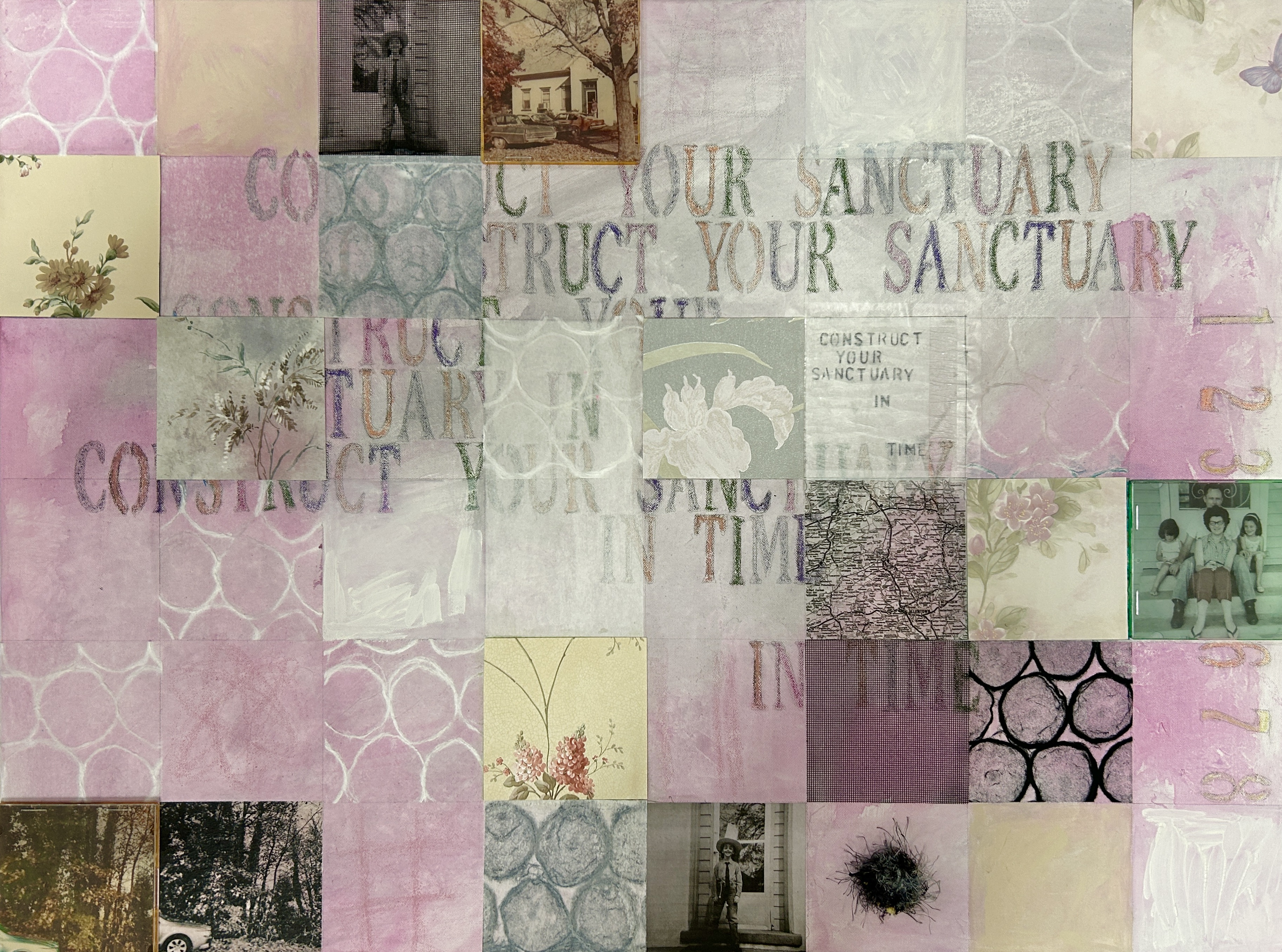
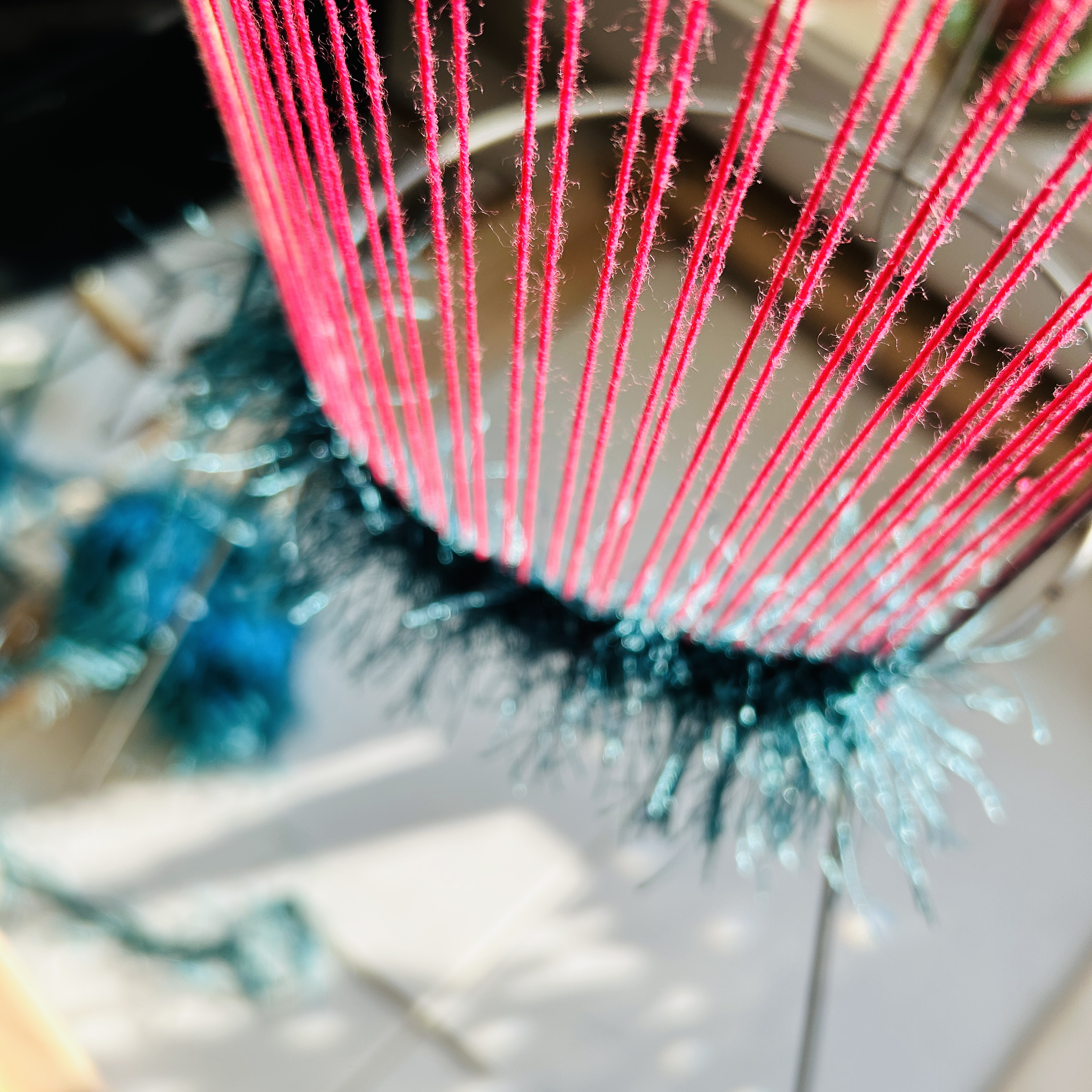
Instead I’ve been working on two small aluminum picture frames that I’m repurposing as looms and a large 24×36 inch piece. Contrary to everything I just wrote, the larger work is on a loom, where it will remain. This rustic loom, a rectangle of reclaimed wood with pin nails to hold the warp, was made years ago by someone else and given to me by a friend. I’ve attached a collage I created with tissue paper on foam core with the stenciled text ‘looking at art reminds us that we are not alone’ to the back so that the loom frames the collage. The weave hovers an inch above the collage. And what a weave it is. I chose a palette far removed from the swampy browns of my earlier photo encaustic work. It is off the charts bold, bright and neon. I chose cotton, wire and monofilament for the warp and more wire, embroidery floss, beading, produce netting and the funny plastic stuff we made lanyards from when we were kids for the weft. I tied warp threads together and l’ve let the weft hang in places like stray hairs. The viewers eyes have to dodge around the threads and wire in order to find the text hiding beneath it all. 

As I worked I believed in what I was doing. I considered each choice, I killed my darlings and explored new ways to solve the technical issues I bumped into along the way. Pushing the boundaries of weaving is not new, yet as I worked on this piece I believed I was being bold and inventive.

But ss I was attempting to photograph the work for submission to a call for art at a Richmond, Virginia gallery any thoughts I had of its ‘bold inventiveness’ were replaced with thoughts like ‘what were you thinking?’ and ‘this is a mess!’.

Confidence and conviction can be fleeting. Self-doubt is easier to handle than the deep  exploration it takes to uncover the truth of why we make what we make. Art is a language without words and what keeps me anchored in the process is asking myself again and again ‘what story am I trying to tell?’.  But sometimes the work is too hard.

I seek validation from others rather than trust my own instincts because I forget that we need art in the world. Because I forget that we need art to remember that we’re not alone.


What Do Gardening, Health & Art Have in Common? Kinds of Kindness.

There was a time when the level of happiness I felt in a day was determined by the number I saw on the scale upon weighing myself each and every morning. As I aged I saw the futility and ridiculousness of that ritual and stopped weighing myself. For many years I lived without a scale in the house. If I’m being truthful, however, to this day, on those rare occasions when I do check in on my weight the number I see still has the power to set my mood.

Something similar happens when I am in my studio. If the work is going well then I’m all smiles. If I’m struggling with the materials, or if I’m certain I’ve ruined a new piece I was enamored with just the day before, I question why I even bother. Then there’s the mental baggage that accompanies me when I’m headed to the studio. If by chance I open that baggage and spill it’s contents then navigating my studio and doing the work my heart wants me to do is made more difficult by the messy mental stumbling blocks I’ve placed in my way. Like my ever-present impostor syndrome, for example. Or the envy I sometimes feel for another artist – their gorgeous work, their incredible success. And when there is envy, shame for feeling envious is not far behind.  

As I write these thoughts I can look out the window and see that the team of gardeners we’ve hired have arrived. It will take some time to clear out decades of overgrowth, to repair a stone wall and to remove the non-native ivy climbing the trunks of our trees. But when the work is finished I will begin to prepare one small bed at the base of the largest tree for planting in spring. Which reminds me of something someone told me a few weeks ago. They told me that gardening is not a project, it’s a process. Indeed.

Two and a half decades ago I joined Weight Watchers and lost sixty unnecessary pounds. I lost the weight so quickly that I gained more than a few gallstones and a nasty case of disordered eating but we can save that story for another day. The mistake I made at the time was thinking of my weight loss journey as a project. And once those pounds were dropped the project was complete. Silly me.

Three years ago, when we moved to Virginia, I was determined to find the artist I abandoned when the need to have a steady income was more urgent than the need to create. Somehow the universe felt my determination and opened a few doors for me. She built a solid foundation for me when I was accepted into the Incubator Program at McGuffey Art Center in Charlottesville.

In 2023 I took on the year-long residency at McGuffey as a project. Show up. Do the work. Exhibit the work. Sell the work. Repeat. What was I thinking?

Gardening is not a project, it’s a process. Holding on to good health is not a project, it’s a process. Creating art that resonates is not a project, it’s a process. I guess it follows, then, that life is not a project. It’s a process. 

It’s a process that begins with kindness. Being kind to my home. Planting seeds. Nourishing the earth beneath my feet. Hard and rewarding work. Being kind to others. Admitting when I’ve made mistakes or when my words have hurt someone. Showing gratitude for deep friendships. Remembering anniversaries and birthdays.

But being kind to my breathing heart? Being kind to my creative heart? That can be challenging.

Manifesting kindness towards myself when I’ve spent seven decades judging and comparing myself to my wealthier friends, to the skinny models I see in magazines, to the artists that speak with eloquence and passion about their work is a struggle. Maybe it requires breaking the habits that keep my self-care and kindness at bay.

Maybe it begins with embracing the truth that the process – whether it’s planting a garden, celebrating good health or creating art  – doesn’t run in a straight line. It meanders and curls and doubles back on itself and then forges ahead. It moves around obstacles, plows through roadblocks, climbs metaphorical mountains and charges down steep hills like a child on a Schwinn Stingray Chopper, bugs in her teeth from smiling too much and bright colored vinyl ribbons dancing from the handlebars.

Each moment of the journey – the bumps, the stumbles, the thrills and delights – they all require different kinds of kindness. Sometimes I have to be forgiving. Sometimes I have to be honest. Sometimes I need to put my nose to the grindstone and sometimes I need to rest. Figuring that out is exasperating. And kinda fun.

Don’t forget…Practically Twisted is disappearing in a few months. If you appreciate my musings, join me at Mimm Patterson Art.


Nests & Vessels

Reminder: Practically Twisted is going to practically disappear soon.

If you’d like to continue to receive my sporadic meanderings please visit mimmpattersonart.com and sign up. Thanks!

It’s funny how one word can change everything. Until a few months ago I wore the label ‘mixed media artist’. But it never felt right. Did that mean I was a dabbler? Unable to settle? At best it was an easy way to not have to talk too much about specifics. At worse it made me feel at times like a dilettante. I’ve come to realize that, for me, ‘multidisciplinary’ is a much better fit. It’s a word that grounds me. It’s a word that denotes serious dedication to the work.

Being an artist is an evolving process. Re-framing how I identify as an artist is moving my process forward and bringing me closer to something I consider my authentic voice. 

My work has experienced a dramatic shift over the last two years.  Despite this I remain compelled to explore the energetic imprint we leave behind on the objects we touch and the moments we share with others. Through that exploration I am drawn toward themes of impermanence and fragility.

In 2024 these themes were represented by images very personal to me: my grandmother’s silk hankies, the vase left to me by a late friend. But over time the photo-encaustic work became too literal. At the start of 2025 I began adding encaustic paint and oil pastel over photographs to suggest what I call the ‘ash of memory’. These pieces engage the viewers curiosity as they study the image. They encourage the viewer to find the story I am trying to tell or to create one of their own. 

My latest body of work, however, moves away from story-telling. All art is personal, of course, but I’m tired of my stories. I feel drawn to create work that is less anchored to specific moments experienced and more tethered to feelings for which there are no words. 

I’m releasing my attachment to the artist I believed I should be. I’m learning to trust my intuition, to embrace happy accidents and to break rules.

We are living through unusual, precarious times and I believe my work has been transformed by this new world. The work is my coping mechanism.

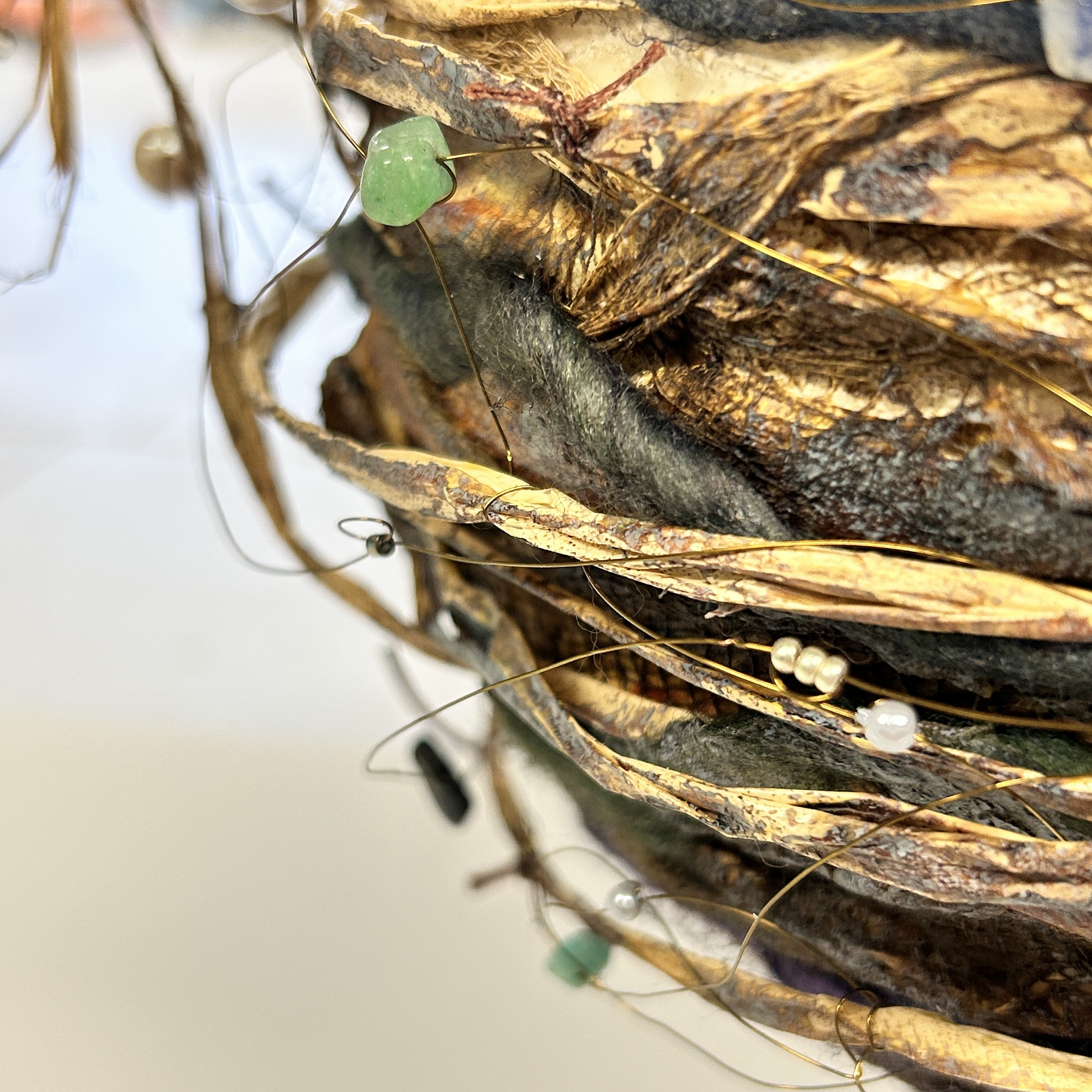
And so, for now, I’ll continue to build nests and vessels. Little containers to hold our hopes.


Fresh Start! New Website!

I’m a person who enjoys choosing the path of least resistance. In other words, I lean toward the lazy. I settle in the middle of humdrum. When I could choose to apply a bit of concentrated focus in order to bring clarity to the path forward I choose instead to distract myself with anything other than the task at hand. 

This doesn’t mean I don’t work hard. I do. But when confronted with a challenge I’ll procrastinate or avoid it altogether. Especially when it comes to taking care of business. And by ‘business’ I mean the business end of being an artist. The whole self-promotion thing has always felt a little unseemly to me. 

Or maybe naming the business of art as ‘unseemly’ is my excuse. My avoidance mechanism. Maybe the truth is that the self-promotion required in the 21st century to find enough success to justify the expense of being an artist means I need to be both vulnerable and confident. Vulnerable? Confident?

Eww.

Holing up in my studio with the hope that the right person finds my work feels so much easier.

But – sigh –  it’s time for me to pull up my wax splattered big girl pants and get real. There is art. And there is the business of art. One nurtures my soul. The other provides an opportunity to share stories that cannot be expressed with words in order to create an ineffable connection with those touched by my work. 

And so…welcome to my new website. If you follow me here please connect with me there. I promise to not fill your inbox with photos of what I had for breakfast. The occasional blog post? Sure. Notice of upcoming shows? Definitely (I have TWO solo exhibits in the next eight months!). And that’s about it.


Art Imitates Yoga

For as long as I’ve been writing and posting – which must be at least twenty years – I’ve held the intention that I will post each week and each post will be a reflection on my experience as a yoga student and teacher. 

That has never come close to happening.

My last post was on September 9th, 2024, when I introduced the world to the incredible Tondu, the senior feline companion who moved in and filled the gap left by dear Brucie’s departure. After that post I found myself struggling to put together a few paragraphs describing the fear and anxiety so many of us are experiencing as our country moves toward a darker age. I finally abandoned all hope and hit the delete button.

Because I can’t write on command. Writing about a specific topic with a self-imposed deadline sucks any ability I possess to string two words together from my brain. I suspect that with discipline (if I showed up daily for myself and for my writing practice) the issue would right itself (pun intentional). But until I do that I’m going to have to be content with writing when the mood strikes.

Which makes me question whether, at the dawn of 2025, I want a writing practice as much as I wanted it in 2010. Fifteen years ago I wrote a full-length manuscript (90,000 words!) about a young woman eager to fly at the start of WWII. The story was inspired by a woman I knew who had been an WASP. In my story she falls in love with a neighbor boy who is Japanese and is sent to an internment camp. Forbidden love! Separation! War! Oh the Drama!

I was never happy with the ending. Do they reunite? Have they been changed so much by their experiences that love dies? Or is love the one true thing? Oh the Potential Heartbreak!

I was going through my own heartbreaking drama at the time and the joy I found living with these characters in my brain was lost. And so the finished manuscript sits in a dusty box, unedited. I always tell myself I’ll get back to it one day but that day has yet to arrive.

Practicing a visual art feels different. Maybe because, fifteen years older, I’ve learned to take myself less seriously. Or maybe I’ve learned to not make creating a competition. Showing up for my art practice is not a chore. It’s a joy. And although when I’m in the art studio I experience the same struggles and setbacks as I do when I write they are never enough to make me push it to the back burner. If anything I grow more determined to find a solution.

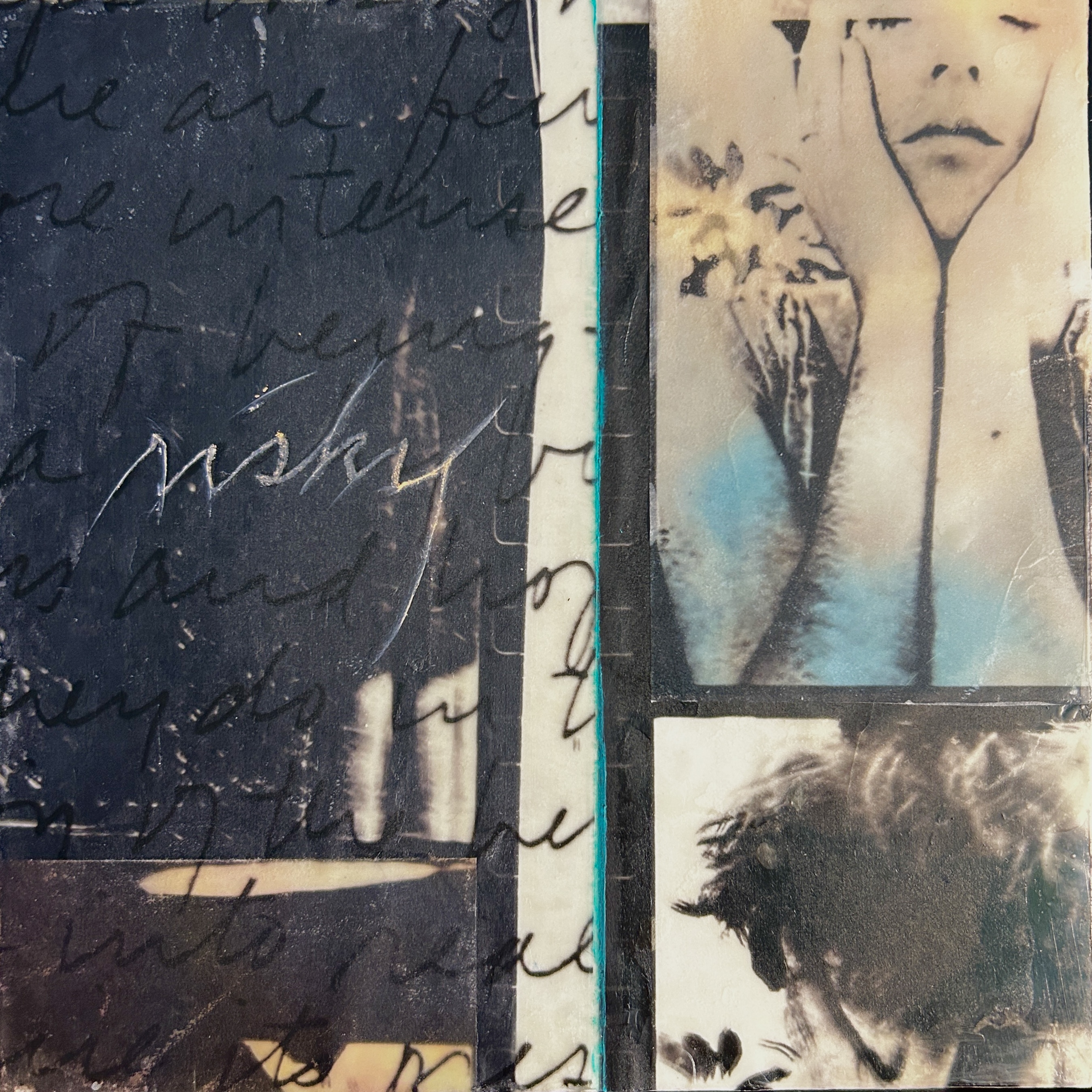
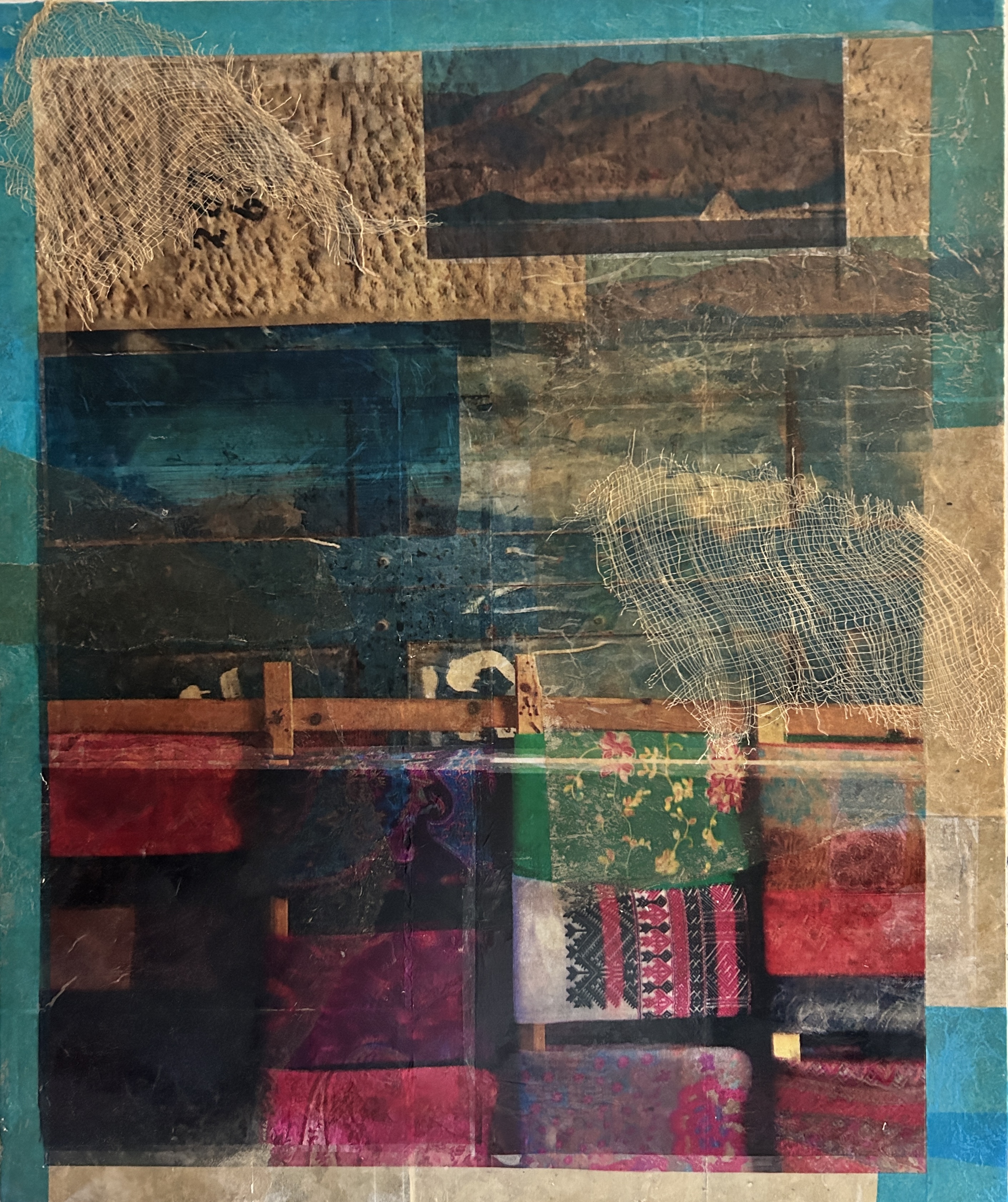
For the past two years I’ve been exploring encaustic photography. The process is this: I take a photograph with my camera. I edit the image on my laptop. I print the image on a sheet of tissue paper and then adhere the paper to cradled birch with encaustic medium, which is a combination of bees wax and damar resin. The tissue paper becomes transparent from the melted wax. I build on this with further layers of tissue paper on which images, texture and text have been printed.

Late last year I found the process becoming rote. I struggled with a few technical issues and when they were resolved I produced work like a robot on an assembly line. The process became a race to see how much I could create in a day. The idea of art as a practice was lost.

The truth is, since my intention is for my art practice to also be a business – in other words I want to exhibit and to sell the work I create – then my time in the studio should be both business and practice. But I was listing heavy toward ‘produce at all costs’. My art had lost its heart. 

So I put the camera, the wax and the tissue paper and I pulled out my scraps of fabric.

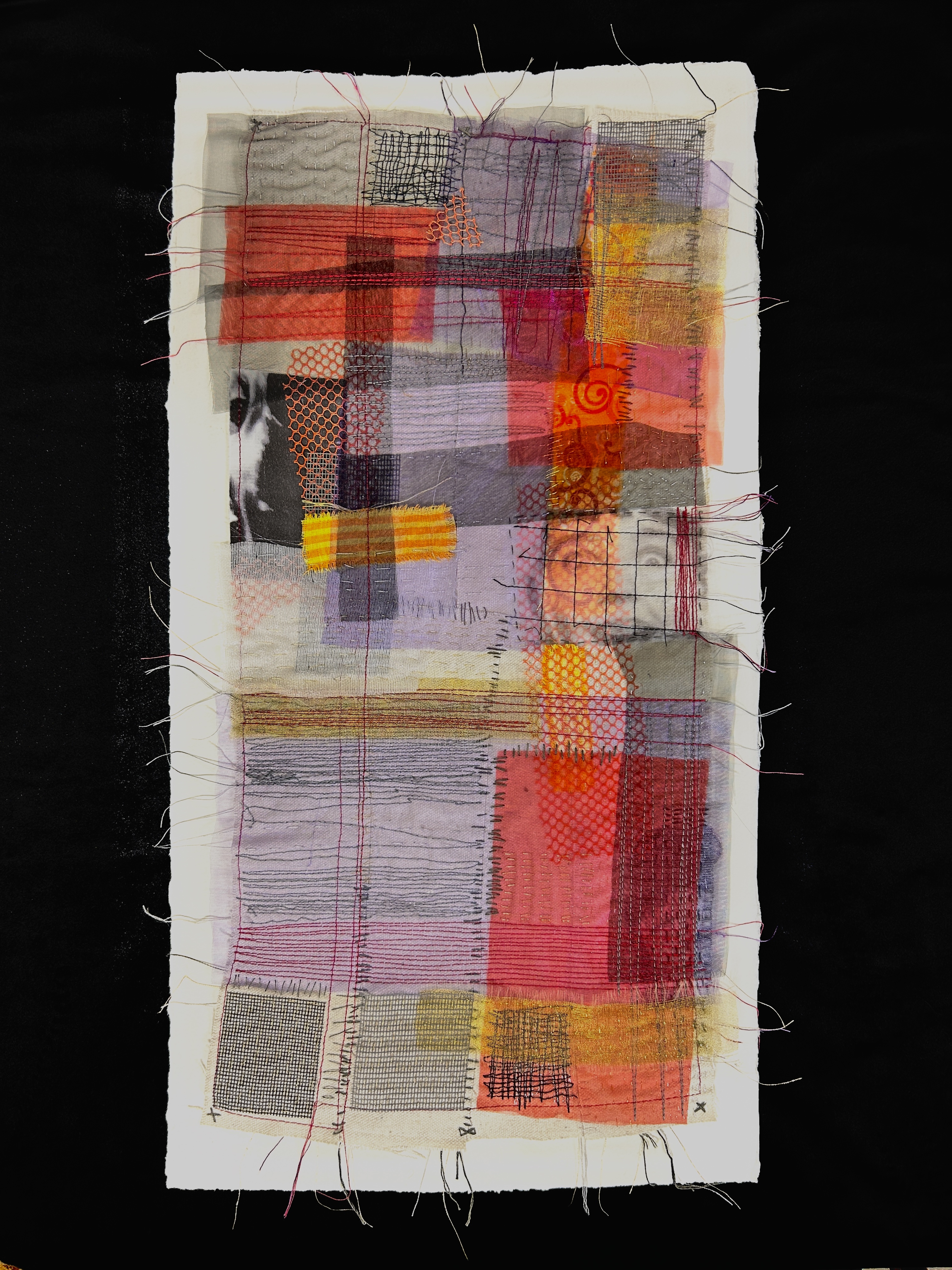
And yesterday, as I stitched layers of rust-stained cotton and dreamy organza together, I thought about yoga. I thought about the verbal cues I use with the women and men with whom I practice. I thought about how I ask them to move with care. To move with intention and to be thoughtful. I thought about how I ask them to meet their bodies where they are in that moment. How I ask them to be present with their bodies and with their breath.

Yoga is a practice. Writing is a practice. Art is a practice, too. And as I move forward in my art practice I’m going to apply all the cues I provide for others during our sessions on the yoga mat. I want the work I bring into the world to be intentional, not rote. I want the work to be thoughtful, not thoughtless. I want to remain present for the making of the work and not to be thinking about what comes next.

I believe this new awareness will serve me well. 


When Art Makes You Cry

When I bring something I’ve thought about in my head to life, and it happens with ease, I feel as if I have super human powers. It doesn’t matter whether I’m searching my brain’s thesaurus for the perfect few words to convey a feeling, or trying to capture with my camera how dawn transforms shadowy black tree trunks into golden beams of light, or attempting to prepare a satisfying evening dinner without a recipe.

When I create – whether it’s good or bad, whether it’s through words or with images – and the work begins to flow, the experience becomes something beyond feeling superhuman. It’s a rare and fleeting moment of connection to The Source. I don’t believe for a moment that I’m special. This euphoric flow is available to all of us. We just need to get out of our own way. 

I knew that our move to a Virginia townhome three times the size of the 600-square-foot apartment we left behind in California would afford me the space to create. Specifically, I would have the space to create visual art. This was not a random whim. I was an art and education major in college. In my thirties I was the quintessential starving, struggling artist. By the time I reached my fifties I thought I’d left all that ‘art nonsense’ behind. But then, as I entered my sixties, we had a global pandemic. The pandemic was a tragic blessing. The shutdown and all the ramifications of being essentially under house arrest by an invisible and deadly invader afforded those of us who remained healthy the time to remember who we were.

I took advantage of the opportunity and remembered that I was an artist. I didn’t do this on my own. I was encouraged by a friend who was beginning her own art journey and of course by Ben, who would support me no matter what path I chose to follow. Our small home limited my options but I could feel my creative impulses coming back to life.

When we settled into our new home in Virginia I set up a space and began my creative practice in earnest. Within a year I had found some success. My work was being exhibited and I was awarded first place in a competition I believed I had no chance of winning. I secured a year-long residency at McGuffey Art Center that culminated in a group show with five other artists and where I am currently renting a studio. This October I will have my first solo exhibit in forty years at a lovely gallery just steps off the Pedestrian Mall in Charlottesville.

It was after we organized the group show in late May, as I was beginning to consider the new body of work I needed for my solo exhibit, that the artist’s block landed on my psyche like a ton of bricks. An artist’s mental block is not too far removed from the ‘twisties’ gymnast Simone Biles experienced at the Tokyo Olympics – minus, of course, the potential for career ending injury or death.

I was lost in my head. Obsessed and over-thinking. Every empty and soulless hour in my once vibrant studio chipped away at my flagging confidence. And as my confidence wavered so did my motivation. The block I was experiencing fueled every limiting self-belief I’ve carried with me since childhood. I knew I was a fraud. I knew the success I achieved  was nothing more than a simple fluke. It was time to let the gallery in Charlottesville know that I would not have work ready for my solo exhibit. I was done.

What felt like a bitter eternity in reality was six precious weeks. But finally, in early July, the block began to shift. It was a heavy burden that I fought like hell to get through. But more and more, momentary flashes of insight would arc through my mind like the faint shooting stars we search for in the wee hours on a warm summer night. 

I was encouraged but hadn’t quite found my footing. And then, two weeks ago, this happened:

It’s the middle of a very hot July. There’s an exhibit of women fiber artists at the Renwick Gallery in Washington, DC that I am desperate to see. Ben and I decide to have a mini-break and head north. On a warm Saturday morning we walk to the gallery from our hotel and discover a small but comprehensive show of work in a gorgeous space. As we move through the exhibit we stop at a piece by artist Lenore Tawney. From a canvas frame suspended several feet above our heads and parallel to the ceiling, Tawney has dropped several hundred – maybe several thousand – thin linen cords. The work is part of her Cloud series. The effect mesmerizes me to the point that tears fill my eyes. It is stunning. An ethereal cube of light comprised of suspended strings floats over the gallery floor. It is spectral and yet, at the same time, it feels solid. 

I hear Ben ask what I’m thinking.

I’m thinking that visual artists are trying to tell a story in a language that cannot be translated for others. A language where fluency is evasive. But the more they work, the more they explore, the more visual vocabulary they gain. This is the difficult path we traverse as we move closer to finding our own voice. Our own visual language.  It is a challenging and sometimes frightening journey because it requires us to look starkly and deeply within. But as we work, as we explore, we begin to scrape away the muck of over-thinking until all that is left is feeling. From there, everything is simple. From there, one thousand linen threads suspended from a ceiling can move a person to tears. 

I don’t know if artists ever find their one true creative voice. Perhaps striving to work from a base of feeling rather than intellect is the best we can do. We learn techniques in the same way a creative chef practices with their set of knives (or a yoga teacher practices asana). And mastering our technique with a brush or a potter’s wheel or a loom is, of course, important. But finding that simple, pure, critical and instinctual base of feeling? To borrow a bit from the Little Prince – that feeling comes from the energetic heart and is invisible to the eye.


Small Change

‘Swampy’. That’s the word a friend used to describe my palette. She wasn’t wrong and I wasn’t offended. I couldn’t be offended because as a stained glass artist her whole world is about clarity and color. Besides, she was right. My last body of work leaned toward variations of sepia with a smidge of mud thrown in for good measure. But still. Swampy? A gauntlet was thrown and I accepted the challenge, purchased a few blocks of pigmented encaustic wax and as I watched them soften into puddles of bright, primary colors asked myself, ‘what the heck am I supposed to do with this?

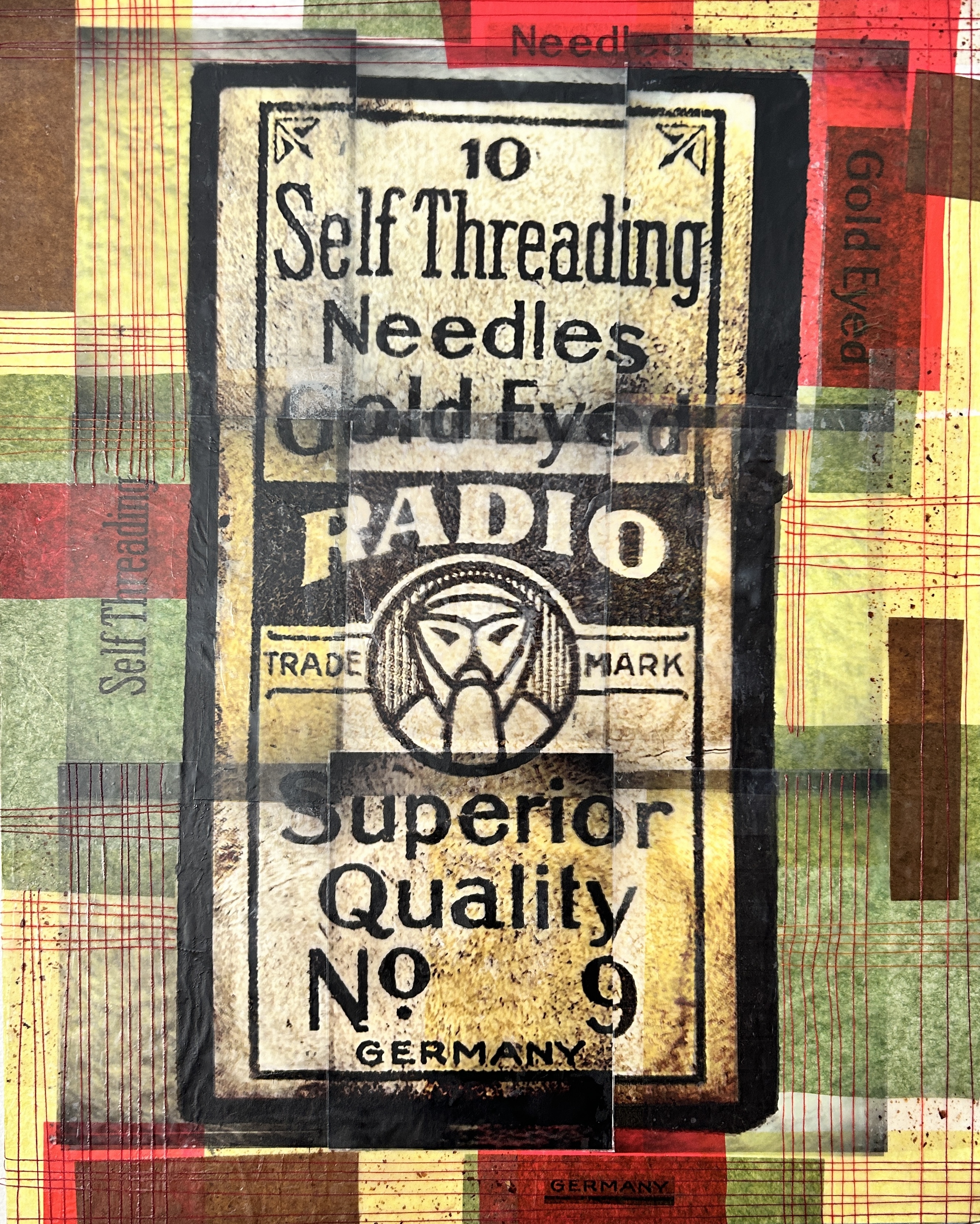
‘Superior Quality’ 16×20 inch encaustic collage

I’m learning as I go. It’s not easy. I’m not a painter, and the pigments want me to paint. And so I regress back to what I know I can control. I choose papers similar in chroma to the melted pigments. The result feels garish and unsophisticated. I long for my swampy neutrals! I might be learning as I go but it’s a very steep curve. But I guess, on reflection, it’s also a metaphor for life. Every day we’re alive is another day of ‘learning as we go’. Somehow I find that comforting.

Nevertheless it has been a bumpy few weeks as I consider the work I need for my show in October. I know I’m over-thinking. Trying too hard. I need to relax. To stop striving. To have fun and to learn how to play again. Creating isn’t about me hoping the next piece of art is better than the last. It’s about me being in the moment. It’s about problem solving. There’s no doubt creating is hard work but when we step out of our own way it is joyful hard work. Creating requires proper technique – or in my case, a close proximity to proper technique. But it also requires a fearlessness that allows us to trust our intuition. Creating asks for us to believe that the story we are trying to tell is worth telling. That the changes we are trying to manifest are positive.

Every moment of our too short ‘learn as you go’ life is an act of creation. Every choice is a catalyst that sets in motion the conditions for change and the opportunity to create something new. 

What choices will you make today? What will you create?

As I wrote those words I realized that the body of work I’m attempting to create will hang in an October exhibit that ends days before the next chapter of this beautiful and flawed country begins. So the choices I make today are not focused on art alone. As we race toward November I want to make choices that build my reserves of strength and resilience so that the overheating chemical soup that is my brain’s mosh pit doesn’t boil over. I want to make choices that keep me steady. Grounded. Even-tempered. And if those choices support the creation of art – great. But that’s not my priority. My priority is figuring out how my choices can become a catalyst for change. I’ll settle for small change. Because collectively, our small change will add up. 

To that end, I’m going to choose to remain informed by reliable sources so that I have facts to back up my beliefs. I’m going to choose to support Vote Forward, either by writing letters or contributing funds to help cover postage. I’m going to choose to listen to others speak without interrupting – even those who may have beliefs that differ from my own.

We are living through a period of time where others are pushing us to become untethered from our truth. Treating us like frogs in a pot of slowly heating water, the voices that have hijacked one of our country’s political parties want to see us lose our ability to separate fact from fiction. They want to see us blind with anger. This is a time to remain calm and to live by the courage of our convictions. 

So again I ask, what choices will you make today? What will you create? What act or conversation will be a catalyst for change? And I’ll remind us all: small change matters.


Panic at the Studio: How I’m Learning to Show Up for Myself

I can’t say this is true for all artists, but it’s true for this artist. After a show is hung, after the studio is swept and organized, after the opening is over –  my mind goes blank. I’m certain I’ll never create again.

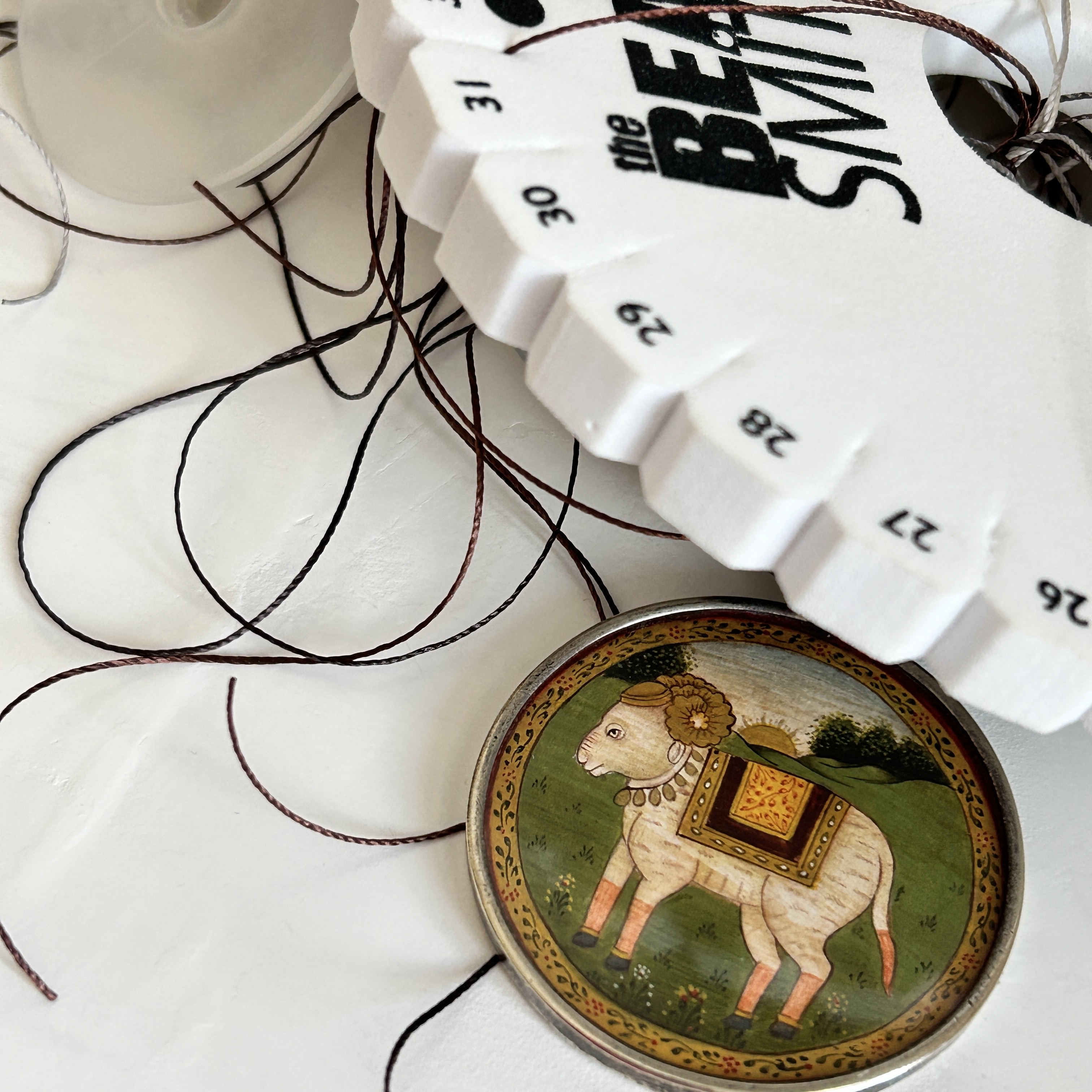
At the end of May there was no doubt my encaustic days were over. I was done. I brought a table loom into the studio and pulled out a few kumihimo wheels from storage in the garage believing I had spent my limited creative battery life. I felt drained.

Playing with weaving on a tomato cage

And then the panic began. I realized that October is not too far away and in October I will be hanging a solo show. 

Panic, of course, was getting me nowhere. To distract myself from the rising tide of fear that my life was a total waste and that I was incapable of ever having a good idea again, I settled into weaving on the table loom. Which also got me nowhere. So I settled into creating kumihimo braids for the charms that came back with me from our trip to India a few years ago. At least that was something productive. December, after all, will be here not long after October and I need product for the holiday craft shows.

And that’s where I found my calm.

The meditative nature of kumihimo and the rhythmic click of the bobbins as the wheel turns in my hands brought me to a place where I could begin to think about melting wax again. And that’s how I realized there’s something brewing inside me. Another story asking to be told.

Wheeling away with my kuihimo wheel

Of course, Austin Kleon would point to Tom Waits and Nick Cave, songwriters who believe the music is not within them and struggling to get out. Instead, they prefer to  believe the words and music already exist and are floating in the ether waiting to be found. Which is not unlike Michelangelo’s assumption that the sculpture he was searching for was already in the marble. It was his job to chisel away the superfluous material. Or like the art teacher I knew, who asked his students to consider that the drawing was already in the pencil they held in their hands. 

If I’m willing to open myself to those sweet possibilities then my time at the table loom and with the kumihimo wheel was time that I needed to settle. Time I needed to become receptive. To tune in. To reflect on how I want to show up for the work, for the muse, and for myself. 

The supplies I need to build my new body of work will arrive on Tuesday. I’m itching to get back to what I love to do and I need to do. I’m excited by what I might learn this time around. 

We are acts of creation and born to create. It doesn’t matter if you’re dragging a loaded paintbrush across a blank canvas, typing on a keyboard, pouring ingredients into a mixing bowl or writing formulae on a whiteboard. We are acts of creation born to create. 

As we step into a new week – what will you do to be more receptive to that possibility? How will you show up for yourself these next seven days?


A Year at McGuffey’s: Goals, Expectations & Steve Albini

Last year around this time I became part of the McGuffey Art Center Incubator Studio. I was given 1/6th of an old classroom in the red brick former school and the promise of an exhibit at the end of my ‘incubation’. That exhibit will open in June and my time as an incubator will end. But I hope my life as an artist and my affiliation with McGuffey’s will continue.

When I entered the program, I imagined six artists sharing a large space, working together, encouraging one another.  I imagined mentors gently guiding us and helping us integrate into the culture and politics of an art center that has been thriving for fifty years. I imagined myself being welcomed into a circle of supportive Charlottesville creatives. I imagined myself making friends, being part of a group, having inspiring conversations about process and technique. I knew the work I wanted to create and I knew exactly how I was going to create that work. My expectations and my excitement for the year were high. My goals were, I thought, admirable. And very, very rigid.

So it should be no surprise that this year as a McGuffey Incubator was not the year I imagined. The good news is, despite my kicking and screaming, despite my many attempts to force a square peg into a round hole, this year as a McGuffey Incubator has been so much more than what I imagined. 

And the insights I gained along the way have been liberating. I think the biggest insights have been around how our expectations can bind us to a particular mindset. The expectations I set for my year at McGuffey Art Center before the year even began did not consider the expectations my five fellow incubators. My expectations chained me to a specific idea of how things should be without offering room to shift and grow. My expectations were limiting. The fear/jealousy/longing that I stewed in from time to time was limiting. Even the goals I set for myself were limiting. 

But we’re taught to set goals from the moment we’re born. If we don’t have goals for our life, then who are we? What are we? Aimless? Lazy? So I’ve always been a huge goal setter. Yet every time I failed to achieve a set goal and every time I met a goal I found myself spiraling out of control. And I never understood why.  

What I needed was this quote from Steve Albini, the record producer who died this month. I found it while reading Austin Kleon’s weekly newsletter:

“I’ve lived my whole life without having goals, and I think that’s very valuable, because then I never am in a state of anxiety or dissatisfaction. I never feel I haven’t achieved something. I never feel there is something yet to be accomplished. I feel like goals are quite counterproductive. They give you a target, and until the moment you reach that target, you are stressed and unsatisfied, and at the moment you reach that specific target you are aimless and have lost the lodestar of your existence. I’ve always tried to see everything as a process. I want to do things in a certain way that I can be proud of that is sustainable and is fair and equitable to everybody that I interact with. If I can do that, then that’s a success, and success means that I get to do it again tomorrow.”

If I’d read this twelve months ago I wonder if my experience as a McGuffey Incubator would be different? Because every time I do read his words it’s as if a window in my mind has been opened and a fresh breeze comes through to remind me that I am free to live my life with intention. And a life lived with intention is not corralled by goals and objectives and deadlines. 

There will be a new crop of McGuffey Incubators moving in to the studio in July. If I were to offer any advice it would be this: let go of expectation, let go of goals, enjoy the process and the adventure. The year flies by and if you open your heart and your mind and are ready to embrace the unexpected you’ll be amazed at what can happen.

The Incubator Show opens on First Friday, June 7th, from 5:30-8:00 PM. If you’re in the Charlottesville area please join us at McGuffey Art Center, 201 2nd Street Northwest.

Also…I have a new website for my art! 


A Year at McGuffey’s: Gratitude, Connection, and Am I the Mean Girl?

I have a cold. I’ve not slept. And I’ll be honest. Stringing together a series of cohesive sentences is a struggle. But it’s been too long and so I must try. Yet how dare I write about the trivial pursuits of my life when it feels like the world is falling apart? Although we know the detrimental impact to our mental health, Ben and I watched CNN non-stop most of last week. We saw Clarissa Ward dive into a ditch and Anderson Cooper cry. 

Turning away from what is happening in the world is not possible. Moving through life under an umbrella of blissful ignorance is wrong. It’s difficult to watch but not as difficult as surviving while bombs rain down. Meanwhile, Ukraine still burns and Putin rubs his hands together with glee. We live in tragic times.

The word clarity has been used. The phrase ‘moral clarity’.

Clarity is a good word. By the second half of last week Ben found the clarity to remain informed while at the same time focusing on the goodness in life. The beauty. The moments of awe. Like the maple trees outside our back window turning more crimson red by the hour. Or the adorable warblers making enough racket on our porch for poor deaf Bruce the Cat to take notice.

I gained a different sort of clarity during my week in California at the end of September. On a sunny Thursday morning in the garden of a friend I found myself surrounded by bright and beautiful people who had gathered to celebrate not just my visit but one another. There were moments that morning when I stepped back to a quiet corner so that I could take in all the color and the effervescent joy. Those moments were a rich reminder of the value of human connection and community. 

Before that morning and since the early days of the pandemic shutdown I’d seen most of the friends around me three days a week via the flat, muted scrim of Zoom. I assumed that was enough. It wasn’t until I was basking in their technicolor energy that I learned my assumption was wrong. I realized what I was missing.

I am so grateful for that experience. It was an invaluable lesson. The question is: how will I put what I’ve learned into action?

I’m not the natural traveler that I was a few decades ago but being with my friends that morning, in that garden, recharged my batteries.

I have to do it again. I’ve known many of these men and women for twenty years. Zoom chats fill a gap but I can’t let a continent keep us apart. I’m looking forward to seeing everyone again in September 2024.

Meanwhile, at McGuffey Art Center I’m creating relationships with my five studio mates. When we moved into the studio space in July I envisioned six women of various ages and backgrounds building something together – building a small community, I guess. But as the weeks went by and it didn’t feel like that was happening I withdrew into myself and began to work mostly from home, going into the studio for First Friday gallery openings and to install completed art. When I did see someone I heard myself complaining or being contrary about the silliest things. I felt myself being a little judgmental. One day I wondered aloud, “Am I the mean girl in this group?”

Yesterday we had an hours long critique of our work with two well-established local artists and teachers. My early hope of us being a community had vanished weeks ago. Besides, my cold was settling in and so my enthusiasm for the afternoon was at a low. But as each of us spoke about our work and why we do what it is we do as craftspeople and artists, I began to see the thread that binds us together. We are very different. Different ages, different faiths, different socio-economic backgrounds and different countries of origin. Our little group includes a potter, a pastel artist, a painter, a printmaker, a performance artist and a mixed media artist. And yet – there’s something that connects us on a level deeper than the fact that we were accepted into the McGuffey Incubator Program.

If I fail to nurture that connection – a connection that won’t last forever but will at least last until June – then I am failing myself, missing opportunities to learn and ignoring the lesson I learned in California. It won’t be easy for me. I am an introvert who enjoys her own company. But connection shines a light on our humanity.

And I want my light to shine.