Small Change

‘Swampy’. That’s the word a friend used to describe my palette. She wasn’t wrong and I wasn’t offended. I couldn’t be offended because as a stained glass artist her whole world is about clarity and color. Besides, she was right. My last body of work leaned toward variations of sepia with a smidge of mud thrown in for good measure. But still. Swampy? A gauntlet was thrown and I accepted the challenge, purchased a few blocks of pigmented encaustic wax and as I watched them soften into puddles of bright, primary colors asked myself, ‘what the heck am I supposed to do with this?

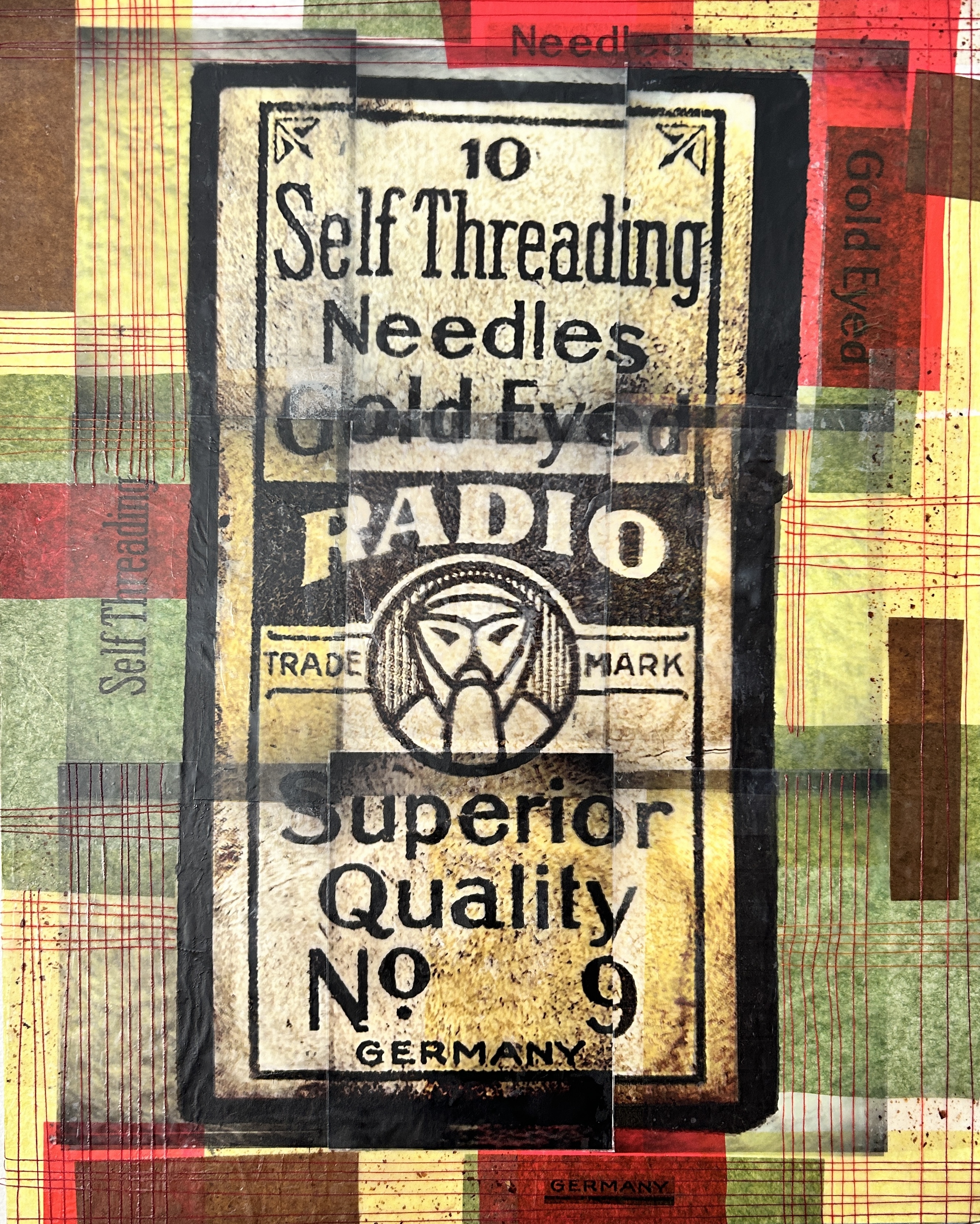
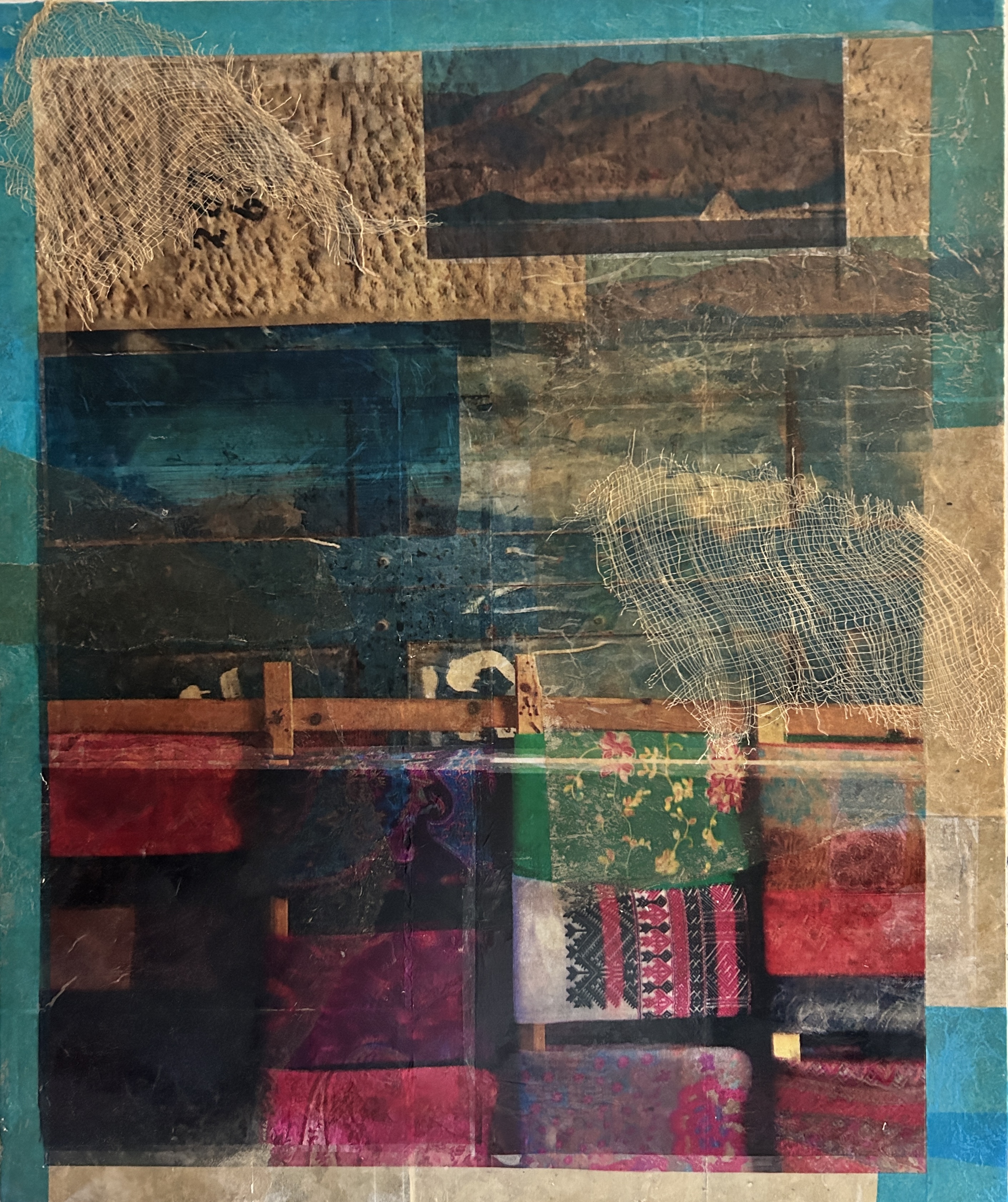
‘Superior Quality’ 16×20 inch encaustic collage

I’m learning as I go. It’s not easy. I’m not a painter, and the pigments want me to paint. And so I regress back to what I know I can control. I choose papers similar in chroma to the melted pigments. The result feels garish and unsophisticated. I long for my swampy neutrals! I might be learning as I go but it’s a very steep curve. But I guess, on reflection, it’s also a metaphor for life. Every day we’re alive is another day of ‘learning as we go’. Somehow I find that comforting.

Nevertheless it has been a bumpy few weeks as I consider the work I need for my show in October. I know I’m over-thinking. Trying too hard. I need to relax. To stop striving. To have fun and to learn how to play again. Creating isn’t about me hoping the next piece of art is better than the last. It’s about me being in the moment. It’s about problem solving. There’s no doubt creating is hard work but when we step out of our own way it is joyful hard work. Creating requires proper technique – or in my case, a close proximity to proper technique. But it also requires a fearlessness that allows us to trust our intuition. Creating asks for us to believe that the story we are trying to tell is worth telling. That the changes we are trying to manifest are positive.

Every moment of our too short ‘learn as you go’ life is an act of creation. Every choice is a catalyst that sets in motion the conditions for change and the opportunity to create something new. 

What choices will you make today? What will you create?

As I wrote those words I realized that the body of work I’m attempting to create will hang in an October exhibit that ends days before the next chapter of this beautiful and flawed country begins. So the choices I make today are not focused on art alone. As we race toward November I want to make choices that build my reserves of strength and resilience so that the overheating chemical soup that is my brain’s mosh pit doesn’t boil over. I want to make choices that keep me steady. Grounded. Even-tempered. And if those choices support the creation of art – great. But that’s not my priority. My priority is figuring out how my choices can become a catalyst for change. I’ll settle for small change. Because collectively, our small change will add up. 

To that end, I’m going to choose to remain informed by reliable sources so that I have facts to back up my beliefs. I’m going to choose to support Vote Forward, either by writing letters or contributing funds to help cover postage. I’m going to choose to listen to others speak without interrupting – even those who may have beliefs that differ from my own.

We are living through a period of time where others are pushing us to become untethered from our truth. Treating us like frogs in a pot of slowly heating water, the voices that have hijacked one of our country’s political parties want to see us lose our ability to separate fact from fiction. They want to see us blind with anger. This is a time to remain calm and to live by the courage of our convictions. 

So again I ask, what choices will you make today? What will you create? What act or conversation will be a catalyst for change? And I’ll remind us all: small change matters.
Panic at the Studio: How I’m Learning to Show Up for Myself

I can’t say this is true for all artists, but it’s true for this artist. After a show is hung, after the studio is swept and organized, after the opening is over –  my mind goes blank. I’m certain I’ll never create again.

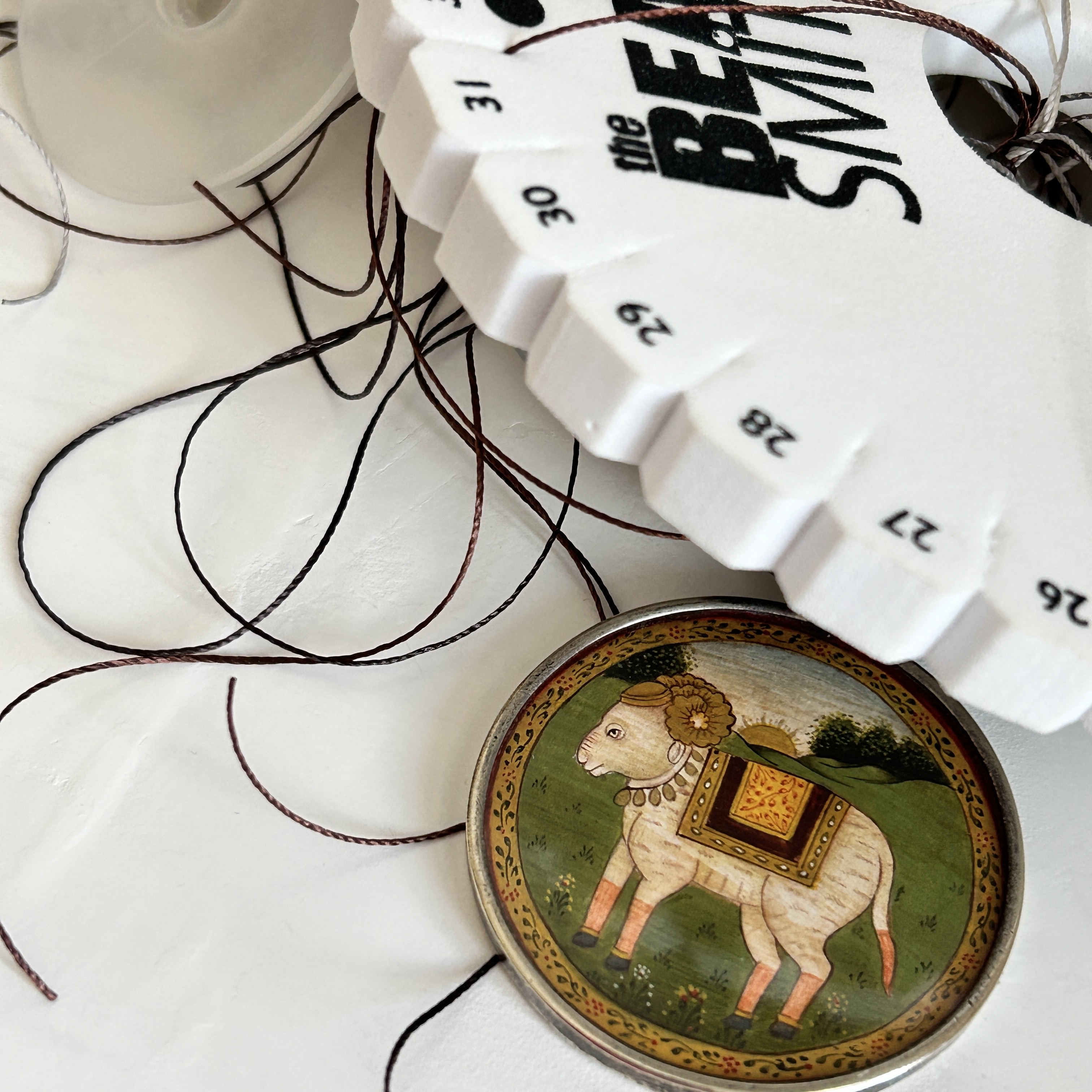
At the end of May there was no doubt my encaustic days were over. I was done. I brought a table loom into the studio and pulled out a few kumihimo wheels from storage in the garage believing I had spent my limited creative battery life. I felt drained.

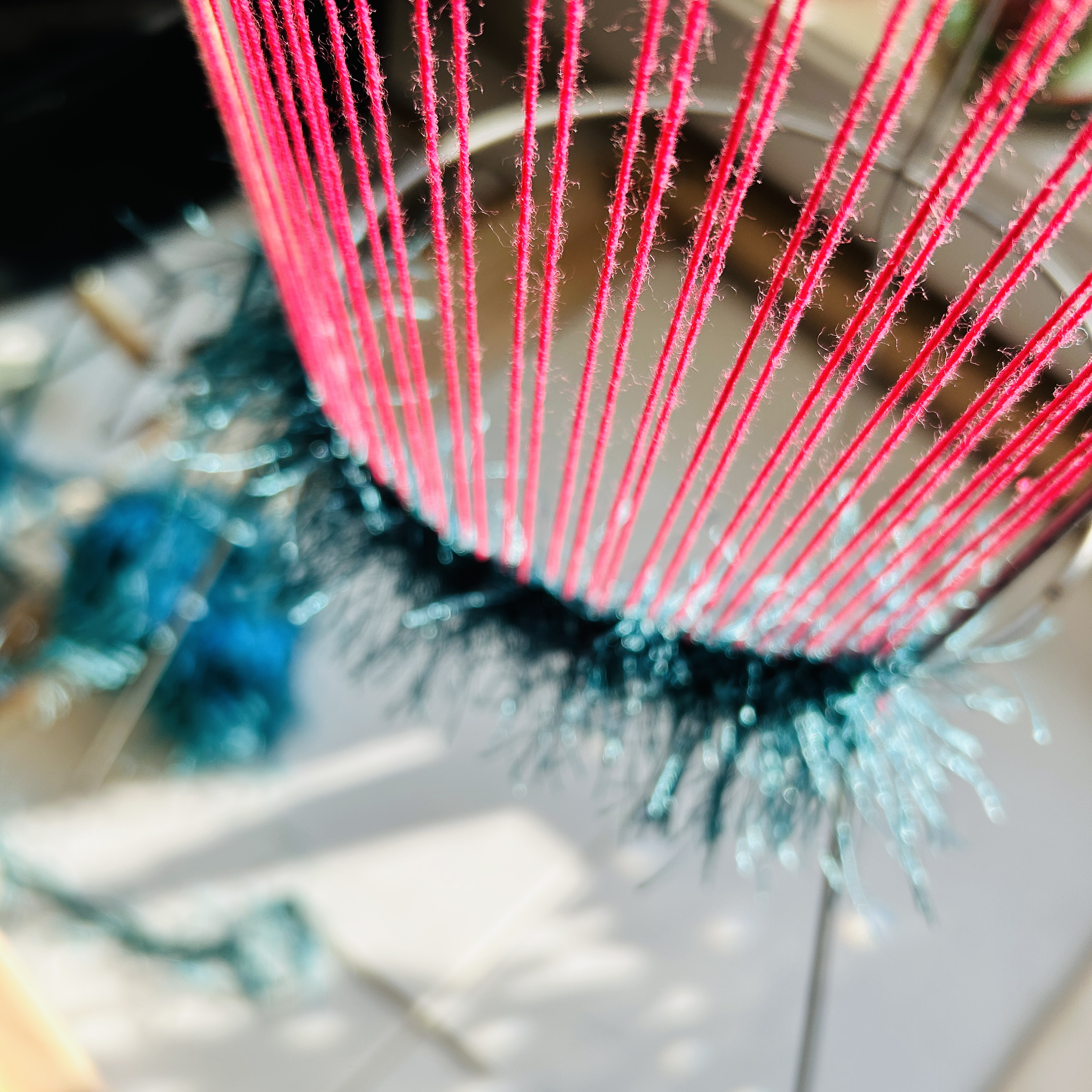
Playing with weaving on a tomato cage

And then the panic began. I realized that October is not too far away and in October I will be hanging a solo show. 

Panic, of course, was getting me nowhere. To distract myself from the rising tide of fear that my life was a total waste and that I was incapable of ever having a good idea again, I settled into weaving on the table loom. Which also got me nowhere. So I settled into creating kumihimo braids for the charms that came back with me from our trip to India a few years ago. At least that was something productive. December, after all, will be here not long after October and I need product for the holiday craft shows.

And that’s where I found my calm.

The meditative nature of kumihimo and the rhythmic click of the bobbins as the wheel turns in my hands brought me to a place where I could begin to think about melting wax again. And that’s how I realized there’s something brewing inside me. Another story asking to be told.

Wheeling away with my kuihimo wheel

Of course, Austin Kleon would point to Tom Waits and Nick Cave, songwriters who believe the music is not within them and struggling to get out. Instead, they prefer to  believe the words and music already exist and are floating in the ether waiting to be found. Which is not unlike Michelangelo’s assumption that the sculpture he was searching for was already in the marble. It was his job to chisel away the superfluous material. Or like the art teacher I knew, who asked his students to consider that the drawing was already in the pencil they held in their hands. 

If I’m willing to open myself to those sweet possibilities then my time at the table loom and with the kumihimo wheel was time that I needed to settle. Time I needed to become receptive. To tune in. To reflect on how I want to show up for the work, for the muse, and for myself. 

The supplies I need to build my new body of work will arrive on Tuesday. I’m itching to get back to what I love to do and I need to do. I’m excited by what I might learn this time around. 

We are acts of creation and born to create. It doesn’t matter if you’re dragging a loaded paintbrush across a blank canvas, typing on a keyboard, pouring ingredients into a mixing bowl or writing formulae on a whiteboard. We are acts of creation born to create. 

As we step into a new week – what will you do to be more receptive to that possibility? How will you show up for yourself these next seven days?


A Year at McGuffey’s: Goals, Expectations & Steve Albini

Last year around this time I became part of the McGuffey Art Center Incubator Studio. I was given 1/6th of an old classroom in the red brick former school and the promise of an exhibit at the end of my ‘incubation’. That exhibit will open in June and my time as an incubator will end. But I hope my life as an artist and my affiliation with McGuffey’s will continue.

When I entered the program, I imagined six artists sharing a large space, working together, encouraging one another.  I imagined mentors gently guiding us and helping us integrate into the culture and politics of an art center that has been thriving for fifty years. I imagined myself being welcomed into a circle of supportive Charlottesville creatives. I imagined myself making friends, being part of a group, having inspiring conversations about process and technique. I knew the work I wanted to create and I knew exactly how I was going to create that work. My expectations and my excitement for the year were high. My goals were, I thought, admirable. And very, very rigid.

So it should be no surprise that this year as a McGuffey Incubator was not the year I imagined. The good news is, despite my kicking and screaming, despite my many attempts to force a square peg into a round hole, this year as a McGuffey Incubator has been so much more than what I imagined. 

And the insights I gained along the way have been liberating. I think the biggest insights have been around how our expectations can bind us to a particular mindset. The expectations I set for my year at McGuffey Art Center before the year even began did not consider the expectations my five fellow incubators. My expectations chained me to a specific idea of how things should be without offering room to shift and grow. My expectations were limiting. The fear/jealousy/longing that I stewed in from time to time was limiting. Even the goals I set for myself were limiting. 

But we’re taught to set goals from the moment we’re born. If we don’t have goals for our life, then who are we? What are we? Aimless? Lazy? So I’ve always been a huge goal setter. Yet every time I failed to achieve a set goal and every time I met a goal I found myself spiraling out of control. And I never understood why.  

What I needed was this quote from Steve Albini, the record producer who died this month. I found it while reading Austin Kleon’s weekly newsletter:

“I’ve lived my whole life without having goals, and I think that’s very valuable, because then I never am in a state of anxiety or dissatisfaction. I never feel I haven’t achieved something. I never feel there is something yet to be accomplished. I feel like goals are quite counterproductive. They give you a target, and until the moment you reach that target, you are stressed and unsatisfied, and at the moment you reach that specific target you are aimless and have lost the lodestar of your existence. I’ve always tried to see everything as a process. I want to do things in a certain way that I can be proud of that is sustainable and is fair and equitable to everybody that I interact with. If I can do that, then that’s a success, and success means that I get to do it again tomorrow.”

If I’d read this twelve months ago I wonder if my experience as a McGuffey Incubator would be different? Because every time I do read his words it’s as if a window in my mind has been opened and a fresh breeze comes through to remind me that I am free to live my life with intention. And a life lived with intention is not corralled by goals and objectives and deadlines. 

There will be a new crop of McGuffey Incubators moving in to the studio in July. If I were to offer any advice it would be this: let go of expectation, let go of goals, enjoy the process and the adventure. The year flies by and if you open your heart and your mind and are ready to embrace the unexpected you’ll be amazed at what can happen.

The Incubator Show opens on First Friday, June 7th, from 5:30-8:00 PM. If you’re in the Charlottesville area please join us at McGuffey Art Center, 201 2nd Street Northwest.

Also…I have a new website for my art! 


A Year at McGuffey’s: Gratitude, Connection, and Am I the Mean Girl?

I have a cold. I’ve not slept. And I’ll be honest. Stringing together a series of cohesive sentences is a struggle. But it’s been too long and so I must try. Yet how dare I write about the trivial pursuits of my life when it feels like the world is falling apart? Although we know the detrimental impact to our mental health, Ben and I watched CNN non-stop most of last week. We saw Clarissa Ward dive into a ditch and Anderson Cooper cry. 

Turning away from what is happening in the world is not possible. Moving through life under an umbrella of blissful ignorance is wrong. It’s difficult to watch but not as difficult as surviving while bombs rain down. Meanwhile, Ukraine still burns and Putin rubs his hands together with glee. We live in tragic times.

The word clarity has been used. The phrase ‘moral clarity’.

Clarity is a good word. By the second half of last week Ben found the clarity to remain informed while at the same time focusing on the goodness in life. The beauty. The moments of awe. Like the maple trees outside our back window turning more crimson red by the hour. Or the adorable warblers making enough racket on our porch for poor deaf Bruce the Cat to take notice.

I gained a different sort of clarity during my week in California at the end of September. On a sunny Thursday morning in the garden of a friend I found myself surrounded by bright and beautiful people who had gathered to celebrate not just my visit but one another. There were moments that morning when I stepped back to a quiet corner so that I could take in all the color and the effervescent joy. Those moments were a rich reminder of the value of human connection and community. 

Before that morning and since the early days of the pandemic shutdown I’d seen most of the friends around me three days a week via the flat, muted scrim of Zoom. I assumed that was enough. It wasn’t until I was basking in their technicolor energy that I learned my assumption was wrong. I realized what I was missing.

I am so grateful for that experience. It was an invaluable lesson. The question is: how will I put what I’ve learned into action?

I’m not the natural traveler that I was a few decades ago but being with my friends that morning, in that garden, recharged my batteries.

I have to do it again. I’ve known many of these men and women for twenty years. Zoom chats fill a gap but I can’t let a continent keep us apart. I’m looking forward to seeing everyone again in September 2024.

Meanwhile, at McGuffey Art Center I’m creating relationships with my five studio mates. When we moved into the studio space in July I envisioned six women of various ages and backgrounds building something together – building a small community, I guess. But as the weeks went by and it didn’t feel like that was happening I withdrew into myself and began to work mostly from home, going into the studio for First Friday gallery openings and to install completed art. When I did see someone I heard myself complaining or being contrary about the silliest things. I felt myself being a little judgmental. One day I wondered aloud, “Am I the mean girl in this group?”

Yesterday we had an hours long critique of our work with two well-established local artists and teachers. My early hope of us being a community had vanished weeks ago. Besides, my cold was settling in and so my enthusiasm for the afternoon was at a low. But as each of us spoke about our work and why we do what it is we do as craftspeople and artists, I began to see the thread that binds us together. We are very different. Different ages, different faiths, different socio-economic backgrounds and different countries of origin. Our little group includes a potter, a pastel artist, a painter, a printmaker, a performance artist and a mixed media artist. And yet – there’s something that connects us on a level deeper than the fact that we were accepted into the McGuffey Incubator Program.

If I fail to nurture that connection – a connection that won’t last forever but will at least last until June – then I am failing myself, missing opportunities to learn and ignoring the lesson I learned in California. It won’t be easy for me. I am an introvert who enjoys her own company. But connection shines a light on our humanity.

And I want my light to shine.


A Year at McGuffey’s: The Artist Statement

I love writing artist statements for other artists. I hate writing artist statements about my own work. It’s torture. How do I put into words the story I am wanting to tell through line and shape and form? How do I find the language to describe the process by which I chose a particular color? A specific texture? How can I describe what the work means to me when I’m not yet certain I know?

It’s not easy.

Visual art transcends the written word. Art is its own language. A language that is difficult to translate.

In the middle of July our Incubator group was tasked with writing personal artist statements for the McGuffey website. For the past few weeks I fought with mine. It finally came together yesterday. I submitted my three hundred and fifty nine words and hoped for the best. I tried to be concise and tried to avoid all the things I dislike about most artist statements. That being said, ‘ash of memory’ was a darling I could not kill. Here’s what I wrote:

Fail better. Samual Beckett’s words of advice are Mimm Patterson’s goal for her year as an Incubator Artist at McGuffey Art Center. Mimm, who moved from California to Crozet in 2022, is a mixed-media artist, writer and trauma-informed yoga therapist. She is also someone who knows failure. 

“In my thirties, before I moved to Ireland, I worked as an artist” she says. In the 1990’s Mimm was the quintessential struggling artist in the San Francisco Bay Area. “I survived but I didn’t thrive. I think I lacked the self-belief required to create from a place of authenticity. I wasn’t brave enough to be vulnerable. But now I possess a grounded sense of purpose and the tenacity that comes with decades of life experience. I won’t feel shattered if I fail. I’ll feel stronger knowing that I tried.”  

Mimm’s work is informed by the belief that truth is malleable. Once we understand that our own truth is unfixed – that it is determined by the perspective from which it is viewed – we are able to reconcile our past with our perception of the present. 

This concept is critical to her current work, an exploration of her family and the dark mark its ash of memory has left on Mimm like an inky fingerprint that can’t be washed away.

“In some ways my new work is a practice of self-study. When my mother and I reunited after twenty years of estrangement I learned my family’s history for the first time. When she passed in 2019 she left behind several thick volumes of photographs and documents dating back to the mid-nineteenth century. I am learning who I am and how I came to be through these images and the stories they tell.”

Over the next year she hopes to share those stories through a body of work that inspires connection and shines with clarity and resonance. 

Mimm holds a BA in Studio Art and Education and a MFA in Transpersonal Psychology. She is an ICF certified coach as well as a SoulCollage® and Guided Autobiography facilitator. Mimm shares her new home in Crozet with her partner Ben and their twenty-year-old cat Bruce.


A Year at McGuffey’s Art Center: A Body of Work, Everyday Distractions and…Squirrel!

One of the distractions – a cuff bracelet made from the silk fabric Ben brought home from India.

When Ben returned from India in January, he brought with him half a suitcase of stunning silk remnants, trimmings and buttons. At the time I thought I might use the fabric and findings to make drawstring bags embellished with embroidery and beading. But I overestimated my machine sewing skillset and underestimated the difficulty in manipulating the slippery, fraying nature of silk. And so the fabric was neatly folded and stacked in a basket while I waited, frustrated and disappointed, for my ability to catch up to the demands of the material. 

Instead I satisfied my creative itch with coiled basketry and hand stitching. I made a few kumihimo braids and continued to play with image transfers. I tripped from one technique to another like a dog uncertain of which squirrel to chase. Yesterday I attended a fantastic  encaustic workshop with Karen Eide at McGuffey Art Center and I’m considering an online weaving course through Fiber Arts Takes Two with Harriet Goodall that begins in September.

All squirrels. Wonderful, fun, enlightening, creative squirrels. Squirrels that might be useful as I press forward. Or they might sploot and cool down my fevered creative energy. If there was a way to ignore the squirrels – the distractions – in order to stay focused, less impulsive and more intentional I don’t know it it would be useful. Maybe the distractions are good – even the splooting squirrel distractions.

But over the next eleven months, as one of six Incubator Artists at McGuffey’s, I need to create a cohesive body of work as part of our final group exhibit in June 2024. With that in mind, do I need to stop chasing squirrels?

An encaustic collage created with Karen Eide’s guidance over the weekend.

An artist’s body of work traces in color, form, line and texture the artist’s creative journey. Piet Mondrian is a good example. You know him for his iconic red, yellow and white grid paintings. Maybe his Broadway Boogie Woogie. But look at his earliest paintings of trees. Or his gingerpot. And we begin to see the process. The conviction. The exploring and the questioning.

An artist’s body of work can also be a gathering together of color, form, line and texture that contains the artist’s creative response to a chosen theme, specific experience or period of time. A reflection of sorts. An epilogue. Kansas City artist Mark Kielkulki is a good example. His works on paper are grouped almost as chapters in the story of his painting life. At the same time, when you look at his overall body of work, no matter how many themes he chooses to explore, there are underlying motifs that speak to isolation, Wes Anderson-esque oddities and shifting perspectives.

Thirty years ago I created a series of manipulated photographs based on Milan Kundera’s The Unbearable Lightness of Being. Later I created another series featuring Jim Morrison of The Doors and the Fourteen Stations of the Cross. I was young and cocky, insecure and envious. I was in a race against time and a duel to the death with every other young artist. I was desperate to look the part of the artist, more interested in the external experience and eager to provoke. I’m grateful that, as far as I know, this work no longer exists. 

Because this time around feels different. I want my body of work to evoke. Not provoke. I don’t care what I look like and I’m eager to encourage rather than envy the five other much younger women who are will be my studio-mates at McGuffey’s this year.

I’m looking inward, not outward, this time. Maybe that’s why I should embrace the squirrels who come along to distract me. They offer me moments of peace. Of reflection. They give me space to consider the story I want to tell in the body of work I am creating.


A Year at McGuffey’s: My New Tribe

Ben and I are days away from our first anniversary in Virginia. We’ve been here for one full tour around the sun. And yet I’m still settling. Still moving furniture around. Still figuring out the best cabinet for our pots and pans. Still looking for connection. For my Virginia tribe and community.

The final decade of the California life I left behind changed my destiny in ways I couldn’t imagine. It made this move possible. I met my beloved Ben and adopted my beloved feline Bruce. I cyber-stalked John Berg until he invited me to teach at Samyama. And it’s there I matured as a teacher and as a human. It’s there that I found a family of friends. A group of like-minded souls. We laugh together, commiserate together and attempt to navigate the journey of life and the practice of yoga one ardha chandrasana at a time.

And somehow, through births, deaths, illnesses, weddings, divorces, menopause, high school graduations, moves not only across the country but to the other side of the world, our community holds itself together. We even made it through a pandemic that put our lives on hold. Thank goodness for technology because it helped us navigate COVID. The shutdown is history and yet we are still signing in to Zoom and still showing up for ourselves and for one another three days a week to share asana practice. It blows my mind. 

In some ways the strength of my California Tribe makes finding connection here in Virginia less important. In some ways it makes finding connection here more difficult. Why make the effort when everyone I care about is one text, one email or one Zoom click away? Do I even need a new tribe? A new community? And if the answer to that question is ‘yes’ does it mean I need to surrender the community I already have or can the two co-exist?

We create community to build social connection. To know that we belong somewhere. Our tribe anchors us to the place where we began and at the same time supports us when it is time to take flight. We need community in order to find fulfillment within a group of individuals with whom we share similar attitudes, values and aspirations.

And so – yes – I need to find community here, in Virginia. And also – yes – it can coexist with the community that I love in California and to which I already belong.

I knew the move to Virginia would afford me more time to breathe life back into my artist self and reacquainting myself with her has been revelatory. I didn’t know how much I missed being able to tell my story through a visual medium. But isn’t creating art a solitary practice? Where does an artist go to find her tribe?

One morning in late March while searching for something else on the internet (isn’t always that way?) I found McGuffey Art Center’s Incubator Program. McGuffey’s has been thriving in an old brick school leased from the City of Charlottesville and a few blocks from the city’s famed pedestrian mall since the 1970’s. The Incubator Program, now in its ninth year, offers emerging artists shared studio space at a reduced rate while supporting their growth as artists through exhibitions, networking and education. The morning I found McGuffey’s I also discovered that applications for the 2023-2024 Incubator Program were due that weekend. I didn’t waste any time and without overthinking or second guessing myself I submitted an application.

I’ll be picking up the keys to my studio this weekend. It’s a very competitive program and I am proud to say that I am one of six artists chosen.

Does this mean that I’ve found a new tribe? We’ll find out.


Mark Making

Hang around with enough artists, eventually you’ll hear the phrase ‘mark making’. It’s the bane of my existence.I know the words roll off the tongue. I know the alliteration hums. But as much as we want the term to describe some magical, mysterious portal to the creative process, the phrase ‘mark making’ describes nothing. Two words puffed up to mean something special, in reality the phrase is nothing more than empty air.  Using the term to describe what it is we do as artists diminishes our work. 

We paint. We draw. We sculpt. Along the way we scumble and scratch, we carve and stitch and scribble and brush. We etch and boil and glue and cut. We try to communicate in a way that moves beyond words. We blur edges. We skew and flatten perspective. We hope that what we pull from our own heart touches someone else’s. Are we making marks? Of course. But mark making is so much more than what’s left behind on a canvas. 

And mark making isn’t restricted to fine art. We all make marks. All the time. And the marks we make don’t require a loaded paint brush, threaded needle or stick of charcoal.

Bump into the sharp edge of a coffee table with your shin and as the welt begins to form you might say, ‘oh, that’s gonna leave a mark’. Lean a dirty palm against a white wall? You left a mark. 

In the same way that you don’t have to be an artist to make a mark, not all marks are seen. Sometimes an angry storm of words or a hardened glare will leave a mark on another person that is invisible to the eye. Those marks are like tiny paper cuts on the psyche. 

When I’m creating I can erase, paint over, or cut away the marks I make. I can use a seam ripper to remove misplaced stitches. When I choose hurtful words or glances – those are marks that I can’t make disappear. So in the same way that I try to make considered choices when I create, I need to have the same consideration when I speak. What about you? Have you left any marks that you can’t erase?


Neurographic Drawing

At the start of the year I set the intention of building a writing practice that would allow me to post every two weeks. I created a spread sheet of topics around these obvious themes: yoga, coaching and craft. I hoped I would have the strength and energy (and the technical prowess) to have a brief video accompany the posts I wrote about aspects of our yoga practice. I managed one video, but my posts over the past six months have been consistent. Not what I intended, but consistent. Until now.

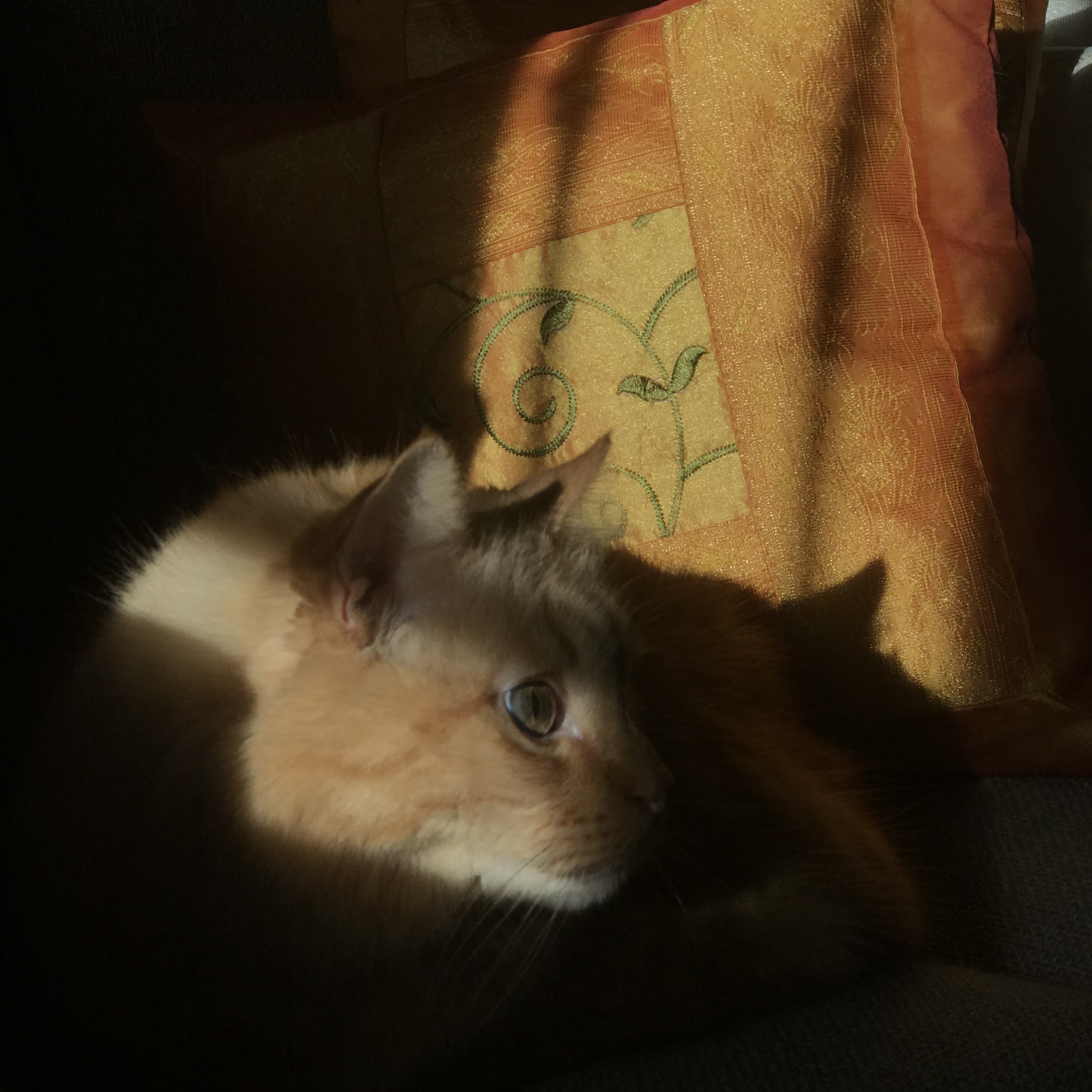
Writing, like yoga or art, is a practice that requires our presence. We have to show up. And I find it difficult to show up for writing practice when my brain is full. And right now my brain is full. My beloved and I are three weeks away from a major life transition – our move to the ‘other coast’. Our home has become a storage unit filled with boxes and I’m obsessed with worry about how Bruce – our amazing, elderly, deaf ginger cat – will manage the flight to Virginia and how he will adjust to a new home. There are so many details that need to be attended to that there is no room in my brain for putting words down on a page.

And don’t even mention my preoccupation with…well…everything else.

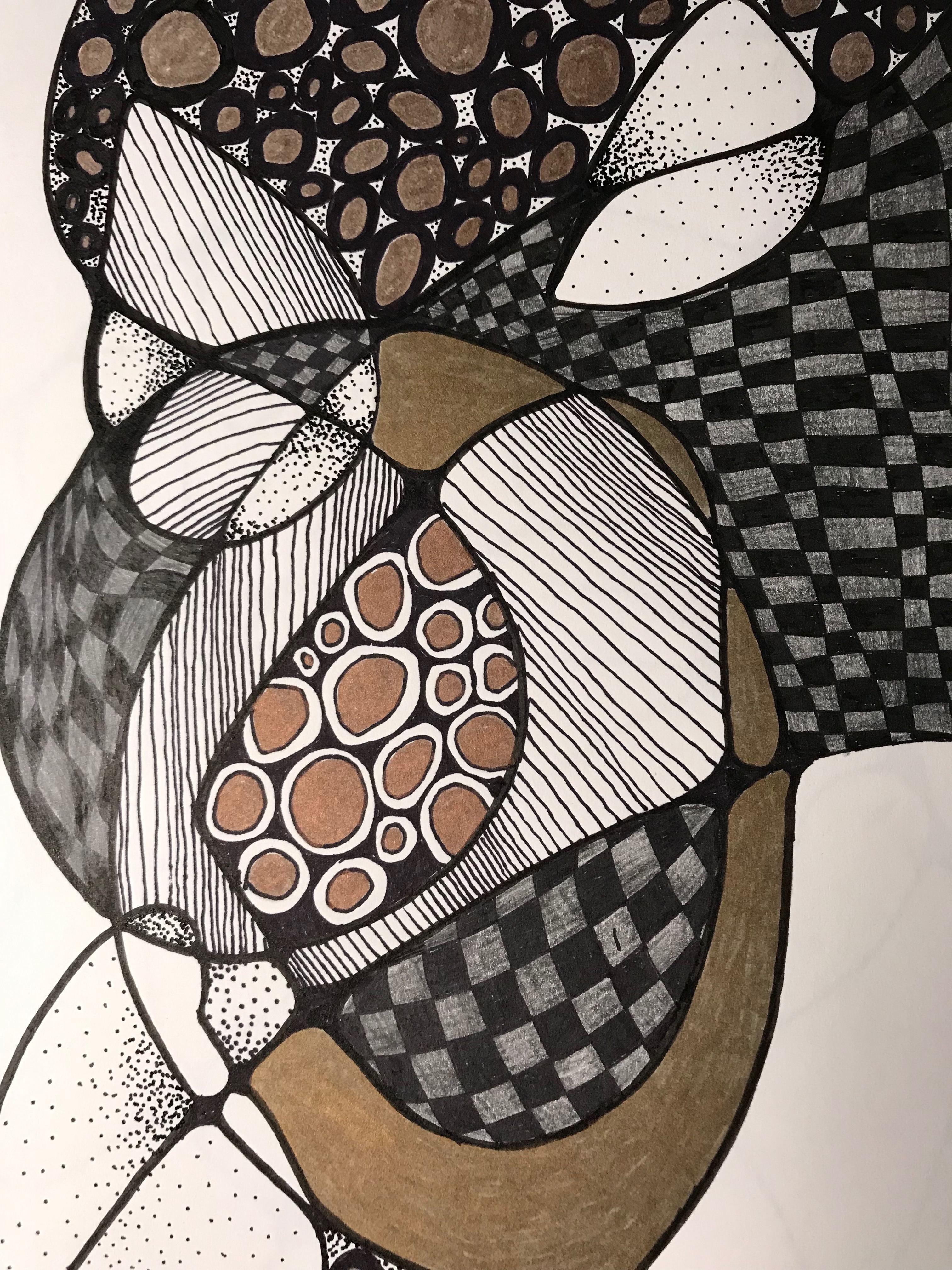
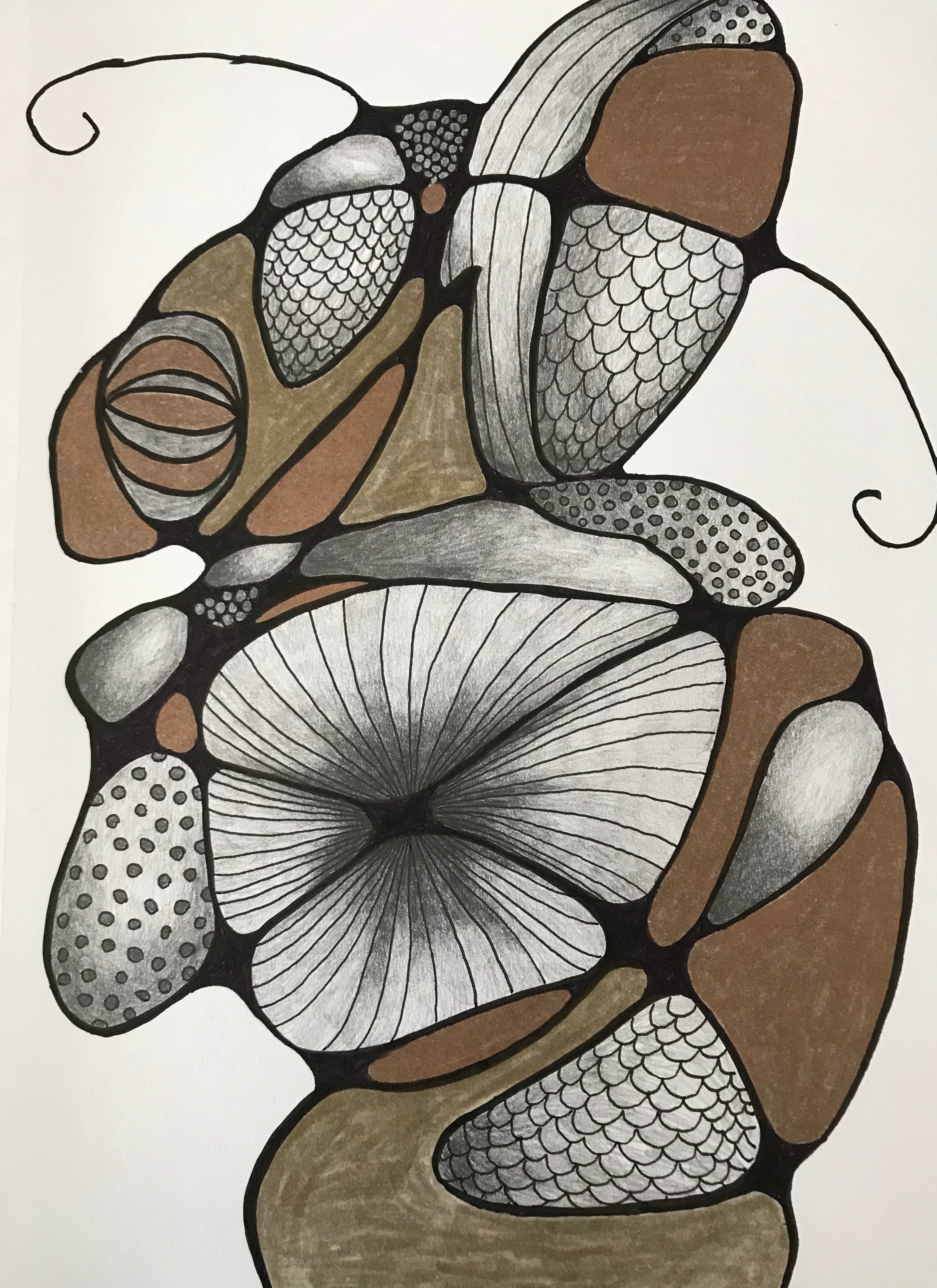
And so I’ve decided to draw. My art supplies are packed and so all I have to work with are a few sharpies and a mechanical pencil. But that’s all I need for neurographic drawing. The technique, a distant cousin to SoulCollage®, begins with just a thought. A quiet thought, a few shapes and a single line. So simple and yet it doesn’t take long before my energy settles. The jumbled words and racing thoughts become quiet, and I’m lost in the shapes I’ve drawn. I’m lost in the moment, which is a nice place to rest.


Creating as a Contemplative Practice

As a young girl I spent weekends at my grandmother’s narrow red brick row home, the one at the end of Poplar Street in Allentown, Pennsylvania, while my mom and step-dad went on the road with their country and western band. To cure my boredom, on Saturday afternoons my grandma would take a small bottle of Elmer’s Glue, some colored construction paper and a pair of child’s safety scissors from the metal cabinet tucked in a corner near the back door and put them down in front of me while I watched at the kitchen table.

Sometimes she poured all the dots left in the bottom of my grandpa’s hole punch into a bowl. Even better was when she gave me the hole punch so that I could make my own dots from the pages of a well read McCall’s magazine. Sometimes my grandma crushed the egg shells she’d saved from breakfasts that week, separated them into three or four Dixie cups and adding a few drops of McCormack’s food coloring to each one.

And then she left me to my own devices. I was free to create textured mosaics with the egg shells or to follow the outline of a pencil drawing with my pile of dots in all shades of color and tone. I sat at that table for hours while my grandma worked around me, grilling sliced onions, mixing horseradish with catsup and frying my beloved Minute Steaks while rolls toasted in the oven for my favorite Saturday dinner. 

The act of creating – whether it’s an egg shell mosaic or an egg filled soufflé, a loom knitted beanie or a black bean burrito – can be a balm that shifts our focus from ruminating on the past or worrying about the future to the moment in which we are living. This moment. The present. There is, however, one caveat. While our intent when we’re creating may be to produce something that we’ll gift to others, the act of creating must be something we gift ourselves. Because creating is a mind-freeing act of self-care.

It took me half a century and a global pandemic to figure that out. 

I think what catches us up when we consider creating something out of nothing is our predilection for wanting to make something perfect. Wanting to create precisely what we see in our mind’s eye. The perfect portrait. The perfect flower arrangement. The perfect layered cake. The perfect dance. When we abandon those ideas of perfection and decide instead to lean into the question ‘I wonder what would happen if…’ creating becomes contemplative play. As the chaos we’re living through continues to storm around us, creating as contemplative play becomes a gift of self-care that reduces anxiety, changes perspective and sparks joy.

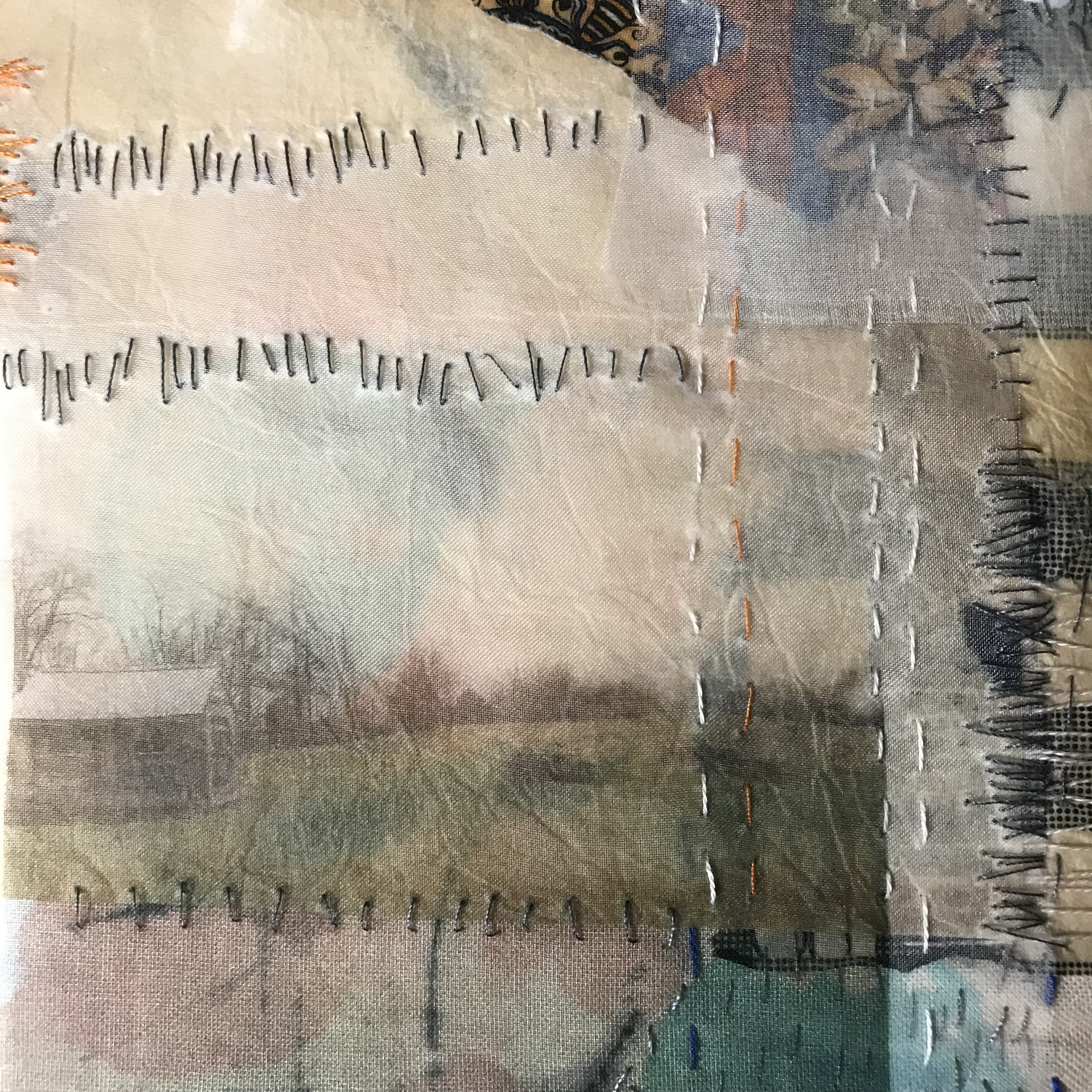
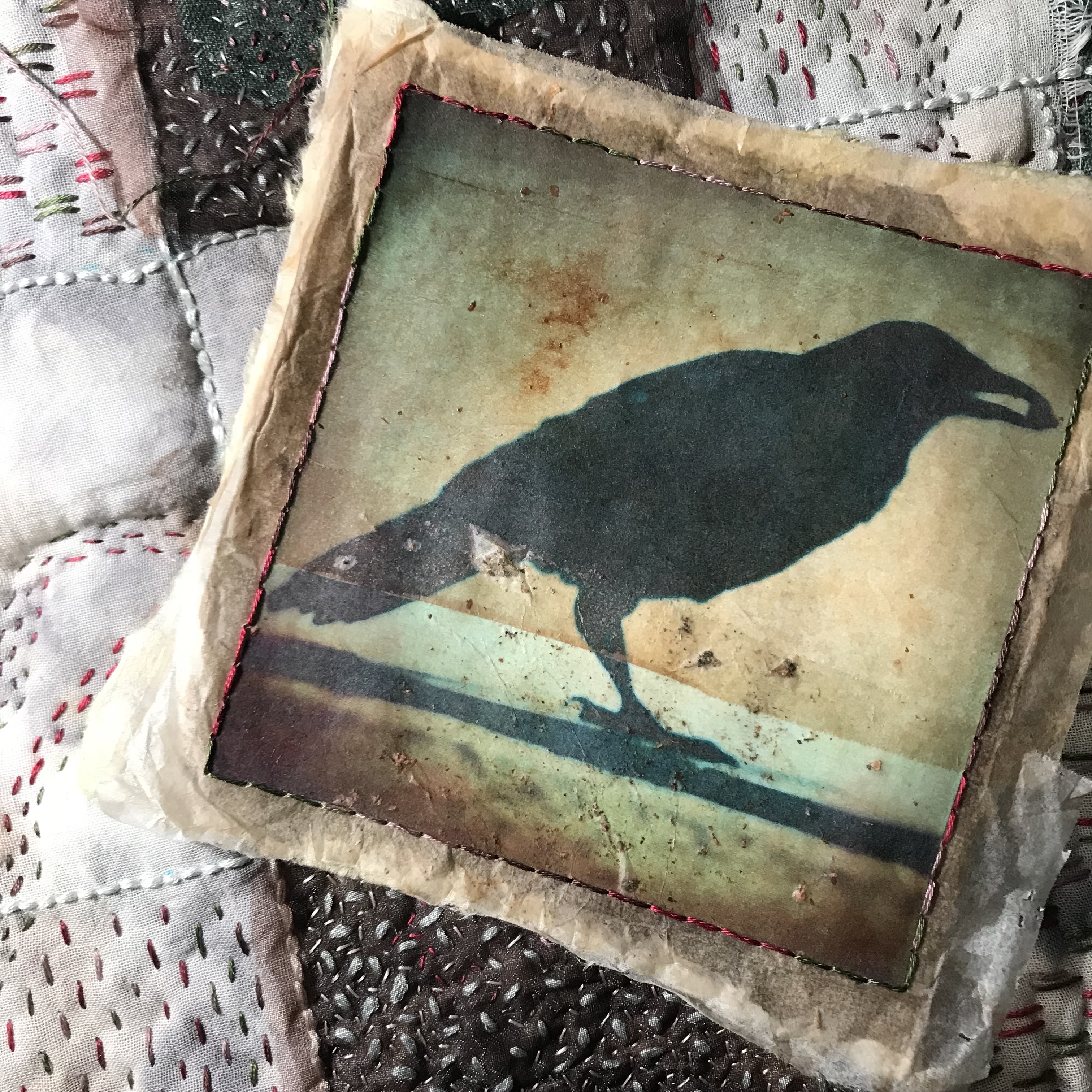
Right now I’m spending my ‘creativity time’ playing with needle and thread, fabric and photographs. I’m learning new skills like felting and sashiko and boro and remembering old skills that I loved as a child like embroidery. 

When was the last time you dug out that set of colored pencils you keep stashed at the back of your desk? Or finished the blanket you began knitting two years ago? Or made your grandmother’s lemon bar recipe? Or dusted off that guitar? Or done any activity that lights up a different part of your brain and moves you from the routine to the sublime?

It’s time.