Home Sweet Home

House sitting is a little bit like grand parenting (not that I have any experience being a grandparent, but I can imagine).  What I mean is that I move into a home, look after the fine furnishings, the houseplants and the mail.  I lovingly care for the cat, dog, or Koi in question and then – after a few days or a few weeks – I hand it all back.

House sitting is also a bit discombobulating.

Returning home over the weekend after my last extended gig, I believe I felt as disoriented and jet-lagged as the homeowners.  I had grown accustomed to their lovely house, the big kitchen, and the shaded deck where I shared meals with my friend.

It became very comfortable.

And now I’m back in the apartment that I am of course very grateful for but I have to admit – it feels pretty small.  It’s taken me a few days to figure out how to live in the space again.  I can’t remember where my “things” are, and I can’t figure out why I have so much stuff crammed into 200-square-feet.

It’s time to clear the decks.

I want to peel back the layers of detritus – the physical and psychic debris that litters my path and slows the journey.


The Baffling Case of the Rigid Mimm Day

I had the day marked on my calendar.  Sunday the 4th of March.  Mimm Day.  My first day of freedom.  No teacher training.  No dog sitting.  No private clients.  I was commitment free for the first time in months.  Come hell or high water I was going to celebrate and it was going to be perfect.

The day I planned included an early morning drive to Santa Cruz with a friend.

After a few hours of Dance Church at the 418 Project we take a leisurely stroll downtown until we find the perfect café where we enjoy a quiet brunch.  A table is waiting for us under the shade of a tree with the sunlight filtered to shield our eyes but not so much that it can’t keep us warm.  My friend reaches down and pulls a book from his grey backpack and with our second cup of tea we take turns reading to one another.  We’re generous with our tip – a compensation for keeping the café table too long. We continue our stroll and find an old record shop around the corner or maybe a shop full of bric-a-brac to bury ourselves in for a bit before making our way to a pristine beach that, miraculously, is empty except for an older couple and their two Golden Retrievers. The sound of the gulls, the crashing waves and the solar warmth of the sand lulls us to sleep just long enough to refresh but not so long as to make us cranky when we wake.

Another bite to eat and then a drive home along Highway 1 with a few stops to enjoy the view of a setting sun as the credits roll…

Mimm Day.  My perfect day.

But on designated Mimm Day I opened my eyes and discovered the alarm clock had never been set and we were already two hours too late to attend Dance Church. I cried like a ten-year-old who had slept through Christmas.  It was only 9:30 but the day, as far as I was concerned, was ruined.  And if I was wrong – if the day wasn’t really ruined – I was still going to nurture my disappointment and bad temper.  I didn’t get what I wanted and I was too swept up into the movie I had written in my head about what Mimm Day was supposed to be that I couldn’t see that the day was still perfect.  It was sunny and warm, it was a gorgeous morning – there was plenty of day left.  And I was still free to do whatever I wanted.

But I couldn’t see it.   I was blind to what I had right in front of me: my best friend, a blue sky and eight more hours of sunlight.

How many times are we guilty of placing emotional importance on an unpredictable future?  How often do we trip over ourselves reaching for paper tigers and ghosts that we can never hold and that never live up to the movies we make in our mind?

I’ve been reading to my students from Sharon Salzberg’s book Lovingkindness:  The Revolutionary Art of Happiness.  She writes:

When we become lost in desire, we are put firmly into the framework of linear time.  We become focused on getting what we do not yet have or on keeping what we do have.  We become oriented toward the future.  To be caught in this concept of linear time brings us to what in Buddhist teachings is called bhava, or becoming, always falling into the next moment.  It is as if before each breath ends, we are leaning forward to grasp at the next breath.

On March 4th I leaned so far forward I fell flat on my face.

Thinking about the future is not a bad thing.  But clinging to an ideal of what I believe the future should be does not allow room for change or perspective.  It leaves no room for living.

And isn’t it time to live a little?


Perfectionism: The Voice of the Oppressor

Cover of "Bird by Bird: Some Instructions...

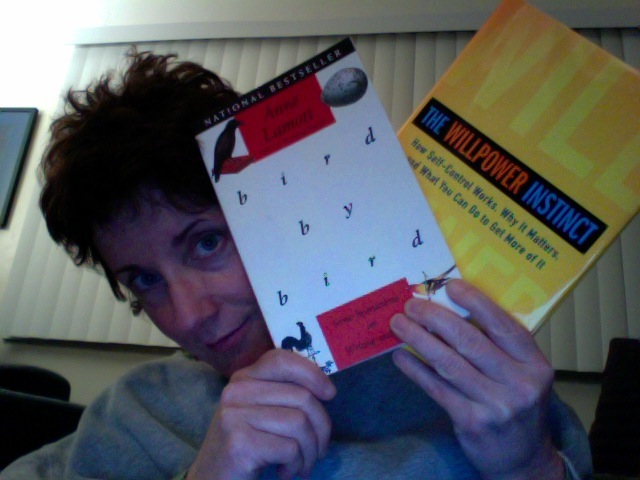
I don’t know that I could have picked two better books to read simultaneously.  If Kelly McGonigal’s The Willpower Instinct is the brain of the operation, then Anne Lamott’s Bird by Bird is the heart.

I know everyone has already read Bird by Bird.   Most likely in 1994, when it was published. I was a little busy that year.  Plus, I have a stubborn streak and if someone says to me, Oh, you’ve just got to read this book! (or see this movie, or meet that person), I won’t.  Just to be stubborn.  It took me twenty years to see E.T. the Extraterrestrial.

Still, even if you loved Bird by Bird when you read it seventeen years ago chances are you’ve forgotten why. I’ll remind you:

Here are Anne Lamott’s thoughts on perfectionism:

Perfectionism is the voice of the oppressor, the enemy of the people.  It will keep you cramped and insane your whole life, and it is the main obstacle between you and a shitty first draft.  I think perfectionism is based on the obsessive belief that if you run carefully enough, hitting each stepping-stone just right, you won’t have to die.  The truth is that you will die anyway and that a lot of people who aren’t even looking at their feet are going to do a whole lot better than you, and have a lot more fun while they’re doing it.

Meanwhile, back on the pages of Kelly McGonigal’s The Willpower Instinct we find studies that support Anne’s heartfelt commentary and advice on how to relinquish the desire to be perfect.  Kelly explains why offering compassion and forgiveness to ourselves instead of layering on the guilt for our missteps strengthens our ability to see the big picture. 

I didn’t expect Bird by Bird to make me smile as often as it has.  And I didn’t expect The Willpower Instinct to be so easy to take.  I expected an overly sweet Bird by Bird to have me in a literary sugar coma by page forty, but Anne Lamott’s practical advice is seasoned with just the right enough bite to balance the moments that bring tears to your eyes.

I thought Kelly McGonigal’s book would be like any other book I’ve read about goal setting.  I thought I’d be writing lists, repeating affirmations and by the end of the day – with few items on the list accomplished – calling myself a failure.

The truth is, Kelly’s book is about forgiveness. It’s about settling down.  Giving yourself a break.  And she has all the scientific evidence we need to see why this is important.

My intention was to break my Hulu habit by reading eight books in six weeks.  That’s not going to happen.  Why?  Because I chose an astoundingly unrealistic goal.  That’s typical of me and, according to McGonigal, typical for many of us.  But don’t blame Hulu. While I haven’t severed my attachment to Hulu completely (a once-a-week, twenty-two minute dose of The Big Bang Theory after a long day is medicinal) I’m certainly no longer sliding down a steep slippery slope toward a self-inflicted Hulu-lobotomy.

A more realistic goal is four books in six weeks.  Today Bird by Bird returns to the bookshelf.  The Willpower Instinct, however, is staying out.  Now that I’ve read it from cover to cover my intention is to go back and read it again – this time actively working through the exercises provided.  I’ll keep you posted how all that works out.

The book I’m beginning today is John Green’s The Fault in Our Stars. No, it wasn’t on my original list. I’ve chosen this young adult novel because I’m working on a young adult novel (yes, again). The book has a bit of buzz on it and I’m looking forward to digging in.

Next time:  An update on the meditation practice I committed to in January or A Funny Thing Happened on the Way to Whole Food’s Meat Counter


Day One. Reading, Writing and Meditation

I’ll be the first to admit that I lean a bit toward the odd.  In a good way I hope, but still.  I allowed myself one last moment with Jimmy Fallon (“I Gotta Have More Cowbell!”) and then broke the news to Hulu:

“I think I need a break.”

“Did I do something wrong?”

“No, Hulu – it’s not you.  It’s me.”

“You want to spend more time with Facebook, don’t you?  I know the two of you are tweeting.”

“No – that’s not it at all, Hulu!  It’s just that…well…it’s just that I want to…”

“You want to what?  Go on, Mimm.  Tell me.”

“I want to read.”

“What do you mean you want to read?”

“You know.  Books.”

“Is this a joke?”

“No, Hulu, it’s true.  I want to read books. I have a goal.  Eight books in six weeks.”

“Don’t make me laugh.  You’ll never do it.  Two days from now when the latest episode of Glee is available you’ll come crawling back.”

“I don’t think so, Hulu.  Not this time.”

At that point I said good night.  I thought I heard a sniffle as I closed the laptop, and then I set my alarm, rolled to my side and went to sleep.

Today I determined that all eight books amounted to about 2300 pages.  I have thirty-six days to make it from cover to cover on all of them.  That means reading at least sixty-three pages per day.  No problem.  I hope.

I’ve begun with Kelly McGonigal’s The Willpower Instinct.  Even though I had dipped into the book earlier, I decided to begin at the beginning.  Here’s what I discovered today:

It turns out my recent commitment to meditation is doing more than creating a calmer Mimmsy.  Meditation is helping my brain to build grey matter in the prefrontal cortex and other regions of the brain that support self-awareness.  In other words, my meditation practice strengthens my will power and bolsters any skill that involves self-control.  Like reading.

In addition to Kelly’s book I’ve decided to read a chapter per day of Bird by Bird, the wonderful book about our writing life by Anne Lamott.  Today I read the introduction.  I’ll leave you with a Wendell Berry poem, The Wild Rose.  Written for his wife but used by Anne to describe how writing feels to her sometimes – like a person – “the person who,” Anne writes, “after all these years, still makes sense to me.”

Sometimes hidden from me

in daily custom and in trust,

so that I live by you unaware

as by the beating of my heart,

Suddenly you flare in my sight,

a wild rose blooming a the edge

of thicket, grace and light

where yesterday was only shade,

And once again I am blessed, choosing

again what I chose before.


Negative Space

I’m captivated by negative space.

The space that isn’t the thing:  the blue between the branches of a bare winter tree, the angles drawn by a box of pencils spilled atop a desk, the shapes that fall between the shadows of a picket fence on a summer sidewalk.  Negative space.  The space that isn’t the thing.  The space that connects.

Sometimes it happens that during our yoga practice the asana becomes a single intention.  A shape to hold in passive static until we decide – or someone decides for us – that it is time to move.

This can happen if we’re practicing a slow flow or lightening quick vinyasa.   The shape becomes the goal.  There’s a rhythm and a reason for our wanting to be there. When I arrive at my full expression of the asana I’m practicing I’ve arrived at someplace familiar.  Someplace balanced.  Home.

But what about the negative space?  What about the space between the shapes our bodies sketch? What about the movements we create as we shift toward trikonasana or sirsasana? And what about the breaths we draw around that movement?  Shouldn’t the journey we take to create the asana be considered, too?

As you practice this week notice the negative space.  Connect with the space that isn’t the thing.


Eknath Easwaren’s Passage Meditation

At first I was put off by Eknath Easwaran’s Passage Meditation.  The prose was too anecdotal, the advice too simple.  The book was for beginners.  Didn’t I already know all of this?  I wanted the answers to my deeper questions, not a parable on the hectic pace of life.

But because I promised my meditation teacher I would finish the book, I continued to read. And once I tucked my ego and arrogance away (and admitted I am a beginner!) I discovered that this book is a gem of subtle yet powerful insights.

Embracing a daily meditation practice requires discipline that, quite honestly, isn’t easy for me to summon.  I keep trying.  There are rare mornings when finding my seat and watching my breath feels like my natural state.  As if this is how it has always been and always will be.  On most mornings, however, the clarity and stillness I’m looking for spends most of the thirty minutes competing with random thoughts about clients, classes and topics for my next blog post.  On these days I sit, I breathe, I wait and then, when the timer sounds, I smile.  Have I failed?  No.  I showed up.  And as long as I continue to show up I know that eventually the days I feel meditation is my natural state will outnumber the days when stillness has to compete with my chattering mind.

Tonight I was reading about the power of thoughts and control of the senses.  Easwaran writes that this is our goal:


When we stimulate the senses unduly, vitality flows out through them like water from a leaky pail, leaving us drained physically, emotionally and spiritually.  Those who indulge themselves in sense stimulation throughout their lives often end up exhausted, with an enfeebled will and little capacity to love others.  But when we train the senses we conserve our vital energy, the very stuff of life.  Patient and secure within we do not have to look to externals for satisfaction.  No matter what happens outside – whether events are for or against us, however people behave towards us, whether we get what pleases us or do not – we are in no way dependent. 

Then it is that we can give freely to others; then it is that we can love.


Initially I thought I’d write that Passage Meditation is a simple book.  It feels like a simple book.  But once the heart and mind are open to its teaching, it becomes a rich and layered set of ideas that will move us forward in our practice.


This Present Moment: Adventures in Meditation and the Arrival of a Mantra

English: All Solutions By Yogi Tamby Chuckrava...

Image via Wikipedia

It began with the purchase of my iPhone, this new bad habit.  The cold weather, this cold apartment and my laptop encouraged me.  I began to love curling up under the blanket and surfing in the hour before sleep.  And if I woke in the night, which I do sometimes, I’d pick up the phone or the computer and surf again.  When the harp sounded on my iPhone alarm in the morning, guess what?  Out came the laptop.  I just needed to know if Matt’s gig in Oxford was a success, if it was snowing in Michigan or if I could chat with a friend in Nevada I’ve never met.

Don’t get me wrong – I’ve a stack of books next to my bed, too.  And sometimes I even read them.  I jest.  Of course I read.  Since ditching the cable and television I’ve had plenty of time to read.  But it’s clear to me this new bad habit is filling the gap those ten-year-old episodes of “That 70’s Show” once held.

If I really want to quiet Monkey Mind and to have a life long, transformative meditation practice, then I need to break this new bad habit and begin a new good habit.

Here’s where I’ve gone wrong:

Rather than dedicating the same time each day to practice, I’ve been fitting it in when I can – four or five days a week, ten or twenty minutes at a time.  The only dedicated periods of meditation are the forty-five minutes a friend of mine and I take prior to a yoga class we attend and the hour of practice I enjoy on Thursday evenings with a local Daoist Meditation Group (I’m new to this group and have only attended twice.  Still, it feels as though I’ll continue indefinitely).

I don’t want meditation in my life as something I practice on a whim.  Meditation should be who I am, not something that simply hovers around me.

Fortunately, I have a mentor who is gently guiding me in the right direction.  He’s the teacher who recommended Eknath Easwaran’s Passage Meditation to me – a book I’m now recommended to anyone who is on a path similar to mine.

Last night my mentor gave me the gift of a mantra.  He said it would change my life.  He said it would settle me (how did he know I was unsettled?) and that if I repeated this mantra each day very soon nothing would ever again ruffle my feathers (how did he know my feathers were ruffled?).

Seriously.  All that from one word? Almost less than a word – my mantra is one single syllable. He’s telling me one single sound can change my life?

I surfed before sleep last night.  And when I dreamed about earthquakes I woke and checked the USGS website.

But when my iPhone’s harp began to play this morning I swung around, placed my feet flat on the floor and set the timer for thirty minutes.  I let my hands rest on my lap, right hand nestled in the left with my thumbs touching and I closed my eyes.  And then, for one hundred and eight rounds, I began to repeat…


More Monkey Mind: Finding Clarity in the Muck

It would be fair to say that over the past few days my life has begun to resemble a lamentably bad country and western song:

“My boyfriend left and the car won’t start.  My battery’s dead, I gots a broke down heart…”

So cue the violins.  Stuff happens.  Here’s the thing.  Yesterday I wrote about how Monkey Mind will mess with your head by encouraging you to re-live your mistakes in an endless Groundhog Day-esque loop.

But that’s not her only talent.

When I stepped out the door this morning I expected today to be like most Wednesdays:  I should have been on the road to see clients in Saratoga by 8:15, back to Palo Alto for a 12:45 appointment, up the road for two back to back classes, home for dinner, out to the studio to teach the 7:30 class, home to bed.

But when I slipped the key into the ignition and heard the glurg, glurg, glurg of an engine that had no intention of delivering me to my appointed rounds, Monkey Mind took her cue and started chattering:

“Oh, it’s probably the starter.  Do you have any idea how much that is going to cost?  You’ll probably have to cancel all your clients today…and tomorrow…maybe even Friday!  Your clients won’t want to see you again.  You’re too unreliable.  And you’ll have to call a tow truck.  Do you know how hard it is to call a tow truck?  And that will cost money, too.  Do you have any money?  You don’t have money, do you? Oh and don’t forget about rental car you’ll need while yours is being repaired.  You might as well kiss your savings goodbye…”

And so on.  My little Monkey Mind bounced from one scenario to another – all of them bad.  It would have been easy to just submit to the chatter and allow myself to become more and more wound up, anxious and frustrated.  I mean, that’s what we do, right?  Life hands us a bit of unpleasantness and we give in to it.  We listen to Monkey Mind.

Not so fast.  Maybe we don’t listen to Monkey Mind.  Maybe we see through Monkey Mind’s games and choose an alternative course.

This morning I gave Ms. Monkey about ten minutes of my time before I sat down, closed my eyes and took a few breaths.  And then I found the number for Honda Care’s roadside service.  I rang and the tow truck arrived within thirty minutes.  The driver charged my battery.  I drove to my dealership and purchased a replacement.  Yes, I missed my clients in Saratoga but the rest of the day went pretty much according to plan.

So stick that banana in your pipe and smoke it, Monkey Mind!

I’m not going to try to convince you that today is one of my better days.  But it’s far from the crisis my chattering Monkey Mind wanted to create.  It’s just been a day.  One simple, human day.

Like most habits we are trying to build or break, creating a daily meditation practice is a process full of ups and downs.  I always understood that part of the process was being diligent about setting aside time each to practice.  But I also need to welcome opportunities that allow me to weave what I’m learning into the fabric of my day-to-day life.

When we step back from the muck occasionally thrown our way and examine our lives from the edge rather than the center it becomes clear that the work we’re doing is powerful and transformative.

I know that Monkey Mind will always be lurking.  But today I discovered that she’s no match for me.


Monkey See, Monkey Do, Monkey Mind: Further Adventures in Meditation

Over the weekend some ill-timed and unkind words hurt the feelings of a dear friend. With a rare lack of consideration, I replied to a friend’s loving note with rude sarcasm.  When I realized my mistake it was, of course, too late.  I could not take back what I had written.

I am a kind person.  I am empathetic and accommodating.  This lapse in judgment was unusual for me and I continued to dwell on it until little Monkey Mind and her chattering little monkey friends cobbled together a story in my brain that my heart grabbed hold of like a dog with a bone.  Click here to read a great article about what the Buddha had to say about the monkey mind.

The result?  Monkey Mind’s got me.  She has a firm hold of my cerebral cortex and is giving it a real rattle.

You know Monkey Mind, don’t you?  She’s the uninvited guest who insinuates herself in many ways.  She’s our inner gossip.  She keeps our mind restless and unsettled; doubtful and confused.

I regret the choice of words I used with my friend but instead of acknowledging my lack of judgment and moving on Monkey Mind is making certain I stay stuck right at the moment when I pressed ‘send’.  I’ve no opportunity to push ‘pause’; no way to hit ‘delete’. Instead, my mind is set on instant replay so I can witness the fumble on a constant loop. I’ve seen the sequence of events in my mind’s eye enough times to rewrite several different, happier outcomes.  But of course those alternative outcomes will not be realized.

Monkey Mind is a trouble-making nuisance that serves no purpose.  She’s distracting. When Monkey Mind has the upper hand we lose concentration and focus.  Trying to meditate when Monkey Mind has us by the bal…er…brain is a little like trying to walk a straight path during an earthquake.

But guess what?  We should meditate anyway because a pint of comfort in the guise of Ben & Jerry’s Cherry Garcia washed down with a bottle of root beer will not settle Monkey Mind.

But meditation will.  I need to meditate.


And so I did.

I began with a thirty-minute asana practice that balanced a strong standing flow with calming forward folds.  Focusing on my breath redirected my awareness away from the chatter in my mind.

Nevertheless, when I took my seat and closed my eyes Monkey Mind was still poking at me.  But I knew a subtle shift away from Monkey Mind’s influence had begun.

As I settled into meditation, I did not force myself to ignore the chatter.  Instead, with detachment and non-judgment, I simply watched my thoughts as they rose, lingered and floated away.

I turned my awareness to the tip of my nose where I noticed the cool in-breath and the warm out-breath.  And when I felt suitably centered I began to silently repeat the mantra ‘so-hum’.

Thirty minutes later I blinked my eyes opened and took a gentle stretch.

I will not try to convince you that Monkey Mind disappeared after one asana and meditation practice.  What I can tell you is that Monkey Mind’s loud, distracting and overriding cackle has softened.  Once more I can thrive in the present.  And that sure beats obsessing about a future I’m unable to predict and a past that I unfortunately cannot change.


Start Where You Are: More Adventures in Meditation

Since beginning the teacher training program at Avalon Yoga Studio in Palo Alto last September I’ve heard this phrase repeated again and again:  start where you are.

Start where you are is simple level-headed advice that we should remember when we’re beginning anything new, whether it’s the yoga we’ve always wanted to try, the novel we’ve wanted to write or the song we’ve wanted to learn on our guitar.

Don’t argue, don’t procrastinate and don’t wait for conditions to be perfect.  Start where you are.

The advice is particularly useful when contemplating a meditation practice.  Do you want to meditateStart where you are.

Read this blog back far enough and you’ll find a post about my two weeks of Yin Training in the Santa Cruz Mountains with Paul and Suzee Grilley the summer of 2009.  We began each morning with thirty minutes of meditation.  I was determined to continue the practice once I returned home.

It didn’t happen.

I used every excuse imaginable from being too tired to crawl out of bed to convincing myself I’d practice later in the day but of course I never did.

Why?  Because I felt fraudulent.  No one gave me a list of instructions (and we know how I like my lists).  I didn’t understand the steps. I couldn’t possibly be meditating correctly. And so I didn’t meditate at all.

The truth is, there are no list of instructions, no easy steps.  And there’s very little you can do short of strapping on headphones and cranking Nirvana’s Smells Like Teen Spirit to eleven that would ruin the experience.

Because we start where we are.  We find five minutes and we sit still.  And then we find ten minutes to sit still and to listen to the breath.  Soon we’re sitting for twenty minutes and the breath may become a mantra.  Or not.

There are plenty of books that offer techniques.  I’m reading one now, Eknath Easwaran’s Passage Meditation. The book is a basic primer the offers suggestions and teaches the reader why meditation is life enhancing.

And there are groups you can join.  A friend of mine and I recently dropped in on a local Daoist Meditation Group.  And you know what?  The Daoist technique was deeply different to my personal practice.  Does that mean I’m wrong?  Of course not.  And neither are they.

We start where we are.  We find our way.  We choose our path. And there is no wrong.  We start where we are.