
Quick reminder. Practically Twisted is going away soon. Please follow me here.
Last year I submitted my application and was selected to be part of the Enso Circle 12-week online residency. But the timing felt off and, with reluctance, I put the residency on hold.
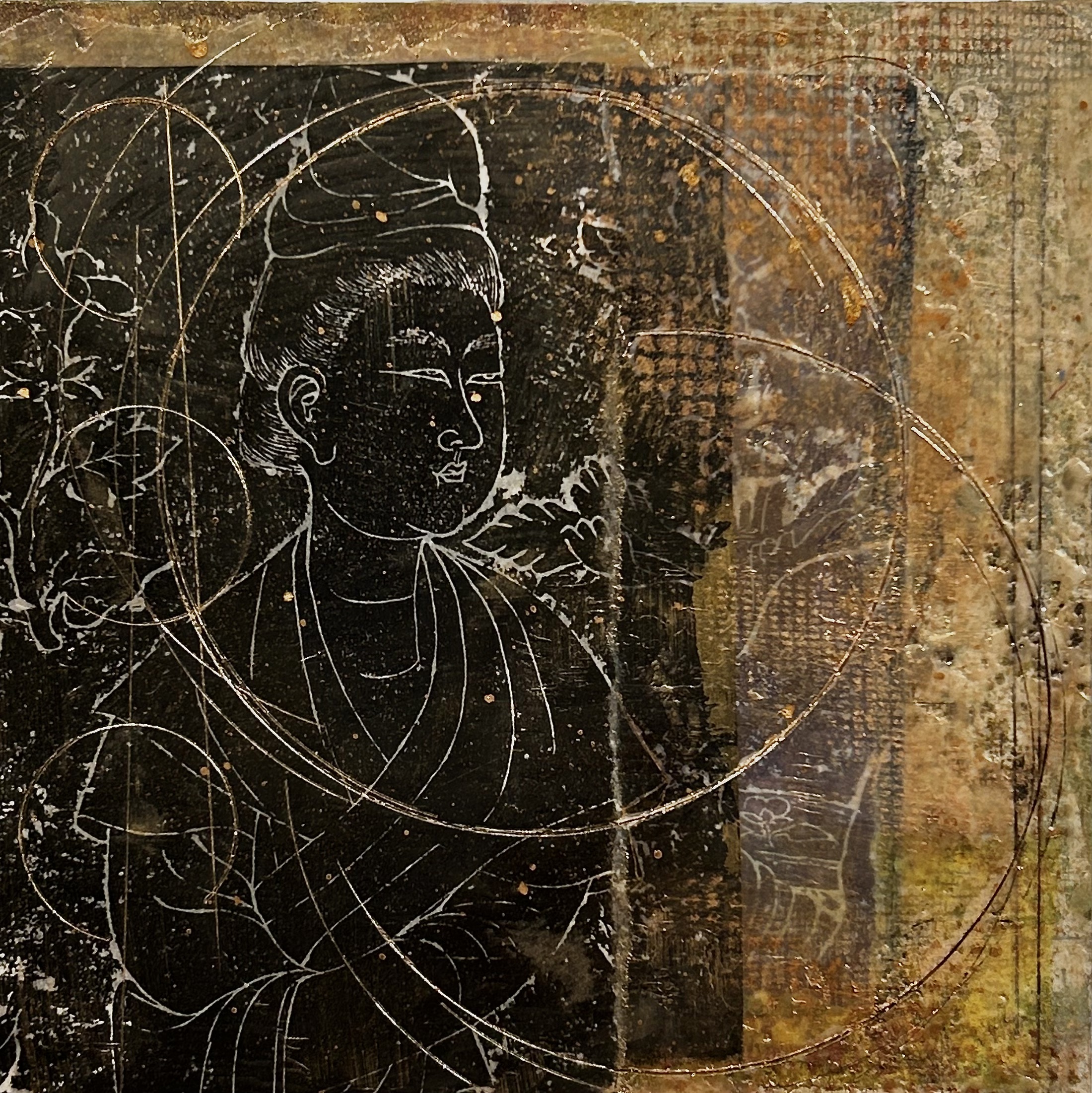
The timing was perfect this year. My exhibit at McGuffey was installed. The opening was on the first Friday in March, and the residency began the following Monday. What better way to process that weird, restless feeling I experience between the end of one intensive burst of creative energy and the beginning of whatever happens next?
I have a few more weeks with my Enso Circle cohort, and as the residency begins to wind down, I’m reflecting on what our time together is adding to my creative process.
I’ve shared this time with six other artists from across the country and our two facilitators, the Enso Circle creators Lyn Belisle and Michelle Belto. I was very familiar with Lyn’s gorgeous work, having taken several online classes with her via Teachable and being charmed by her relaxed and honest approach to instruction (case in point: in one video she accidentally replaces the word “methylcellulose” with “Metamucil” — more than once — and does not edit out the malapropism). I knew Michelle’s work but wasn’t as familiar with her teaching; I’ve come to love her calm, quiet, almost Zen-like approach.
Every Monday begins with a morning email and concludes with a gathering over Zoom to learn, to discuss, and to share. But I have an aversion to sitting in circles and talking about feelings, so I don’t always look forward to the check-ins, which feel like the online equivalent. That being said, Lyn and Michelle manage these meetings beautifully, and over the weeks I’ve come to appreciate my cohort’s varied experiences, the wounds we lay bare, and the hopes we share.
Yesterday’s discussion danced around impostor syndrome, authenticity, and the self-talk we cling to as a reminder that we’re not good enough. By the end, I’d loosened my grip on negative self-talk (at least a little) and embraced the idea that my Enso cohort and I are continuing a long lineage of women artists. What Lyn and Michelle share with us they learned from their own teachers, who learned from their teachers, who learned from their teachers. It grounds me and gives me strength to imagine our lineage traveling back to the first woman who dared to trace an ochre line around her hand.
Our online lesson guide provides the resources we need to move our studio practice forward and ideas to consider as we attempt to bring spirit and authenticity to our work.
We have a Slack channel — it’s the virtual hub of the residency, and I check in a few times each day. It’s here that we ask questions, submit weekly progress reports, post work-in-progress, and do our best to offer substantial yet compassionate critique.
The residency concludes with the creation of a catalog featuring the work created over the three months we’re together.
What I’ve appreciated about this residency is the focus it provides. I have a reason for returning to the studio to explore anew. I also appreciate the selflessness of Lyn and Michelle, who offer support by being available to answer questions, provide reams of resources, weekly challenges, and expert technical advice.
I’m grateful to be part of this circle of nine women artists. We are all so very different. At the start of March we determined our individual goals for the residency. One artist set the intention of being a witness to her creative process. She wasn’t concerned with making or doing—just watching. As someone whose studio practice leans toward “jump first, ask questions later,” I was enthralled. As much as I’ve learned about technique, as much as I’ve explored new tools, it’s this woman’s contemplative approach to understanding her process that might be the most important lesson.
Or maybe jumping in feet first is my process.
Whether it is or isn’t, I think that after my residency with the Enso Circle ends, I might take a week or two away from the studio. I might step back for a bit to absorb all that has happened to me—to my art—since I moved into Studio 6B at McGuffey Art Center sixteen months ago. After pushing, pushing, pushing for so long, it might be time to rest, reflect, and reset.