Finding Joy in Weaving: Embracing Artistic Messiness

Quick reminder: My Practically Twisted blog will be going away over the next few months. If you want to continue to receive my random musings and to keep up with my art life please sign up at the new website.

There’s snow in Crozet today, Friday. It’s beautiful and white and still falling. Rather than drive into the studio I’m going to stay at home and feed the squirrels peanuts. After weeks of non-stop making I’m going to press pause. I’m going to take time to reflect. Ponder. Reconsider. 

Hey – do you remember learning to weave with strips of paper when you were in grade school? I do. And then we learned that our strips of paper didn’t have to be as straight as arrows. If we cut them with curves or at angles they still wove together and – for this little girl at least – created something magical.

I still think weaving is magical.

With this in mind, several years ago I purchased a small frame loom. And then a larger one. And then a larger one still. I’ve brought them home from the studio and while I have every intention of dusting them off the truth is that my messy artist self feels constrained (or maybe intimidated) by those looms. But any time I see a discarded wire rack or some window screen or an abandoned picture frame my brain says, ‘Hey! I can weave on that!’.

And that’s what I’ve been doing these past few weeks. 

We’re not talking the incredible Anni Albers here. This adventure I’m on is fun and frustrating and weird and has taken me on an unexpected detour from the encaustic ‘dream boats’ I was focused on in October.

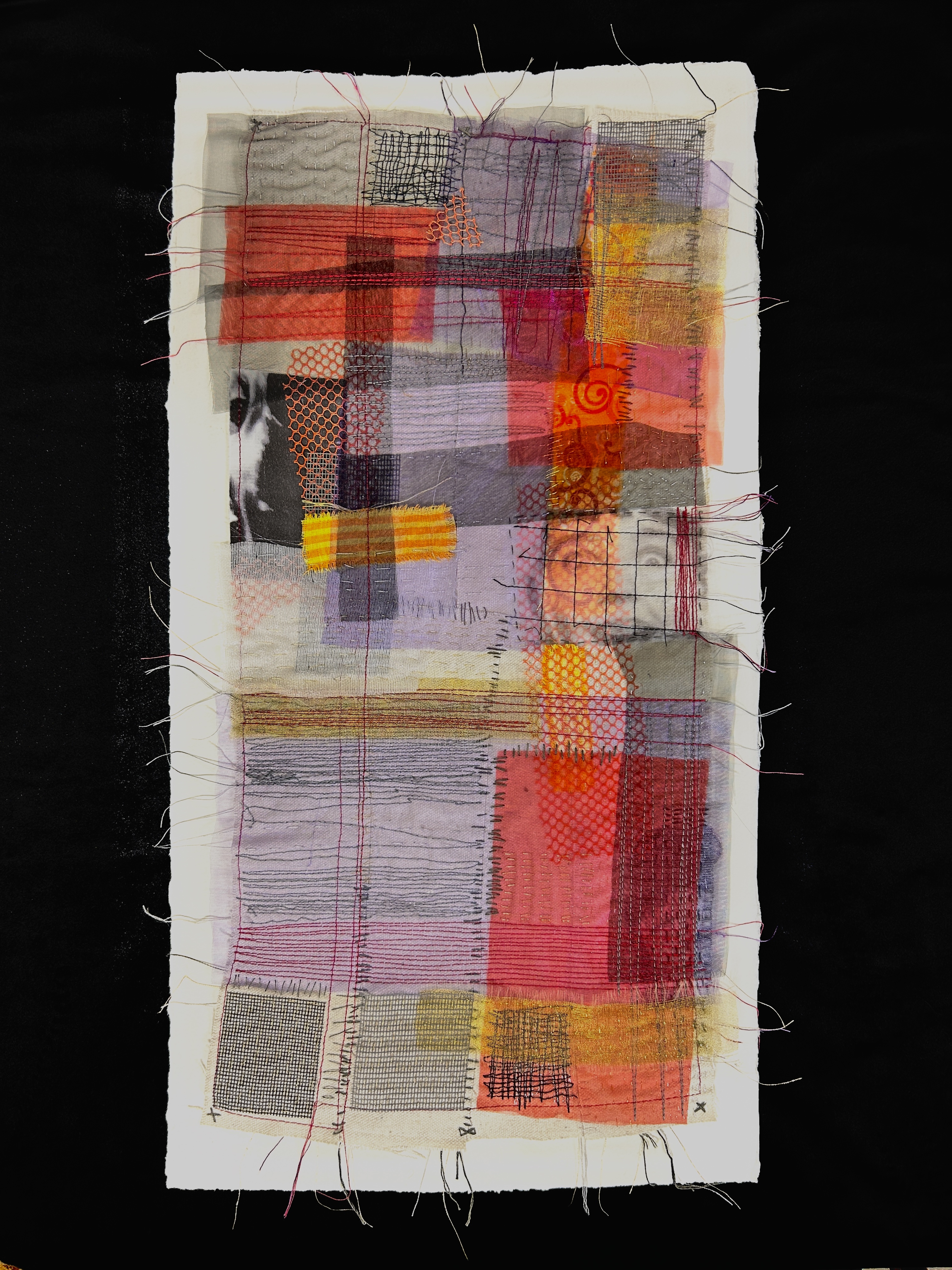
Instead I’ve been working on two small aluminum picture frames that I’m repurposing as looms and a large 24×36 inch piece. Contrary to everything I just wrote, the larger work is on a loom, where it will remain. This rustic loom, a rectangle of reclaimed wood with pin nails to hold the warp, was made years ago by someone else and given to me by a friend. I’ve attached a collage I created with tissue paper on foam core with the stenciled text ‘looking at art reminds us that we are not alone’ to the back so that the loom frames the collage. The weave hovers an inch above the collage. And what a weave it is. I chose a palette far removed from the swampy browns of my earlier photo encaustic work. It is off the charts bold, bright and neon. I chose cotton, wire and monofilament for the warp and more wire, embroidery floss, beading, produce netting and the funny plastic stuff we made lanyards from when we were kids for the weft. I tied warp threads together and l’ve let the weft hang in places like stray hairs. The viewers eyes have to dodge around the threads and wire in order to find the text hiding beneath it all. 

As I worked I believed in what I was doing. I considered each choice, I killed my darlings and explored new ways to solve the technical issues I bumped into along the way. Pushing the boundaries of weaving is not new, yet as I worked on this piece I believed I was being bold and inventive.

But ss I was attempting to photograph the work for submission to a call for art at a Richmond, Virginia gallery any thoughts I had of its ‘bold inventiveness’ were replaced with thoughts like ‘what were you thinking?’ and ‘this is a mess!’.

Confidence and conviction can be fleeting. Self-doubt is easier to handle than the deep  exploration it takes to uncover the truth of why we make what we make. Art is a language without words and what keeps me anchored in the process is asking myself again and again ‘what story am I trying to tell?’.  But sometimes the work is too hard.

I seek validation from others rather than trust my own instincts because I forget that we need art in the world. Because I forget that we need art to remember that we’re not alone.
What Do Gardening, Health & Art Have in Common? Kinds of Kindness.

There was a time when the level of happiness I felt in a day was determined by the number I saw on the scale upon weighing myself each and every morning. As I aged I saw the futility and ridiculousness of that ritual and stopped weighing myself. For many years I lived without a scale in the house. If I’m being truthful, however, to this day, on those rare occasions when I do check in on my weight the number I see still has the power to set my mood.

Something similar happens when I am in my studio. If the work is going well then I’m all smiles. If I’m struggling with the materials, or if I’m certain I’ve ruined a new piece I was enamored with just the day before, I question why I even bother. Then there’s the mental baggage that accompanies me when I’m headed to the studio. If by chance I open that baggage and spill it’s contents then navigating my studio and doing the work my heart wants me to do is made more difficult by the messy mental stumbling blocks I’ve placed in my way. Like my ever-present impostor syndrome, for example. Or the envy I sometimes feel for another artist – their gorgeous work, their incredible success. And when there is envy, shame for feeling envious is not far behind.  

As I write these thoughts I can look out the window and see that the team of gardeners we’ve hired have arrived. It will take some time to clear out decades of overgrowth, to repair a stone wall and to remove the non-native ivy climbing the trunks of our trees. But when the work is finished I will begin to prepare one small bed at the base of the largest tree for planting in spring. Which reminds me of something someone told me a few weeks ago. They told me that gardening is not a project, it’s a process. Indeed.

Two and a half decades ago I joined Weight Watchers and lost sixty unnecessary pounds. I lost the weight so quickly that I gained more than a few gallstones and a nasty case of disordered eating but we can save that story for another day. The mistake I made at the time was thinking of my weight loss journey as a project. And once those pounds were dropped the project was complete. Silly me.

Three years ago, when we moved to Virginia, I was determined to find the artist I abandoned when the need to have a steady income was more urgent than the need to create. Somehow the universe felt my determination and opened a few doors for me. She built a solid foundation for me when I was accepted into the Incubator Program at McGuffey Art Center in Charlottesville.

In 2023 I took on the year-long residency at McGuffey as a project. Show up. Do the work. Exhibit the work. Sell the work. Repeat. What was I thinking?

Gardening is not a project, it’s a process. Holding on to good health is not a project, it’s a process. Creating art that resonates is not a project, it’s a process. I guess it follows, then, that life is not a project. It’s a process. 

It’s a process that begins with kindness. Being kind to my home. Planting seeds. Nourishing the earth beneath my feet. Hard and rewarding work. Being kind to others. Admitting when I’ve made mistakes or when my words have hurt someone. Showing gratitude for deep friendships. Remembering anniversaries and birthdays.

But being kind to my breathing heart? Being kind to my creative heart? That can be challenging.

Manifesting kindness towards myself when I’ve spent seven decades judging and comparing myself to my wealthier friends, to the skinny models I see in magazines, to the artists that speak with eloquence and passion about their work is a struggle. Maybe it requires breaking the habits that keep my self-care and kindness at bay.

Maybe it begins with embracing the truth that the process – whether it’s planting a garden, celebrating good health or creating art  – doesn’t run in a straight line. It meanders and curls and doubles back on itself and then forges ahead. It moves around obstacles, plows through roadblocks, climbs metaphorical mountains and charges down steep hills like a child on a Schwinn Stingray Chopper, bugs in her teeth from smiling too much and bright colored vinyl ribbons dancing from the handlebars.

Each moment of the journey – the bumps, the stumbles, the thrills and delights – they all require different kinds of kindness. Sometimes I have to be forgiving. Sometimes I have to be honest. Sometimes I need to put my nose to the grindstone and sometimes I need to rest. Figuring that out is exasperating. And kinda fun.

Don’t forget…Practically Twisted is disappearing in a few months. If you appreciate my musings, join me at Mimm Patterson Art.


Nests & Vessels

Reminder: Practically Twisted is going to practically disappear soon.

If you’d like to continue to receive my sporadic meanderings please visit mimmpattersonart.com and sign up. Thanks!

It’s funny how one word can change everything. Until a few months ago I wore the label ‘mixed media artist’. But it never felt right. Did that mean I was a dabbler? Unable to settle? At best it was an easy way to not have to talk too much about specifics. At worse it made me feel at times like a dilettante. I’ve come to realize that, for me, ‘multidisciplinary’ is a much better fit. It’s a word that grounds me. It’s a word that denotes serious dedication to the work.

Being an artist is an evolving process. Re-framing how I identify as an artist is moving my process forward and bringing me closer to something I consider my authentic voice. 

My work has experienced a dramatic shift over the last two years.  Despite this I remain compelled to explore the energetic imprint we leave behind on the objects we touch and the moments we share with others. Through that exploration I am drawn toward themes of impermanence and fragility.

In 2024 these themes were represented by images very personal to me: my grandmother’s silk hankies, the vase left to me by a late friend. But over time the photo-encaustic work became too literal. At the start of 2025 I began adding encaustic paint and oil pastel over photographs to suggest what I call the ‘ash of memory’. These pieces engage the viewers curiosity as they study the image. They encourage the viewer to find the story I am trying to tell or to create one of their own. 

My latest body of work, however, moves away from story-telling. All art is personal, of course, but I’m tired of my stories. I feel drawn to create work that is less anchored to specific moments experienced and more tethered to feelings for which there are no words. 

I’m releasing my attachment to the artist I believed I should be. I’m learning to trust my intuition, to embrace happy accidents and to break rules.

We are living through unusual, precarious times and I believe my work has been transformed by this new world. The work is my coping mechanism.

And so, for now, I’ll continue to build nests and vessels. Little containers to hold our hopes.


Fresh Start! New Website!

I’m a person who enjoys choosing the path of least resistance. In other words, I lean toward the lazy. I settle in the middle of humdrum. When I could choose to apply a bit of concentrated focus in order to bring clarity to the path forward I choose instead to distract myself with anything other than the task at hand. 

This doesn’t mean I don’t work hard. I do. But when confronted with a challenge I’ll procrastinate or avoid it altogether. Especially when it comes to taking care of business. And by ‘business’ I mean the business end of being an artist. The whole self-promotion thing has always felt a little unseemly to me. 

Or maybe naming the business of art as ‘unseemly’ is my excuse. My avoidance mechanism. Maybe the truth is that the self-promotion required in the 21st century to find enough success to justify the expense of being an artist means I need to be both vulnerable and confident. Vulnerable? Confident?

Eww.

Holing up in my studio with the hope that the right person finds my work feels so much easier.

But – sigh –  it’s time for me to pull up my wax splattered big girl pants and get real. There is art. And there is the business of art. One nurtures my soul. The other provides an opportunity to share stories that cannot be expressed with words in order to create an ineffable connection with those touched by my work. 

And so…welcome to my new website. If you follow me here please connect with me there. I promise to not fill your inbox with photos of what I had for breakfast. The occasional blog post? Sure. Notice of upcoming shows? Definitely (I have TWO solo exhibits in the next eight months!). And that’s about it.


Art Imitates Yoga

For as long as I’ve been writing and posting – which must be at least twenty years – I’ve held the intention that I will post each week and each post will be a reflection on my experience as a yoga student and teacher. 

That has never come close to happening.

My last post was on September 9th, 2024, when I introduced the world to the incredible Tondu, the senior feline companion who moved in and filled the gap left by dear Brucie’s departure. After that post I found myself struggling to put together a few paragraphs describing the fear and anxiety so many of us are experiencing as our country moves toward a darker age. I finally abandoned all hope and hit the delete button.

Because I can’t write on command. Writing about a specific topic with a self-imposed deadline sucks any ability I possess to string two words together from my brain. I suspect that with discipline (if I showed up daily for myself and for my writing practice) the issue would right itself (pun intentional). But until I do that I’m going to have to be content with writing when the mood strikes.

Which makes me question whether, at the dawn of 2025, I want a writing practice as much as I wanted it in 2010. Fifteen years ago I wrote a full-length manuscript (90,000 words!) about a young woman eager to fly at the start of WWII. The story was inspired by a woman I knew who had been an WASP. In my story she falls in love with a neighbor boy who is Japanese and is sent to an internment camp. Forbidden love! Separation! War! Oh the Drama!

I was never happy with the ending. Do they reunite? Have they been changed so much by their experiences that love dies? Or is love the one true thing? Oh the Potential Heartbreak!

I was going through my own heartbreaking drama at the time and the joy I found living with these characters in my brain was lost. And so the finished manuscript sits in a dusty box, unedited. I always tell myself I’ll get back to it one day but that day has yet to arrive.

Practicing a visual art feels different. Maybe because, fifteen years older, I’ve learned to take myself less seriously. Or maybe I’ve learned to not make creating a competition. Showing up for my art practice is not a chore. It’s a joy. And although when I’m in the art studio I experience the same struggles and setbacks as I do when I write they are never enough to make me push it to the back burner. If anything I grow more determined to find a solution.

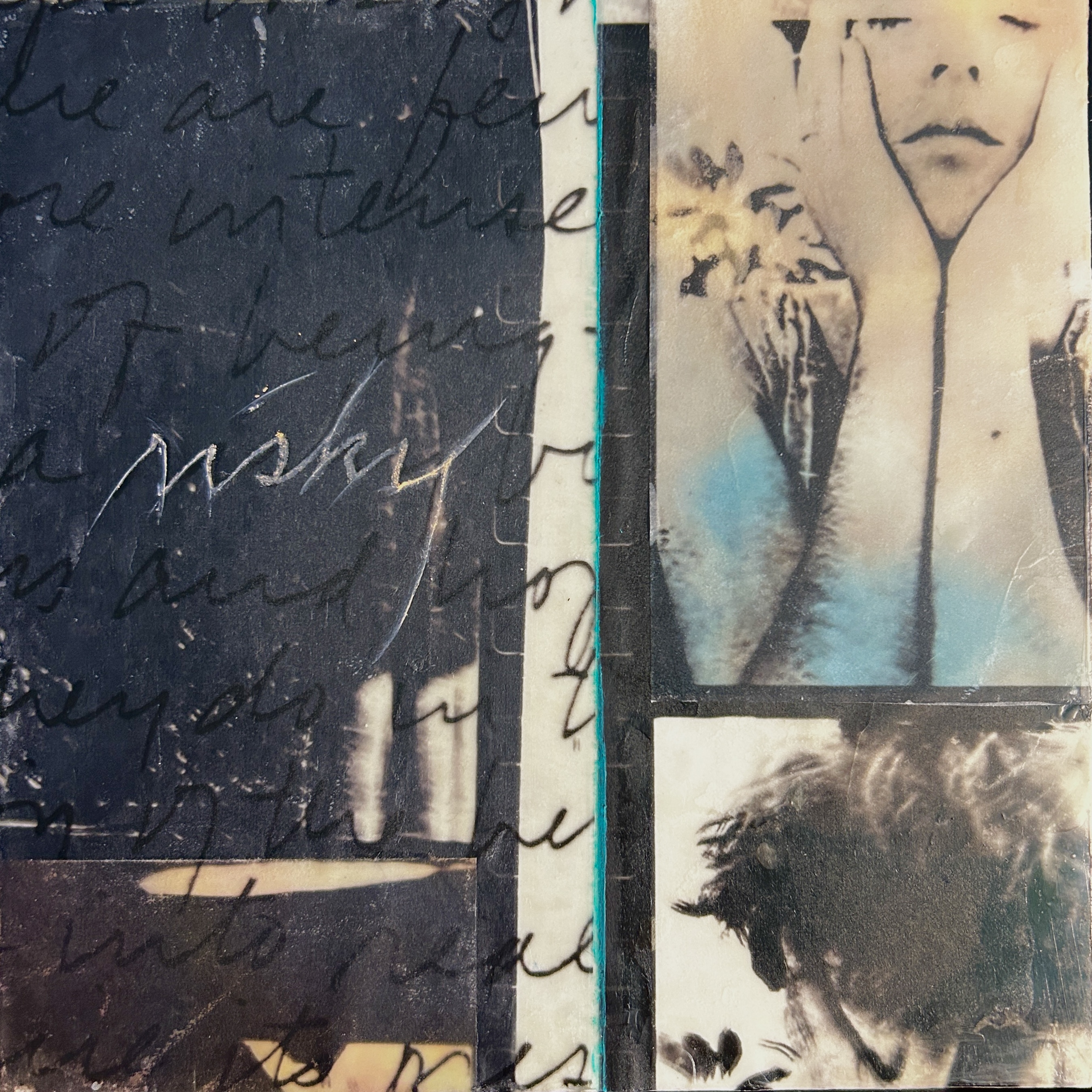
For the past two years I’ve been exploring encaustic photography. The process is this: I take a photograph with my camera. I edit the image on my laptop. I print the image on a sheet of tissue paper and then adhere the paper to cradled birch with encaustic medium, which is a combination of bees wax and damar resin. The tissue paper becomes transparent from the melted wax. I build on this with further layers of tissue paper on which images, texture and text have been printed.

Late last year I found the process becoming rote. I struggled with a few technical issues and when they were resolved I produced work like a robot on an assembly line. The process became a race to see how much I could create in a day. The idea of art as a practice was lost.

The truth is, since my intention is for my art practice to also be a business – in other words I want to exhibit and to sell the work I create – then my time in the studio should be both business and practice. But I was listing heavy toward ‘produce at all costs’. My art had lost its heart. 

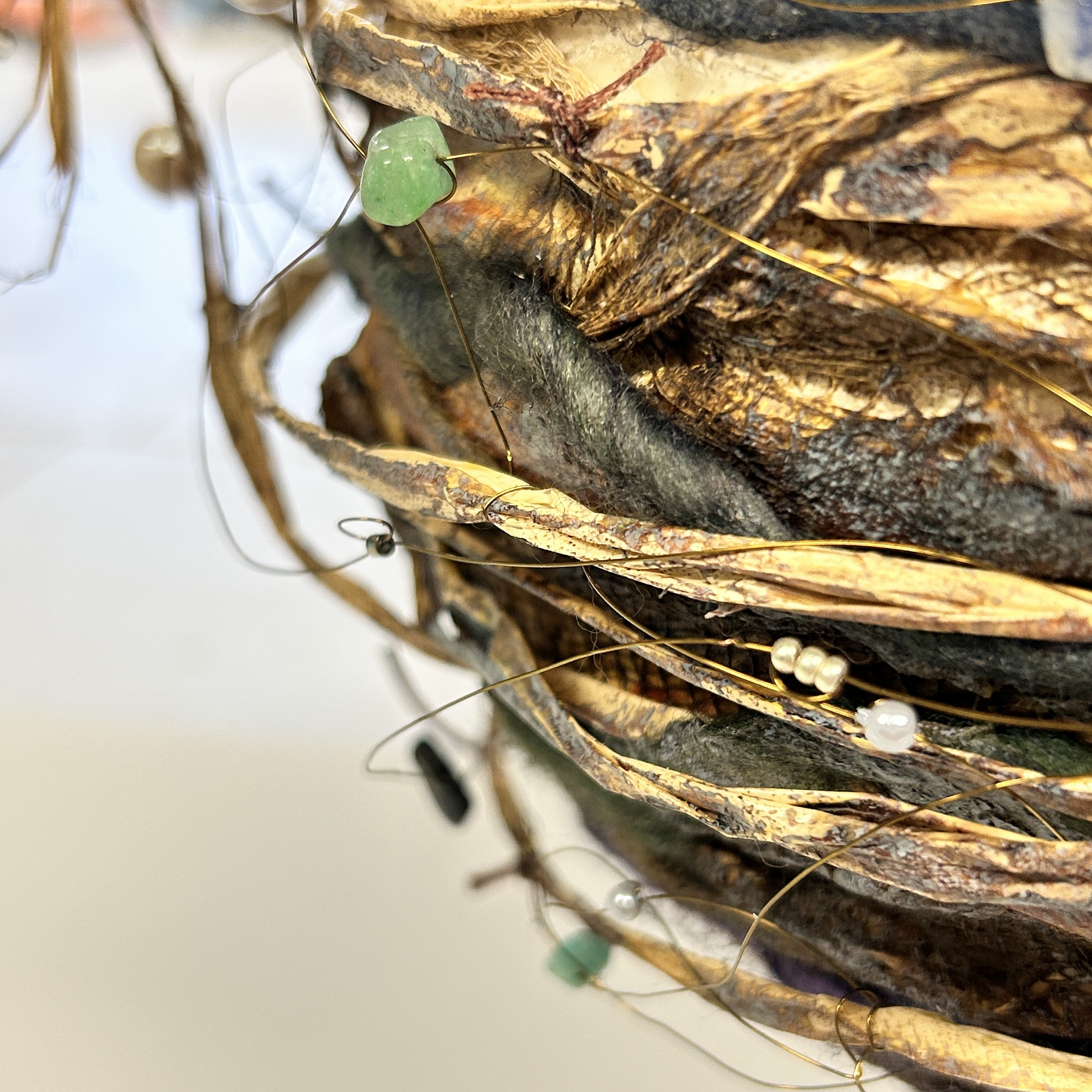
So I put the camera, the wax and the tissue paper and I pulled out my scraps of fabric.

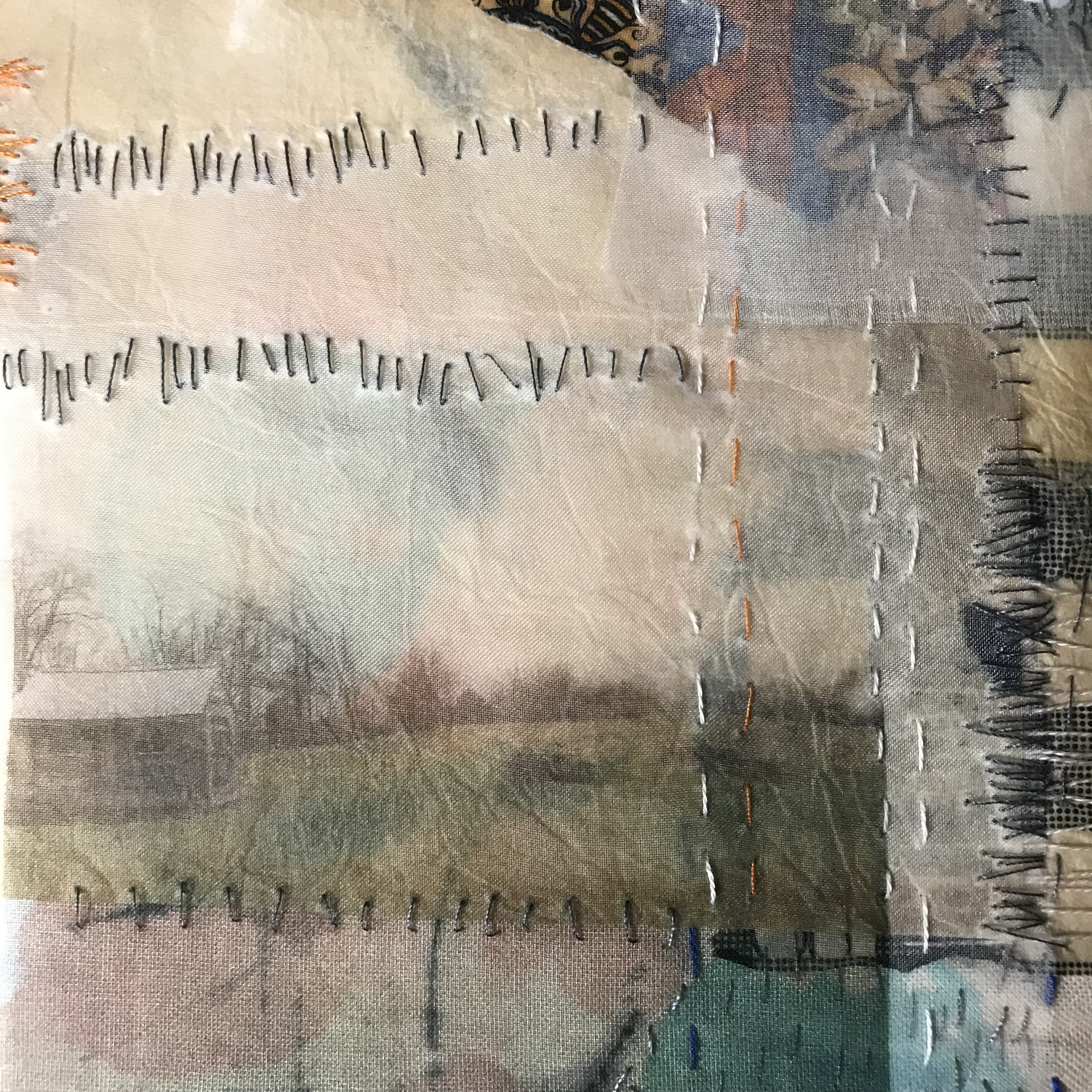
And yesterday, as I stitched layers of rust-stained cotton and dreamy organza together, I thought about yoga. I thought about the verbal cues I use with the women and men with whom I practice. I thought about how I ask them to move with care. To move with intention and to be thoughtful. I thought about how I ask them to meet their bodies where they are in that moment. How I ask them to be present with their bodies and with their breath.

Yoga is a practice. Writing is a practice. Art is a practice, too. And as I move forward in my art practice I’m going to apply all the cues I provide for others during our sessions on the yoga mat. I want the work I bring into the world to be intentional, not rote. I want the work to be thoughtful, not thoughtless. I want to remain present for the making of the work and not to be thinking about what comes next.

I believe this new awareness will serve me well. 


When Art Makes You Cry

When I bring something I’ve thought about in my head to life, and it happens with ease, I feel as if I have super human powers. It doesn’t matter whether I’m searching my brain’s thesaurus for the perfect few words to convey a feeling, or trying to capture with my camera how dawn transforms shadowy black tree trunks into golden beams of light, or attempting to prepare a satisfying evening dinner without a recipe.

When I create – whether it’s good or bad, whether it’s through words or with images – and the work begins to flow, the experience becomes something beyond feeling superhuman. It’s a rare and fleeting moment of connection to The Source. I don’t believe for a moment that I’m special. This euphoric flow is available to all of us. We just need to get out of our own way. 

I knew that our move to a Virginia townhome three times the size of the 600-square-foot apartment we left behind in California would afford me the space to create. Specifically, I would have the space to create visual art. This was not a random whim. I was an art and education major in college. In my thirties I was the quintessential starving, struggling artist. By the time I reached my fifties I thought I’d left all that ‘art nonsense’ behind. But then, as I entered my sixties, we had a global pandemic. The pandemic was a tragic blessing. The shutdown and all the ramifications of being essentially under house arrest by an invisible and deadly invader afforded those of us who remained healthy the time to remember who we were.

I took advantage of the opportunity and remembered that I was an artist. I didn’t do this on my own. I was encouraged by a friend who was beginning her own art journey and of course by Ben, who would support me no matter what path I chose to follow. Our small home limited my options but I could feel my creative impulses coming back to life.

When we settled into our new home in Virginia I set up a space and began my creative practice in earnest. Within a year I had found some success. My work was being exhibited and I was awarded first place in a competition I believed I had no chance of winning. I secured a year-long residency at McGuffey Art Center that culminated in a group show with five other artists and where I am currently renting a studio. This October I will have my first solo exhibit in forty years at a lovely gallery just steps off the Pedestrian Mall in Charlottesville.

It was after we organized the group show in late May, as I was beginning to consider the new body of work I needed for my solo exhibit, that the artist’s block landed on my psyche like a ton of bricks. An artist’s mental block is not too far removed from the ‘twisties’ gymnast Simone Biles experienced at the Tokyo Olympics – minus, of course, the potential for career ending injury or death.

I was lost in my head. Obsessed and over-thinking. Every empty and soulless hour in my once vibrant studio chipped away at my flagging confidence. And as my confidence wavered so did my motivation. The block I was experiencing fueled every limiting self-belief I’ve carried with me since childhood. I knew I was a fraud. I knew the success I achieved  was nothing more than a simple fluke. It was time to let the gallery in Charlottesville know that I would not have work ready for my solo exhibit. I was done.

What felt like a bitter eternity in reality was six precious weeks. But finally, in early July, the block began to shift. It was a heavy burden that I fought like hell to get through. But more and more, momentary flashes of insight would arc through my mind like the faint shooting stars we search for in the wee hours on a warm summer night. 

I was encouraged but hadn’t quite found my footing. And then, two weeks ago, this happened:

It’s the middle of a very hot July. There’s an exhibit of women fiber artists at the Renwick Gallery in Washington, DC that I am desperate to see. Ben and I decide to have a mini-break and head north. On a warm Saturday morning we walk to the gallery from our hotel and discover a small but comprehensive show of work in a gorgeous space. As we move through the exhibit we stop at a piece by artist Lenore Tawney. From a canvas frame suspended several feet above our heads and parallel to the ceiling, Tawney has dropped several hundred – maybe several thousand – thin linen cords. The work is part of her Cloud series. The effect mesmerizes me to the point that tears fill my eyes. It is stunning. An ethereal cube of light comprised of suspended strings floats over the gallery floor. It is spectral and yet, at the same time, it feels solid. 

I hear Ben ask what I’m thinking.

I’m thinking that visual artists are trying to tell a story in a language that cannot be translated for others. A language where fluency is evasive. But the more they work, the more they explore, the more visual vocabulary they gain. This is the difficult path we traverse as we move closer to finding our own voice. Our own visual language.  It is a challenging and sometimes frightening journey because it requires us to look starkly and deeply within. But as we work, as we explore, we begin to scrape away the muck of over-thinking until all that is left is feeling. From there, everything is simple. From there, one thousand linen threads suspended from a ceiling can move a person to tears. 

I don’t know if artists ever find their one true creative voice. Perhaps striving to work from a base of feeling rather than intellect is the best we can do. We learn techniques in the same way a creative chef practices with their set of knives (or a yoga teacher practices asana). And mastering our technique with a brush or a potter’s wheel or a loom is, of course, important. But finding that simple, pure, critical and instinctual base of feeling? To borrow a bit from the Little Prince – that feeling comes from the energetic heart and is invisible to the eye.


Mark Making

Hang around with enough artists, eventually you’ll hear the phrase ‘mark making’. It’s the bane of my existence.I know the words roll off the tongue. I know the alliteration hums. But as much as we want the term to describe some magical, mysterious portal to the creative process, the phrase ‘mark making’ describes nothing. Two words puffed up to mean something special, in reality the phrase is nothing more than empty air.  Using the term to describe what it is we do as artists diminishes our work. 

We paint. We draw. We sculpt. Along the way we scumble and scratch, we carve and stitch and scribble and brush. We etch and boil and glue and cut. We try to communicate in a way that moves beyond words. We blur edges. We skew and flatten perspective. We hope that what we pull from our own heart touches someone else’s. Are we making marks? Of course. But mark making is so much more than what’s left behind on a canvas. 

And mark making isn’t restricted to fine art. We all make marks. All the time. And the marks we make don’t require a loaded paint brush, threaded needle or stick of charcoal.

Bump into the sharp edge of a coffee table with your shin and as the welt begins to form you might say, ‘oh, that’s gonna leave a mark’. Lean a dirty palm against a white wall? You left a mark. 

In the same way that you don’t have to be an artist to make a mark, not all marks are seen. Sometimes an angry storm of words or a hardened glare will leave a mark on another person that is invisible to the eye. Those marks are like tiny paper cuts on the psyche. 

When I’m creating I can erase, paint over, or cut away the marks I make. I can use a seam ripper to remove misplaced stitches. When I choose hurtful words or glances – those are marks that I can’t make disappear. So in the same way that I try to make considered choices when I create, I need to have the same consideration when I speak. What about you? Have you left any marks that you can’t erase?


Fear or Faith: My Choice

Can you keep a secret? The trainings in which I’ve been entrenched since before the pandemic’s shutdown began are coming to a welcome end and I find myself with a strange amount of time on my hands. But please. Let’s agree to keep this little admission between friends. I don’t want the universe catching wind of my twiddling thumbs because you know as well as I do that empty space loves to be filled. I’d like a chance to see what I do with all this spare time before that happens.

But I’m wondering…now that I have the chance to dive into all those ‘things’ I’ve always wanted to do but never had time for…what’s stopping me?

I’d like to blame the bout of ‘pandemic malaise’ I’m experiencing but to be truthful the malaise I’ve encountered on and off these past twelve months is fleeting. Maybe it has more to do with the weather, which has been unseasonably chilly and wet for mid-March in Northern California. Or maybe what looks like malaise on the outside is really, on the inside, indecision and fear.

Indecision I understand. I’ve always seen both sides of every coin. But why fear? What’s that about?

In a recent coaching conversation I wondered if the fear my client experienced was less about feeling unprepared for the tasks she needed to complete in order to move her project forward and more a fear of wasting time. It was easy for me to share that observation because that is where most of my fear is rooted. I’ve been alive longer than I have years left to live. I don’t want my time wasted. Besides, I need to earn my keep while my jiggly human form still takes up space on this planet. I need to draw a salary. Make money. Pay bills. I don’t have time for flights of fancy.

I wonder, though, if my excuse, “I don’t have time for that”, masks a harder truth. My interests, outside of teaching yoga, require focused attention. Commitment. Awareness of both my strengths and my weaknesses. They require a willingness to learn.

Yeah. Who has time for that? Especially if the final result is an amorphous unknown.

Another friend of mine is an artist. Seven or eight years ago, when we first met, she was learning to paint. Now she wins awards, exhibits regularly and is about to have her work published in two books.

I wonder if she felt her time was wasted while she was learning to turn a flat circle into a sphere? I wonder, when she first picked up a paint brush, if she even considered time?

It’s funny, isn’t it, how we give fear permission to stop us in our tracks? It can be fear of the unknown, fear of time wasted, fear of hard work or fear of financial insecurity. Or, in my case, all four.

Rather than giving fear carte blanche to run our lives, maybe it’s faith we need? 

So. Will turning my fears of the unknown into faith in myself lift the malaise? Will it help me find the motivation and momentum I need to make the transformation from someone who watches from the sidelines into someone who’s willing to take a chance on herself?

Good question. I can’t wait to find out.


Write as if No One is Reading

People don’t ask, “How’s the writing going?” the way they used to.  They probably know.  It’s been too long since I put fingers to keyboard for any sustained amount of time.

The advice we’re given is “treat writing like a job.”  In other words, show up, sit down and write.  That was easy for me to do when I was writing the manuscript now gathering dust on my bookshelf.  Three years ago, as I dived into research about World War II, the contributions of civilian women during wartime and Japanese internment camps, it was easy to set the alarm at five.  I was on a mission to complete a full-length novel.  Eighty-eight thousand words later the job was done.

I just don’t know if I’m on a mission any more.

I haven’t lost my love, only my drive.  Or maybe it’s not my drive.  Maybe it’s my vision – I can no longer see in my mind’s eye the writer I wanted to be in 2008.  The writer who craved commercial success has disappeared.

An old friend said to me last night, “Of course you’re not writing – these days you’re too busy living.” And then a few hours later a new friend said, “Write as if no one is reading.”  When I began to study the craft of writing that was my focus – writing for the potential reader with the conviction that one day the President of the United States would put a hardcover copy of my best seller in his summer vacation carry-on.  And now?  I think it’s time to begin writing for me – to color outside the lines a bit or maybe allow the flow of words to lead me down an unexpected path.

(Why does that make me feel uncomfortable?  What would happen if I did that?  What would I discover?)

With the counsel of those friends still sitting warmly in my heart I’m going to embark on a new writer’s path.  No matter what I read in all the “how to write” books I am not going to treat writing like a job.  The writing that I want to produce – the writing that nurtures or challenges or pulls at you – that  writing is not a job.

And so the dozen half-written essays on my desktop, the few short stories I began but never finished and the unfinished novel languishing in an electronic file – they’re all going to wait a while longer.  I’ve got to go live a little and then write about it as though no one is reading.