Dharma: Look Before You Leap

The question of the day in the afternoon seminar I attended at the SYTAR (Symposium on Yoga Therapy and Research) conference in Asilomar, Pacific Grove, California was, “how do we know the difference between dharma and wishful thinking?”  In Hinduism dharma refers to our personal obligations, callings and duties.  And wishful thinking?   Wishful thinking is…well…just that.

You’d think the answer would be pretty straightforward.  In fact when I sent the question via text to the friend I go to with all conundrums of the metaphysical sort his reply was  “If you have to ask…”

I suppose he’s right.  I shouldn’t have to ask.  I should know.

But here’s the thing:  how many times have I been swept up by an idea or an intention or a goal that I was convinced was my path?  My destiny. The reason for my existence.

And for a few weeks it is.  Until it isn’t.

So you can see why I’m a little hesitant to trust my instincts.

Then again, I’m one of those people who might on occasion leap before looking.  But when it comes to dharma blind leaping may not be such a good thing.

My friend has a point.  We probably shouldn’t have to ask if what we’re feeling is dharma calling or wishful thinking.  Instead of asking and then desperately grasping at any answer, perhaps it’s simple stillness that’s required.  A moment’s silence.  The space to meditate with a quiet spirit and a calm heart.  When we can temporarily vanquish the turbulence of life only then will we find the clarity to look our dharma in the eye.


Autumn Teaching Schedule

I love this time of year.  Summer is winding down and the last few weeks of August are rolling by slow and lazy.  Kids are anticipating the start of the new school year and so am I.

I’ve had a wonderful summer full of hikes, a trip to Point Reyes and a weekend with friends outside of Reno.  I’m ending my summer with four days at Asilomar for the Symposium on Yoga Therapy and Research (SYTAR).  I’ve never been to Asilomar nor have I attended a SYTAR conference and I’m excited to be doing both.

The following weekend teacher training begins at Avalon Yoga Studio.  Although I’ve been teaching for almost twenty years I’ve decided to complete this six-month teacher training to add to my knowledge of yoga and to fill any gaps in my education.  I’m looking forward to the new vocabulary one gains with learning.

Of course a girl has to pay the rent and so while all this is going on I’ll still be teaching my usual schedule.  I hope you’ll join me.

California Yoga Center:

With the exception of the Monday night Yin class, which is a fantastic practice for anyone, my classes at California Yoga Center are considered Level I/II – most suitable for beginners and continuing beginners:

  • Monday evenings from 7:30 to 8:45 – Yin Yoga
  • Tuesday mornings from 9:00 to 10:00 – Iyengar Influenced Slow Flow
  • Friday mornings from 9:00 to 10:00 – Iyengar Influenced Slow Flow

You can find more information about these classes on my website or here.

Avenidas Senior Center:

As long as you are over the age of fifty you may register for classes at Avenidas.  The space is basic and we don’t have the same amenities as a yoga studio but you can’t beat the price.  You can find out more about Avenidas here.

  • Monday afternoons from 1:00 to 2:00 – Beginning Yoga
  • Tuesday afternoons from 5:00 to 6:00 – Improved Beginner
  • Friday mornings from 10:30 to 11:30 – Beginning Yoga
  • Friday mornings from 11:45 to 12:45 – Improved Beginner

I am also happy to work with you on a one to one basis from the comfort of your home.  This is a good choice if you’re recovering from illness or injury, new to yoga or simply can’t find the time to travel to and from the yoga studio.  Working one to one gives us the opportunity to design a program specific to your needs and goals.


Today, Music is My Yoga

Maybelle Carter

Image via Wikipedia

My music teacher in elementary school was a big, buxom woman with dark eyes and even darker hair that she kept piled in curls on the top of her head.  She’d go from classroom to classroom, tapping out rhythm, encouraging us to sing, rallying the boys in the back of the room.  I loved her.  I especially loved her on the days that she brought the instruments – a cardboard box full of triangles, tambourines and wooden sticks.  But the best instrument of all was the one that came in the odd-shaped box.  The Autoharp.  I always volunteered to play the Autoharp, and Mrs. Soldridge always chose me.  Maybe it was unfair to the other few who could manage to keep time, but I didn’t care.  I wanted that instrument.  I wanted it bad.  It was heavy and wonderful and all you had to do to make a sound like angels calling was press a button and strum the felt plectrum across the strings.  And there were so many strings they were impossible to count.

By the time I was in high school though, I’d forgotten all about Mrs. Soldridge and her Autoharp.  I was too busy failing in my attempts to play the opening of Stairway to Heaven on my guitar.  The Autoharp was old-fashioned and silly and so were all those traditional folk songs I loved as a kid.

Flash forward more decades than I’d like to count and enter Evo Bluestein.  Evo brings traditional folk music and dance to schools across the country.  His ability to charm even an introvert like me into believing she’s musical is legendary.  I could take a few pages to sing Evo’s praises but it would be easier for you to just click here.  On Saturday Evo offered an Autoharp Workshop at Gryphon Music in Palo Alto.  With my friend Sarah’s encouragement, I signed up.

The workshop began at 1:00 when I pulled a 21-bar Evoharp (Evo’s custom built version of the Autoharp) from its case.  By 1:15 Sarah and I were playing our first song.  Knowing he had two (cough) extraordinarily talented students in front of him he decided on a more accelerated course.   By 2:00 he and Sarah – a music teacher with a classically trained voice and her own 14-bar Evoharp – were playing exquisite melodies while I attempted to keep a steady rhythm (pick strum pick strum pick strum…).  Our voices rang out in three-part harmony.  By 2:30 Evo was introducing me to more complicated strumming patterns and by 2:45 my left arm was ready to fall off.

He ended the workshop by playing a Bessie Smith blues number.  It was unbelievable.

Music transforms you.  It alters the beat of your heart and the way blood spills through your veins.  I walked into that workshop a bit blue and more than a little nervous.  I left two hours later knowing there had been change on a cellular level.

Today music was my Yoga and every cell of my body was filled with joy.

I loved every single minute of that time spent with my friend, with Evo and with music.  I’m no Mother Maybelle, but damn that was fun!


My Weekend with Hermann Hesse

Siddhartha (novel)

Image via Wikipedia

When someone is seeking … it happens quite easily that he only sees the thing that he is seeking; that he is unable to find anything, unable to absorb anything … because he is obsessed with his goal. Seeking means: to have a goal; but finding means: to be free, to be receptive, to have no goal.

I have a stubborn streak.  I took me ten years before I saw the movie ET the Extraterrestrial.

And I knew only one thing about Hermann Hesse’s book Siddhartha:  It was the paperback tucked into the back pocket of anyone attempting to look more enlightened than the rest of us fumbling saps when I was beginning college in Nebraska.  Sure I wanted to hang with that clique, but I refused to fall for the hype.

So when a friend asked incredulously, “You haven’t read Siddhartha?” I had to sheepishly admit my literary and yogic faux pas.  He pulled the book from his shelf.  “Here.”

I took the book from his hands and thumbed the pages.  It looked thin enough.  Even though I had several books ‘on the go’, what harm would it do to take the weekend to read this one?

I opened the book and a bottle of Hefeweizen that afternoon.  Beautiful, lyrical prose.  I kept reading, the beer grew too warm to drink and the truth began to reveal itself.  Somewhere in the final pages I recognized my clinging, grasping nature.  More than that, I realized that what I was trying to grab hold of was an illusion.

There’s a part of me that regrets not tackling Siddhartha when it was suggested reading for my Philosophy 101 class.  But there’s another part of me that believes the book fell into my hands at the perfect moment.  My advice?  If the last time you read Siddhartha the Beatles were still together, consider reading it again.  And if, like me, you were waiting?  All I can say is, for what?


Half Moons and Flying Dragons

I remember the evening twenty-five years ago when our teacher led us into Ardha Chandrasana (Half Moon Pose).  I had been attending Karl’s class for just a few weeks and it was my first Half Moon.  It wasn’t pretty. I distinctly remember thinking that night would be my last night at Yoga.  My standing leg was shaking, my extended leg’s hip was screaming and my brain was telling me “This is nuts. You can’t do this.  Just go home.”

But I didn’t go home.

To this day Ardha Chandrasana ranks as one of my favorite poses.  Several classes after that first attempt, when I smoothly transitioned into the pose from Triangle and felt the strength in my balancing leg and the openness in my hip, I was free.  I felt like a soaring bird.

And when I introduce Half Moon to a new class for the first time, teaching in the same studio where I was taught, I always stand in the spot where I attempted the pose for the first time and tell the class “Things change.”

These days I’m adding modifications to my Half Moon.  Sometimes, with limited success, I bring my fingers up from the floor to rest the hand on my heart chakra.  More often I’ll take the ankle of my extended leg and pull myself into something I’m certain has a proper name but I call Sideways Bow.

We grow.  We learn.  We fall down. We try again.  We grow.

It took a lot of prying to open my mind to a new way of thinking about Yoga.  My practice was firmly rooted in Iyengar.  There was no other way.

But things change.

While I will probably never, ever understand how I can further my Yoga practice while listening to rock music (please, someone, explain this trend to me), a few years ago I was encouraged to explore the possibility of a fluid, non-alignment based practice.

Enter Flying Dragon. Wait a minute, wasn’t that a Bruce Lee movie?

The truth is, I can be a little bit…ahem…rigid in my thinking.  I like having a place for everything and everything in its place.  Just like an Iyengar practice. I’m not saying Iyengar theory is rigid, only that it might appeal to someone with rigid thinking.

When Suzee Grilley introduced the Flying Dragon sequence to us on a summer morning at teacher training my brain was telling me, “You can’t do this.  This isn’t Yoga.  Give Up.  You’re too out of shape.”  My brain even said this, “You’re too old.”

Several mornings later and I was flying my dragon with joy.

Flying Dragon is the cure for my rigid thinking.  I can feel my soul open to the universe when I practice Flying Dragon.  It lifts my spirit.  It is a balm for the type of depression that feels heavy and leaden.

Different approaches to Yoga fill different needs. Right now I need less formal alignment and more fluid movement.

And for the past few weeks I’ve had this idea in my head that I can’t shake.  There’s a local park not far from my home, and I see myself there, teaching Flying Dragon to anyone who wants to learn.  When I mentioned this to a friend he suggested I was ‘giddy’.  I probably am.  But the thought of a Flying Dragon Flash Mob puts a big smile on my face.

So that’s what I’m going to do.  If you’d like to free your rigid mind – or just feel like flying your dragon – join me for a morning of Flying Dragon (with a few Golden Seeds thrown in for a nice warm up) this Saturday at 11:00 in the park on Homer Street in Palo Alto.

Update:  Four hours after I posted Half Moons and Flying Dragons the August (August?  Seriously?) issue of Yoga Journal arrived.  My “Sideways Bow” variation of Half Moon has a name:  Ardha Chandra Chapasana.  Whew.  Now I can sleep tonight.

The Healing Power of Yoga. Any Yoga.

I taught my first Yin Basics Workshop yesterday at the California Yoga Center, my home studio.  One hour of theory followed by an hour of practice.  Nine beautiful yogis joined me.

Teaching a workshop requires a different skill set to teaching a class.  I felt challenged by the task of explaining the theory and practice of Yin in sixty minutes and then further challenged by the questions raised by students coupled with my self-doubt.

It was a great afternoon.

And yet, this morning I’m convinced that despite the training I’ve completed, the workshops I’ve attended and the books I’ve read I really know nothing about Yoga.  After thirty years of practice, my knowledge only scratches the surface of everything there is to know about how Yoga affects the body on a spiritual and cellular level.

It was a wake-up call.

Meanwhile, labels are beginning to irk me.  I’m beginning to get the feeling that we’re all making it up as we go along.

During our workshop the question that is always asked was asked yet again:  What is the difference between Yin Yoga and Restorative Yoga?  I tried to answer by explaining my experience with the restorative class I attended two weeks ago (read about it here).  The student asking the question – who is a yogi for whom I have great admiration – replied:  “That wasn’t restorative.  In my restorative classes we do eight to ten poses in an hour and hold them like we’re holding them today.”

And yet, at the end of my Restorative Yoga experience two weeks ago, I felt restored.  So who’s to say it wasn’t restorative yoga?  And maybe what she’s calling Restorative is really Yin?  And does it really, really matter?

The truth is I want to feel restored at the end of any yoga practice.  I want to feel connected.  Grounded.  Free of doubt and fear.  I want to feel my blood moving and warm, living muscle tissue.  I want to experience an ease of movement in my body, my spirit and my soul – as though I’ve come home to something I longed for.

That’s how yoga heals.


An Old Dog Learns a New Trick

I may have mentioned once or twice that in Chinese Astrology I am a Yellow Dog.  Not only am I prone to drooling in my sleep but I can also catch a Frisbee between my teeth, forgive instantaneously and love unconditionally.  I am also fiercely loyal.  Loyalty is, at times, a curse.  It makes it difficult for me to try new things without feeling as though I’m being unfaithful.

But on Sunday I overcame those feelings and attended my first ever Restorative Yoga Class.  I was on a quest. I needed calm.  I wanted my mind to clear and my nervous system to unwind.   I didn’t need to break a sweat.  I didn’t need to feel the burn.  I didn’t need my heart pumping within 85% of its maximum rate.

I considered a Yin session at home, but I’ve been making an effort to get out more.  And so that’s how I found myself at my local JCC at 5:15 on a sunny afternoon.

Chihiro is a lovely teacher.  Confident and quiet, she demonstrated all three poses we completed in the hour-long class.  Yes, that’s right.  THREE poses:  the first was a supported chest opener, the second took our legs up the wall and the third was supported relaxation.  As my body melted into the work, Chihiro observed, corrected and comforted students with a whisper.

In my Yin class on Monday, I mentioned the Restorative class.  Several students wanted to know the difference between to two styles of yoga.

Here it is:

The Difference Between Restorative Yoga and Yin Yoga

Restorative Yoga uses props to create support and reduce stress on the body. 

Yin purposely places stress on the connective tissue.

Yin requires that the practitioner open to discomfort rather than requiring comfort in order to open.

It was important for me to allow my inner Yellow Dog to run off leash.  Chihiro’s restorative class offered the support I needed and I learned a valuable lesson.  Even though my yoga loves are Yin and Iyengar, there are times when other schools of yoga are better able to heal my body, mind and spirit.


The Gil Hedley Experience

150

Image via Wikipedia

Last Monday morning I picked up a scalpel for the first time since seventh grade biology class and made a tentative incision.  Six days later at 3:00 in the afternoon I saw a brain that had been meticulously dissected with the spinal cord intact.  I touched the bundle of nerves in our lower back we call Cauda Equina and watched as the white filament in the middle of it all – the filum terminale – was teased into view.  It was like looking into the center of universe.  It was the Source.  It was what I came to see.

When we meet our cadaver for the first time we begin by lifting a fitted rubber sheet.  This exposes her form, covered in layers of white gauze.  Each layer of the shroud is a long veil.

As the days progress we continue to remove layers. Skin, fat, tissue, viscera, bone, brain.  Each layer is another beautiful veil and each time a layer is eased away, a new secret is revealed.

And as the veils on our form are drawn back, so our own veils are, too.  How we perceive, our beliefs, our longing, our pain – it all floats to the surface, is taken up and the next layer revealed.

Gil Hedley is an unconventional teacher.  For six days we did clinical work, named muscles, found ligaments, traced nerve paths and looked inside the brain.  And while we were doing that, we were listening, too.

On death:

“We are walking in the land of taboo.”

On life:

“We resist the life that we’re given.”

On the body:

“The spine is a string.  It’s not an instrument of compression but an instrument of levity.”

“We don’t need to choose between the heart and brain.  The body is the shape of the heart.  The body is the shape of the brain.  And they’re braided together.”

“How do we feel about the body?  Sometimes we feel we’re a victim of the body.  Sometimes we’re taught to be disgusted by the body.  Sometimes we’re taught to love the body.”

“Instead of thinking ‘look at the body I’ve been given’ why don’t we think ‘look at the body I’ve chosen’.  And aren’t some folks incredibly brave and courageous for making the choices they make?”

On learning and teaching:

“If you’re afraid of making a mistake – of hitting the ball into the net – put down the tennis racket and don’t play.”

“You attract a different crowd of people by being vague.”

“Will you dare to embrace your power?  Dance through all your layers.  Is your heart free to dance?”

So today, after everything I’ve seen this past week, it’s time to ask myself:

“Is my heart free to dance?”


Inner Space

The body is a holy and wondrous thing. Broken or healthy, it is a miracle. I know this to be true – but my belief is something I’ve cobbled together from books and good teachers – not from first hand experience.

In a few hours I’m boarding a train for San Francisco and will spend the week with fifteen or so other somanauts exploring the body’s inner space with Gil Hedley of the popular Fuzz Speech.  Tomorrow we’ll begin with the dermis and superficial fascia.

I will confess to being apprehensive.  Even this morning I ran through excuses that would keep me home. For a moment I convinced myself to head for the City, hide in the apartment I’m borrowing from clients, skip the workshop and treat myself to a week of isolation and stillness.  A silent retreat.  No one would know.

And then I came to my senses.  I would know.

Earlier today I wrote this to a friend:

Taking train to City today for cadaver week…to be able at last to see it all in front of me – to cut into it (which still seems to me such a violation)…I may be making too big a deal of this but I feel as though I’m stepping though a portal and will emerge in six days a different woman.

People ask me why I want to do this.  Some are incredulous.  Those who have worked with the cadaver are excited for me.  To answer their question “why?” I tell them about being a kid and flipping through the volume of Encyclopedia Britannia that had the transparencies of the human body.  Remember those?  You could flip from the circulatory system to the nervous system; you could see all the muscles and count all the bones.  I got lost for entire afternoons just looking, looking, looking. I was so curious.  I’m still curious.

And curiosity trumps apprehension any day.  I’ll see you in a week.


Lists, Love and Epiphanies

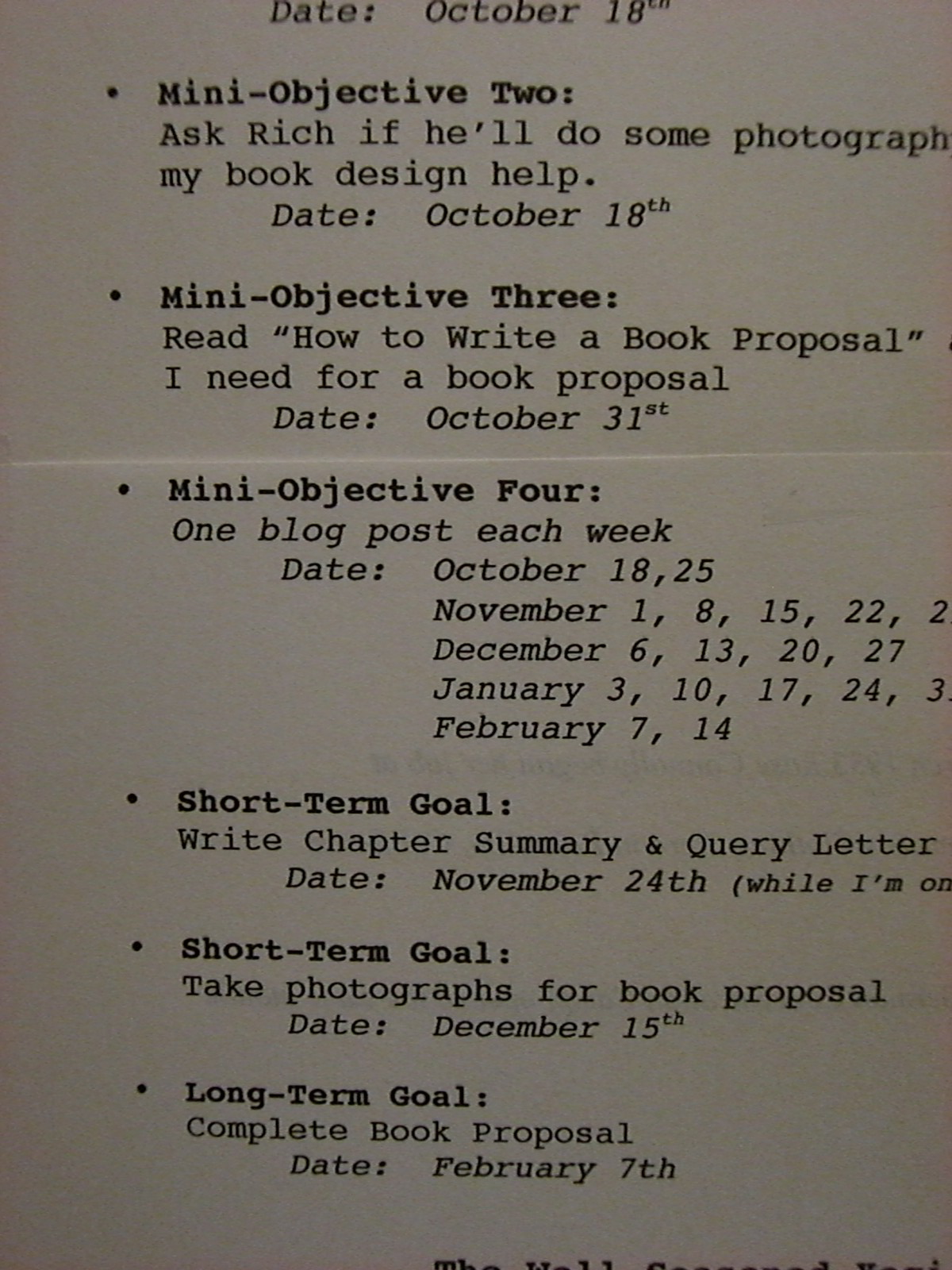
An list from a few years ago...I'm exhausted looking at it.

There’s nothing like a Wednesday morning epiphany to get my juices flowing.  I’m still obsessed with the advantage and disadvantages of keeping detailed lists and goals and objectives.  The merits of having a game plan.  (I’m also wondering how we determine what is instinct and what is illusion but that’s for another post).

Yesterday I walked Rose the Labradoodle without my ever-present iPod and discovered that not having my brain bombarded with Green Day, downloads of Michael Krasny (I have a huge crush on his voice) and the occasional Miles Davis opened my brain up to the possibility of – yeegads – random, spontaneous, creative thought.  Who knew?  Unplugging the external cacophony gives us a chance to listen to what’s going on deep inside.

And here’s what I came up with on Rose’s walk yesterday:  Most writers create a story arc – an outline of who their characters are, where they’re going and how they’re going to get there.  A beginning, middle and an end.  The story arc is roughly hewn list that chronicles the events that move the plot forward, the set backs the protagonist may endure, and the big payoff – why the heroine began the journey in the first place.

But a story arc is simply a road map.  It’s malleable.  It’s possible to turn left and venture down an unmarked avenue.

Cue big flash of insight.

When I think of my life as a series of lists, goals and objectives I set myself up for failure and disappointment.  The list is too long, the goals are too high. All I can see in my mind’s eye is that white piece of paper and one bulleted 10-point Helvetica command after another. My self-esteem is fragile enough already.  Why would I do that to myself?

But – if I create a story arc for my life then I acknowledge that there has to be room for uncertainty, moments when I decide to turn left instead of right, unexpected opportunity.  It doesn’t eliminate a game plan – I still want everything I want with all my heart and I know that I have to work for it.  But in my mind’s eye I can see my arc play out like a stunningly framed Ang Lee movie.

So, good-bye dry, boring lists.  Hello, The Story of Mimm.

Take a moment.  If you’re a chronic list maker like me, how does it feel to release those rote set of goals for a moment and instead see your life as an amazing story?