And Now, a Quick Word from Our Sponsor: January Classes

I thought it was time for me to remind everyone where I teach, how to register and what to expect.  Currently I teach in two studios:  California Yoga Center and Avenidas Senior Center.  I work privately with individuals or small groups in the home and am also available to teach introductory classes and workshops at your school or office.

California Yoga Center

One of the first yoga studios on the Peninsula – and where so many of us were first introduced to yoga – CYC has locations in Palo Alto and Mountain View.   My classes are at 541 Cowper Street in Palo Alto between University Avenue and Hamilton.  I teach three classes at CYC.  They are on going.  Two are Iyengar-influenced “slow flow” style classes and the third is a Yin class taught in the Paul Grilley tradition.  If you’re still looking for a last minute gift you can purchase Gift Certificates for individual or a series of classes.  More information about purchasing gift certificates can be found on the CYC website.

Here’s what to expect from a class with Mimm:

Yin Yoga – Mondays 7:30 to 9:00 PM

Yin is a donation-based class.  Please pay what you can afford up to $17 (the regular drop-in fee).

The long-held stretches characteristic of Yin Yoga help to recover and maintain a full range of movement and flexibility in the joints and connective tissue.  The work is challenging but profoundly relaxing. While Yin should not be confused with Restorative style yoga on more than one occasion students have told me, “I have the best night’s sleep on Yin nights!”

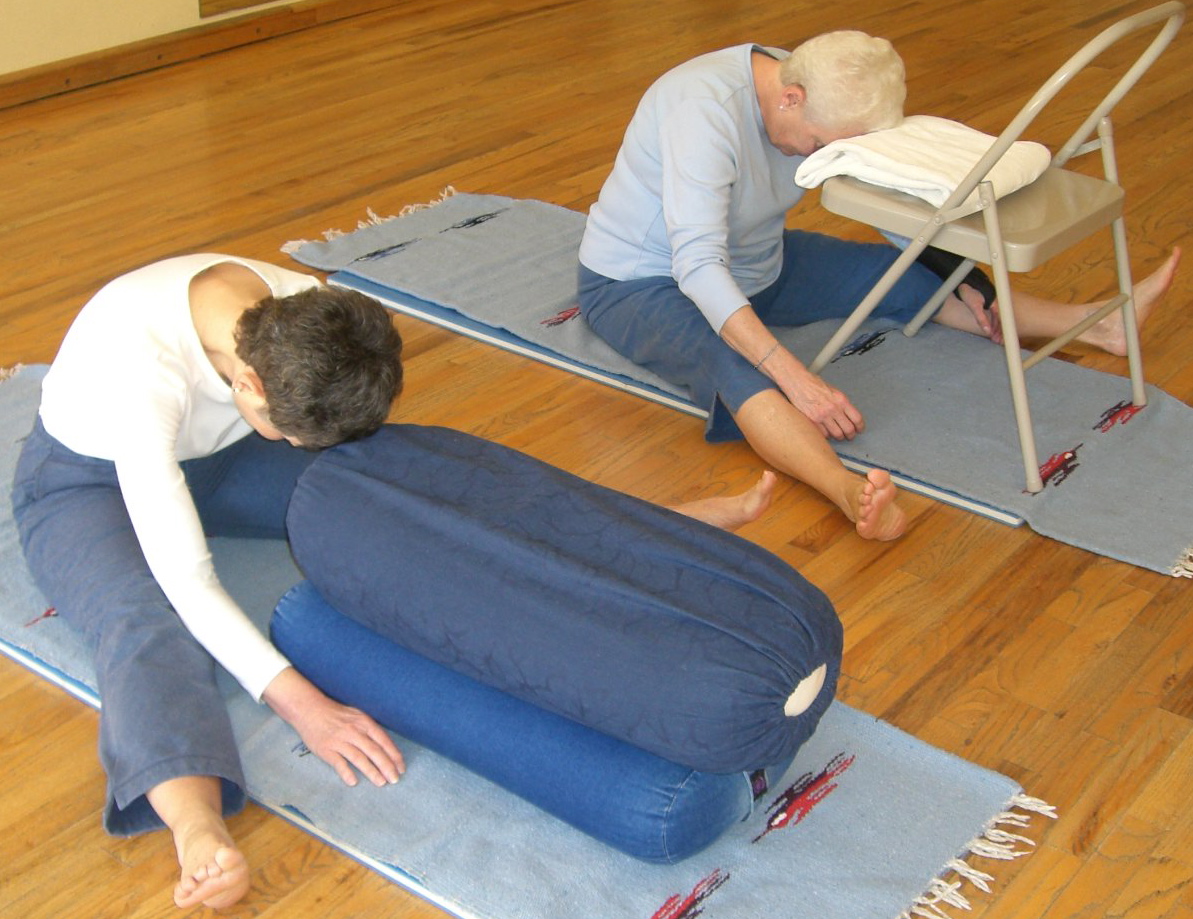
I keep the studio very dark.  Soft futons and bolsters, blankets and pillows are used for support.  Sometimes I’ll use music to help set a tone.

Verbal instruction is kept to a minimum.  Nevertheless, enough suggestions and options are offered to create an environment that feels comfortable and safe.

All the work takes place on the floor and poses are held between 2 and 6 minutes.  For more information regarding Yin Yoga look here.

Iyengar-influenced Hatha and Slow Flow – Tuesdays or Fridays from 9:00 to 10:00 AM

The drop-in fee for these classes is $15.  A 4-week series is available for $52.  An 8-week series is available for $104.  Classes do not have to be taken consecutively and there is no expiration date (this applies to my classes only.  Other CYC instructors may have different policies).

In the beginning, there was Iyengar.  At least for me.  I loved the attention to alignment, the emphasis on safety and the slow, careful pace as we moved from one pose to another.  But things change.

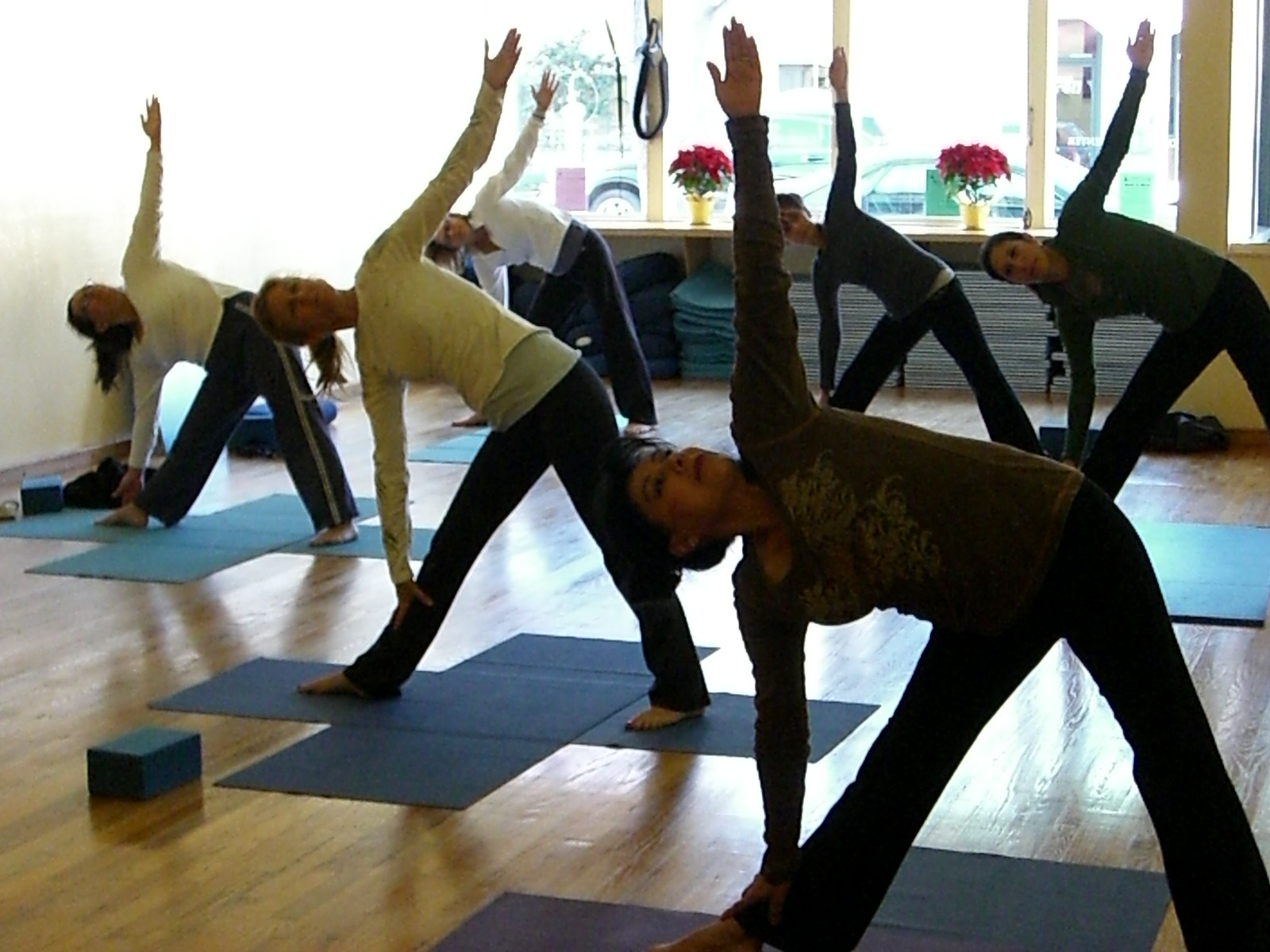
I still love my Iyengar roots, but I also love moving with my breath from one shape to another.  We move at a pace that allows time to settle into the pose and to explore how it feels in the body.  I provide options for anyone not ready to take on the more challenging standing poses.

Both of these classes are Level I/II – suitable for beginning and intermediate students.

California Yoga Center has everything you need for a safe practice:  bolsters, straps, pillows, and blocks.  It’s recommended that you bring your own “sticky” mat.

Avenidas Center

It’s a misnomer to call Avenidas a “senior” center.  Yes, you have to be over the age of fifty to enroll in classes – but what’s a number?  Pre-registration is required, but you can enroll online or drop by the front desk at 450 Bryant Street (cross street University Avenue).  Classes are held in 10-week blocks.  Our winter session begins the week of January 9th, 2012.  There is no drop-in but anyone is welcome to visit and try out my yoga classes before enrolling.  The price for a ten-week session is $60 for Avenidas members and $70 for non-members.  Where are you going to find a one-hour class for $6.00 anywhere on the Peninsula?

I have three classes at Avenidas:

  • Mondays from 1:00-2:00
  • Fridays from 10:30 to 11:30
  • Fridays from 11:45 to 12:45

Because of student demographics these classes tend to lean toward the introductory level but everyone is encouraged to deepen into the work as their bodies allow.  Some students have had years of yoga experience and will have a more full expression of the pose we’re working in.  Others who are new to yoga are given modifications that help awaken the body.

All three classes begin with floor warm-ups, followed by a carefully planned standing sequence and then finishing with seated work and relaxation.  Because of the nature of my classes at Avenidas, it’s suggested that students be able to safely lower and then rise from the floor.  That being said, chairs are available to assist.

Unfortunately, equipment is limited at Avenidas. We have soft exercise mats but I recommend you bring a sticky mat and two bath towels that can be folded into mini-bolsters.  A strap is also handy – this can be a yoga strap or, if you’re on a budget, a man’s tie or belt.  Yoga blocks are helpful, too.

Individual Study

If you are recovering from illness or injury then I recommend two or three sessions of individual study.  Together we can see where you’re at in terms of strength and flexibility.  We can build a program that will support recovery instead of setting it back.

Some clients, of course, simply enjoy how individualized attention deepens their practice. You’ll discover the body responds to the work easily when hands on adjustments and personalized modifications are part of the program.


More Monkey Mind: Finding Clarity in the Muck

It would be fair to say that over the past few days my life has begun to resemble a lamentably bad country and western song:

“My boyfriend left and the car won’t start.  My battery’s dead, I gots a broke down heart…”

So cue the violins.  Stuff happens.  Here’s the thing.  Yesterday I wrote about how Monkey Mind will mess with your head by encouraging you to re-live your mistakes in an endless Groundhog Day-esque loop.

But that’s not her only talent.

When I stepped out the door this morning I expected today to be like most Wednesdays:  I should have been on the road to see clients in Saratoga by 8:15, back to Palo Alto for a 12:45 appointment, up the road for two back to back classes, home for dinner, out to the studio to teach the 7:30 class, home to bed.

But when I slipped the key into the ignition and heard the glurg, glurg, glurg of an engine that had no intention of delivering me to my appointed rounds, Monkey Mind took her cue and started chattering:

“Oh, it’s probably the starter.  Do you have any idea how much that is going to cost?  You’ll probably have to cancel all your clients today…and tomorrow…maybe even Friday!  Your clients won’t want to see you again.  You’re too unreliable.  And you’ll have to call a tow truck.  Do you know how hard it is to call a tow truck?  And that will cost money, too.  Do you have any money?  You don’t have money, do you? Oh and don’t forget about rental car you’ll need while yours is being repaired.  You might as well kiss your savings goodbye…”

And so on.  My little Monkey Mind bounced from one scenario to another – all of them bad.  It would have been easy to just submit to the chatter and allow myself to become more and more wound up, anxious and frustrated.  I mean, that’s what we do, right?  Life hands us a bit of unpleasantness and we give in to it.  We listen to Monkey Mind.

Not so fast.  Maybe we don’t listen to Monkey Mind.  Maybe we see through Monkey Mind’s games and choose an alternative course.

This morning I gave Ms. Monkey about ten minutes of my time before I sat down, closed my eyes and took a few breaths.  And then I found the number for Honda Care’s roadside service.  I rang and the tow truck arrived within thirty minutes.  The driver charged my battery.  I drove to my dealership and purchased a replacement.  Yes, I missed my clients in Saratoga but the rest of the day went pretty much according to plan.

So stick that banana in your pipe and smoke it, Monkey Mind!

I’m not going to try to convince you that today is one of my better days.  But it’s far from the crisis my chattering Monkey Mind wanted to create.  It’s just been a day.  One simple, human day.

Like most habits we are trying to build or break, creating a daily meditation practice is a process full of ups and downs.  I always understood that part of the process was being diligent about setting aside time each to practice.  But I also need to welcome opportunities that allow me to weave what I’m learning into the fabric of my day-to-day life.

When we step back from the muck occasionally thrown our way and examine our lives from the edge rather than the center it becomes clear that the work we’re doing is powerful and transformative.

I know that Monkey Mind will always be lurking.  But today I discovered that she’s no match for me.


Monkey See, Monkey Do, Monkey Mind: Further Adventures in Meditation

Over the weekend some ill-timed and unkind words hurt the feelings of a dear friend. With a rare lack of consideration, I replied to a friend’s loving note with rude sarcasm.  When I realized my mistake it was, of course, too late.  I could not take back what I had written.

I am a kind person.  I am empathetic and accommodating.  This lapse in judgment was unusual for me and I continued to dwell on it until little Monkey Mind and her chattering little monkey friends cobbled together a story in my brain that my heart grabbed hold of like a dog with a bone.  Click here to read a great article about what the Buddha had to say about the monkey mind.

The result?  Monkey Mind’s got me.  She has a firm hold of my cerebral cortex and is giving it a real rattle.

You know Monkey Mind, don’t you?  She’s the uninvited guest who insinuates herself in many ways.  She’s our inner gossip.  She keeps our mind restless and unsettled; doubtful and confused.

I regret the choice of words I used with my friend but instead of acknowledging my lack of judgment and moving on Monkey Mind is making certain I stay stuck right at the moment when I pressed ‘send’.  I’ve no opportunity to push ‘pause’; no way to hit ‘delete’. Instead, my mind is set on instant replay so I can witness the fumble on a constant loop. I’ve seen the sequence of events in my mind’s eye enough times to rewrite several different, happier outcomes.  But of course those alternative outcomes will not be realized.

Monkey Mind is a trouble-making nuisance that serves no purpose.  She’s distracting. When Monkey Mind has the upper hand we lose concentration and focus.  Trying to meditate when Monkey Mind has us by the bal…er…brain is a little like trying to walk a straight path during an earthquake.

But guess what?  We should meditate anyway because a pint of comfort in the guise of Ben & Jerry’s Cherry Garcia washed down with a bottle of root beer will not settle Monkey Mind.

But meditation will.  I need to meditate.


And so I did.

I began with a thirty-minute asana practice that balanced a strong standing flow with calming forward folds.  Focusing on my breath redirected my awareness away from the chatter in my mind.

Nevertheless, when I took my seat and closed my eyes Monkey Mind was still poking at me.  But I knew a subtle shift away from Monkey Mind’s influence had begun.

As I settled into meditation, I did not force myself to ignore the chatter.  Instead, with detachment and non-judgment, I simply watched my thoughts as they rose, lingered and floated away.

I turned my awareness to the tip of my nose where I noticed the cool in-breath and the warm out-breath.  And when I felt suitably centered I began to silently repeat the mantra ‘so-hum’.

Thirty minutes later I blinked my eyes opened and took a gentle stretch.

I will not try to convince you that Monkey Mind disappeared after one asana and meditation practice.  What I can tell you is that Monkey Mind’s loud, distracting and overriding cackle has softened.  Once more I can thrive in the present.  And that sure beats obsessing about a future I’m unable to predict and a past that I unfortunately cannot change.


Start Where You Are: More Adventures in Meditation

Since beginning the teacher training program at Avalon Yoga Studio in Palo Alto last September I’ve heard this phrase repeated again and again:  start where you are.

Start where you are is simple level-headed advice that we should remember when we’re beginning anything new, whether it’s the yoga we’ve always wanted to try, the novel we’ve wanted to write or the song we’ve wanted to learn on our guitar.

Don’t argue, don’t procrastinate and don’t wait for conditions to be perfect.  Start where you are.

The advice is particularly useful when contemplating a meditation practice.  Do you want to meditateStart where you are.

Read this blog back far enough and you’ll find a post about my two weeks of Yin Training in the Santa Cruz Mountains with Paul and Suzee Grilley the summer of 2009.  We began each morning with thirty minutes of meditation.  I was determined to continue the practice once I returned home.

It didn’t happen.

I used every excuse imaginable from being too tired to crawl out of bed to convincing myself I’d practice later in the day but of course I never did.

Why?  Because I felt fraudulent.  No one gave me a list of instructions (and we know how I like my lists).  I didn’t understand the steps. I couldn’t possibly be meditating correctly. And so I didn’t meditate at all.

The truth is, there are no list of instructions, no easy steps.  And there’s very little you can do short of strapping on headphones and cranking Nirvana’s Smells Like Teen Spirit to eleven that would ruin the experience.

Because we start where we are.  We find five minutes and we sit still.  And then we find ten minutes to sit still and to listen to the breath.  Soon we’re sitting for twenty minutes and the breath may become a mantra.  Or not.

There are plenty of books that offer techniques.  I’m reading one now, Eknath Easwaran’s Passage Meditation. The book is a basic primer the offers suggestions and teaches the reader why meditation is life enhancing.

And there are groups you can join.  A friend of mine and I recently dropped in on a local Daoist Meditation Group.  And you know what?  The Daoist technique was deeply different to my personal practice.  Does that mean I’m wrong?  Of course not.  And neither are they.

We start where we are.  We find our way.  We choose our path. And there is no wrong.  We start where we are.


Cleaning, Chaos and Attachment: Adventures in Meditation

When life seems out of control I do the only reasonable thing.  I clean and organize my apartment. And when I say clean and organize, I mean it. Knick-knacks and clothes are bagged for donation to Goodwill.  Books are boxed for re-sale at Book Buyers in Mountain View.  Every surface is scrubbed and dusted and then furniture is moved in the hope of creating the perfect Feng Shui flow.  This last time I went so far as to cancel my cable and donate my television to charity.  It seems the only way I can reclaim control is to pare down my life to little more than the bare necessities.

When there’s nothing left to clean and if I remain desperate for more control, I update my calendars. I have three calendars – the calendar on my laptop, the hardcopy I keep in the event of a computer meltdown and the calendar on my iPhone (which of course is supposed to sync with my laptop but I haven’t sorted that out yet). I’m embarrassed to admit that all three calendars are color-coded.

If I continue to feel unsettled I start with the lists.  I write shopping lists, goals for the immediate and the far away future and a list of day-to-day chores.

I keep at it until I’ve lulled myself into believing that I’ve created order from chaos.  Of course, instead of feeding my compulsive nature by focusing all my energies on the external environment I could be creating the control and calm I crave by – wait for it (smacks palm of hand on forehead)meditating.

And while I’m preparing for meditation by hanging out in Adho Mukha Savasana I could ask myself the right question – what is the turmoil I’m experiencing within all about?

The sense of impending calamity I feel from time to time boils down to my talent for creating unreasonable attachments to events out of my control.  The more I sense the loss of control, the more I attempt to cling to the story I have in my mind of how my life should be. But clinging to a story is like trying to grab vapor.  You can’t, can you?

The truth is, I can clean and clean until my knuckles are raw but that will bring me no closer to the control I crave.  If I truly want control, then I have to relinquish my desire for it and instead embrace the gift of clarity that a growing meditation practice offers.  I need to understand that we can only control our response to the events around us – not the events themselves.


The Hip Bone’s Connected to the…

Anterior Hip Muscles

Image via Wikipedia

Do yoga teachers need to study anatomy?

I recently heard a well-loved and respected teacher with decades of experience give this answer before a group of trainees: “in my opinion, no.”  He believes we learn everything we need to know about the body through a strong asana practice.

Is he right?  Maybe.

A finely tuned practice, after all, strengthens our understanding of how we move, how we function, our strengths and restrictions.  Why do we need to know the muscles used for breathing?  Why do we need to know how the bones join together at the knee?

Because when a new student enters our studio and tells us they’re a few months past a lumbar laminectomy, or that last year they had meniscus surgery, or they’ve recently been diagnosed with osteoporosis – we should know what that means and what the implications are for their yoga practice.

And so, in my opinion:  yes, yoga teachers should study anatomy.

The teacher continued with his points:

“You don’t want to take up class time explaining the muscles…”

He’s right.  I don’t use class time for anatomy lessons.  But when a student asks why they feel Ustrasana (camel pose) near their hip crease I can move beyond “it’s because you’re tight there” and explain the hip flexors and their function.  I can explain how they become shortened and other ways to lengthen them.

And when a student’s knees are no closer to the ground in Baddha Konasana (seated cobbler’s pose) than they were when they began their practice five years earlier I can explain how each skeleton is different.  I can reassure her that it has little to do with flexibility and more to do with how the femur sits in the acetabulum. Knowing I can do this – knowing I can guide my student toward an improved understanding of their body – increases my confidence as an instructor.

Furthermore, when a student needs help modifying a pose or if they’re unable to assume “correct” alignment my understanding of anatomy informs the choices I make to help the student – whether it’s a different verbal cue, using a different prop for support or suggesting a different asana.

Do I know the name of every muscle and bone?  Of course not.  But by studying anatomy I’ve been given an amazing gift – a sort of “x-ray vision.”

Every body is unique. Knowledge of anatomy helps us see these differences. And since we can’t step into our students’ bodies to experience an asana as they do, having a good understanding of the body – knowing that the rectus femoris is a two joint muscle and might explain why the front of the hip hurts when the knee is drawn back in Natarajasana (dancer’s pose) – well, if I can’t experience what my student’s feel first hand, then knowledge of anatomy is the next best thing.


Coming Back to Stillness

Skagit Bay mudflats; Larus sp.; Ika Island (Wa...

Image via Wikipedia

It’s amazing what half a pint of crème de leche frozen yogurt, a five-episode marathon of Grey’s Anatomy via Hulu and eight hours of solid sleep wrapped in a warm duvet will do for a woman’s disposition.

It’s not everyone’s first choice cure for over-extension and except for the sustained sleep not particularly healthy – but when I need brain candy only the vast wasteland of computerized television viewing and a dairy-based fat and sugar delivery system will do.  I’m not proud.

Earlier the same day, however, I spent an hour sitting on a bench at Shoreline Park.  The sun was warm, the breeze cool, the tide out.  The mudflats were filled with aquatic birds (and one extremely noisy raven) feeding like gluttons on whatever was free for the picking.

I love watching birds in their natural habitat.  My favorites are the pelicans.  I saw a squadron of fourteen fall into formation and execute perfect three point landings.  They were white with black tipped wings and glowing orange-pouched bills.

My other favorites – the ones that can make me cry sometimes – are the little ones that fly in huge swarms and seem to shape shift in flight. I believe they’re sandpipers. The wings are dark and their underbellies white. As they race through the sky they seem to appear from nowhere and then vanish depending upon how the light has fallen on them.

That hour in the sun was food for my soul.  The hours spent eating frozen yogurt and watching the trials and tribulations on Grey’s?  Not so much.

A few years ago I believed wasting sixty minutes of my life bird watching on a sunny weekday afternoon was pure decadence.  Spending an evening watching television was “relaxation.”

But on Tuesday I embraced both experiences on a day that could have been better. Trust me – burning the candle at both ends really does bite you in the backside eventually.

What did I learn?

The obvious.  An hour outside – even during a workday – beats wrapping myself in a duvet, stuffing my face with ice cream and filling my spirit with the distraction of a bad soap opera. Hands down.

Why?

That little bench by the mudflats delivered stillness.   Connection.  It tempered the endless chatter in my mind.  The clarifying peace of that hour allowed me to feel my feelings without judgment.

The lesson?

I’m not ready to give up the occasional binge of ice cream, Hulu and duvet – but I know it won’t nourish me.

For real nourishment – the kind of soulful nourishment that lifts my spirit – I need the sun, the birds, and an hour on the water’s edge.


You Want Me to Breathe Into My WHAT???

Heart and lungs

Image via Wikipedia

“Breathe into your back ribs.”

What?

“Breath into the space around your kidneys.”

Seriously?

“Breathe into your big toe.”

Ok.  Now you’re just trying to be funny.

How many times have you been instructed to take your breath someplace considered physiologically impossible?  Yoga teachers give this instruction all the time, but it sounds pretty dumb, doesn’t it?  Our breath moves into our lungs.  Period.

Right?

No one takes the instruction to breathe into the soles of the feet literally.

Do they?

Because, the thing is – I’m one of those yoga instructors.  I’m one of those instructors who will ask you to breathe into places where the breath doesn’t travel.  But I’ve got my reasons.

When I provide the verbal cue to breathe into the back of the ribs I’m instructing my students to bring their awareness to a specific part of the body in a more efficient way than the cue “relax.”

Furthermore, by breathing into the back during a pose like Balasana (child’s pose), the student becomes attuned to the physiology of breathing.  They gain an awareness of the muscles involved.  The lungs may be the workhorse of breath, and the diaphragm our ‘third lung’, but there’s a whole lot more to consider.  Our intercostal muscles, for instance, extend and contract with each breath to move the ribcage.  Our internal obliques work in opposition to the contracting diaphragm.  The gift of breath – the art of breathing – is more than filling the lungs like a balloon.  It is a complex event with an interrelated team of muscles, organs and bones.

So if my verbal cue “breathe into your spine” sounds weird and maybe a bit ‘airy fairy’ – don’t laugh.  Go with it.  Like I said, I have my reasons.


Yoga is More than Skin Deep

When I began to practice yoga twenty-five years ago, the emphasis was on the physical.  In fact, it would be closer to the truth to say I wasn’t practicing yoga at all – I was practicing asana.  And while my early training included work on the philosophy and history of yoga, I listened about as carefully as I did during fifth-grade arithmetic (and my friends are all too aware that my ability to add and subtract leaves much to be desired). 

What was I afraid of?

I convinced myself that asana was enough.  But I was only swimming on the surface.  To me, deeper work meant something physical, nothing more than graduating from half to full lotus without damaging my fragile left knee. The thought of moving deeper spiritually was too uncomfortable.  My asana practice strengthened  but I failed to see beyond its gifts. Deeper examination meant diving into the unknown.  And I was uncertain of what I might find.

But twenty-five years after my first utthita trikonasana I now see awesome beauty in the unknown.  I’ve yet to reach center – do we ever?  But to paraphrase one of my teachers, I know that when I do find my center, freedom will be waiting for me.

Although I have no proof, I think it is reasonably safe to assume that most yoga practice in the West is asana-centric. There’s nothing wrong with that.  I mean, what’s not to love about asana practice? It brings us to a place where we feel balanced and alive.  It calms or energizes depending upon our needs and our sequencing.  And if we pay attention to the sensations we feel after our practice we’ll realize they are more than physical. More than skin deep.  Our asana practice influences our emotional state.  It influences how we perceive the world around us.

But this is just a tease.

When we broaden our yoga practice with elements of pranayama and  meditation we build a practice that is deeply integrated and holistic.  The physiological and spiritual sensations that asana practice hints at become intensified. We begin to dive beneath the surface.

The same teacher who taught me where to find freedom also offered a metaphor.  He suggested that our day-to-day lives, our random thoughts, our unconsidered reactions to the world around us are like the surface of the ocean: rough and unsettled with white caps and tides that rush in and just as quickly rush out.  But beneath the surface of the ocean there is calm.  If we can turn away from chaos and turn toward the calm found in a measured breath and silence then our spirits – and our asana practice – will be nourished.


Why I Love Teaching at California Yoga Center

Over the weekend someone asked me the name of the studio where I teach.

California Yoga Center,” I said with a smile.

“Huh,” he sniffed.  “I walk by there all the time and it’s always empty.”

I confess. Un-yogic thoughts overwhelmed me. I admit to being, from time to time, overly sensitive.  Perhaps even a bit defensive. But what I interpreted as a flippant dismissal stunned me and I missed my opportunity to reply with a witty retort as the conversation quickly moved on to other topics.

But his comment has buzzed around me like the nagging mosquito that finds your ear just after you crawl into bed.  And boy is it annoying.

I teach at California Yoga Center.  And I’m proud of the fact.  And here’s why:

  • California Yoga Center opened in 1980, making it not only the first yoga studio in Palo Alto but also one of the oldest studios in the Bay Area.  It now has two locations – the original studio at 541 Cowper Street in Palo Alto and the new studio in Mountain View at 1776 Miramonte Drive, in the Blossom Hill Shopping Center.
  • I attended my very first yoga class, with teacher Betsy McGuigan, at California Yoga Center in 1984.  When I returned to Palo Alto in 2005 after an eleven-year absence one of the first places I visited was the California Yoga Center.
  • We’re plain folk at CYC.  It’s about the yoga, pure and simple.  Plain wooden floors that have a distinctive squeak.  Plain and patched walls.  No giant Buddha or tented ceiling. No fancy retail area.  The most exciting indulgences are the dozen or so 8×10 framed black and white photographs of Mr. Iyengar hung above the mirrored wall at the Palo Alto studio.
  • While its focus remains on offering classes in the Iyengar tradition, CYC has mellowed somewhat over the years.  You’ll now find my Yin class on Monday evenings in Palo Alto.  Another instructor offers Anusara.  Plus, weekend workshops offered throughout the year at both locations help deepen your practice.
  • On top of that, CYC Mountain View is one of the few yoga studios on the Peninsula with a dedicated rope wall to offer support or facilitate stronger work.

Yes, I teach at California Yoga Center. My classes are filled with happy yoginis.  Of course, from time to time I teach at other local studios – Studio Rincon in Menlo Park comes to mind, as does the Page Mill YMCA – and while I embrace every opportunity to teach, CYC is my yoga home and I can’t imagine leaving.

So if my friend walked by CYC’s window and found the studio empty, he was walking by at the wrong time.

If you’re a teacher or a student at California Yoga Center, tell me, what makes it special for you?