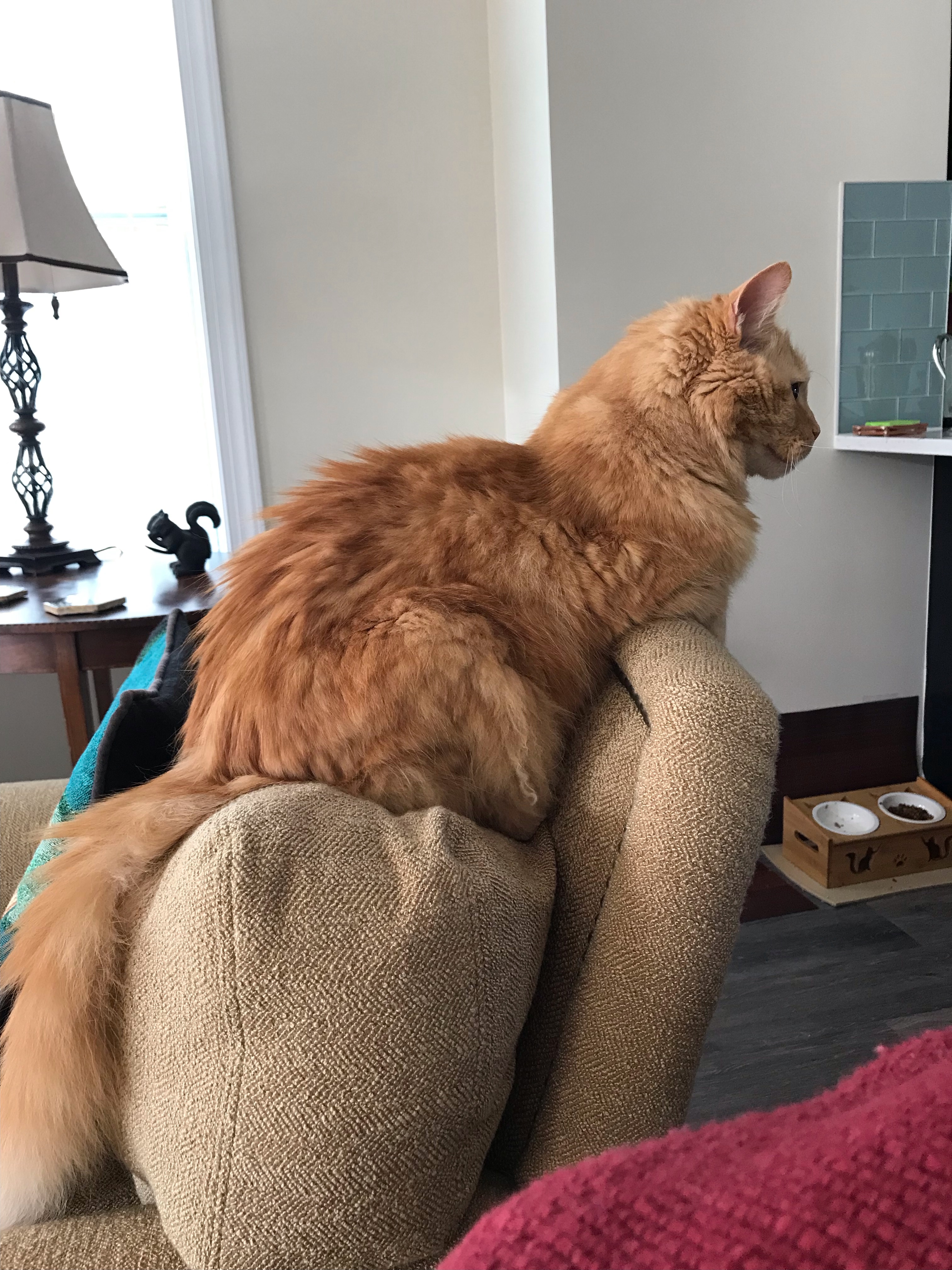
After Bruce the Amazing left us last February I swept up the last of the kitty litter, gave away his food and moved the living room furniture to a new configuration so that Ben and I no longer looked for his furry orange form curled in his favorite chair when we came down the stairs. After a suitable period of sadness and reflection on the years we shared with our cranky, lovable Brucie we settled into life without him. While it’s true our home felt a little empty Ben and I were enjoying not being responsible for a creature lacking opposable thumbs.
And then Tondu arrived.
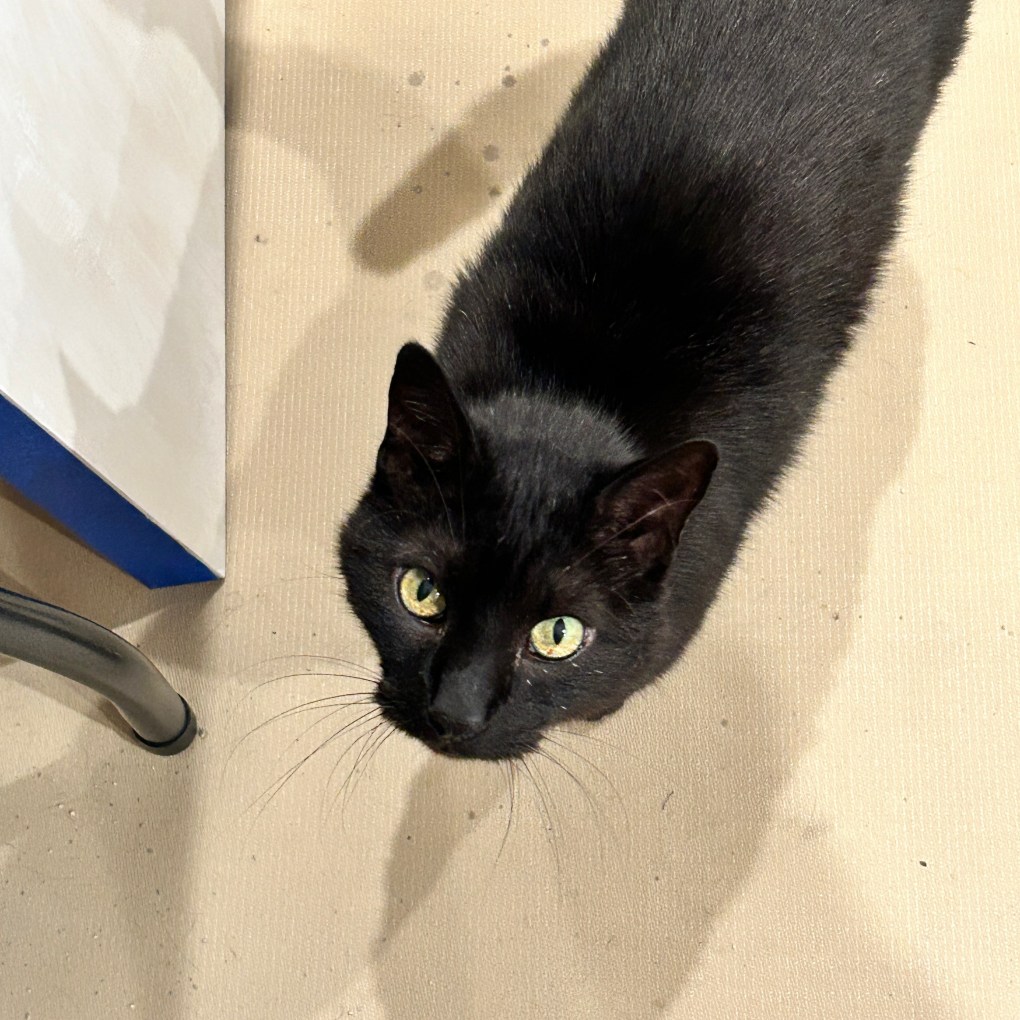
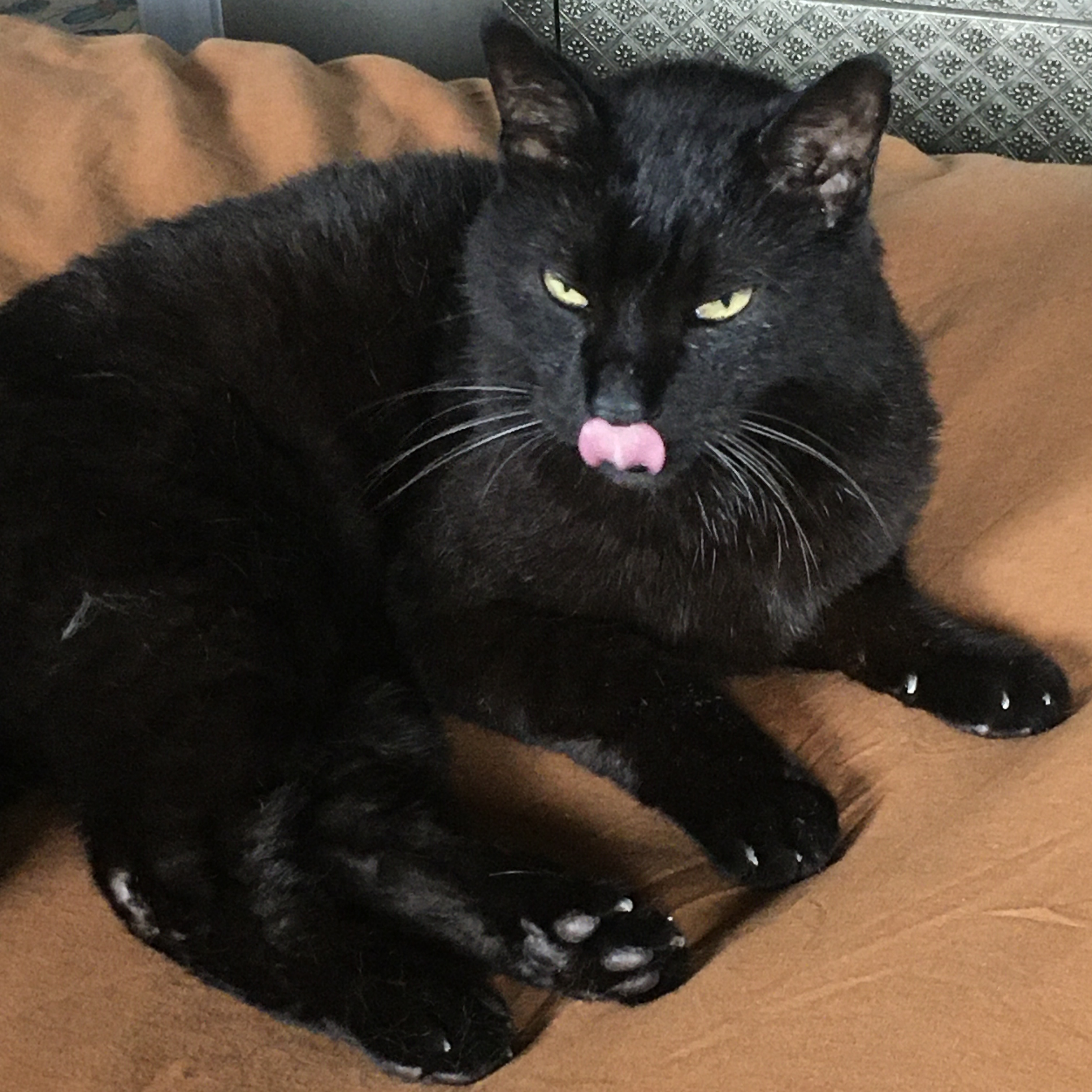
The first time I saw Tondu, before I knew his name or that his purrs would soon be familiar, he was perched on the narrow edge outside of the railings around a patio two stories high at the back of the senior center where I teach yoga. Panther sleek, he was surveying his kingdom with fearless poise and confidence. I later learned he was the beloved feline companion of an older gentleman who was seriously ill.
Two weeks later Tondu moved in.
He’s fourteen – the same age as Bruce when we first met him. Unlike Bruce, Tondu has a French passport. His human, before coming to Virginia two years ago, lived in France and bottle fed Tondu as a kitten after Tondu’s litter mates and mother died. Tondu and his human were inseparable.
I didn’t meet Tondu until the day I brought him home and this so easily could have been a disastrous decision. But it’s been a wonderful decision for both Ben and I. And for Tondu, too.
Tondu’s personality is very different from our darling Brucie’s. Bruce loved being brushed. Tondu can’t tolerate it. Bruce loved eating the house plants and so they all had to be placed out of reach. Tondu could care less about the greenery around the house and on the porch. Bruce was not interested in jumping on tables and counters. Tondu has a four foot vertical leap. Bruce rolled his eyes at toys but loved his cat tree. Tondu ignores his cat tree but loves the little toy that arrived with it. Every evening he and I race up and down the stairs while he chases a grey little puff with a white string attached. I think it reminds him of his days as a mouser in France, when he was an indoor/outdoor kitty.
I know adopting seniors (cats, dogs or humans) comes with risks. I know we’ll be lucky to have him in our lives for as long as we had Bruce. I know that there will be health issues and decline and loss. Such is life. But Tondu has settled in and I am wrapped around his paw.
The Stoics remind us to contemplate our death each day. I contemplate Bruce the Cat’s.
Bruce the Cat turned twenty-one in September. I’ve known him since he was fourteen, when his previous human companion passed away and Bruce came to live with me and Ben. Over the years, and especially since our move to Virginia almost two years ago, Bruce and I have developed a morning routine. He wakes me sometime between 5:00 and 5:30 AM. I follow him down the stairs into the kitchen. He stands by the door to be let out onto our porch, where he searches in vain for a nibble of the mint or Thai basil I grow in pots during the summer. But it’s gone now, pulled out just after the first frost. Back inside he paces and cries at my feet while I brew coffee in my stainless steel cafetière and shred the chicken I cooked for him the night before. He turns his nose up at it until I add two of his favorite treats. After his breakfast he sits at my feet for a moment, then gracefully jumps onto my lap and squeezes in between the laptop and my belly for cuddles while I read headlines from the New York Times website and try to conquer the day’s Connections. After twenty minutes cuddles are complete. Bruce jumps from my lap, ponders a detour to his litter box, but decides instead to lumber over to his chair. The same chair that I once envisioned as my ‘writing chair’. But instead of being my writing chair it has become – and this is non-negotiable – Bruce’s chair. Covered in a mound of blankets to protect the upholstery, it is the throne from where King Bruce the Cat holds court. It’s where he sleeps and dreams wild dreams of chasing rabbits. I can see why he likes it. First of all, the chair is positioned at an angle that provides the royal feline a view of everything his subjects are up to in the living room and kitchen. It has the added benefit of being placed near a window that has afternoon sun, which is perfect for nap-taking when counting the number of times Ben and I putter about in the kitchen becomes too boring.
But one day soon Bruce’s throne will become my chair. When it does my heart will be broken because it will mean King Bruce the Cat is gone. But I know my sadness at his passing will gently transition to happy memories I’ll keep of having had the honor of being his human companion.
I wrote those words on a cold pre-dawn morning in early November. And this past Saturday Bruce’s throne became my chair. His health had been declining for a few months and then, over this past week, Ben and I witnessed a rapid decline. On Saturday we knew it was time. An appointment was made for early evening and so we had one last day with our most wonderful Brucie.
The vet techs and doctor were compassionate and with gentle assurance promised to take care of Bruce. Promised we were making the right decision. We can never know for certain but Bruce seemed ready. I scratched his chin, gave him a kiss. Ben stroked his head and talked to him. Then we said goodbye.
Bruce and I first said ‘hello’ eight years ago, while Ben was out of town on business. I made the executive decision to adopt Bruce after seeing his photo on NextDoor. Ben, not a fan of felines and convinced he was allergic to dander, reluctantly agreed via Zoom (yes, he loves me that much). But when Ben returned from his business trip a few days after Bruce the Cat moved in he made it clear that ‘the cat’ was not allowed on our bed. ‘No problem’, I said. ‘It’ll never happen’, I said. ‘Bruce is too old and too fat’, I said.
Not long after that conversation Bruce decided Ben and I would suffice as human companions. He wiggled his sixteen pound frame out from under the sofa where he’d been hiding for the first three days in his new home, waddled past us with his head and tail held high, and in one graceful leap jumped on the bed.
It was clear to Ben and me there was a new boss in town.
And now our boss is gone and we are bereft.
The connections we share with our non-human animal companions are unlike any we share with our human animal companions. The love language Bruce and I used to communicate had no words. It was energy based, instinctual and intuitive. Bruce asked for few things: food, water, shelter, cuddles and a clean litter box. Easy things to provide. In return he provided warm, comforting purrs and the occasional, perfectly formed hairball. We met each others’ needs without speaking a word.
I want to go on and on about the impact Bruce had on Ben’s and my life. His antics. The trouble he sometimes caused. The many smiles and laughs he provided. His willfulness. These stories are what make mourning Bruce’s loss a beautiful process. Because the massive waves of sadness I felt on Saturday are gentler now as all those memories wash over me.
So I won’t bore you with stories about Bruce. I sorta wanna keep them to myself anyway. I’ll just tell you this: Brucie was a wonderful cat. The house is empty without him and we will miss him very much.
The moon woke me this morning. Just like last month’s full moon. Suspended like a prison guard’s searchlight outside my living room window. So bright I can read by its light. That moon. Too stunning to turn away. I watch its stealth decent – soon half gone behind the trees across the way. Meanwhile, grey dawn begins to cast its own soft light through the kitchen window behind me. A reminder that soon there’ll be no time to be distracted by light bouncing from a pock marked rock floating in blue black space. My day is beginning. And in the last few minutes of pre-dawn stillness my task is to put down words to describe what I see and feel.
But that’s impossible because the padded click of Bruce the Cat’s clawed feet across our luxury vinyl plank flooring tickles my ears as he approaches the overstuffed chair where I sit with my laptop resting – appropriately – on my knees. A fresh brewed cup of coffee is on the table to my right.
Bruce the Cat is deaf. These days he compensates for his deafness with meows loud enough to wake the dead. They are meows that after twenty years are beginning to grow rough around the edges – a combination of Screech from Saved by the Bell, Urkel from Family Matters and a two-pack-a-day habit. And as his primary human companion I know what each meow means.
‘Hold me. Love me. Feed me. Pet me. Take me out. Bring me in. Leave me alone.’
Despite a stagger in his step when he first wakes Bruce remains nimble and has no problem hopping onto the arm of the chair. He spends a good five minutes investigating – my computer, my face, my coffee cup – before settling on the sofa to watch the moon with me. Or to take a nap.
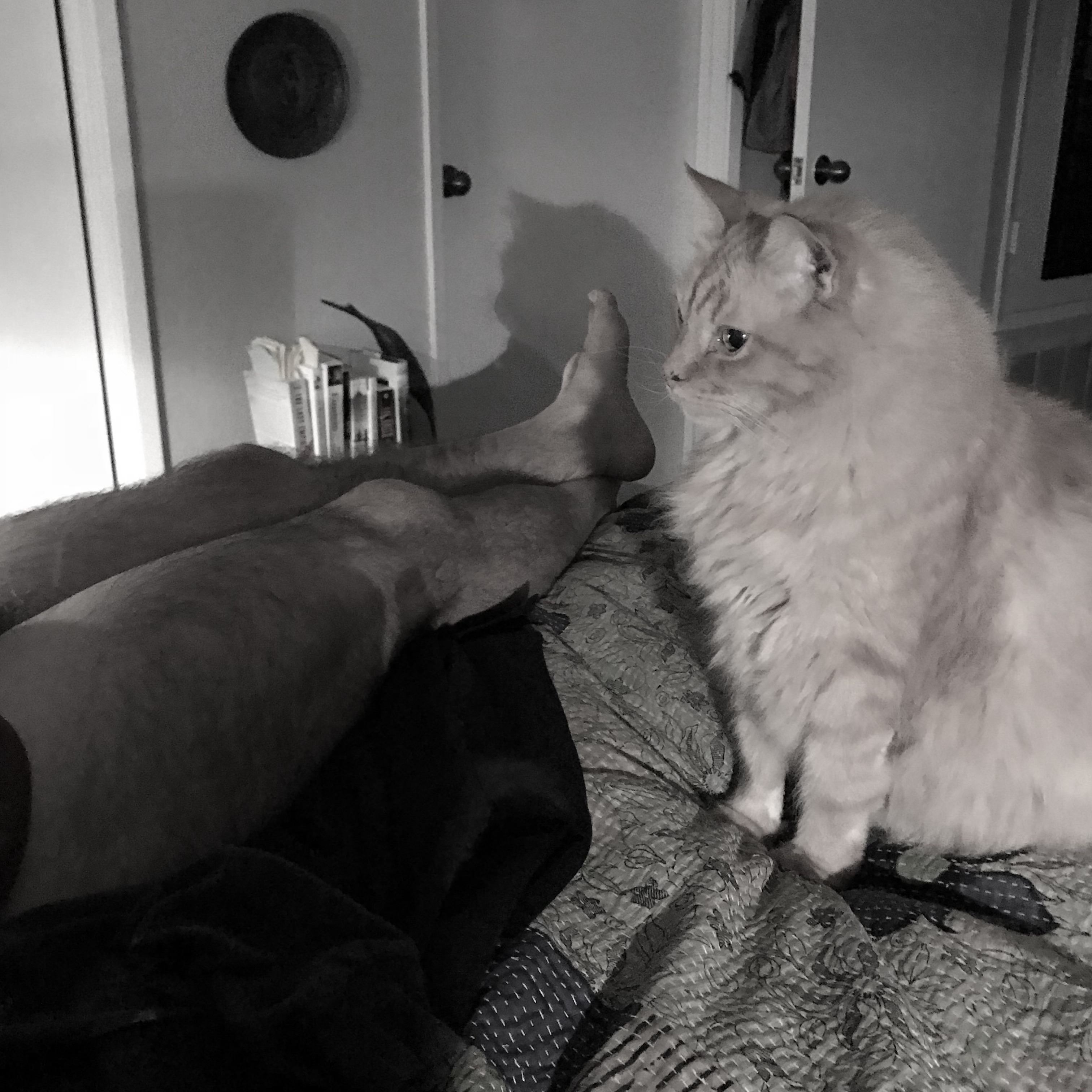
I adopted Bruce when he was fourteen-years-old the death of his first human companion. I saw his photo on NextDoor and was smitten by the cheeky look in his eyes and his long ginger coat. My own human companion, Ben, was not a ‘cat person’. But he loved me (miraculously he still does). He said ‘as long as Bruce doesn’t jump on the bed’. Not only was Bruce a senior cat, he was obese. So I said, ‘don’t worry, he’ll never be able to jump on our bed’.
After three days, when Bruce the Cat decided that his new living accommodations were satisfactory, he crawled out from under the couch, sauntered into the bedroom, wiggled his butt to build maximum vertical lift, leapt onto the duvet and fell asleep on Ben’s and my pillows.
From that moment Ben and I knew who was boss. It wasn’t us.
And now, six years later, our lives revolve around Bruce the Cat. We’ve grown accustomed to being covered in cat fur. It’s become second nature to do a visual sweep of the kitchen floor in the morning to make certain there are no horked up hairballs. And we clean Bruce’s litter boxes with the ease and nonchalance of a mother changing a diaper.
Bruce the Cat will be twenty-one in September and I know that means the time Ben and I have left with him is limited.
If I’m being truthful, knowing that Bruce’s best days are behind him, I feel compelled to spend time with him. To keep him nurtured and comfortable. I cook chicken for him and give him bonito flakes as a treat. I don’t like to upset his routine and avoid traumatizing Bruce with cat sitters. So I don’t leave the house for more than a day. And as the sun rises and the moon sets, I put off writing to offer Bruce the cuddles he and I both need. I love Bruce, I love Ben and I love my home. I feel immense gratitude for all three.
I enjoy Caitlin Kelly’s Broadside blog. Kelly is the author of Malled and Blown Away and, as a journalist, has written for the Financial Times, the New York Times and Forbes. And every Monday morning, without fail, I can count on finding Broadside in the dozen or so emails that have landed during the night.
Tiny treasures: a bag of vintage buttons and century old sewing needles.
What I enjoy about Broadside is Caitlin Kelly’s concise, sweet, simplicity. She has a way of taking quiet moments from her own life and writing about them in a way that makes her readers feel as if she’s writing each one a personal letter. Kelly is not maudlin nor does she over-romanticize stories from her life. She writes with touching economy and clarity that’s easy to read with my morning coffee. And more often than not what she chooses to share resonates because I either have been or am ready to go through a similar experience. I’m certain it’s because we are about the same age and life events tend to align, but sometimes I can’t help but say, ‘dang girl, you too?’.
For example, in a recent Broadside Kelly wrote about a small inheritance she received from her mother with whom she was estranged. The inheritance included a large pastel of Kelly’s great-grandmother and a small framed sampler – the embroidered alphabet grey with age. Having never received an inheritance, she found comfort and continuity in having these objects around her. And then she asked her readers, ‘what brings you comfort?’.
Many things, of course, bring comfort. A good meal. A loving partner. The purrs of your feline purr baby or the unconditional happiness of your canine best friend.
But other things – other circumstances – bring me comfort, too. I find comfort in surrounding myself with objects that have a history and the energetic imprint of the people from whom they were received. In fact, from where I sit this morning, I’m surrounded by things given to me by others: the painting on my wall, the brass lamp, the sofa and chairs, the tea chest and pillows, the porcelain box and the ceramic vase. Everywhere I look I’m reminded of friends that feel more like family and am I filled with love.
I wasn’t always so blessed. I’ve lived what I might describe as an IKEA-like existence. Easy to assemble, sometimes quick to fall apart, ready to go at a moment’s notice. No matter where life took me I managed to get there with as few boxes as possible. With as little excess weight as possible.
There are a few things, of course, that managed to stay with me through my many moves. I still have the capo I was given fifty years ago when I played 12-string guitar. I still have the little plastic box that held my guitar picks. I have a few of my picks from those days, too. But these things don’t speak to who I am. They speak to a time in my life when I borrowed my roommate Sissy’s Gunne Sax dresses, which were always a size too small. They speak to a time when I rode shotgun in Mike’s green Chevy Nova from our college campus in Crete, Nebraska to a shopping mall’s fern bar in Lincoln where we’d unpack our guitars and sing Dan Fogleberg songs.
I love that I have that old capo and those guitar picks even though I no longer have the guitar. It’s nice to have a few things that hold the memory of moments decades old. But what do I have that tells the story of who I am and why does knowing who I am – where I came from – bring comfort?
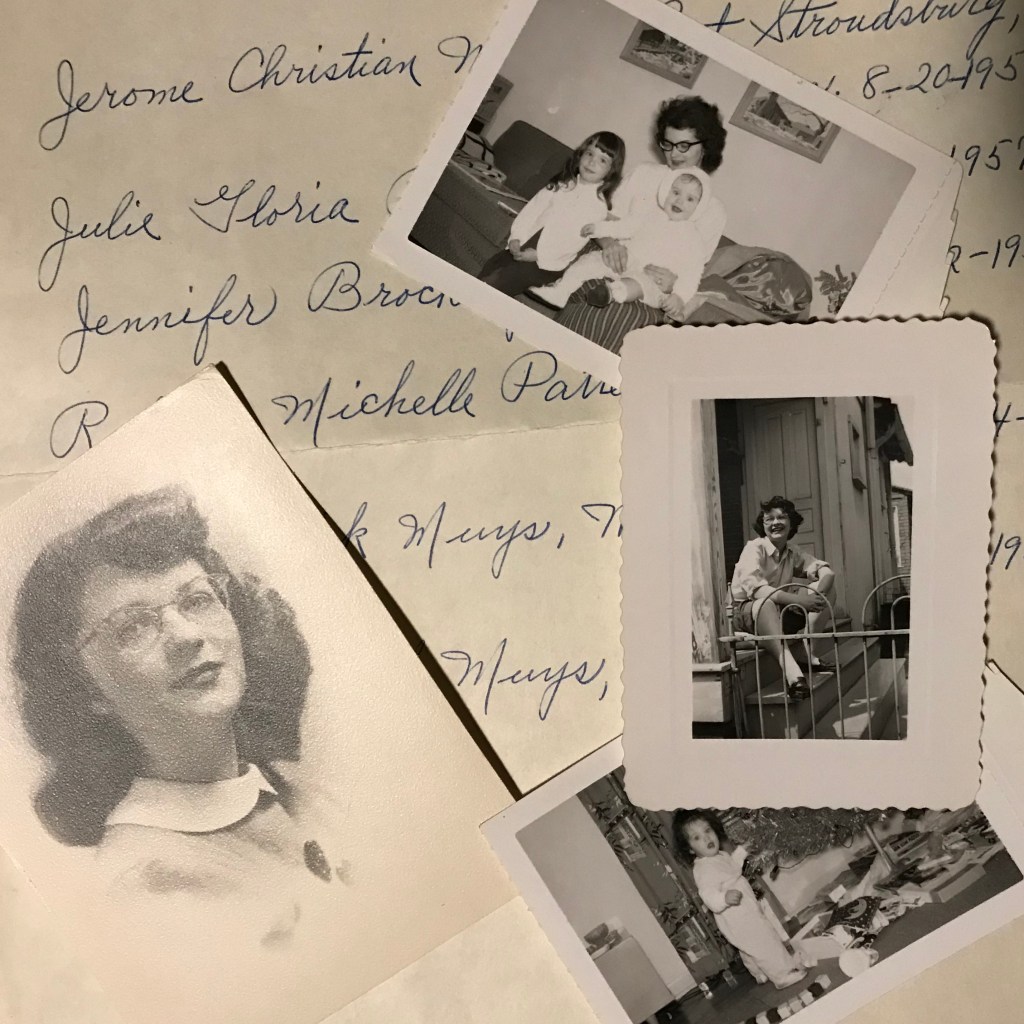
Over this past weekend I drove five hours north on Interstate 81 to clear out the books and tchotchkes and photographs and furniture that filled every square inch of storage locker 2011 at the East Penn Self Storage emporium in Trexlertown, Pennsylvania. These things were the remnants of my mother’s life and had been collecting dust and bugs and spiders for four years. My mother was still alive when I sold her trailer; when I threw away her sofa and shoved her clothing into a collection locker I found in the parking lot of the Walmart off of Hamilton Avenue. She didn’t know that I needed to do that; that she wasn’t going home. And I didn’t tell her. Instead I saved what I thought was important. Furniture that had been in the family for a few generations. The dog tags she wore when she joined the Women’s Army Corp. Family photos, marriage certificates and divorce decrees. A complete set of the Harvard Classics. I saved a wooden 12-inch ruler advertising a long since closed life insurance company headquartered in Pittsburg. And her knitting needles. I really wanted her knitting needles.
What I saved has little monetary value. Not the ugly Edwardian pendulum clock that stopped working before I was born nor the yellowed newspaper clippings my mother taped onto lined binder pages, her perfect Palmer penmanship taking note of why and how and who. I saved them anyway.
I don’t need these things. And while friends who, like me, are approaching the middle of their seventh decade choose to downsize I’m choosing the opposite. I’m gathering. Surrounding myself with a collection that others might describe as junk but to me is a treasure that exists to remind me of a time long past and a place that no longer exists.
It’s important for me to do this because it connects me to a history and to people I never knew but who gave me my nose, my blue eyes and my propensity for weight gain. These strangers whose blood is in my veins also gave me a passion for art and music. A love of nature. Keeping my great-grandmother’s writing desk and my great-aunt’s crocheted doilies honors my history. It honors them. I know the fragile aperitif glasses, the shell shaped plate from Japan and the lustreware casserole dish in which my grandma made my favorite corn pie could be gone in an instant. And after the sorrow of loss passed my life would be the same. Every new day people move through the loss of the things that remind them of who they are and I know how lucky and how blessed I am and I understand the impermanence of this jumbled collection of artifacts that until Sunday were covered in grime in a storage locker five hours up the road. But having these things around me now helps me feel less lost in this world; less like an uncertain, aimless wanderer and more like a woman secure in who she is and how she came to be.
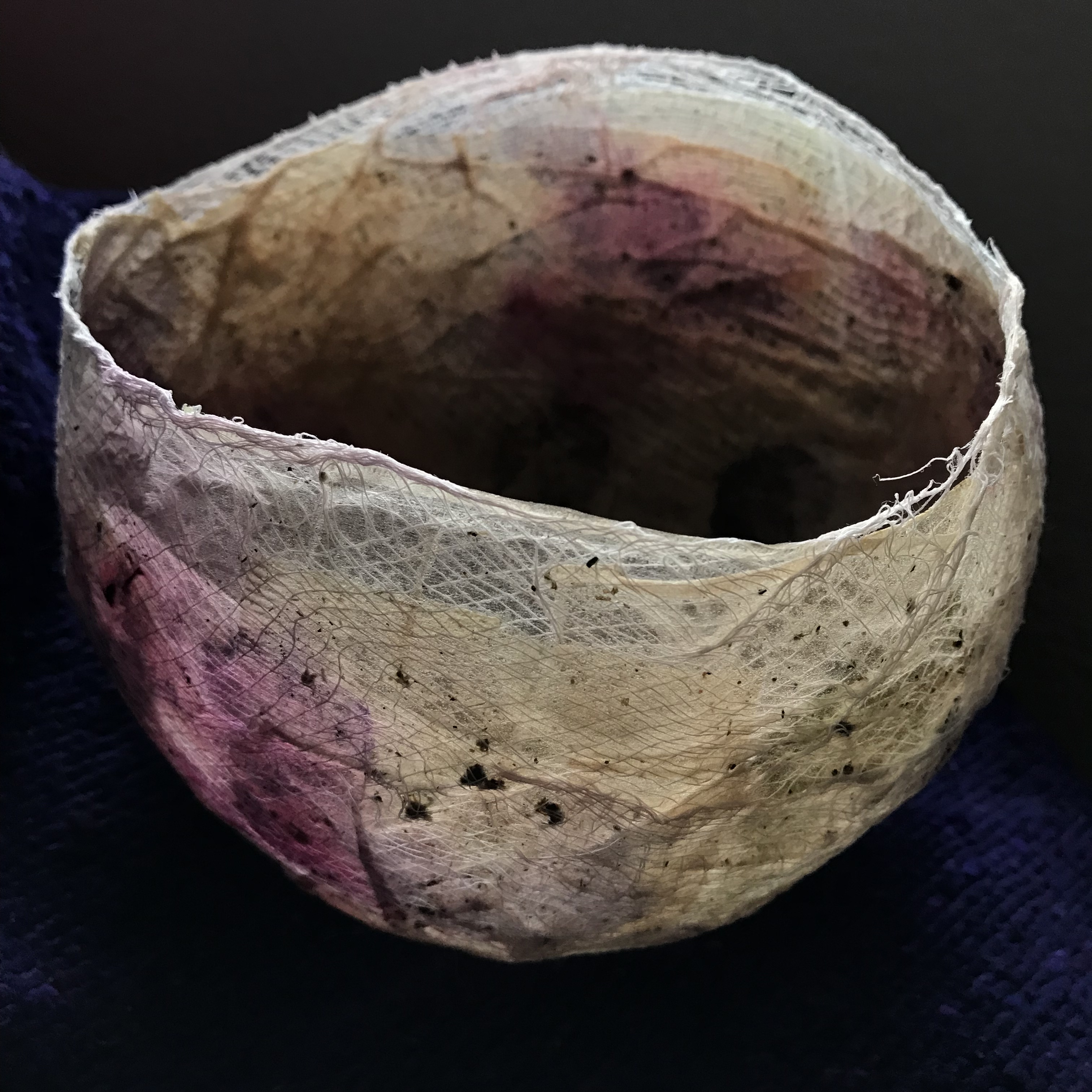
We power through cups of tea at our house. I’ve been saving the wrinkled and wet used tea bags in a bowl. Don’t judge me. I have my reasons.
Not quite finished. The dark flecks are tea. The red pigment comes from pounded rose and geranium petals.
In JuneI began a year long virtual course of study with India Flint. India is an artist who works with plants and found objects to create beautifully dyed paper and cloth. India’s course of study is why keen eyes might find me in the wee hours of the morning gathering handfuls of eucalyptus leaves from along the bike path that parallels El Camino Real and stuffing them into the pockets of my baggy cargo pants.
India Flint, and this course, is why I save used tea bags.
India’s teaching style is that of a storyteller. Rather than providing precise step-by-step directions – like the sort you’d find if an Ottolenghi cook book – she weaves a tale of her experiences with the plants she is using, the mistakes she’s made, the lessons she’s learned. She gives permission for us to take what we need, to leave the rest, and to be inspired by her life’s work.
I’m inspired.
Our first journey was through the making of a book. I didn’t have much of what was needed – proper paper, a sewing machine, a very sharp pair of scissors – but this course is filmed with such care and beauty it didn’t bother me that I wasn’t playing along. I was still learning.
Which is how, this morning at 5 AM, I found myself carefully deconstructing a dozen or so tea bags, emptying their contents into a bowl and spreading the fragile paper out like one might smooth a bedsheet.
But there is more to this story:
Over the weekend my friend Diane – a talented and dedicated artist – gifted me Beth Pickens’ book Make Your Art No Matter What: Moving Beyond Creative Hurdles. This is a book that weighs much more than it should and its Times Roman font is a point size or two smaller than my eyes enjoy. The first chapter, however, is about time. Something I’ve been pondering lately.
And here’s a little more to the story:
I had lunch yesterday with a friend I’ve not seen since before the shut down. Carolyn and I laugh when we’re together. We laugh a lot. But yesterday, as we were talking about how the pandemic changed us, we thought of something that stopped us in mid-giggle. The shutdown gave us time. And now time feels more precious. Both Carolyn and I are discovering how different life is when we treat time as a gift and not a commodity to burn through. We’re learning to say ‘yes’ to what we love. Even if that means saying ‘no’ to something we love less.
And that is how I found myself at 5 AM this morning gently opening the tea bags that had been drying for a day instead of reading emails and absorbing all that had happened in the world as I slept. India’s course is inspiring me to explore. Diane’s book is encouraging me to love my inner artist. My conversation with Carolyn is reminding me that time is precious.
Deconstructing tea bags is a slow, careful process. While I sat at my desk, my Ottlite breaking the pre-dawn grey, I fell into a sort of meditative reverie. I thought about the tea, how far it had traveled – the Ashwaghanda from India and the green from Japan – I thought about the farmers who grew and harvested the tea then bundled it off to factories to be processed. I thought about the work it takes to create the paper that holds the tea and about how I was moving the process of creation forward by turning the old tea into dye and the these fragile scraps of paper vessel into a new vessel.
It was a profound moment to experience that deep sense of connection. It felt new to me because it wasn’t cerebral. The connection came from my heart.
I hope I can hold on to that feeling of connection.
I was not expecting to feel the way I do. Relieved. Guilty. Annoyed. Two weeks later and I’m just realizing now that I no longer have any reason to avoid calling my mother. I’m realizing, too, that unless I plan on learning I won’t be knitting any blankets and don’t need to keep her collection of needles.
I’m keeping them anyway.
I’m keeping pieces of paper with her perfect Palmer penmanship. A piece of cardboard with a list of passwords she created each time she forgot the last password. When we first reconciled a decade or so ago I sent the money for a laptop. I told her if she had a laptop we could send letters (she insisted on called emails ‘letters’) every day. In the end though, she really only used it to find out what was on television and to check the obituaries in Allentown’s Call Chronicle.
Friends tell me this is normal. To be reminded of all that has been lost while doing the simplest things. While walking through the freezer section at Mollie Stone’s and hearing the chorus of a song she sang. She loved music. When we first moved to Lynnport she and my step-dad formed a country and western band called Johnny and the Texas Tophands. Local bars from Topton to Hamburg booked them for gigs most weekends. Once they played before a NASCAR race at the Pocono Speedway. John rented a tour bus to take the band and all their equipment up to the mountains. I think my sister was old enough for the two of us to stay home alone that weekend.
I suppose what my friends tell me is true. That this is normal. That no matter the gulf between mother and daughter, losing a parent changes a child’s life. Even if that child was born when Dwight D. Eisenhower was President.
There’s a space in my life that wasn’t there before and I’m not yet certain how it should be filled.
As I come to understand that my mother is going to die soon I find it difficult to remain present. My mind wanders to past injustices real or imagined and to future hurdles. I was not the best daughter. I stew in the guilt of our 28-year estrangement and then in the next moment choke it down where it sits like a lump in my belly.
Watching my mother’s dementia worsen is like watching a life disappear. And as I empty her trailer of books and furniture and clothing and photos it’s clear to me that my actions, too, are part of the process of disappearing.
What do I do with the things that hold resonance for me? Like the oak bookshelves, or the cookie jar and the 4-string guitar? They’re stacked and covered in blankets in a storage locker 2500 miles away. Will they stay there forever? Would it have been better to sell or give them away? In a year will I have regret for the books I saw thrown away or the trinkets I decided to keep?
And what about the things too big to hide in a storage locker? Like her trailer? It won’t sell and I can’t pay the $800 lot rent. Do I abandon my mother’s home for the past forty years? Her neighbor is afraid that if I close the PPL (Pennsylvania Power and Light) account the water pipes will freeze and burst, causing havoc and despair for everyone in her Green Acres Mobile Home Park circle.
I didn’t expect to be doing this alone. I didn’t expect to be doing it at all. When I ran away from my mother and my sister I had no plans to return. But there was a moment when I thought ‘an old woman deserves peace’ and I reached out. I told myself that I didn’t need to love her. I didn’t even need to like her. But I needed to be with her and to do my best to care for her. To be kind to her.
And I was.
She and my sister had stopped speaking to one another years earlier. For that reason I kept Margaret shut off from my life. Something I regret. A few years after the reunion with my mother Margaret died.
And now here I am, finding it difficult to remain present.
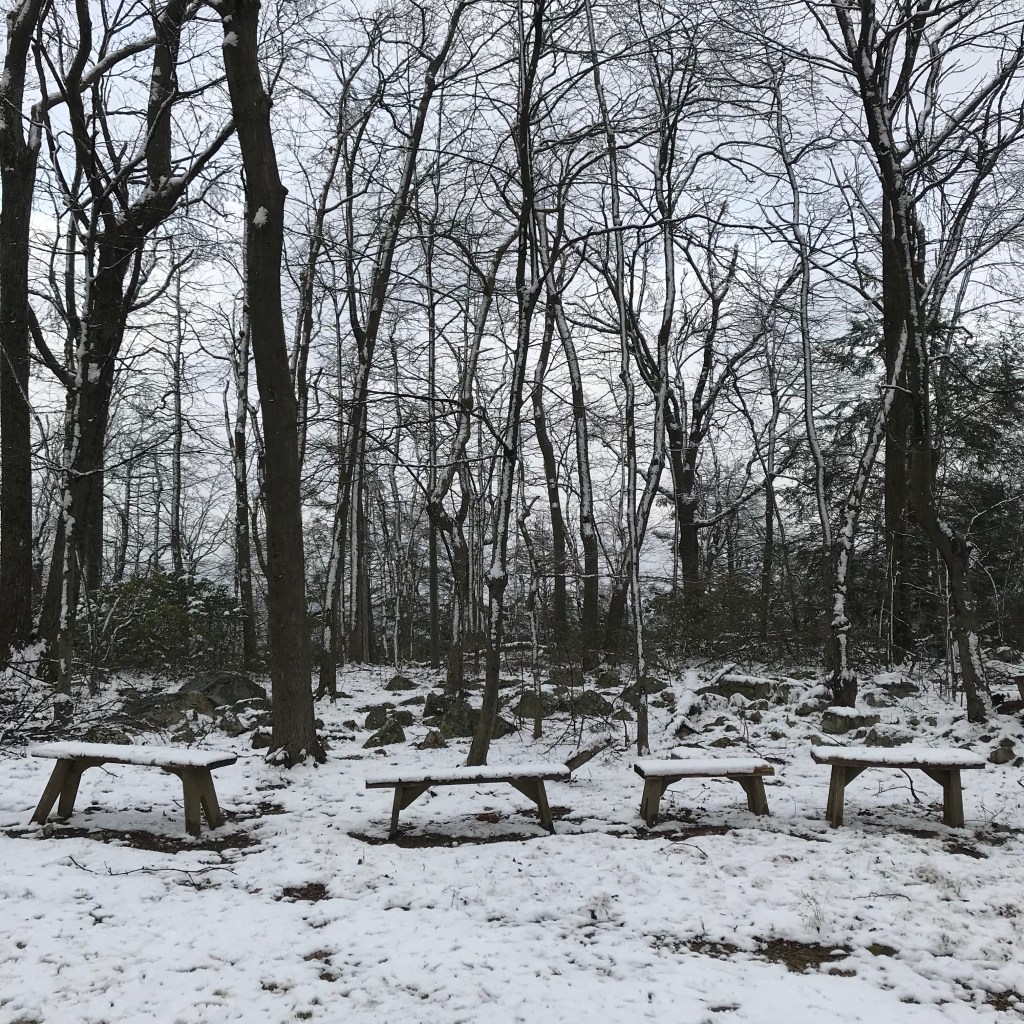
When I was in Pennsylvania in October I began each day with a walk and a photograph. It was grounding and brought a sense of calm presence to me that stayed with me for much of the day. But when I returned to Allentown last week I forgot that practice. Until I took half a day to visit my favorite place – Hawk Mountain.
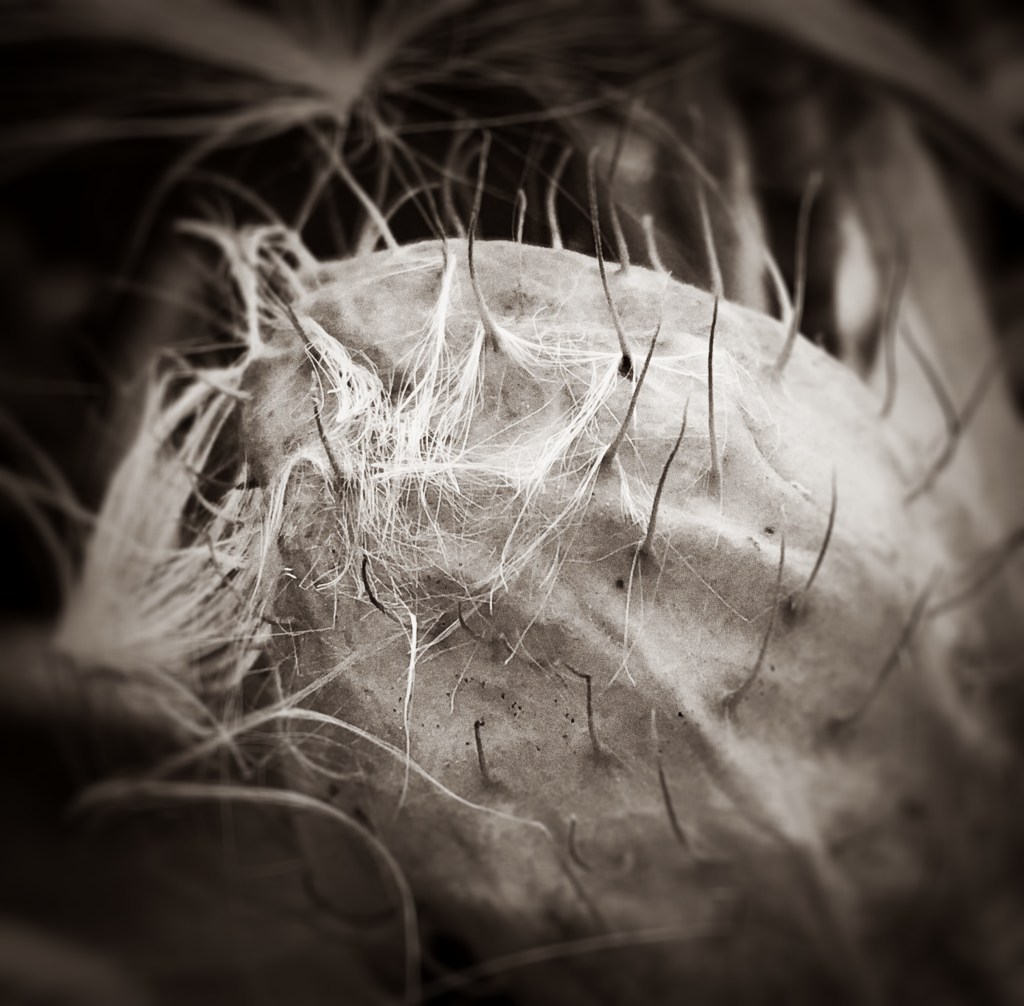
The photographs are nothing fancy – simply shot with my iPhone 7. But each time I hold up that little miracle of a computer I am in the moment. There is nothing but my beating heart and the leaf or flower or mountain I’m looking at. For that little moment there is no past, no future. There is only now.
I came home last Friday and have decided to continue the practice of taking one photograph each day. And in that moment all things fall away and I am here.
The suitcases are back down in the storage locker, the laundry is folded and tucked away. The photos have been filed and the promise to have our favorites made into a Shutterfly book is written on that long ‘to do’ list.
It’s like a dream. The only reason why I know for certain I was there is because of the sense of familiarity that welled inside when I saw images of the protests that occurred in Kerala in early January. A wall of women stretched the length of the place I had just been and deep in my soul I could feel the heat and hear the traffic and smell the layered perfumes of India.
I’ll be honest. I don’t want to be writing this. The deeper my last post about the backwaters of Kerala sinks into this blog’s history, the further away I am from that magical land. That’s how wonderful those ten days were.
I know plenty of people who look forward to their two-week holiday every year. Friends, students and private clients let me know they’ll be missing class or canceling appointments. They organize the cat sitter, hold the mail and stop the daily delivery of the New York Times. The kids are piled into the family van for a road trip or a race to the airport for a bargain priced flight to parts unknown.
Our ten days in Kerala were a first for Ben and me. Over the past five years we’ve enjoyed time spent with family back east and long weekend breaks to Half Moon Bay and Arcata, but we’ve never had an extended holiday all to ourselves. Even worse, there’s never been a time when we’ve taken a so-called break and didn’t take work along as if it were a third traveling companion. (And if I’m being totally honest, on my first day in Bangalore, while Ben was finishing his business meeting, I worked on Samyama’s monthly newsletter, Prana Pulse).
I’ve always been a little weak in the self-care department and until December I didn’t understand the point of vacations. Time away from work for me usually means I’m attending an IAYT conference or taking another training. But to just sit still? Until December this was impossible. Which is pretty funny considering how often I encourage clients to be kind to themselves. I guess it’s sort of a ‘do as I say and not as I do’ situation.
Besides its gentle beauty, the biggest blessing of Kerala were the blissful two days without wifi.
For those two days my brain turned the volume down on the endless chatter, my body relaxed in a way I didn’t think was possible, and Ben and I had a chance to bask in the love we share. We engaged with life, with the world around us and with each other. During those two days I was fully immersed in the life around me – the colors, the textures, the sounds and even the silence. I engaged with life, not with a computer.
I was very lucky to be able to travel to the other side of the world and I don’t know when I’ll have that opportunity again. No matter. Ben and I plan on taking another vacation this year. It might not be extreme or exotic or even that expensive. But after this experience, after really feeling what it means to renew and recharge, our next vacation will be designed with kindness and self-care in mind.
The hashtag ‘me, too’ isn’t enough and I am not man-bashing. I’m asking the question, “when are boys taught that certain behaviors towards girls are all right and who does the teaching?”
As a girl I was taught to be either flattered, to shrug it off because ‘boys will be boys’ or to wonder what I did wrong. And now I’m asking the question, “when are girls taught that being objectified by a boy is something to aspire to and who does the teaching?”
I was taught by observing my mother and my older sister, their behavior with men and the behavior of the men they chose to have in their lives. But I was also taught by what I watched on television, by the books I read, and by the screaming silence.
How can we teach our children? By no longer being silent.
I’ve decided to share seven experiences that shaped my life.
When I was a pre-teen my first step-father liked to wrestle with me. We wrestled on his and my mother’s bed. He always pulled on my training bra until it opened.
When I was a teenager my second-step father told me I had nice breasts.
Around that same time, a local boy told me he needed help with is homework and asked if I would come to his house. When I arrived he talked me into crawling through the hay bale tunnel he had built with a friend. The friend was waiting in the fort, trapping me in the middle. I managed to talk them out of whatever they planned to do, came home and took a bath.
When I was a senior in high school, a member of the football team stopped me in the hallway to the gym and asked me to unbutton my blouse. I remember thinking how stupid his request was and called his bluff. He was disappointed I was wearing a bra.
When I was a college freshman a plumber who was at my apartment to fix a radiator finished the job and then thought it was appropriate to hug me and grab my bottom.
Several years ago I was in an psychologically abusive relationship. I was called ugly. I was called stupid and told I would amount to nothing. My words and opinions were laughed at. Why didn’t I leave? I was beginning to believe him and I was afraid of his reaction if I began to pack my bags.
A few months ago I was in a local hardware store having a key made. A man working there thought it was all right for him to lean his body against my body and pull me uncomfortably close.
I know that it goes both ways. Women are capable of questionable behavior and sexual predation, too. But I can tell you that in my fifty-nine years I have never wrestled with a boy to feel him up. I’ve never told a man he has a nice package. I have never trapped a boy in a hay bale fort nor have I ever asked a boy to pull down his pants. I have never hugged a plumber so that I could grab his bottom. I’ve never frightened a man until he believed there was no hope. I have never leaned my body against a stranger in order to pull him close.
There are moments in my life when I made poor choices. So let’s teach our children about making choices. Let’s teach our children. Let’s not be silent anymore.
Isn’t it funny how just when we are beginning to believe that our feelings or thoughts will remain the same forever, they change like the direction of the wind? How does that happen? Is it the food we eat? An unexpected smile from a stranger? A happy memory that floats to the surface or a dream that sweetens and soothes our subconscious? Maybe it’s the perfect yoga practice or a soothing few moments of quiet meditation.
All I know is that there has been a welcome shift. I have too many good things piled on my plate to spend time in the stinky muck of overcooked wallow.
I didn’t find it easy to write my last post’s pity fest. To be honest, I haven’t found writing easy at all. The world is overwhelmed and overwhelming. Stepping away from a writing practice was my way of holding space for others to tell more important stories.
But all stories are important. Even the small stories because they are the stories that bring us together. They are the stories we’ve all experienced.
When I was a girl – I may have still been in elementary school – my mother decided to go on strike. She set up camp on the orange Levitt Brothers sofa in our living room with our black and white television console, the afghan my great aunt had crocheted and the coffee table pulled close. My mother piled the coffee table high with supplies including several good novels, a few packs of Pall Malls, a ceramic ash tray and her ever-present plastic mug of black percolated coffee. She was never without that mug. It was white with a turquoise rim. The inside of the mug was stained dirty brown by endless cups of Maxwell House and so, from time to time, she would scrub it clean with Ajax.
My mother’s strike lasted at least a week and possibly two. During this time she refused to cook or clean.
My sister and I were old enough to walk ourselves to the bus stop in the morning and to heat up a can of Campbell’s Cream of Mushroom soup at night and in all honesty our mother probably roused herself enough to make certain her children remained alive. It’s possible, too, that Margaret and I enjoyed the brief respite from rules and order.
What I remember most about my mother’s strike is coming home from school in the afternoon and seeing her stretched out on the couch watching Mike Douglas.
I also remember the cold silence that rose above the sound of the television and that made me walk through the house as though I was walking on shards of shattered ice.
As a girl I didn’t understand the anger between my parents or why my mother might want to teach us the lesson of what our lives might be like without her. But now, looking back, I think she believed there was no outlet for her unhappiness and no cure for her invisibility except for that orange Levitt Brothers sofa, her stack of books, a lukewarm cup of coffee to go along with her smoldering Pall Mall and Mike Douglas in the afternoon.
This is the point in the story where I am supposed to describe the lesson we all learned from my mother’s strike. The thing is, the strike ended and nobody noticed. I came home from school on a sticky afternoon and my mother was in the kitchen, once again resigned to standing over the stove with a spoon in one hand and cigarette in the other, exhaling a cloud of grey over the evening’s meal.
We didn’t know then what we know now. Maybe that is the lesson.





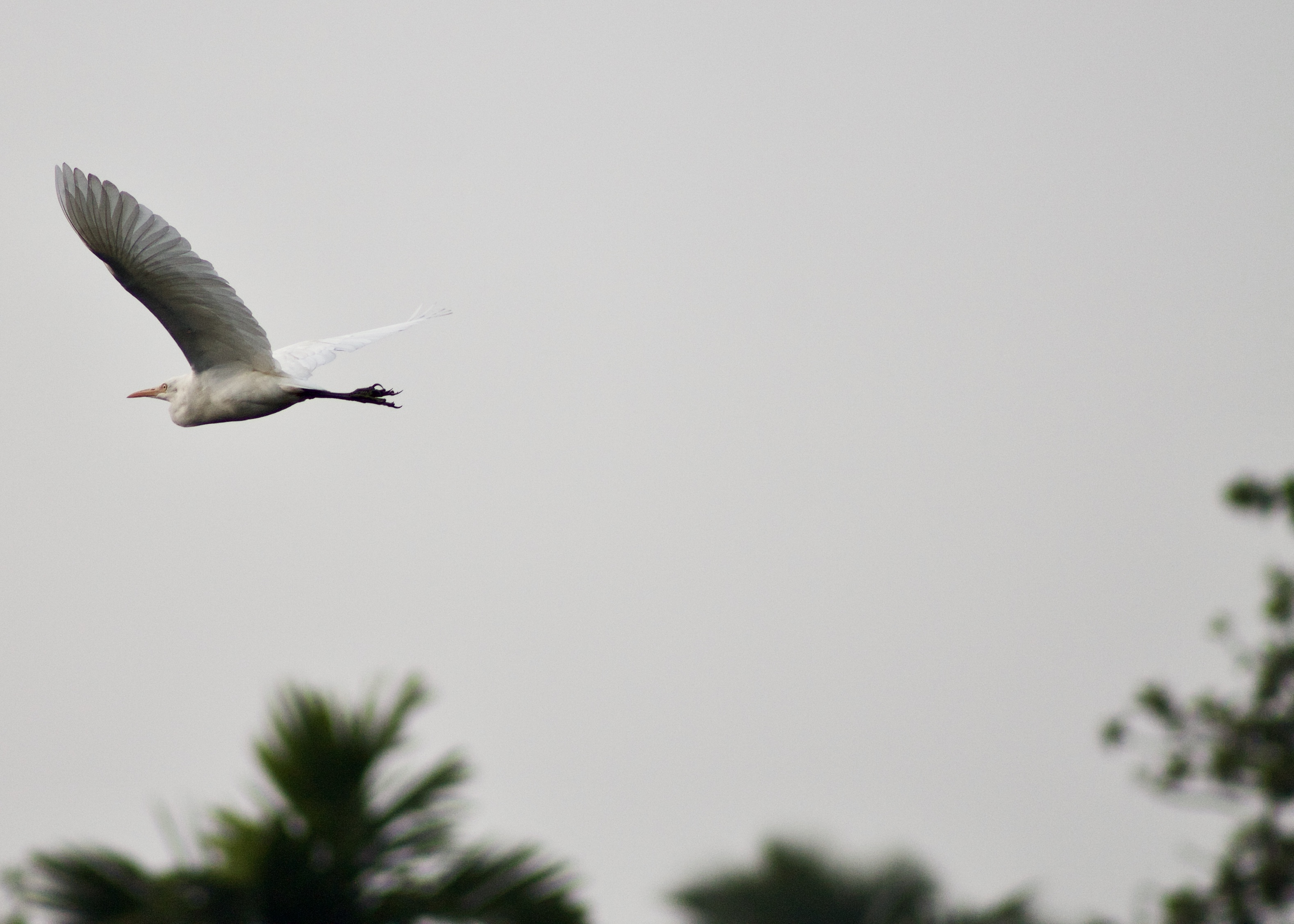 It’s like a dream. The only reason why I know for certain I was there is because of the sense of familiarity that welled inside when I saw images of the protests that occurred in Kerala in early January. A
  Our ten days in Kerala were a first for Ben and me. Over the past five years we’ve enjoyed time spent with family back east and long weekend breaks to Half Moon Bay and
 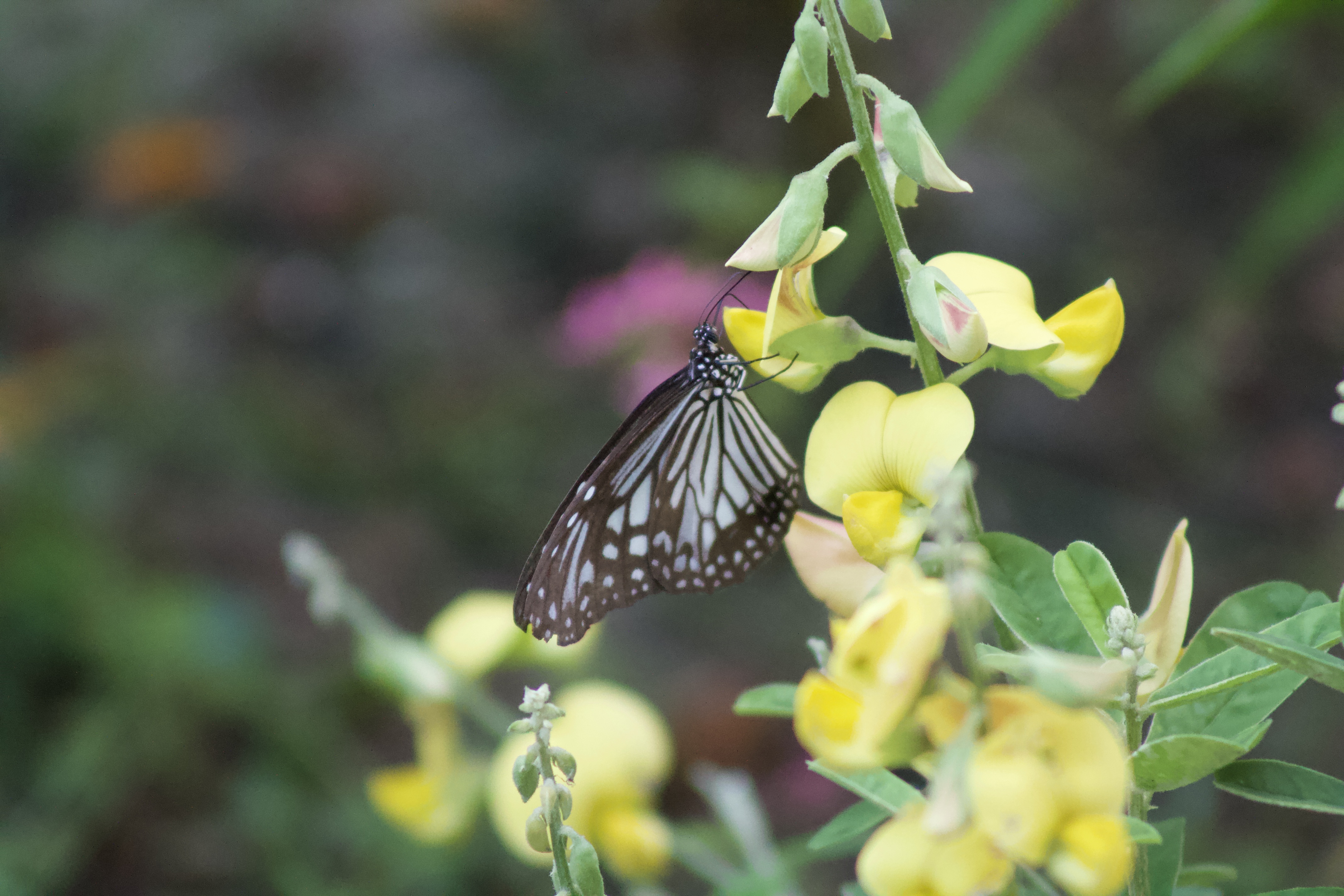 For those two days my brain turned the volume down on the endless chatter, my body relaxed in a way I didn’t think was possible, and Ben and I had a chance to bask in the love we share. We engaged with life, with the world around us and with each other. During those two days I was fully immersed in the life around me – the colors, the textures, the sounds and even the silence. I engaged with life, not with a computer.
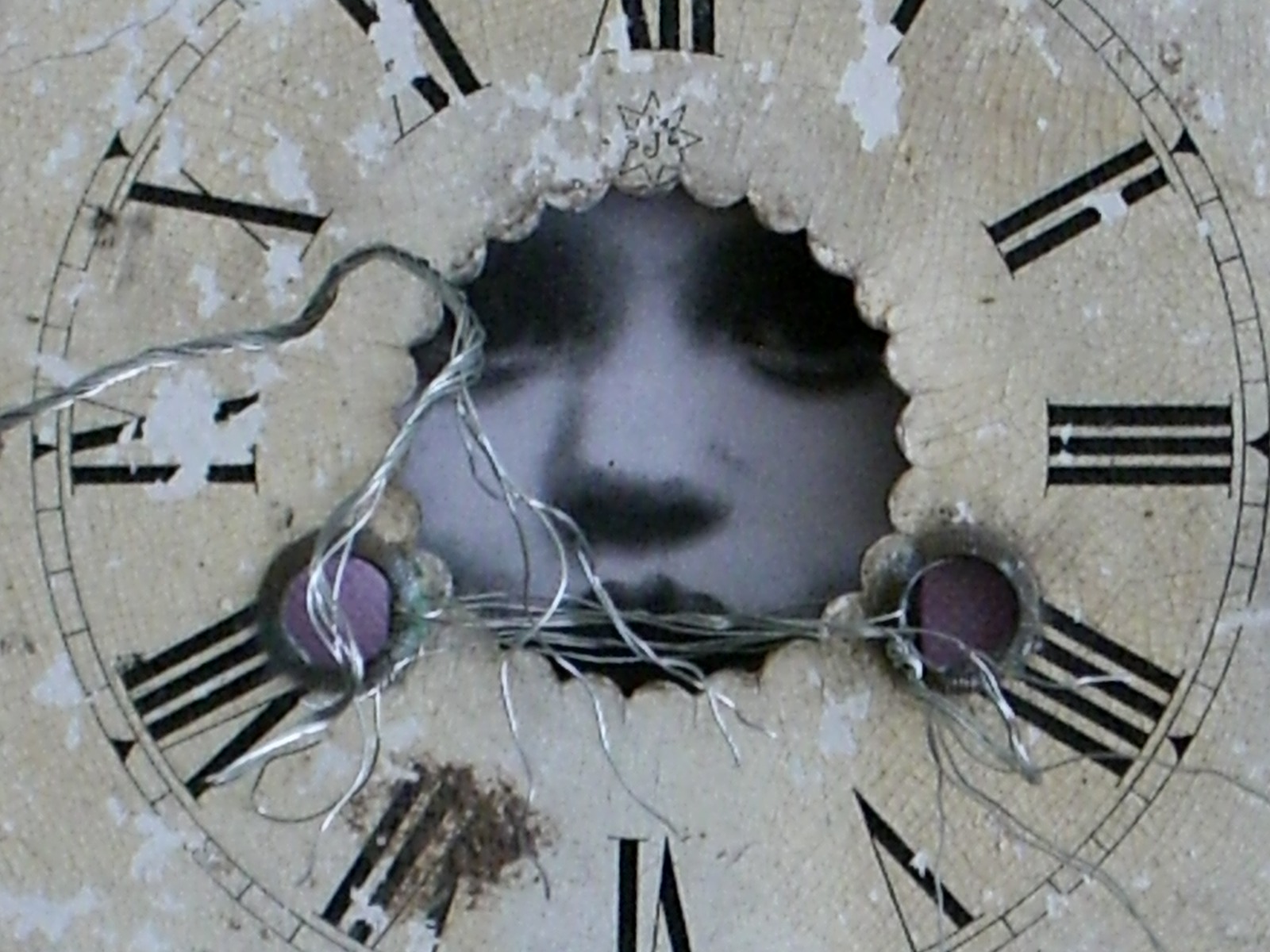 The hashtag ‘me, too’ isn’t enough and I am not man-bashing. I’m asking the question, “when are boys taught that certain behaviors towards girls are all right and who does the teaching?”
 Isn’t it funny how just when we are beginning to believe that our feelings or thoughts will remain the same forever, they change like the direction of the wind? How does that happen? Is it the food we eat? An unexpected smile from a stranger? A happy memory that floats to the surface or a dream that sweetens and soothes our subconscious? Maybe it’s the perfect yoga practice or a soothing few moments of quiet meditation.
 Mimm Patterson