
I facilitate yoga classes for people in chronic pain. In the decade that I’ve been doing this work my teaching has changed, my attitude has changed and my body has changed. I love this work. It’s beyond rewarding to witness the transformation in people as they discover their capacity for movement and learn to trust their bodies again.

Some aspects of the work, however, are challenging. For instance, it’s difficult sometimes to convince students to ‘start where you are’. To lean into the present moment experience, to feel what they are feeling right now and to allow those feelings to lead the practice. But this challenge is not unique to students in chronic pain.
At times we’ve all abandoned what our bodies need in the moment in favor of our deep rooted goal-oriented mindset. Who hasn’t, at some point, embraced an ego-driven yoga practice? Who hasn’t attempted to show off in front of their instructor or maybe the person on their left, the one with the fancy Manduka mat, struggling with ardha chandrasana? Who among us hasn’t judged their practice through the lens of ‘I have to do more, bend more, twist more, achieve more?’
The Sutras remind us that we practice in order to ‘still the fluctuations of the mind’. And in order to still those fluctuation – in order to self-regulate – we must maintain a dedicated practice with no attachment to the outcome. So there is no room for pushing ourselves beyond our limits, no room for unreasonable expectations. There is no room for competition with others and no room for competition with ourselves.
We know that our physical practice is just one limb of this beautiful thing we call ‘yoga’ and that together, all eight limbs of yoga create the yoke that unites the body, mind and spirit. In other words, the dedicated practice called for in the Sutras is not limited to perfecting trikonasana. The forms we create with our bodies, the poses we flow through in alignment with our breath, will build stamina and flexibility. But their true intention is to build the strength we need to find stillness in meditation. An asana practice does not refine our physical body through exercise so that it is capable of doing more. It refines our body so that it might do less.
In your practice this week, what can you do to remain present with your body in this moment? What shift in thinking do you need to make in order to do less?
 I’m at a four-day yoga therapy conference at a Hyatt Regency in Virginia. I’m sitting on the floor of a large, carpeted ballroom. It’s filled with one hundred beautiful, mostly mid-life women dripping in Lululemon, Om symbols, prayer beads and diaphanous Shakti-printed shawls purchased at the ashram in Buffalo where they attended their last silent retreat.
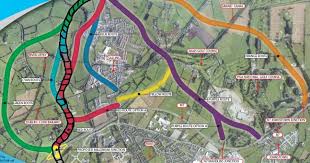 The Naas Bypass, opened in 1983, was the first of its kind in Ireland. Otherwise known as the M7, the highway connects the town Naas in County Kildare to the town of Limerick one hundred and sixty-eight miles to the southwest. In the thirty-four years since the ribbon cutting, new and upgraded bypasses have woven there way across the country. But the Naas Bypass has the honor of being the first road in Ireland to take a driver around rather than through a town. In doing so it relieves congestion in Naas’s town center and slices minutes from the journey.
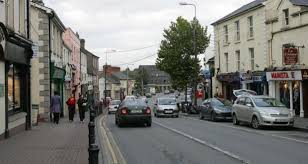 It’s a nice trade-off. We crave speed and ease and so when the goal is to get from Naas to Limerick as fast as possible then the town’s charming character, with its retro Eddie Rocket’s diner and Carphone Warehouse, is not a priority. We can avoid being slowed by the locals on their way to do a weekly shop at Supervalu. We don’t have to dodge truant children chasing runaway pups across the street. We can avoid anything at all that threatens our smooth journey to someplace else and enjoy the open road. The bypass is an alternative that’s both fast and direct.

 Over the past few weeks in the creative expression classes I teach we’ve been creating gratitude journals. Gratitude journals are, as they say, ‘trending’. There are studies, in fact, that suggest keeping one benefits our mental and physical health. This might be true. Shifting our energy toward the positive rather than nurturing our habit of catastrophizing the difficulties we encounter builds our emotional resilience and reminds us that living is a group experience.
 Last month I walked past the sandwich board outside of University Avenue’s Lululemon emporium twice every Tuesday and Thursday for two weeks and each time I wanted to kick it. In my wildest moments I envisioned myself carrying a can of spray paint so no one else would walk past, read its message, and have that little moment of feeling less than. What words did I find so offensive?

 Mimm Patterson