The Intentional Human

Have you ever met someone with whom there’s an instant connection? That’s what happened when I met my friend Evan. We became peer coaches for one another while completing our sixteen-month training with ICA, the International Coaching Academy based in Australia. That was two years ago. And now, every Monday morning, we meet for an hour ostensibly to keep our coaching skills ‘laser focused’. But no coaching takes place until we catch up with one another’s lives and more often than not laugh ourselves silly.

Evan talks a lot about intentionality. I like that about him. He’s curious about his purpose in life and how he might better live with intention. So keen is he on the idea of living with intention his company is named Intentional Human Group.

But it’s challenging, this whole ‘intentional life’ business. Where’s the user’s guide? There is none. It’s as if we’re handed something that looks like a map but it’s nothing but an empty white void with a red ‘you are here’ in one corner and ‘your purpose’ in the other. The only way to show the path that will lead us to the life intended for us is to take one well-thought step at a time.

In short, you better pay attention to your intention. 

Forty years ago Joseph Campbell urged us to ‘follow our bliss’. Like so many others I took the idea to heart. The problem is that the full quote – the idea Joseph Campbell was trying to share – doesn’t fit on the front of a tee shirt.  Why is it a problem? Because the notion of following our bliss has no foundation on which to ground. It’s as light and airy as a flatulent unicorn’s rainbow fart. Taking the concept of following our bliss to its extreme – which is far removed from Campbell’s intent – removes accountability for our actions and disregards the affect those actions have on the people around us. It gives us permission to see self-centeredness as a virtue.

Here is the full quote:

“Follow your bliss.
If you do follow your bliss,
you put yourself on a kind of track
that has been there all the while waiting for you,
and the life you ought to be living
is the one you are living.
When you can see that,
you begin to meet people
who are in the field of your bliss,
and they open the doors to you.
I say, follow your bliss and don’t be afraid,
and doors will open
where you didn’t know they were going to be.
If you follow your bliss,
doors will open for you that wouldn’t have opened for anyone else.”

Just for fun, change the word ‘bliss’ to ‘intent’. The word ‘intent’ creates a foundation on which we can build. It has edges, boundaries. It has form. Ask yourself, ‘What is my intent? What are my intentions? How are my actions and the choices I make intentional?’ 

It’s easier to live with intention than it is to follow bliss. Living with intention is a powerful choice.  

Let’s be intentional humans.


Guided Autobiography: Not a Writing Class

Our next six-week Guided Autobiography session begins Thursday, January 6th, 2022 from 2:00-3:30 PM/PST. Tuition is on a sliding scale of $60-$120.

Curious? Ready to dive in? Contact me for details.

Guided Autobiography is a powerful catalyst for improved self-esteem, self-confidence and communication within our communities and our families. 

Guided Autobiography is not a writing class and no previous writing experience is necessary. Guided Autobiography is a class that will make you laugh and cry. It will break you open in the most wonderful way. It’s an exhausting, exhilarating and soothing balm for the soul.

Since the mid-1970’s Guided Autobiography (GAB) has been a method for helping people document their life stories. Researched and developed by Dr. James Birrin, GAB leads us through themes and priming questions that evoke memories of events once known but filed away and forgotten. A new theme is introduced each week. We have seven days to ponder, remember and write two pages inspired by that theme. When we meet again we share our story. The sharing process forges a deep connection within the group. We gain a greater appreciation not only for our own lives but for the lives of other. Writing and sharing our life stories with one another in a safe space is an ideal way to find new meaning in life and to put life events into perspective.

Doesn’t that sound like a wonderful way to begin the New Year?


I Resolve

Scroll through the last ten years of Practically Twisted posts and you’ll discover a pattern. Every few years, around the middle of December, I write about the long list of promises that I resolve to keep in the fast approaching new year. And then I’ll confess to feeling the deep disappointment of personal failure when those promises are broken by February. In other years I write about how I’ve learned my lesson about resolutions. I decide to throw caution to the wind and to swear resolutions off for good. I give myself carte blanche to do whatever I darn well please.

But throwing caution to the wind is not in my character. It doesn’t sit right, this going rogue. There has to be a place for everything and everything has to (more or less) be in its place. I like to know where I’m going and how I’m going to get there.

I think that’s why I love this time of year. It’s the time of year that asks for introspection and reflection. It’s the time of year when I can look back and see that I’ve survived another circle around the sun more or less intact. It’s the time of year when I’m giddy with the anticipation of making a game plan for the next twelve months. Of figuring out how I can reach the heights to which I aspire.

I guess that’s why I like to make New Year’s Resolutions. Even when I try to convince myself that it’s a fool’s errand. Taking time to make a resolution suggests we’ve taken time to contemplate, to imagine ‘what if’, to ponder. And it helps me create order out of chaos. Resolutions are a road map. There’s plenty of opportunity for me to take side trips and short cuts, but resolutions point me in the right direction.

What about you? Do you set resolutions? 


On Purpose

I have a morning ritual. Bruce the Cat wakes me up at 5AM. While the kettle boils he and I go outside for a breath of fresh pre-dawn air. When he completes his ‘check of the perimeter’ (and after he is thwarted in his attempt to munch on a nasturtium leaf) we come back in, I make a cup of coffee or tea and sit down at my desk to begin my day. I write a few words in my journal and then open all the emails that arrived while I was sleeping.

Last Friday, in between taking the New York Time’s Weekly Quiz (I scored 10.67!) and watching Seth Meyers’s Closer Look (his impersonation of Mike Lindell the Pillow Guy is hilarious!) I opened my newsletter from Medium and scanned the page with my finger ready to ‘delete’ until I saw this quote from the actor Wil Wheaton: “Whenever possible be the person you need(ed) in your life. Do it on purpose.”  

On the surface it reads like one of those sickly sweet pseudo-inspirational phrases that show up on our Facebook feed. The ones written in a graceful, italicized font over a soft focused image of a field of flowers or the sun setting over the ocean.

It’s the second part of Wheaton’s message that struck home for me: do it on purpose

What the little guy from Stand by Me is talking about, I think, is intentionality. 

Back in the day I was in an acting class taught by Ed Hooks in the basement of a local church. Each week we’d perform a short scene with a partner which would be followed by critique. I can’t act my way out of a paper bag (I’m way too self-conscious) but I remember the question Ed posed to us again and again about our acting choices we made for our character: What is your intention? 

In the pre-pandemic Before Times, when I found myself contemplating something new, I often asked myself the same question: What is my intention? Knowing why my choices mattered to me helped me commit more fully to the process.

But the shut down changed all that. My spirit grew as soft as this new roll around my middle. I lost sight of my purpose. I forgot how to live on purpose. I forgot how to choose with intention. Did you?

As we begin to stretch our legs and make our way out of the den after a long COVID winter we might remember Wil Wheaton’s words: Be the person you need in your life. Do it on purpose

Live with intention. 


The Little Things

I’ve begun packing. Our new life on the East coast is still eight months away but I’ve begun to bundle in bubble wrap those things I don’t use but don’t want to lose. It would be far easier to send these silly tchotchkes to Goodwill – after all, they’re just ‘things’ – but I can’t seem to find the resolve. The attachment I have to them is visceral and giving them away at this point is like giving a part of myself away. I did not feel this way when I was younger, when I moved across an ocean and back again. Then, I gave most of what I had away to friends with ease. At the time it was like a cleansing but I realize now that I knew so very little about myself. I had no connection to my own history and thus no connection to the things I kept around me.

But now I do. And it’s these things I’ve packed away – my grandmother’s vase from Germany, the desktop magnifying glass my grandfather used to examine the coins he collected, the wooden puzzle boxes with inlaid images of Mount Fuji my sister and I were given as children, the Bible my mother carried with her through three marriages –  these things connect me to my past and to the blood flowing through my veins. They tell the story of who I am and how I came to be. 

These stories are important. And yet, if a calamity occurred and everything was lost the energetic imprint of these things I hold in my hand would still be held in my heart. 

With the image still fresh of Afghan families huddled by the perimeter walls of the Kabul airport desperate to board a flight that will take them to an unknown destination far away from where they are, and as Haitians emerge newly baptized by the waters of the Rio Grande to gather under a bridge in the sweltering heat of our southern border I am more than aware that the circumstances of my life are sweet blessings.

With that in mind, it’s healthier for me to see the task of deciding what to bring and what to leave behind as a joy rather than a burden. And in the process I can refine the vision I have of the life I want to live with my beloved human and beloved feline in rural Virginia. I can refine the vision of how I want to walk through a world that is so beautiful and fragile.


Your Creative Heart

When I was a child I loved September. I loved school shopping. I loved the smell of a new lunchbox, fresh new clothes, breaking in new shoes and the sharp graphite tip of a bright yellow number two pencil whose perfect pink eraser was still intact and whose pristine finish had yet to be marred by my biting incisors.

But that was then. This is now. And as we enter the second September of the pandemic, it’s a struggle sometimes to hold on to my optimism, my hope and my motivation. I know I’m not alone. Let’s face it. The past year and a half has been one heck of an endless slog.

What do you do when you know you’re reaching critical mass? When you know the stress of all we’ve been through and all we’re bearing witness to weighs too heavily on the heart?

Inspired by a friend whose journey as an artist has been so much fun to watch, I pulled out my own art supplies. The creative process, whether it’s at an easel with a fresh gessoed canvas, in your kitchen whisking a roux or with pen in hand and a story to tell, is the distraction we need. It offers us room to breathe. The creative process slows down time and provides space for honest reflection. It provides the clarity we need to be honest with ourselves about how we are experiencing life in this New Normal.

Where is your creative heart? Music? Visual arts? Cooking? Writing? Is it time to get your creative heart beating again?

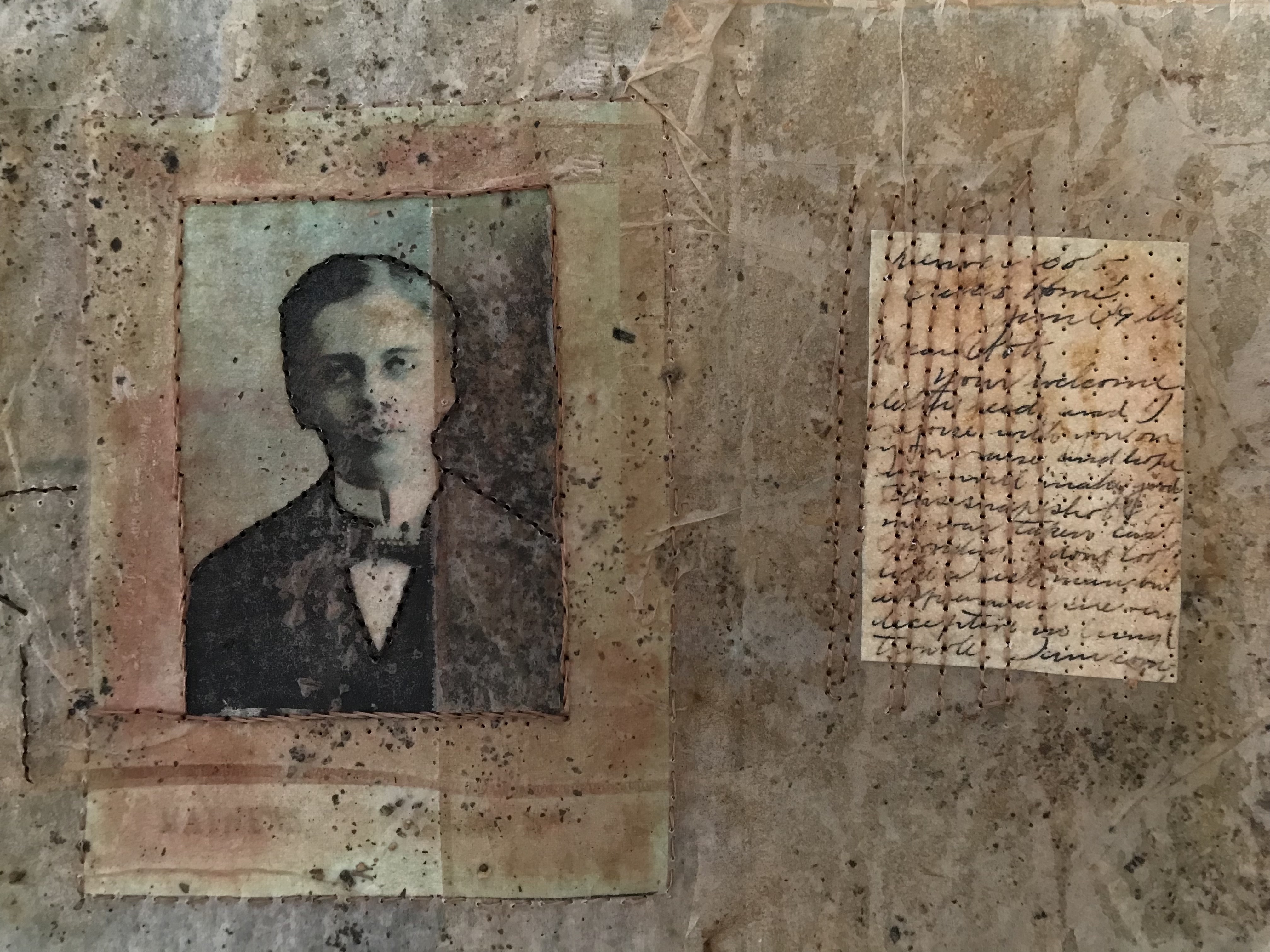
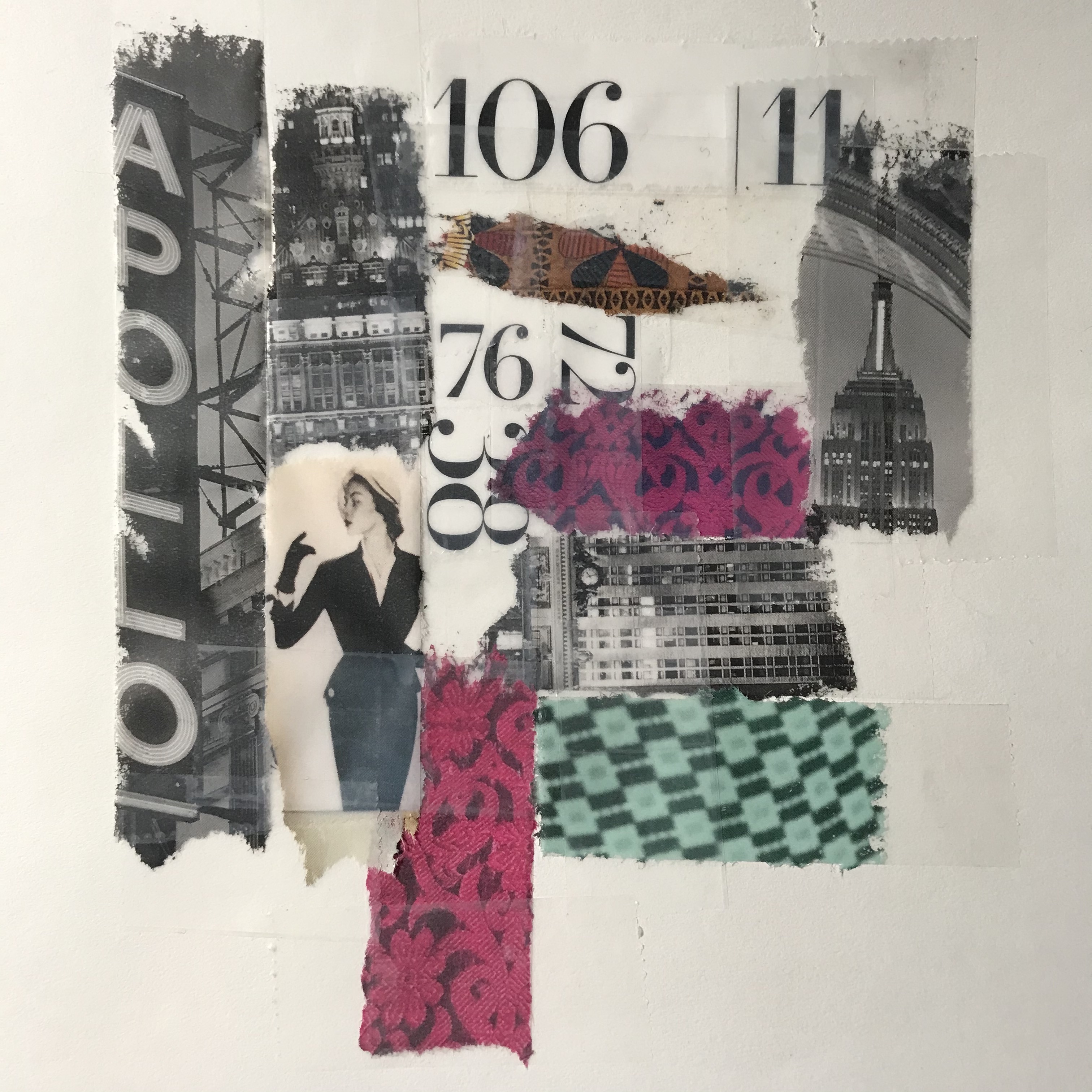
Lately I’ve been seduced by the practice of ‘slow stitching’. Letting time pass one slow stitch at a time. My Aunt Mimmie taught me how to embroider when I was young and slow stitching has nudged awake a joy I’d forgotten. I’ve also been working on a series of mixed media pieces called ‘Family Album’. This collage is from that series. The man on the left is my great uncle William Harrison Barber, known as ‘Henry’ to his friends and family. The text on the right is from the last postcard he sent to his brother Robert. From the moment I found his postcard in my mother’s collection of family ephemera I felt a connection  to this man. I can’t explain it. I just did.

Henry wrote the postcard in 1903 from the Oakes Home for the Consumptive in Denver, Colorado. He tells his brother, “I don’t look like a sick man but appearances are very deceptive with lung trouble.” His doctors tell him he is not improving and advise that he head to Saranac Lake in the Adirondacks. Henry knows that if his health doesn’t improve when he is in New York, he will never see Colorado again. He’s only twenty-three. And he never makes it to Saranac Lake.

His story has given me pause to reflect on what we do to survive and the connection between good health and creativity. 

Throughout the pandemic it’s been my adventures with basket making and needle felting and wet felting and eco-dying and collage that have brought me comfort. They’ve kept me sane and quite possibly alive.

William Harrison Barber was a musician. He left his studies in Boulder to pursue a career in music and found some success with his ditty ‘Dainty Flo from Idaho’. I’m sad that music didn’t save his life but I bet it brought him comfort. 

Can exploring your creative nature be a comfort to you?


Knowing What is Unknowable (and trying to sleep)

Insomnia is like the buzz of a fluorescent lightbulb about to burn out. It’s the annoying clack of your office mate’s pencil against their desk. The cackle of canned laughter coming through the floorboards from your downstairs neighbor’s television. Insomnia is silence broken by the gristled smack of someone chewing with their mouth open.

I’m irritatingly sensitive to sound. And I hate insomnia.

When sound breaks through the cocoon of quiet I need to have wrapped around me in order to work, it’s easily remedied by distraction. Moving to another room. Taking a break. Walking outside. Eating. 

They say that when insomnia steals what you hope will be a deep, restorative sleep the remedy is similar. Distract yourself from the fact that you are unable to sleep with a good book or a warm drink or anything that doesn’t involve too much mental energy or screens.

So when insomnia sat on the edge of the bed in our hotel room in Charlottesville last month and incessantly tapped its pointy little finger on the crown of my head I did what any intelligent human being wide awake for no reason at 3AM would do. None of the above.

Instead, I tossed. I turned. I yearned for sleep and each time my eyes closed and I thought ‘at last’ a new stream of consciousness would flood my brain. It was like a movie of my life that had been cut and pasted out of sequence and it made no sense. My thoughts bounced from the red dress I wore for my first grade school photo to lesson plans I wanted to write for my yoga classes. My brain played pin ball with whether or not the new refrigerator would fit in the kitchen to how we would move the family furniture languishing in a Pennsylvania storage locker. Did I really have to keep the cookie jar from my childhood? My grandfather’s turquoise Jim Beam bottle in the shape of a star created to celebrate my birth place become our 49th state? 

All the while, weaving its way through these warped concerns like a repeating weft with a broken shuttle was a singular truth. My insomnia was not about how to move furniture from one state to the other. It wasn’t about my red dress or cookie jars or Jim Beam bottles. It was about trying to find order in the unknown. Which seems to me to be an impossible quest.

Knowing that, however, left me reconsidering the question ‘are we making the right decision?’. I realize now there is no answer. The answer is unknowable. So I release fear and move forward with love and trust. And I sleep really, really well.


Creating Connections with an Old Bag of Tea

We power through cups of tea at our house. I’ve been saving the wrinkled and wet used tea bags in a bowl. Don’t judge me. I have my reasons.

Not quite finished. The dark flecks are tea. The red pigment comes from pounded rose and geranium petals.

In June I began a year long virtual course of study with India Flint. India is an artist who works with plants and found objects to create beautifully dyed paper and cloth. India’s course of study is why keen eyes might find me in the wee hours of the morning gathering handfuls of eucalyptus leaves from along the bike path that parallels El Camino Real and stuffing them into the pockets of my baggy cargo pants.

India Flint, and this course, is why I save used tea bags.

India’s teaching style is that of a storyteller. Rather than providing precise step-by-step directions – like the sort you’d find if an Ottolenghi cook book – she weaves a tale of her experiences with the plants she is using, the mistakes she’s made, the lessons she’s learned. She gives permission for us to take what we need, to leave the rest, and to be inspired by her life’s work.

I’m inspired.

Our first journey was through the making of a book. I didn’t have much of what was needed – proper paper, a sewing machine, a very sharp pair of scissors – but this course is filmed with such care and beauty it didn’t bother me that I wasn’t playing along. I was still learning.

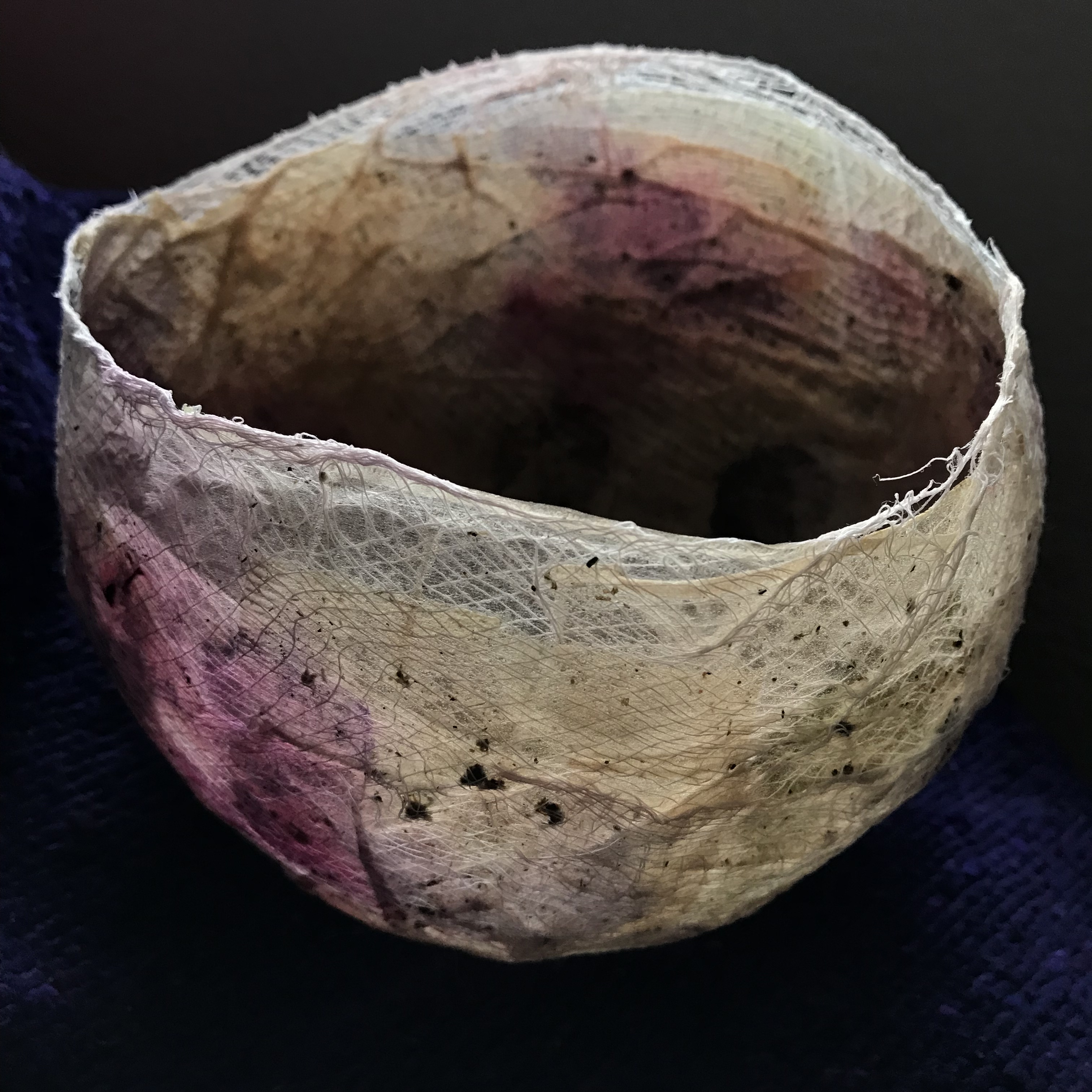
Which is how, this morning at 5 AM, I found myself carefully deconstructing a dozen or so tea bags, emptying their contents into a bowl and spreading the fragile paper out like one might smooth a bedsheet.

But there is more to this story:

Over the weekend my friend Diane – a talented and dedicated artist – gifted me Beth Pickens’ book Make Your Art No Matter What: Moving Beyond Creative Hurdles. This is a book that weighs much more than it should and its Times Roman font is a point size or two smaller than my eyes enjoy. The first chapter, however, is about time. Something I’ve been pondering lately.

And here’s a little more to the story:

I had lunch yesterday with a friend I’ve not seen since before the shut down. Carolyn and I laugh when we’re together. We laugh a lot. But yesterday, as we were talking about how the pandemic changed us, we thought of something that stopped us in mid-giggle. The shutdown gave us time. And now time feels more precious. Both Carolyn and I are discovering how different life is when we treat time as a gift and not a commodity to burn through. We’re learning to say ‘yes’ to what we love. Even if that means saying ‘no’ to something we love less.  

And that is how I found myself at 5 AM this morning gently opening the tea bags that had been drying for a day instead of reading emails and absorbing all that had happened in the world as I slept. India’s course is inspiring me to explore. Diane’s book is encouraging me to love my inner artist. My conversation with Carolyn is reminding me that time is precious.

Deconstructing tea bags is a slow, careful process. While I sat at my desk, my Ottlite breaking the pre-dawn grey, I fell into a sort of meditative reverie. I thought about the tea, how far it had traveled – the Ashwaghanda from India and the green from Japan – I thought about the farmers who grew and harvested the tea then bundled it off to factories to be processed. I thought about the work it takes to create the paper that holds the tea and about how I was moving the process of creation forward by turning the old tea into dye and the these fragile scraps of paper vessel into a new vessel.

It was a profound moment to experience that deep sense of connection. It felt new to me because it wasn’t cerebral. The connection came from my heart. 

I hope I can hold on to that feeling of connection.


Power Tools

While training with International Coach Academy, Power Tools were the bane of my existence. A coaching concept to help shift the perspective of clients, at the time a Power Tool felt too much like mental slight-of-hand, as if a few well-timed questions gave me the ability to trick my client into moving from doubt to trust, from trying to committing, or from reacting to responding. It all seemed too easy. Too magical. Akin to a magazine article proclaiming ‘Ten Days to a New You!’

But coaching isn’t magic (although it can feel that way sometimes). Change doesn’t happen overnight. And, as a coach, it’s not my job to shift a client’s perspective. The client can do that all on their own. My job is to remain present, to remain curious and to ask a few well-timed and on-point questions. When I do my job well a client can move from doubting themselves to trusting themselves, from trying to achieve a goal to committing to a goal, and from reacting to a situation to responding to a situation. 

My changing perspective began when I experienced first-hand how substituting one word for another had the potential to displace a less than desirable attitude for one that offered joy.

Such a simple thing. Changing one word. Simple, in fact, to the point of being embarrassing.

How many times do you find yourself saying a version of any of the following:

  • I need to get up
  • I need to go to work
  • I need to do the laundry
  • I need to email (fill in any name)
  • I need to cook dinner

What would happen if we changed those needs into wants? As in:

  • I want to get up
  • I want to go to work
  • I want to do the laundry
  • I want to email (fill in any name)
  • I want to cook dinner

I told you it was simple. But did you feel it? Did you notice a shift in how you felt about each one of those sentences? A shift from avoidance to engagement, procrastination to anticipation and drudgery toward achievement.

Words have power. They have the power to influence our perceptions and perspectives. Words are tools we use to find clarity and understanding. When we understand their power, we see our world through a different lens. 

Words are tools. 

They’re…wait for it…Power Tools.


What Makes Today Special?

What makes today so special? What makes any day special? Is it the blinding blue sky or grey torrents of rain? Maybe the four mourning doves who have found their way to my home, who have sat in my potted herb garden – have shat in it, too – and eaten my thyme. Maybe that’s what makes today special.

I’ll go for a walk later, toward end of day when the blue turns pearly and pink through the branches of the redwood trees. It’s the time of day that dogs are walked and children run in circles as if life were to be lived with reckless abandon. Sweaty and red faced they won’t notice the cool breeze blowing in from the Pacific while I tighten the drawstrings for the hood of my favorite sweatshirt.

If, while I’m on this walk, I look toward the Santa Cruz mountains, I’ll see pure white pillows of fog folding over the ridge and slipping down the slope to fill nooks and crannies. It’s my favorite thing. A beauteous thing. 

After I’m home and have had a bowl of soup I’ll step out onto the mirpesset to watch the full moon rise over the buildings of this town, its light reflecting back to me the stories of everyone who has ever looked up and dreamed. I’ll look for the planets, lined up like soldiers across the ecliptic plane. Not long ago Jupiter and Saturn were so close they almost kissed. And before that Mars, all bold and red, was as big as I’d ever seen. Before I go back in I’ll take a moment to marvel at the stars I can see and to wonder if anyone is marveling at me.