Age is Not a Number

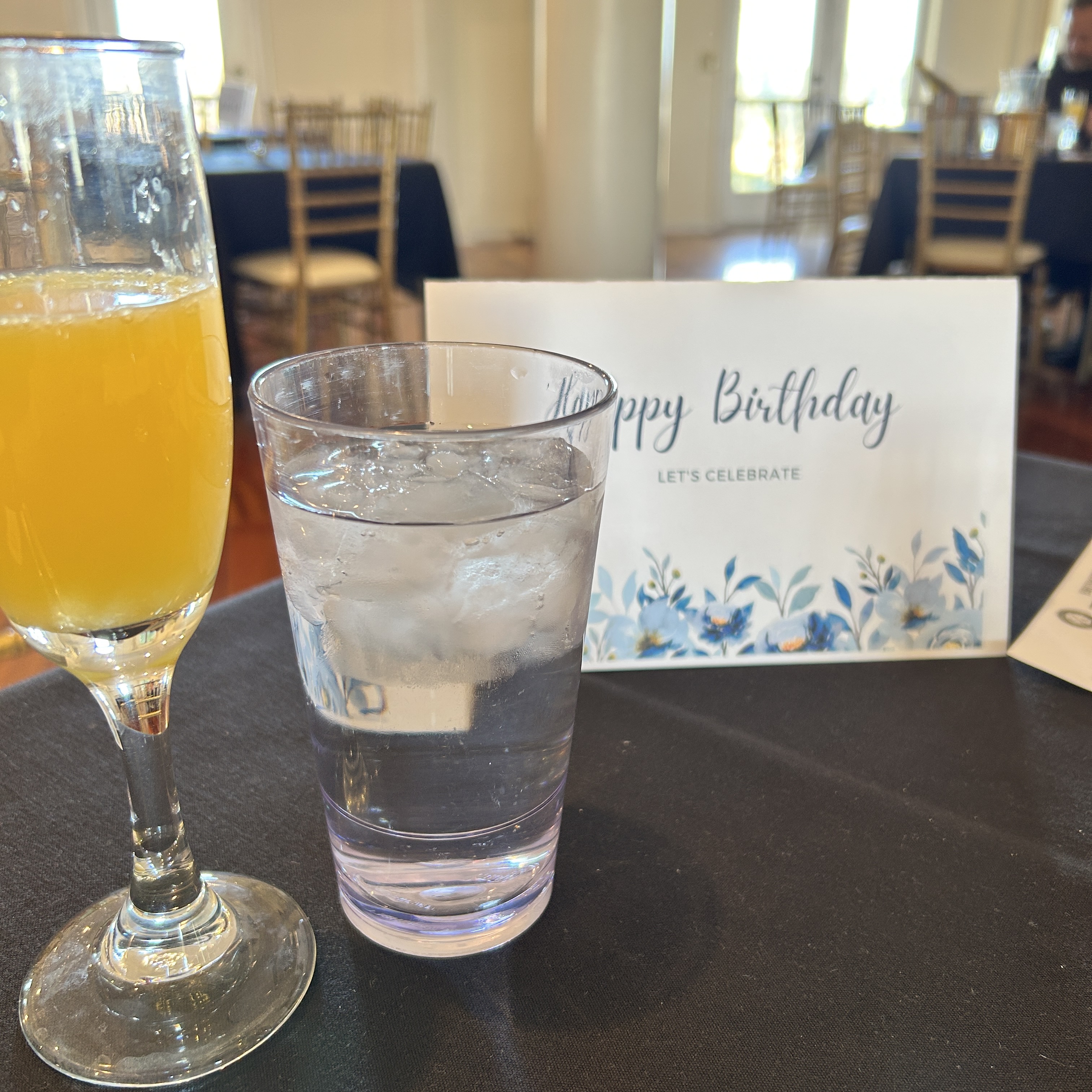
Today is my birthday. I’m sixty-seven years old. And I’m here to tell you that age is not a number.

Age – aging – happens and by believing that age is simply a number bypasses the truth that as the years roll on we change. For example, the hair on my legs is now growing out of my chin and the hair on my head is thinning. My first step in the morning is more like a first limp (yoga hip). My skin is wrinkling, my eyes have gone dry, and over the past year I’ve developed the same hammer toe my mother was blessed with.

So age is not ‘just a number’. I know people mean well. I know the phrase is meant to comfort. But the words also imply that I should ignore reality. The words imply that if I repeat them like a mantra my body at sixty-seven will perform like it did when I was twenty-seven.

I’d rather embrace all the circles I’ve made around the sun. I’d rather embrace all the changes. The not so great changes but the good changes, too. I’m sixty-seven years old today. I have greying hair and I’ve put on weight but I’ve also let go of the envy that consumed me forty years ago. I’ve become more appreciative of the small moments in life. I laugh more. I go to bed early so that I’m awake to see dawn. I want to remember to accept it all.

Acceptance isn’t curling up in a ball waiting for the end. Acceptance puts me on a path of exploration. What can I do now that I couldn’t do forty years ago? What attitudes have shifted? Moving forward, what steps will I put in place to ensure good mental and physical health? What will I do to commit to living a creative life of purpose – a life that has heart and meaning? 

This week I will reflect on these questions – I understand the answers will change over the years as I continue to grow and change. But where am I right now, in this moment? And how can I use the insights I gain by reflecting on these questions? How will these insights impact my art practice? My yoga practice?


What Do Gardening, Health & Art Have in Common? Kinds of Kindness.

There was a time when the level of happiness I felt in a day was determined by the number I saw on the scale upon weighing myself each and every morning. As I aged I saw the futility and ridiculousness of that ritual and stopped weighing myself. For many years I lived without a scale in the house. If I’m being truthful, however, to this day, on those rare occasions when I do check in on my weight the number I see still has the power to set my mood.

Something similar happens when I am in my studio. If the work is going well then I’m all smiles. If I’m struggling with the materials, or if I’m certain I’ve ruined a new piece I was enamored with just the day before, I question why I even bother. Then there’s the mental baggage that accompanies me when I’m headed to the studio. If by chance I open that baggage and spill it’s contents then navigating my studio and doing the work my heart wants me to do is made more difficult by the messy mental stumbling blocks I’ve placed in my way. Like my ever-present impostor syndrome, for example. Or the envy I sometimes feel for another artist – their gorgeous work, their incredible success. And when there is envy, shame for feeling envious is not far behind.  

As I write these thoughts I can look out the window and see that the team of gardeners we’ve hired have arrived. It will take some time to clear out decades of overgrowth, to repair a stone wall and to remove the non-native ivy climbing the trunks of our trees. But when the work is finished I will begin to prepare one small bed at the base of the largest tree for planting in spring. Which reminds me of something someone told me a few weeks ago. They told me that gardening is not a project, it’s a process. Indeed.

Two and a half decades ago I joined Weight Watchers and lost sixty unnecessary pounds. I lost the weight so quickly that I gained more than a few gallstones and a nasty case of disordered eating but we can save that story for another day. The mistake I made at the time was thinking of my weight loss journey as a project. And once those pounds were dropped the project was complete. Silly me.

Three years ago, when we moved to Virginia, I was determined to find the artist I abandoned when the need to have a steady income was more urgent than the need to create. Somehow the universe felt my determination and opened a few doors for me. She built a solid foundation for me when I was accepted into the Incubator Program at McGuffey Art Center in Charlottesville.

In 2023 I took on the year-long residency at McGuffey as a project. Show up. Do the work. Exhibit the work. Sell the work. Repeat. What was I thinking?

Gardening is not a project, it’s a process. Holding on to good health is not a project, it’s a process. Creating art that resonates is not a project, it’s a process. I guess it follows, then, that life is not a project. It’s a process. 

It’s a process that begins with kindness. Being kind to my home. Planting seeds. Nourishing the earth beneath my feet. Hard and rewarding work. Being kind to others. Admitting when I’ve made mistakes or when my words have hurt someone. Showing gratitude for deep friendships. Remembering anniversaries and birthdays.

But being kind to my breathing heart? Being kind to my creative heart? That can be challenging.

Manifesting kindness towards myself when I’ve spent seven decades judging and comparing myself to my wealthier friends, to the skinny models I see in magazines, to the artists that speak with eloquence and passion about their work is a struggle. Maybe it requires breaking the habits that keep my self-care and kindness at bay.

Maybe it begins with embracing the truth that the process – whether it’s planting a garden, celebrating good health or creating art  – doesn’t run in a straight line. It meanders and curls and doubles back on itself and then forges ahead. It moves around obstacles, plows through roadblocks, climbs metaphorical mountains and charges down steep hills like a child on a Schwinn Stingray Chopper, bugs in her teeth from smiling too much and bright colored vinyl ribbons dancing from the handlebars.

Each moment of the journey – the bumps, the stumbles, the thrills and delights – they all require different kinds of kindness. Sometimes I have to be forgiving. Sometimes I have to be honest. Sometimes I need to put my nose to the grindstone and sometimes I need to rest. Figuring that out is exasperating. And kinda fun.

Don’t forget…Practically Twisted is disappearing in a few months. If you appreciate my musings, join me at Mimm Patterson Art.


Nests & Vessels

Reminder: Practically Twisted is going to practically disappear soon.

If you’d like to continue to receive my sporadic meanderings please visit mimmpattersonart.com and sign up. Thanks!

It’s funny how one word can change everything. Until a few months ago I wore the label ‘mixed media artist’. But it never felt right. Did that mean I was a dabbler? Unable to settle? At best it was an easy way to not have to talk too much about specifics. At worse it made me feel at times like a dilettante. I’ve come to realize that, for me, ‘multidisciplinary’ is a much better fit. It’s a word that grounds me. It’s a word that denotes serious dedication to the work.

Being an artist is an evolving process. Re-framing how I identify as an artist is moving my process forward and bringing me closer to something I consider my authentic voice. 

My work has experienced a dramatic shift over the last two years.  Despite this I remain compelled to explore the energetic imprint we leave behind on the objects we touch and the moments we share with others. Through that exploration I am drawn toward themes of impermanence and fragility.

In 2024 these themes were represented by images very personal to me: my grandmother’s silk hankies, the vase left to me by a late friend. But over time the photo-encaustic work became too literal. At the start of 2025 I began adding encaustic paint and oil pastel over photographs to suggest what I call the ‘ash of memory’. These pieces engage the viewers curiosity as they study the image. They encourage the viewer to find the story I am trying to tell or to create one of their own. 

My latest body of work, however, moves away from story-telling. All art is personal, of course, but I’m tired of my stories. I feel drawn to create work that is less anchored to specific moments experienced and more tethered to feelings for which there are no words. 

I’m releasing my attachment to the artist I believed I should be. I’m learning to trust my intuition, to embrace happy accidents and to break rules.

We are living through unusual, precarious times and I believe my work has been transformed by this new world. The work is my coping mechanism.

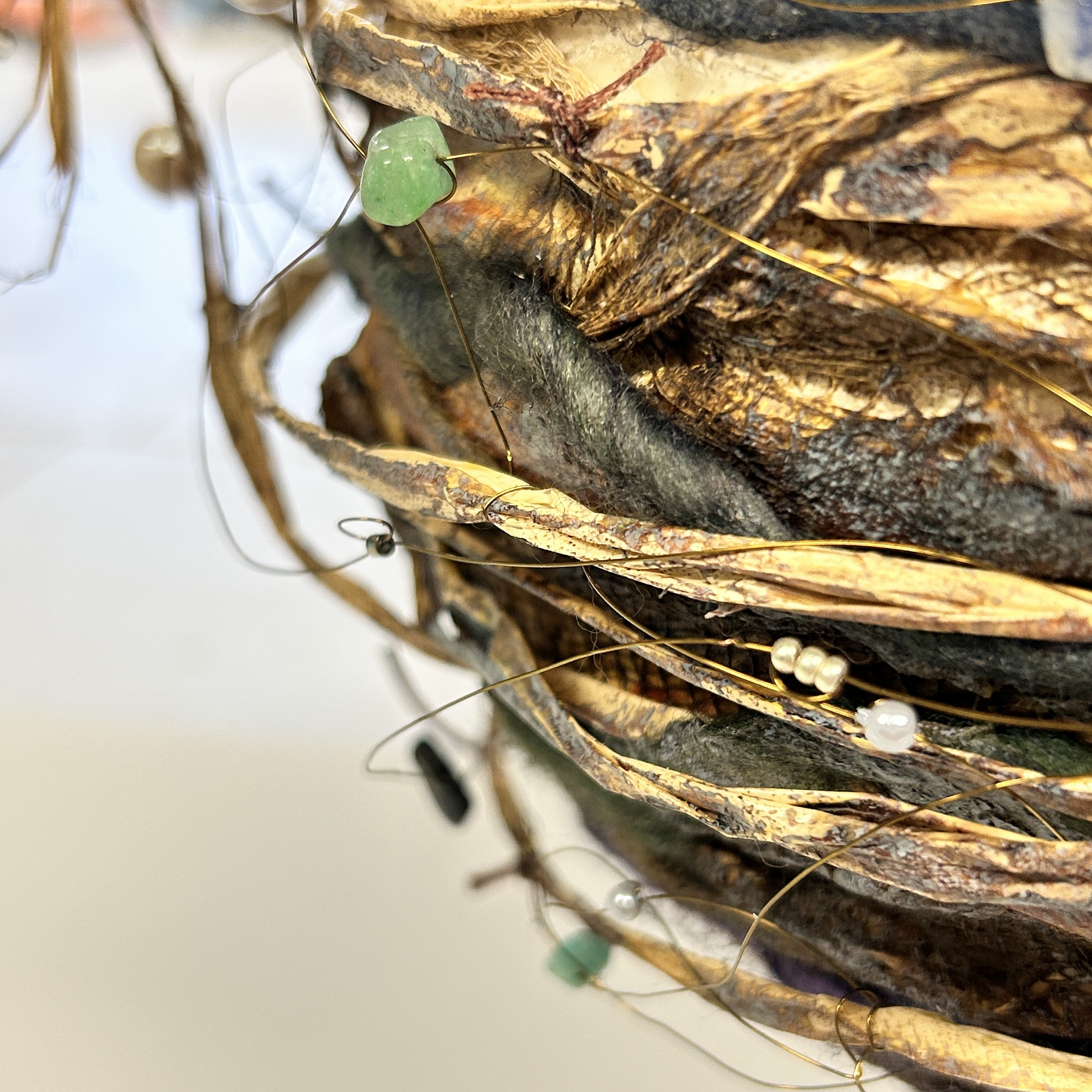
And so, for now, I’ll continue to build nests and vessels. Little containers to hold our hopes.


Art Imitates Yoga

For as long as I’ve been writing and posting – which must be at least twenty years – I’ve held the intention that I will post each week and each post will be a reflection on my experience as a yoga student and teacher. 

That has never come close to happening.

My last post was on September 9th, 2024, when I introduced the world to the incredible Tondu, the senior feline companion who moved in and filled the gap left by dear Brucie’s departure. After that post I found myself struggling to put together a few paragraphs describing the fear and anxiety so many of us are experiencing as our country moves toward a darker age. I finally abandoned all hope and hit the delete button.

Because I can’t write on command. Writing about a specific topic with a self-imposed deadline sucks any ability I possess to string two words together from my brain. I suspect that with discipline (if I showed up daily for myself and for my writing practice) the issue would right itself (pun intentional). But until I do that I’m going to have to be content with writing when the mood strikes.

Which makes me question whether, at the dawn of 2025, I want a writing practice as much as I wanted it in 2010. Fifteen years ago I wrote a full-length manuscript (90,000 words!) about a young woman eager to fly at the start of WWII. The story was inspired by a woman I knew who had been an WASP. In my story she falls in love with a neighbor boy who is Japanese and is sent to an internment camp. Forbidden love! Separation! War! Oh the Drama!

I was never happy with the ending. Do they reunite? Have they been changed so much by their experiences that love dies? Or is love the one true thing? Oh the Potential Heartbreak!

I was going through my own heartbreaking drama at the time and the joy I found living with these characters in my brain was lost. And so the finished manuscript sits in a dusty box, unedited. I always tell myself I’ll get back to it one day but that day has yet to arrive.

Practicing a visual art feels different. Maybe because, fifteen years older, I’ve learned to take myself less seriously. Or maybe I’ve learned to not make creating a competition. Showing up for my art practice is not a chore. It’s a joy. And although when I’m in the art studio I experience the same struggles and setbacks as I do when I write they are never enough to make me push it to the back burner. If anything I grow more determined to find a solution.

For the past two years I’ve been exploring encaustic photography. The process is this: I take a photograph with my camera. I edit the image on my laptop. I print the image on a sheet of tissue paper and then adhere the paper to cradled birch with encaustic medium, which is a combination of bees wax and damar resin. The tissue paper becomes transparent from the melted wax. I build on this with further layers of tissue paper on which images, texture and text have been printed.

Late last year I found the process becoming rote. I struggled with a few technical issues and when they were resolved I produced work like a robot on an assembly line. The process became a race to see how much I could create in a day. The idea of art as a practice was lost.

The truth is, since my intention is for my art practice to also be a business – in other words I want to exhibit and to sell the work I create – then my time in the studio should be both business and practice. But I was listing heavy toward ‘produce at all costs’. My art had lost its heart. 

So I put the camera, the wax and the tissue paper and I pulled out my scraps of fabric.

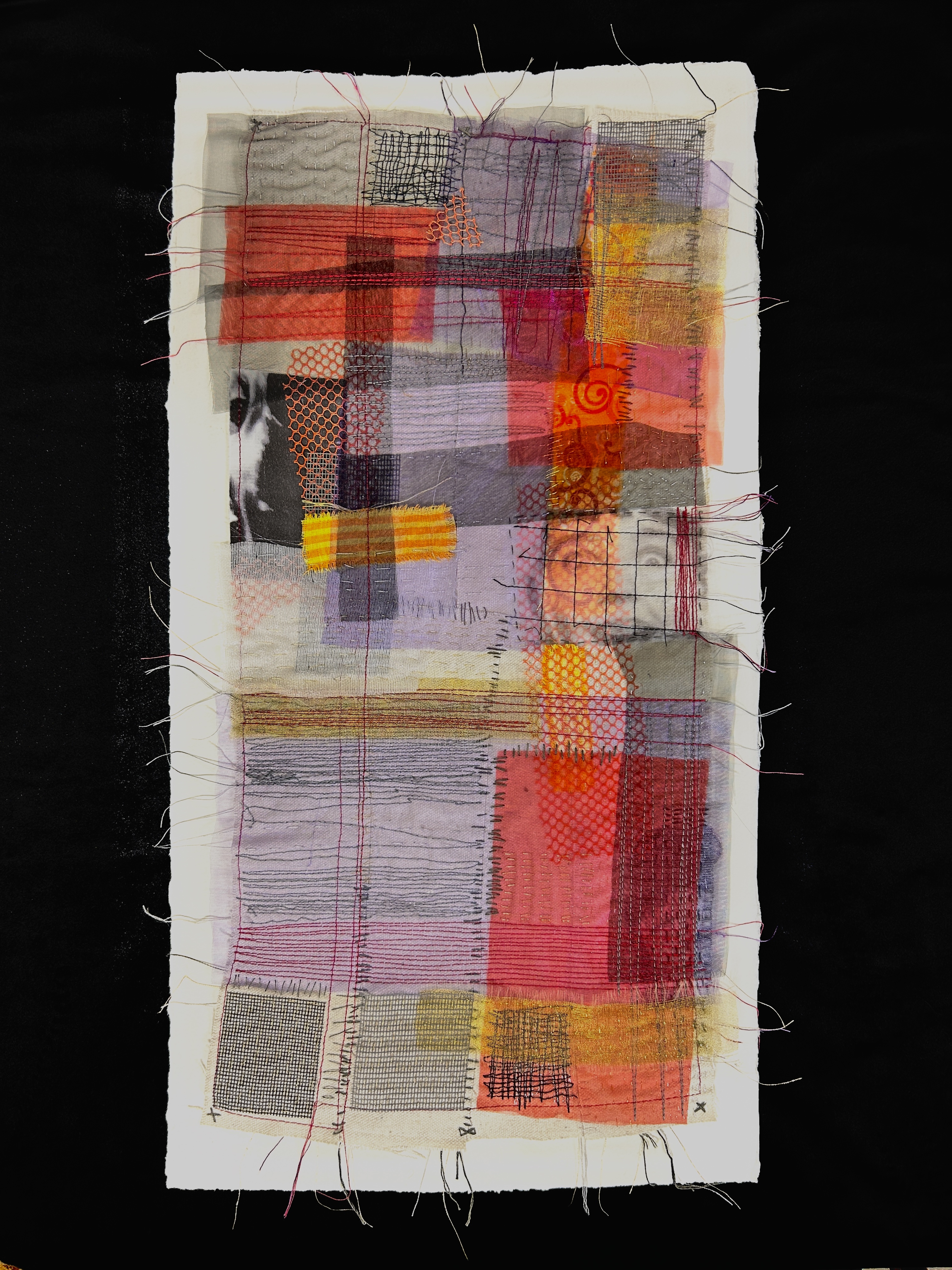
And yesterday, as I stitched layers of rust-stained cotton and dreamy organza together, I thought about yoga. I thought about the verbal cues I use with the women and men with whom I practice. I thought about how I ask them to move with care. To move with intention and to be thoughtful. I thought about how I ask them to meet their bodies where they are in that moment. How I ask them to be present with their bodies and with their breath.

Yoga is a practice. Writing is a practice. Art is a practice, too. And as I move forward in my art practice I’m going to apply all the cues I provide for others during our sessions on the yoga mat. I want the work I bring into the world to be intentional, not rote. I want the work to be thoughtful, not thoughtless. I want to remain present for the making of the work and not to be thinking about what comes next.

I believe this new awareness will serve me well. 


Felis catus: Our Cat Companions

After Bruce the Amazing left us last February I swept up the last of the kitty litter, gave away his food and moved the living room furniture to a new configuration so that Ben and I no longer looked for his furry orange form curled in his favorite chair when we came down the stairs. After a suitable period of sadness and reflection on the years we shared with our cranky, lovable Brucie we settled into life without him. While it’s true our home felt a little empty Ben and I were enjoying not being responsible for a creature lacking opposable thumbs.

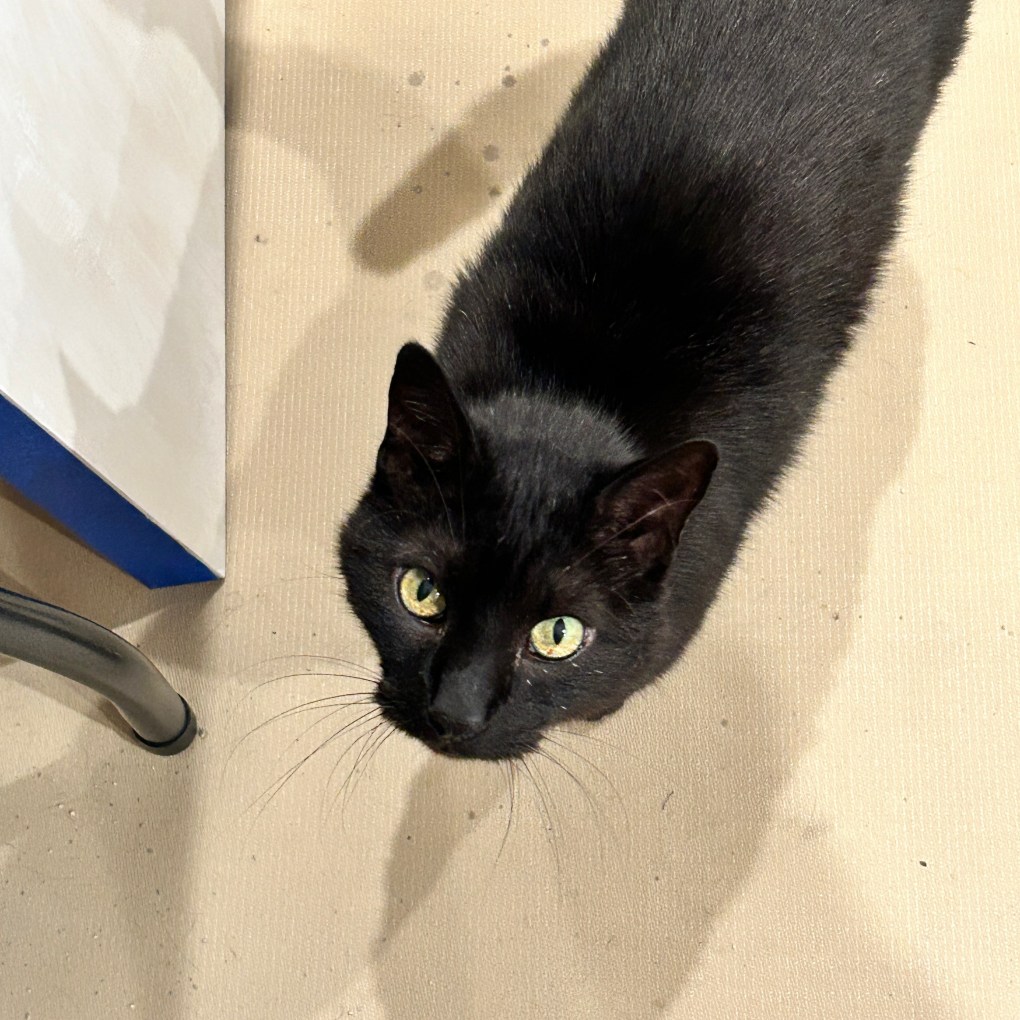
And then Tondu arrived.

The first time I saw Tondu, before I knew his name or that his purrs would soon be familiar, he was perched on the narrow edge outside of the railings around a patio two stories high at the back of the senior center where I teach yoga. Panther sleek, he was surveying his kingdom with fearless poise and confidence. I later learned he was the beloved feline companion of an older gentleman who was seriously ill.

Two weeks later Tondu moved in. 

He’s fourteen – the same age as Bruce when we first met him. Unlike Bruce, Tondu has a French passport. His human, before coming to Virginia two years ago, lived in France and bottle fed Tondu as a kitten after Tondu’s litter mates and mother died. Tondu and his human were inseparable. 

I didn’t meet Tondu until the day I brought him home and this so easily could have been a disastrous decision. But it’s been a wonderful decision for both Ben and I. And for Tondu, too.

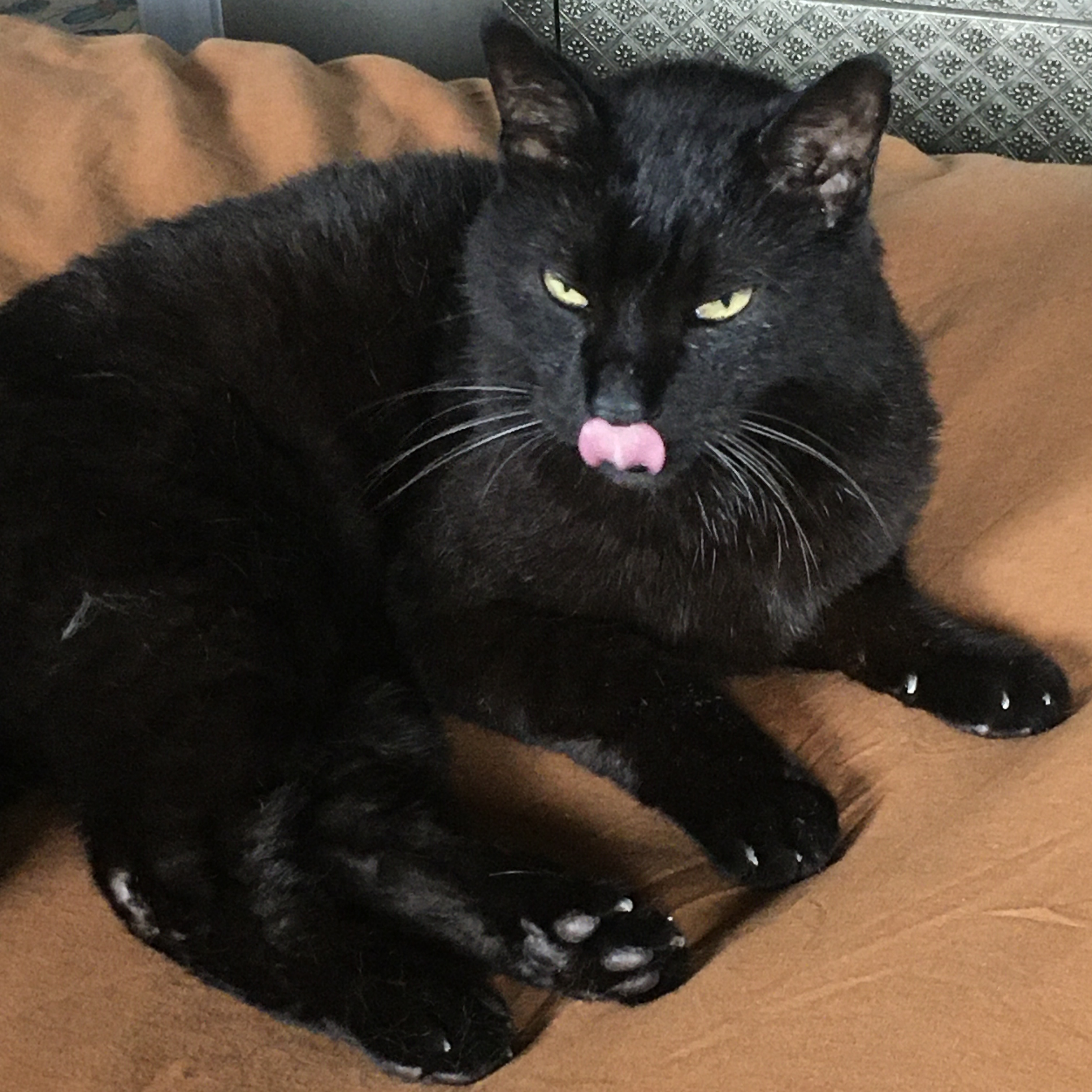
Tondu’s personality is very different from our darling Brucie’s. Bruce loved being brushed. Tondu can’t tolerate it. Bruce loved eating the house plants and so they all had to be placed out of reach. Tondu could care less about the greenery around the house and on the porch. Bruce was not interested in jumping on tables and counters. Tondu has a four foot vertical leap. Bruce rolled his eyes at toys but loved his cat tree. Tondu ignores his cat tree but loves the little toy that arrived with it. Every evening he and I race up and down the stairs while he chases a grey little puff with a white string attached. I think it reminds him of his days as a mouser in France, when he was an indoor/outdoor kitty.

I know adopting seniors (cats, dogs or humans) comes with risks. I know we’ll be lucky to have him in our lives for as long as we had Bruce. I know that there will be health issues and decline and loss. Such is life. But Tondu has settled in and I am wrapped around his paw.


Small Change

‘Swampy’. That’s the word a friend used to describe my palette. She wasn’t wrong and I wasn’t offended. I couldn’t be offended because as a stained glass artist her whole world is about clarity and color. Besides, she was right. My last body of work leaned toward variations of sepia with a smidge of mud thrown in for good measure. But still. Swampy? A gauntlet was thrown and I accepted the challenge, purchased a few blocks of pigmented encaustic wax and as I watched them soften into puddles of bright, primary colors asked myself, ‘what the heck am I supposed to do with this?

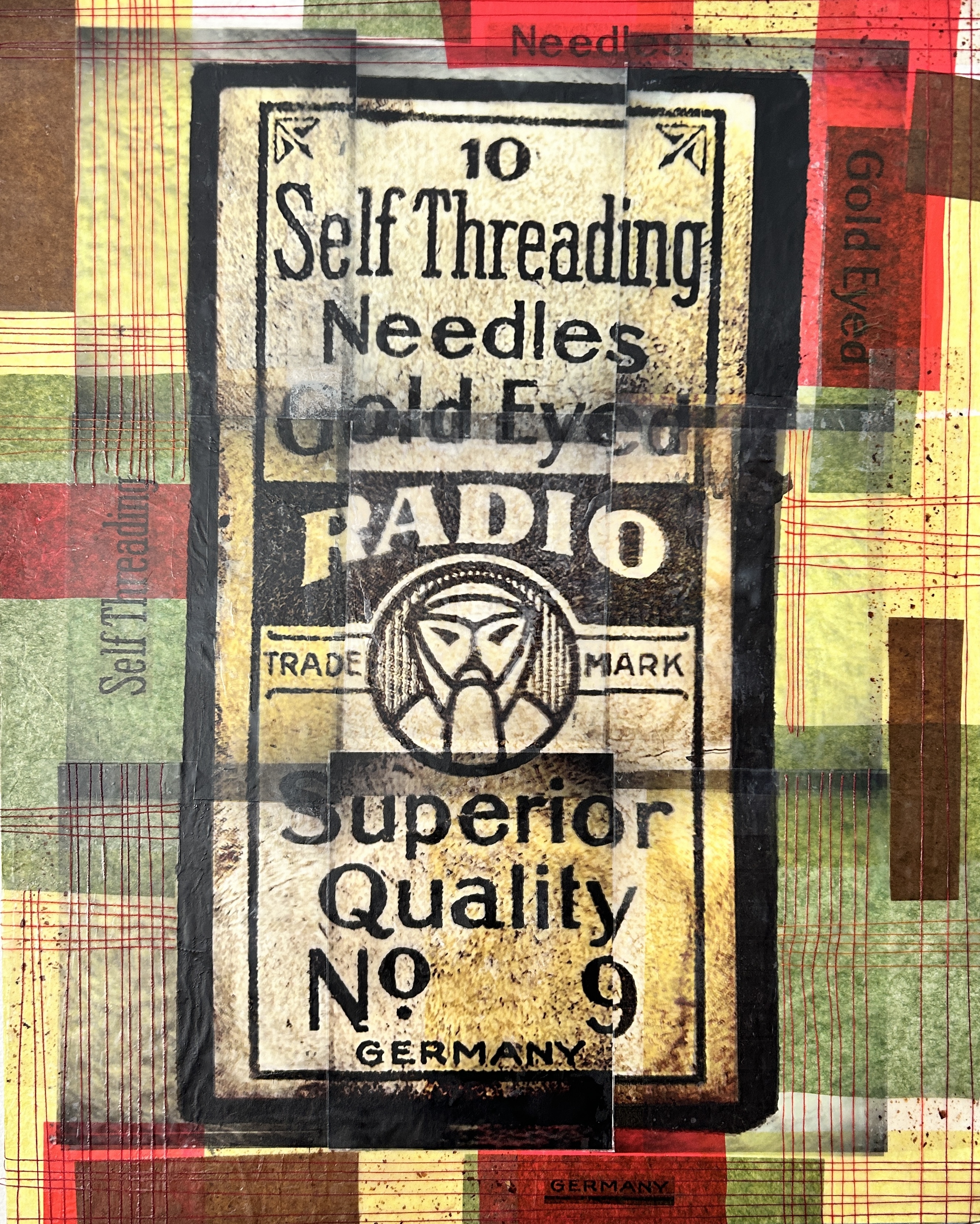
‘Superior Quality’ 16×20 inch encaustic collage

I’m learning as I go. It’s not easy. I’m not a painter, and the pigments want me to paint. And so I regress back to what I know I can control. I choose papers similar in chroma to the melted pigments. The result feels garish and unsophisticated. I long for my swampy neutrals! I might be learning as I go but it’s a very steep curve. But I guess, on reflection, it’s also a metaphor for life. Every day we’re alive is another day of ‘learning as we go’. Somehow I find that comforting.

Nevertheless it has been a bumpy few weeks as I consider the work I need for my show in October. I know I’m over-thinking. Trying too hard. I need to relax. To stop striving. To have fun and to learn how to play again. Creating isn’t about me hoping the next piece of art is better than the last. It’s about me being in the moment. It’s about problem solving. There’s no doubt creating is hard work but when we step out of our own way it is joyful hard work. Creating requires proper technique – or in my case, a close proximity to proper technique. But it also requires a fearlessness that allows us to trust our intuition. Creating asks for us to believe that the story we are trying to tell is worth telling. That the changes we are trying to manifest are positive.

Every moment of our too short ‘learn as you go’ life is an act of creation. Every choice is a catalyst that sets in motion the conditions for change and the opportunity to create something new. 

What choices will you make today? What will you create?

As I wrote those words I realized that the body of work I’m attempting to create will hang in an October exhibit that ends days before the next chapter of this beautiful and flawed country begins. So the choices I make today are not focused on art alone. As we race toward November I want to make choices that build my reserves of strength and resilience so that the overheating chemical soup that is my brain’s mosh pit doesn’t boil over. I want to make choices that keep me steady. Grounded. Even-tempered. And if those choices support the creation of art – great. But that’s not my priority. My priority is figuring out how my choices can become a catalyst for change. I’ll settle for small change. Because collectively, our small change will add up. 

To that end, I’m going to choose to remain informed by reliable sources so that I have facts to back up my beliefs. I’m going to choose to support Vote Forward, either by writing letters or contributing funds to help cover postage. I’m going to choose to listen to others speak without interrupting – even those who may have beliefs that differ from my own.

We are living through a period of time where others are pushing us to become untethered from our truth. Treating us like frogs in a pot of slowly heating water, the voices that have hijacked one of our country’s political parties want to see us lose our ability to separate fact from fiction. They want to see us blind with anger. This is a time to remain calm and to live by the courage of our convictions. 

So again I ask, what choices will you make today? What will you create? What act or conversation will be a catalyst for change? And I’ll remind us all: small change matters.


Panic at the Studio: How I’m Learning to Show Up for Myself

I can’t say this is true for all artists, but it’s true for this artist. After a show is hung, after the studio is swept and organized, after the opening is over –  my mind goes blank. I’m certain I’ll never create again.

At the end of May there was no doubt my encaustic days were over. I was done. I brought a table loom into the studio and pulled out a few kumihimo wheels from storage in the garage believing I had spent my limited creative battery life. I felt drained.

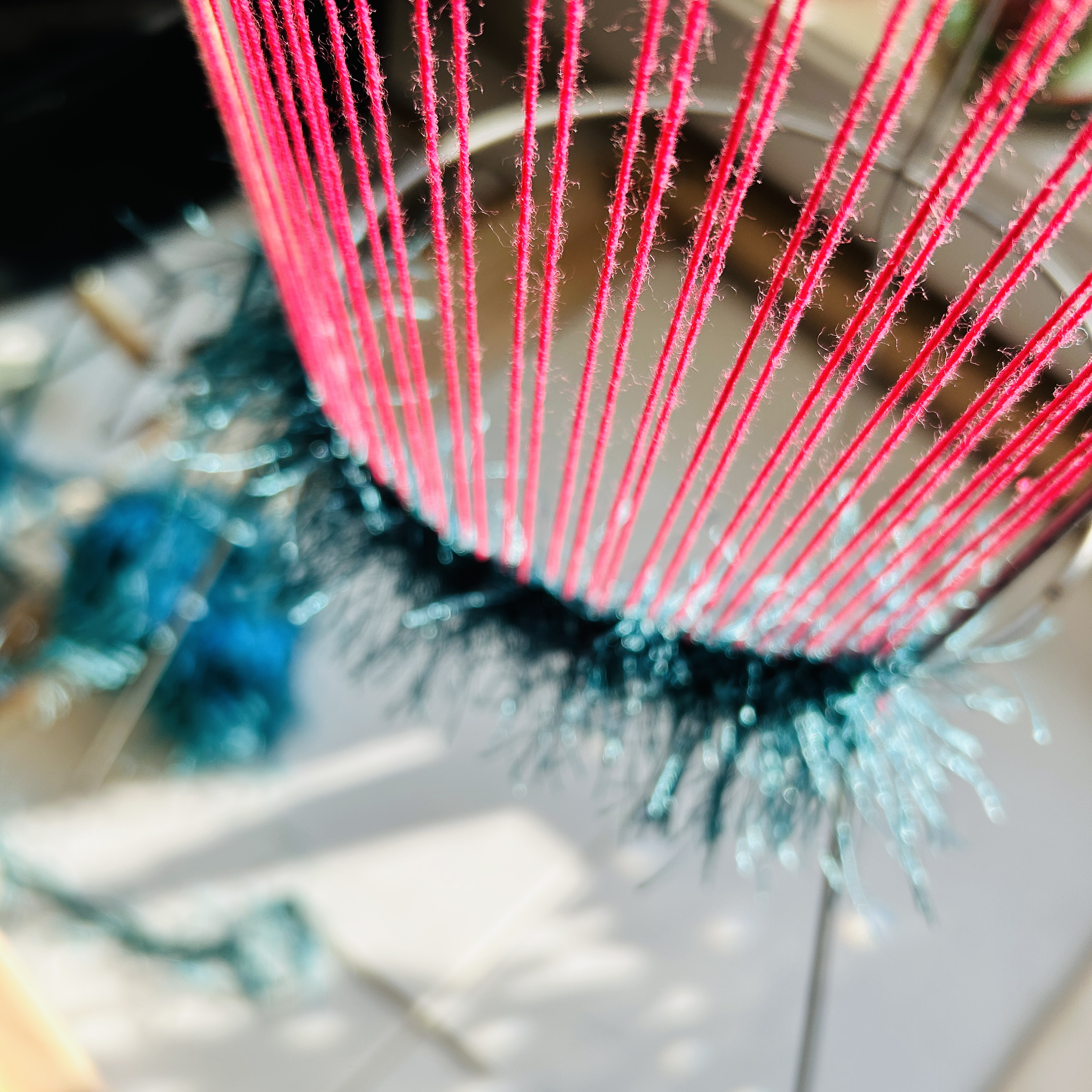
Playing with weaving on a tomato cage

And then the panic began. I realized that October is not too far away and in October I will be hanging a solo show. 

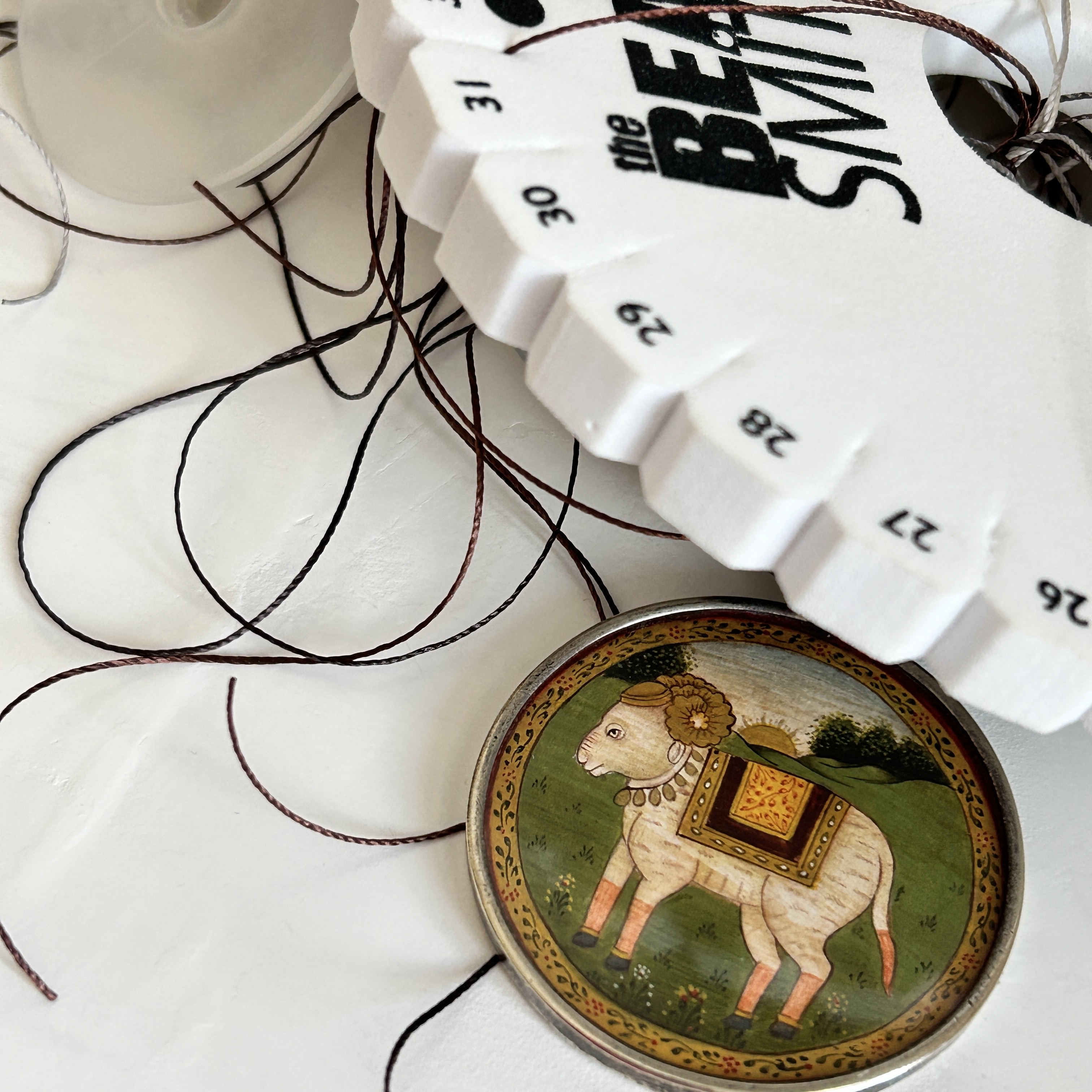
Panic, of course, was getting me nowhere. To distract myself from the rising tide of fear that my life was a total waste and that I was incapable of ever having a good idea again, I settled into weaving on the table loom. Which also got me nowhere. So I settled into creating kumihimo braids for the charms that came back with me from our trip to India a few years ago. At least that was something productive. December, after all, will be here not long after October and I need product for the holiday craft shows.

And that’s where I found my calm.

The meditative nature of kumihimo and the rhythmic click of the bobbins as the wheel turns in my hands brought me to a place where I could begin to think about melting wax again. And that’s how I realized there’s something brewing inside me. Another story asking to be told.

Wheeling away with my kuihimo wheel

Of course, Austin Kleon would point to Tom Waits and Nick Cave, songwriters who believe the music is not within them and struggling to get out. Instead, they prefer to  believe the words and music already exist and are floating in the ether waiting to be found. Which is not unlike Michelangelo’s assumption that the sculpture he was searching for was already in the marble. It was his job to chisel away the superfluous material. Or like the art teacher I knew, who asked his students to consider that the drawing was already in the pencil they held in their hands. 

If I’m willing to open myself to those sweet possibilities then my time at the table loom and with the kumihimo wheel was time that I needed to settle. Time I needed to become receptive. To tune in. To reflect on how I want to show up for the work, for the muse, and for myself. 

The supplies I need to build my new body of work will arrive on Tuesday. I’m itching to get back to what I love to do and I need to do. I’m excited by what I might learn this time around. 

We are acts of creation and born to create. It doesn’t matter if you’re dragging a loaded paintbrush across a blank canvas, typing on a keyboard, pouring ingredients into a mixing bowl or writing formulae on a whiteboard. We are acts of creation born to create. 

As we step into a new week – what will you do to be more receptive to that possibility? How will you show up for yourself these next seven days?


Guided Autobiography & Earworms

What did you do during the pandemic? Some folks adopted dogs. Some binge-watched their favorite shows on Netflix. My beloved Ben decided to study the Polish language. I wasn’t quite that ambitious. I completed my Guided Autobiography training and became a GAB facilitator. Since then I’ve offered online workshops based on the GAB principles envisioned by Guided Autobiography creator James Birren. GAB workshops are not writing classes. There is no critique, no correction. The workshops are a place where we can tell our story and find connection. I provide a theme and a series of questions that dust off our memories and help us to tap into our truth. On the new GAB website they quote the late, great Brian Doyle:

“Stories change lives; stories save lives...They crack open hearts, they open minds.”

If you are curious about my workshops and would like to learn more please reach out. I’d love to tell you more about this beautiful process. In the meantime, here’s the essay I wrote for this week’s workshop:

Earworms and the Soundtrack to My Life

I am constantly reminding us to find one little moment to write about. I encourage us to avoid the helicopter view and instead reflect on a single day, a small incident, a remembered conversation and to focus our story on those moments. That’s where we might find the learning. And when we do that the writing can be more personal. Intimate and insightful.

Yeah. So I did not do that. What I wrote in response to our prompt ‘hope’ is more of a prologue to the memoir I will never write. Plus, it is filled with adverbs. And you know how I feel about adverbs. Nevertheless, here’s my story:

I’ve been pondering the word ‘hope’. What is ‘hope’? What does it mean ‘to hope’?  Despite the deep contemplation, those four letters have failed to trigger a reaction. It’s as if the word has been bandied about so often that it’s lost its potency, like an open bottle of champagne gone flat or an elastic waistband that has outlived its stretch and recoil. 

Do you remember the song ‘High Hopes’? Exactly what did make that little ant move a rubber tree plant? I mean, anyone knows an ant can’t, and where was she trying to move it to anyway? But according to the song it was her irrepressible high hopes that made moving that rubber tree plant possible. And sure enough, that little ant’s success was a reminder that hope and hard work can make anything possible. Boy-oh-boy did my fifteen-year-old Pollyanna-tainted heart just love hearing that message. I knew with absolute certainty that if I believed in myself enough, if I worked hard enough, if I was nice enough, if I was pretty enough, if I hoped enough then anything was possible. No matter my circumstances or the obstacles placed in my path the life I envisioned was mine just for the hoping.

I was in my mid-thirties when I realized the error of my youthful ways. As it happened hope was nothing more than magical thinking because life had a way of diminishing our Disney-fied technicolor dreams.

No matter. 

I was in my forties and living in Donegal, Ireland about half way through my eleven-year odyssey. A stow-a-way escaping her chaotic Bay Area life. But life wasn’t going as planned. The details are silly and inconsequential. In order to survive the hurdles I faced, I set aside hope and instead channeled resilience. It wasn’t easy and I had to land on rock bottom with a decisive thud but then a new song hummed its way into my heart. Somehow I found a way to pick myself up, dust myself off and start all over again. Which I did. Again. And again. And again.

And we all know my story. I found my way out of Ireland. Back to California for twenty restless years. Wait. Can that be true? Twenty years? Has it been that long?

No matter.

I came back to California like a newborn. Once again I found myself full of hope. Ready to not only survive but to thrive. But magical thinking took me nowhere. Even when I channeled my inner ram and tried to bust holes in a billion kilowatt dam. I never did break through. I just got myself covered in dust. Which, of course, I happily brushed off so that I could start all over again. I suppose if you were on the outside looking in on my life you might think I was doing well. And don’t think for a moment that I’m not grateful for all the opportunities that sometimes fell into my lap and that sometimes I fought tooth and nail for. Some of those opportunities paved the way for what happened next. So, you might be wondering, what happened next?

Love. Love happened. Somehow, when I finally knew that love would never happen, he found me. The moment I looked in his eyes I muttered to myself, ‘dammit’, because I knew that the life I’d grown accustomed to – a life that left me never feeling quite like the woman I wanted to be – a life that felt perversely comfortable – was going to change.

And life did change. 

Ben’s and my move to Virginia changed our lives. Changed my life. I’ve come around to the idea of hope again, but it feels different this time. It feels…hmmm…the only word that comes up for me to describe the hope I feel is expansive. I’ve even embraced my inner Pollyanna (except, of course, when watching our country’s perilous descent into autocracy and fascism…but we can leave that story for another time). Hope and resilience are companions that keep me thinking less about the future and more about the present moment. Somehow they’ve slowed me down. I enjoy watching dawn break. I watch flowers grow. I even find myself saying ‘hello’ to the occasional lamppost. 

Because life? I love you. All is groovy.


On Seeing the Infinite

Moving northwest at midnight, seven strangers and two friends in a rented van. Driving into a pitch black wilderness with the southern cross as guide, we are bound together by faith that some force beyond our knowing will take us to the place where a tribe has gathered.

We find them on a hillside. There are hours still to wait. 

It begins at dawn. The orange sun rises behind the Queensland Hills. And then it slips behind the moon. It seems so simple to write these words: the sun slips behind the moon.

But in that moment – that singular moment – spirit is made visible. The universe becomes a sanctuary of peace.

No one can speak. The rhythmic click of shutters that sound like mechanical crickets continues to record the celestial sorcery but in my ecstasy they no longer register. As the world falls dark birds call to one another, confused. Sandy termite mounds turn red in the changing light. The air falls on my skin cool and moist.

We cry. Or at least some of us cry. We open our hearts to the truth of the cosmic order and our own insignificance. Or at least a few of us do.

And then the sun slips out from behind the moon and we take our first new breath. I expect my life to be different now. I expect my life to be different now that I’ve witnessed the infinite. That perfect black hole in the sky. Except I know it won’t be. This was an illusion. It’s only the moon. It’s been the moon all along.


Surviving the Apocalypse

There’s a hiking trail in the Stanford Hills called The Dish. It’s named for the 150-foot-diameter radio telescope that has been planted there since the 1960’s. When I lived on California Avenue in Palo Alto – not far from the Stanford campus – I had a fair view of those hills and that telescope.

In winter the Stanford Hills are brown. Not an ugly brown, mind you. More a mix of yellow ochre with burnt sienna shadows, while the bare brush and bark of trees draws random but perfect streaks of Payne’s grey across the topography. 

It doesn’t matter how pretty the Stanford Hills are. If you know those hills you also know that months of sodden brown can cause us to take those gorgeous winter hills for granted. We stop looking at their beauty. And it’s right about then that a miracle happens.

The Stanford Hills turn green.

On the morning of the first warm day of the first warm week of spring, you  awaken to a hint of the joy to come. The scent of something rising up from the earth. By lunchtime there are scant traces of green. It happens so fast that if you don’t stay present you’ll miss the transformation. An hour or two from dusk the low angle of the bright sun turns what were brown bumps just the day before into glimmering emerald waves.

To be honest, I don’t remember if the hills turn green in only a day but I can promise you it feels that way.

And anyone who has been witness to the transformation knows, of course, that in a matter of weeks great, green waves of grass will transform again to parched summer straw. But isn’t that all the more reason to celebrate those few short days when the Stanford Hills look like shimmering emeralds?

The last quarter of 2023 was an amazing highpoint for me –  a visit to California and a reunion with friends and students I’d not seen since Ben’s and my move from the Bay Area. 

But the last quarter of the 2023 was a low point for me, too. A decade long friendship was fractured, and then I experienced an unbelievably weird accident that left me questioning everything about my health and wellness as I turned sixty-five and navigated weeks of sciatica and plantar fasciitis.

As I wallowed in self-pity hundreds of young people were gunned down and brutalized at a music festival half-a-world away. Grandparents were slaughtered, arms of young men were blown off and on a bomb-scarred strip of land terrified and innocent people are – over one hundred days later – trying to survive and hoping to one day find their way home. 

And this morning, just east of the snow covered mountains that surround the Shenandoah Valley, I sit in my warm home. I drink fresh brewed coffee, its edges softened and sweetened by glugs of vanilla oat creamer. I watch the flurries drift and absentmindedly stroke the ears of Bruce the Cat. All the while anxiety stokes my fears. 

How will we get through what is to come? 

We have ten months of existential angst to survive before we learn if it’s the end of our nightmare or the beginning of a new one. 

I know that I am not the only person whose mental health has taken a direct hit over the past few months. For a time I wasn’t sure how I would find my way out of my ever darkening and deepening malaise.

But somehow, over the last two weeks, something within has shifted. Just like those Stanford Hills, my mental state has moved from grumbling brown to hopeful green. I know it’s a continuum, and that this change is not permanent, so I’m going to lean into this goodness I feel.

Because the Middle East is still on a short fuse and our former president continues to spew dangerous rhetoric. 

So to support the positive uptick in my mood, I’m using the tools I have that help me stay anchored to the present instead of spinning into the dystopian nightmare I sometimes imagine we’re heading towards.

In no particular order, here are those tools:

  1. Routine – I do my best to keep a regular schedule. This means I rise at the same time each day and fall into bed at the same time. It means I do my best to plan ahead so that navigating life feels easier somehow. And, when I know I don’t have the energetic strength to take on a new task or activity, I say ‘no’.
  2. Humor – I will watch any SNL skit where Jimmy Fallon breaks character. The ‘cowbell sketch’ has always been a favorite. But recently I’ve fallen in love with Gary Gulman’s comedy. Especially his bit about the committee that decides how the full names of our fifty states should be abbreviated to two letters. 
  3. Social engagement – I’m not a party type of gal but there’s something to be said for having at least one person outside of your immediate family with whom you can share how you’re feeling. I’m lucky to have that person and sharing with her helps me to shape a healthier perspective.
  4. Nature – I need to move to feel good and for me this means a walk in nature. On my trail walks it’s not unusual to see a few deer, a raptor or two, or scarlet cardinals flitting from bush to tree. Plus it’s really fun to run into neighbors walking their dogs. Especially the corgis. Nothing will put a smile on my face faster than a waddling corgi butt.
  5. Nutrition – When I feel myself sliding into malaise it takes no convincing at all for me to reach for that second glass of wine, or – and in excess, of course – those foods that bring comfort to me: a non-stop conveyor belt of fat, sugar and carbohydrates. But when our mental health is suffering, good nutrition will provide the energy we need to regain our strength. 

But everyone’s tool box looks different. When you find yourself sliding towards despair, what do you reach for as a lifeline?

Because I think we’re in for a bumpy ride this year. I could be wrong. Still, I’m going to prepare for the worse even as I hope for the best. I have my tools and I have my memory of the Stanford Hills turning green in the blink of an eye to remind me that if I don’t stay present I will miss opportunities to find joy.  And I have the feeling that this year we are going to have to embrace all the moments of joy we can find.