Touching Life: Notes from the New Homestead

On Saturday our red CRV was filled with flattened cardboard boxes, bubble wrap, assorted other papers and questionable plastics. After an eighteen mile drive we had arrived at the McIntire Recycling Center, where Ben and I met a man named John.

John knew everything about recycling and was eager to show us what from our bounty of trash we could distribute among his many large green crushing machines and what would be coming home with us, destined for landfill. He taught us, for example, about what plastics are useful to the composite deck making industry: ‘if it stretches and doesn’t stick to itself they can use it..’. So our bubble wrap and bread bags were a ‘go’ but the mountains of cling film the movers wrapped our furniture in were, unfortunately, a ‘no’

This was a very hands on, prepare to do the hard work, old school recycling experience that forced Ben and I to consider how much we consume and to reflect on the environmental cost of our move across the country. It was hot and sticky work that was eye opening and, with all that we learned, sorta fun in that ‘I can’t wait to get home to take a shower’ sorta way. 

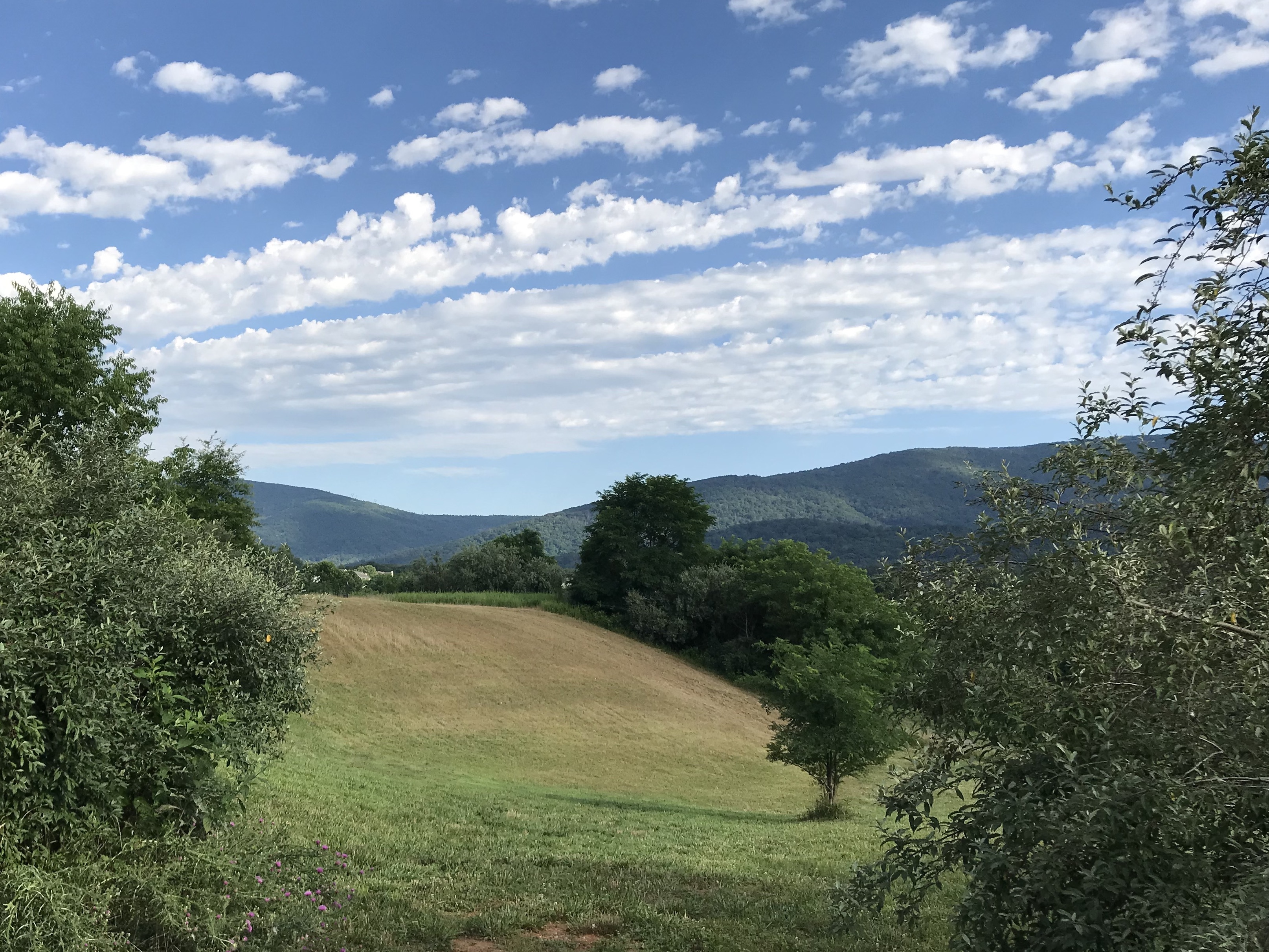
Home for Ben, Bruce the Cat and me is now a pre-planned suburbia, the end townhome in a short row of townhomes that wiggle uphill like caterpillars enjoying a juicy nasturtium leaf toward our ever blooming ‘town center’. And if you’re old enough to remember ‘little boxes made of ticky tacky’ then you get the idea. But we love where we are. We are surrounded by mountains and wooded trails. The view from our kitchen deck looks toward a thick forest that is bound on one side by bright single family homes and a crisp white cement walkway. The difference between the two conditions – one put in order by man and the other by nature – is a constant reminder of our impact on the earth. And somehow it is teaching Ben and I to be better caretakers.

A few evenings ago, just before dusk, I was looking out from my kitchen toward the shadowed woods and saw a slim, young deer enjoying a meal of wild weeds and flowers as she made her way down the grassy verge between the sidewalk and the forest. I called Ben over and as we watched we saw the deer’s fawn – not more than a few days old, all spots and gangly legs – run to catch up to its mother. We watched as they made their way around the pond to disappear back into the thick brush. Another reminder that Ben and I are temporary stake holders. Interlopers.

When we first arrived at our new home we noticed that we had some tenants already living in a vent on the back patio. Two Eastern bluebirds had built a nest and were nurturing their newly hatched brood. A few days after our furniture arrived the bluebirds lost one of their young when it fell from the nest. The next day they lost another. But the parents continued to fly back and forth, feeding what children remained a constant stream of grubs and grasshoppers.

Until Saturday. 

I found Bruce the Cat staring through the glass door in a state of high excitement and agitation. I was happy that Bruce had something to entertain him until I realized what was happening. On the patio was a disaster of Hitchcockian proportions. Two dozen sparrows perched on our railing, harassing the bluebirds. Their last two fledglings had been pulled from the nest and were now writhing on the patio floor. At this point they had feathers but I don’t think they knew how to fly. Their suffering and distress was horrifying. In a panic, one fledgling ran and fell off the patio and down a full story to the earth below. The parents continue to fight off the attacking sparrows to protect their last remaining baby while the sparrow spectators watched in what I imagined was bloodthirsty glee.

When it became obvious that there was nothing more to see the sparrows disappeared. But the parents were still in distress and the young bird was still suffering. Ben and I did not know what to do. Put it out of its misery? Wait for the inevitable? What we decided to do was to cut a hole in the end of a shoe box to create a shelter for the baby bird. We covered the shoebox with a plastic bag and built a sort of dam in front of the box with a rolled towel in order to keep out the rain.

What happened next was astounding. Within an hour the parents were feeding their last offspring an endless meal of grubs and grasshoppers again. Ben and I feel privileged that we were able to witness this remarkable process of feeding, healing and protection for two days. 

Today the box looked undisturbed but there was no sign of the fledgling’s parents. When an hour went by and there was still no activity I ventured out and looked in the box. 

It was empty.

I need to begin this week believing that we saved that young bluebird’s life and that at dawn, with encouragement from its parents, the fledgling spread its wings and took flight. That might not be true but it’s what I need to believe.

I have one more story to share.

On Sunday afternoon Ben and I thought dinner at the Thai restaurant just a five minute walk away would be nice. Delicious food. Friendly service. A mojito that will knock your socks off. What could go wrong?

An hour earlier it had rained. As we enjoyed our drunken noodles and tum yum soup the sky was still grey but there were slices of sunshine. It was only after we paid our bill that the clouds turned black and ominous. We began our short walk home in faltering sunlight. A block later we stayed just two steps ahead of the thick plops of water that began to follow us down the sidewalk. It was less like rain and more like a slow leak in an old ceiling. We were still confident we would make it home. Besides, we had umbrellas. As if they were going beat back the onslaught about to happen.

Just past the roundabout the skies ripped open. And I mean ripped opened. We ran, we screamed, we laughed, we submitted to the inevitable. Ben’s flat cap blew from his head at the same time that our umbrella turned inside out. We ran back to catch the hat before it was lost to the deluge. By the time we reached our doorstep there was not one square inch that wasn’t soaked. It was magical.

I can’t remember having so much fun in the rain.

Over this past week I’ve touched life in ways I never have never touched life before.


Love and Home

I’ve been thinking about love and what makes a home.

The moving van arrived four days after we did. Our townhome has a ground floor garage and spare room (the ‘Mimm Cave’), a first floor open plan living room and kitchen, and a second floor primary bedroom and two smaller bedrooms – an office for Ben and our ‘yoga studio’. Boxes were easy to carry to their designated room. I’d packed over one hundred and sixty and all but a few were small enough and light enough for this sixty-three year old post-menopausal woman to lift. Maneuvering the furniture, however, proved an issue for our intrepid moving team.

Navigating the tight corners and two flights of stairs was an impossible task. After some discussion, the quartet – by now soaked in sweat – drove the truck further into our short driveway and parked at an angle. Two stood on the roof of the truck, which sagged under their weight. One stood on the small deck off our kitchen and the forth ran between the back of the truck, up one flight of stairs and back down again as together they hoisted furniture over the deck’s railing. Three hours later the truck was empty and the house was full.

Four days later Ben and I, along with our brave feline companion Bruce are adjusting to our new life. And I’m left thinking about love and what makes a home.

As I write it is 7:00 AM on a cloudy Sunday in Virginia. The house is quiet. Ben is still sleeping upstairs and Bruce is enjoying breakfast. I’m sitting in my living room, which is filled with soft morning light. Everything that I can see – the chairs, the sofa, the painting on the wall, the tea chest, the brass lamp and baskets – are gifts from someone else. So even though I am alone right now I’m surrounded by the energetic imprint left behind by the friends who offered these objects to me. I can feel the joy and spirt of generosity generated by giving. 

But I’ve been given unseen things, too, which have their own sweet vibration, like the way bright fuchsia and searing red bounce against one another when they are side by side.

All these energies, from the seen and the unseen, have infused our new home with love. And for the first time in a long time, I have space in my heart to feel it. 

So thank you. I feel blessed. Not only for this love-filled home, but for you.


What Would You Carry?

As of this week I’ve filled eighty-six small to medium sized boxes that are light enough for a sixty-three year old woman in good health to lift with relative ease. Each box is numbered, the contents roughly noted on a Google spreadsheet. In twelve weeks – give or take a few days – those boxes that I’ve filled with treasures, junk, books – oh so many books – cookware and memories will be loaded onto a truck by a couple of burly strangers and driven across the country. 

When I was young a move required nothing more than a backpack and a few boxes. I had my life pared down to bare necessities and when the weight of possession became too much I happily gave it away. But to flit about as I did in my youth required a lightness for which I no longer yearn. What I want now, more than anything, is an anchor. I want to feel tied to a place and a people. I want a home. I want family and the sense of belonging that’s alluded me since the days when I was able to pack almost everything I owned into a cardboard box. 

I feel some guilt around my selfish wants. I know there is a difference between a ‘want’ and a ‘need’. I have everything I need and for that I’m grateful. But still, I want these things. Wanting pretty things like porcelain teacups from Japan. Wanting furniture made from wood and not multi-density fiberboard. Wanting a dining room table with extendable leaves and room enough for my beloved’s sisters, his nieces and nephews and their children. Cloaked around the knowledge that it can be taken away without warning is a deep want for stability. But this morning I’m wondering if a stability is determined by your environment or how you experience your environment.

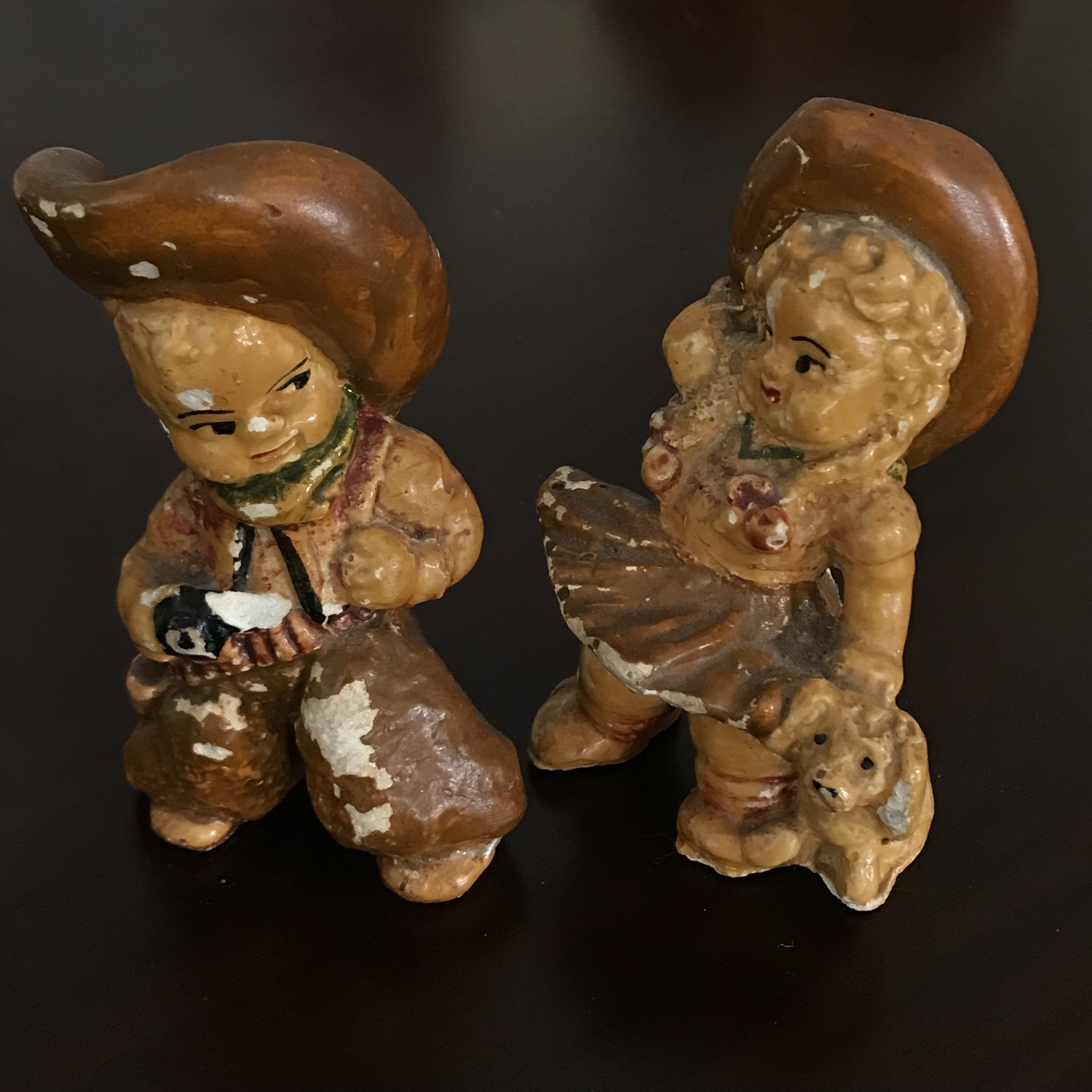
What’s interesting about the process of packing is that as our moving date approaches we’re finding it easier to let go. But I struggle with the precious things. The little things. The tchotchkes that serve no purpose but are the keepers of such potent memories. The carnival chalk ware figurines I found at a car boot sale in Letterkenny, County Donegal twenty years ago. The elf shaped, never-been-burned three inch candle that my beloved keeps at his desk and refuses to abandon. What do we do with the precious things and what would our lives be without them?

The things we choose to keep around us tell our story. They remind us of the places we’ve been, the people we’ve loved, the dreams we’ve lost and the dreams that came true. 

But if I had to chose between these things and my life I would abandon everything without question in order to survive. What must it be like, do you think, to be forced to do that with a moment’s notice? What must it be like to wake up to the sound of explosions and to realize that everything you know, everything you assume will always be there – the school, the hospital, the corner market – is about to be destroyed?

For five weeks we’ve watched missiles rain down on homes that look like the homes we live in and on cities that look like the cities we love. Two weeks ago we saw a mother with her two children, two family dogs and the family friend leading them to safety. One moment they were alive and when the dust cleared they were dead. What did they carry with them? If we opened Tetiana’s rolling suitcase what would we find? What precious toy did her daughter Alise find room for in her backpack? What book was so important to Mykyta that he would choose to carry it with him on their futile attempt to escape a savage war?

What would you bring? What book would you carry?


The Little Things

I’ve begun packing. Our new life on the East coast is still eight months away but I’ve begun to bundle in bubble wrap those things I don’t use but don’t want to lose. It would be far easier to send these silly tchotchkes to Goodwill – after all, they’re just ‘things’ – but I can’t seem to find the resolve. The attachment I have to them is visceral and giving them away at this point is like giving a part of myself away. I did not feel this way when I was younger, when I moved across an ocean and back again. Then, I gave most of what I had away to friends with ease. At the time it was like a cleansing but I realize now that I knew so very little about myself. I had no connection to my own history and thus no connection to the things I kept around me.

But now I do. And it’s these things I’ve packed away – my grandmother’s vase from Germany, the desktop magnifying glass my grandfather used to examine the coins he collected, the wooden puzzle boxes with inlaid images of Mount Fuji my sister and I were given as children, the Bible my mother carried with her through three marriages –  these things connect me to my past and to the blood flowing through my veins. They tell the story of who I am and how I came to be. 

These stories are important. And yet, if a calamity occurred and everything was lost the energetic imprint of these things I hold in my hand would still be held in my heart. 

With the image still fresh of Afghan families huddled by the perimeter walls of the Kabul airport desperate to board a flight that will take them to an unknown destination far away from where they are, and as Haitians emerge newly baptized by the waters of the Rio Grande to gather under a bridge in the sweltering heat of our southern border I am more than aware that the circumstances of my life are sweet blessings.

With that in mind, it’s healthier for me to see the task of deciding what to bring and what to leave behind as a joy rather than a burden. And in the process I can refine the vision I have of the life I want to live with my beloved human and beloved feline in rural Virginia. I can refine the vision of how I want to walk through a world that is so beautiful and fragile.


Creating Connections with an Old Bag of Tea

We power through cups of tea at our house. I’ve been saving the wrinkled and wet used tea bags in a bowl. Don’t judge me. I have my reasons.

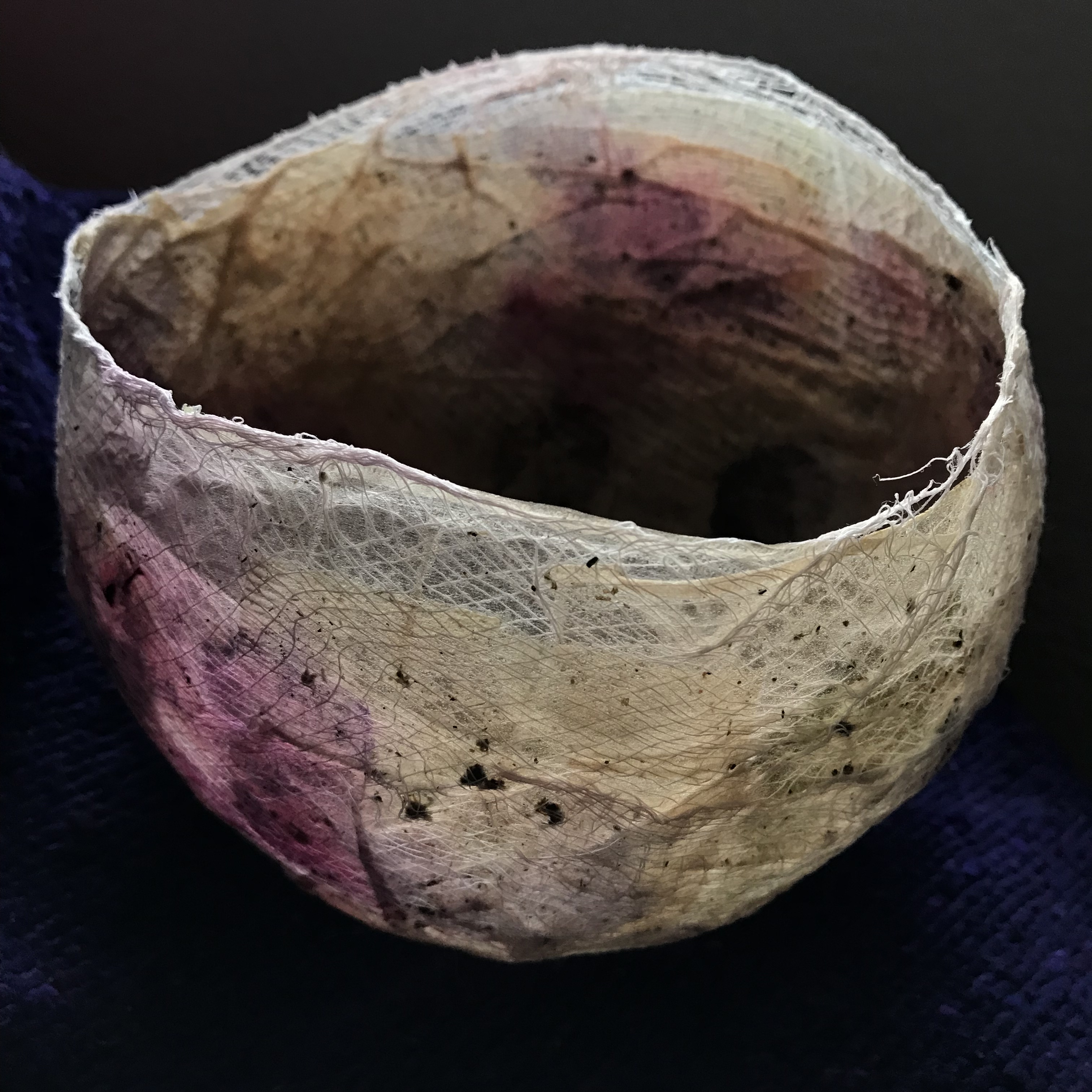
Not quite finished. The dark flecks are tea. The red pigment comes from pounded rose and geranium petals.

In June I began a year long virtual course of study with India Flint. India is an artist who works with plants and found objects to create beautifully dyed paper and cloth. India’s course of study is why keen eyes might find me in the wee hours of the morning gathering handfuls of eucalyptus leaves from along the bike path that parallels El Camino Real and stuffing them into the pockets of my baggy cargo pants.

India Flint, and this course, is why I save used tea bags.

India’s teaching style is that of a storyteller. Rather than providing precise step-by-step directions – like the sort you’d find if an Ottolenghi cook book – she weaves a tale of her experiences with the plants she is using, the mistakes she’s made, the lessons she’s learned. She gives permission for us to take what we need, to leave the rest, and to be inspired by her life’s work.

I’m inspired.

Our first journey was through the making of a book. I didn’t have much of what was needed – proper paper, a sewing machine, a very sharp pair of scissors – but this course is filmed with such care and beauty it didn’t bother me that I wasn’t playing along. I was still learning.

Which is how, this morning at 5 AM, I found myself carefully deconstructing a dozen or so tea bags, emptying their contents into a bowl and spreading the fragile paper out like one might smooth a bedsheet.

But there is more to this story:

Over the weekend my friend Diane – a talented and dedicated artist – gifted me Beth Pickens’ book Make Your Art No Matter What: Moving Beyond Creative Hurdles. This is a book that weighs much more than it should and its Times Roman font is a point size or two smaller than my eyes enjoy. The first chapter, however, is about time. Something I’ve been pondering lately.

And here’s a little more to the story:

I had lunch yesterday with a friend I’ve not seen since before the shut down. Carolyn and I laugh when we’re together. We laugh a lot. But yesterday, as we were talking about how the pandemic changed us, we thought of something that stopped us in mid-giggle. The shutdown gave us time. And now time feels more precious. Both Carolyn and I are discovering how different life is when we treat time as a gift and not a commodity to burn through. We’re learning to say ‘yes’ to what we love. Even if that means saying ‘no’ to something we love less.  

And that is how I found myself at 5 AM this morning gently opening the tea bags that had been drying for a day instead of reading emails and absorbing all that had happened in the world as I slept. India’s course is inspiring me to explore. Diane’s book is encouraging me to love my inner artist. My conversation with Carolyn is reminding me that time is precious.

Deconstructing tea bags is a slow, careful process. While I sat at my desk, my Ottlite breaking the pre-dawn grey, I fell into a sort of meditative reverie. I thought about the tea, how far it had traveled – the Ashwaghanda from India and the green from Japan – I thought about the farmers who grew and harvested the tea then bundled it off to factories to be processed. I thought about the work it takes to create the paper that holds the tea and about how I was moving the process of creation forward by turning the old tea into dye and the these fragile scraps of paper vessel into a new vessel.

It was a profound moment to experience that deep sense of connection. It felt new to me because it wasn’t cerebral. The connection came from my heart. 

I hope I can hold on to that feeling of connection.


Do Clothes Make the Yoga Teacher?

You wouldn’t know it to look at me but I love clothes. It doesn’t matter that my daily uniform rotates around a tee shirt paired with yoga pants or two identical pairs of Target jeans bought in two different sizes on sale for a tenner each – I love clothes.

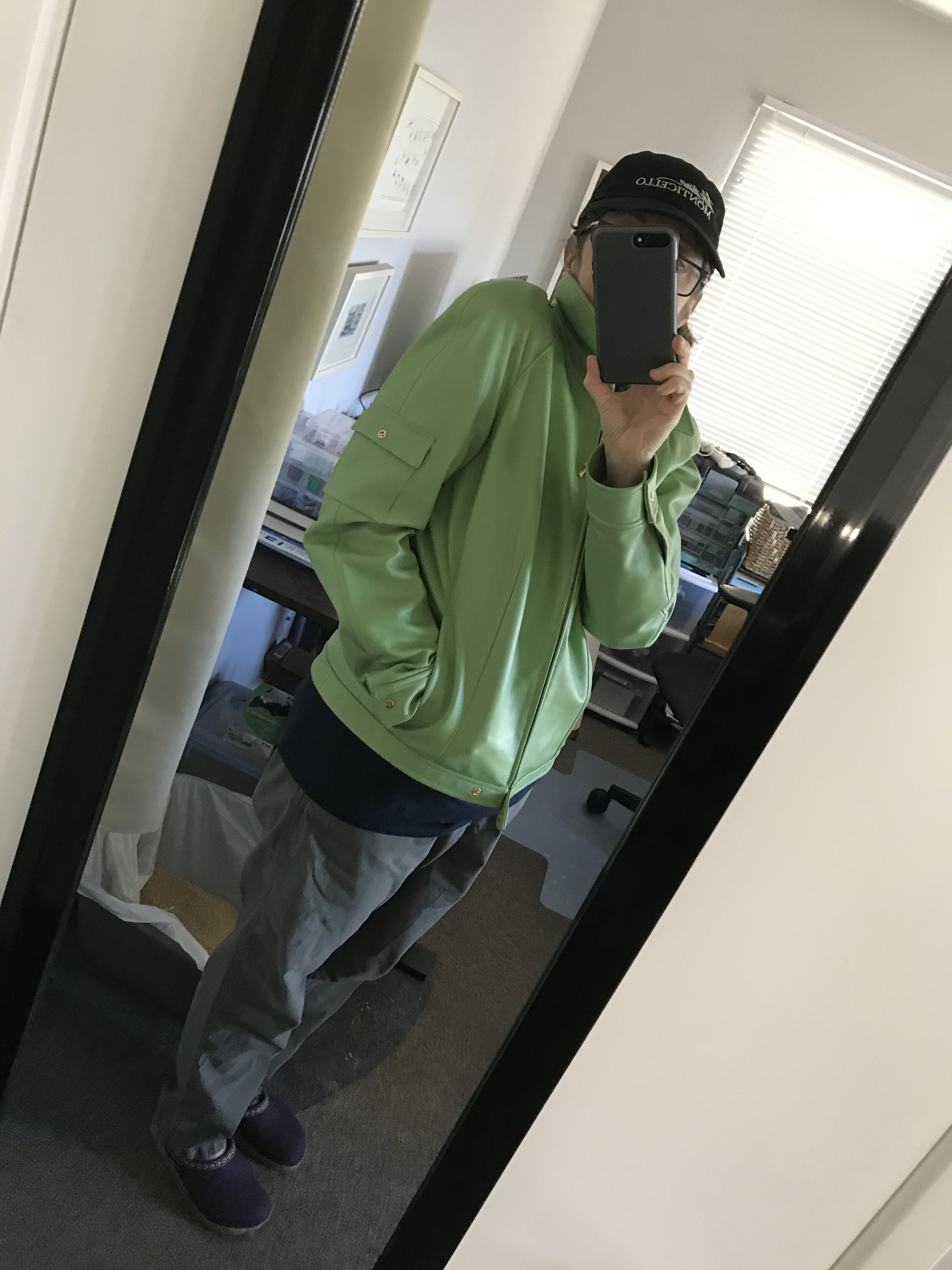
Who knew I needed a pea green bomber jacket?

I love the expressive nature of clothes. How the colors you choose can reflect the mood you are in and how the way you style your clothes can shout to the world, ‘here I am!’ or whisper ‘shhh…I’m thinking’. I love how a structured shoulder can help you ‘fake it ’til you make it’ and how cutting cloth on the bias changes the drape of a dress. Clothes can indicate where you stand politically. Clothes can shine a light on your inner artist or reflect your relationship with nature. 

Thirty-five years ago I loved nothing more than to spend a Saturday afternoon at the Goodwill on El Camino Real in Mountain View scouring the racks for vintage dresses. I paired my findings with fishnet stockings, Doc Marten knock-offs and baggy houndstooth jackets with fabulous, patterned satin linings from the men’s section. I was making jewelry at the time – huge brooches made with old watch parts and those tiny spoons you find in salt cellars – and I’d have one pinned to an oversized collar or maybe use one to replace a missing button. The look had a grunge-goth vibe that I embraced. The style was trendy, of course – I mean, what self-respecting Goth didn’t have a pair of Doc Martens? – but those clothes also told a story. Anyone looking at me would know, without asking a single question, a little bit about me.

I don’t dress to impress or express these days. While the pandemic influenced an even more relaxed approach to my sartorial splendor, I’ve been rolling through life in baggy clothes and graphic tees for awhile now. The only story I’m telling through the clothes I pull on each morning is the one that says ‘I’m not worth the effort’. How sad is that?

But maybe that’s about to change.

Last week a woman who plays the role of ‘cool, older aunt’ in my life cleaned out her closet and offered the clothes she no longer wore to me. 

I took them.

These are not clothes with worn out knees or thread bare elbows. These are clothes my bank account would never allow me to purchase for myself. These are beautiful, classic, never going out-of-style clothes.

I slipped my arms through the sleeves of a well-tailored jacket and caught a glimpse of myself in my friend’s mirror. Who was that? I recognized my face, but everything else about me had changed. For one thing, I had a waist. For another, the chatter in my mind shifted from the typical self-deprecating ramblings to which I’m accustomed into something approaching pride. 

I brought the clothes home that evening and the next day purged my own closet. And the day after that? I started showing up for my Zoom meetings sitting a little bit taller and a little bit more confident.

And then I started thinking.

You wouldn’t know it to look at me but I love clothes.

That being said, I’m conflicted. I know clothes are nothing more than the means by which we keep our bodies – our souls’ temporary home – protected from the elements. So why should clothes matter? But if our naked bodies are a blank canvas then clothes are the paint by which we express to the world who we are and who we aspire to be.

Who will you be today?

ps…As a yoga instructor I will continue to wear baggy tee shirts and budget leggings to class. It’s my small protest against the Yoga Industrial Complex and the sexualization of a practice that means so much to me.


What Makes Today Special?

What makes today so special? What makes any day special? Is it the blinding blue sky or grey torrents of rain? Maybe the four mourning doves who have found their way to my home, who have sat in my potted herb garden – have shat in it, too – and eaten my thyme. Maybe that’s what makes today special.

I’ll go for a walk later, toward end of day when the blue turns pearly and pink through the branches of the redwood trees. It’s the time of day that dogs are walked and children run in circles as if life were to be lived with reckless abandon. Sweaty and red faced they won’t notice the cool breeze blowing in from the Pacific while I tighten the drawstrings for the hood of my favorite sweatshirt.

If, while I’m on this walk, I look toward the Santa Cruz mountains, I’ll see pure white pillows of fog folding over the ridge and slipping down the slope to fill nooks and crannies. It’s my favorite thing. A beauteous thing. 

After I’m home and have had a bowl of soup I’ll step out onto the mirpesset to watch the full moon rise over the buildings of this town, its light reflecting back to me the stories of everyone who has ever looked up and dreamed. I’ll look for the planets, lined up like soldiers across the ecliptic plane. Not long ago Jupiter and Saturn were so close they almost kissed. And before that Mars, all bold and red, was as big as I’d ever seen. Before I go back in I’ll take a moment to marvel at the stars I can see and to wonder if anyone is marveling at me.


Hi. I’m Exhausted. How are You?

There’s a Saki Santorelli quote that asks us to treat ourselves with kindness. If we can learn to treat ourselves with kindness, then we can learn how to treat others with kindness.

If there’s ever been a time to put this in practice, it’s now.

I’m exhausted. Exhausted to the point that it’s hard to speak. Exhausted to the point that if you mention Vice President Harris my eyes well up and I spill joyful tears. And yet I feel as though we’ve been subjected to a forty-eight months long mass psychic trauma and when the valve was opened on Wednesday the grieving for the past four years began.

That’s how it feels. A muddy puddle of joy and grief. I know the mud will eventually settle and I’ll be left with a pool of clear joy but for now this is what I’ve got. Mud. And it’s exhausting.

I don’t think it matters where on the philosophical continuum your beliefs rest. Those of us who ‘won’ mourn the past. Those of us who ‘lost’ are angry about the future. I think it’s important to hold space for the sadness of the previous four years and I think it’s wise to consider what we want for our future. But to dwell in either place for too long serves no one.

So. How do we treat ourselves with kindness? While I’m waiting for the mud to settle, for the grief to pass, how do I treat myself with kindness?

I’m going to stop fighting the exhaustion. I embrace with a full heart the shift in energy that arrived this week, but I need to rest. I need to stop talking about it. I need to spend some time letting go of the frustration and the fear of the last four years. But I need to let go in my own time and at my own pace. That is how I will treat myself with kindness.

I will polish my critical thinking skills and formulate opinions based on what I learn and not on what people tell me. That is how I will treat myself with kindness.

I will practice empathy toward those whose anger is fear-based. It will be difficult when the anger turns to violence, but that is how I will treat myself with kindness. I will not excuse the violence but will do my best to understand the circumstances that caused the violence.

I will treat you with kindness by giving you the space you need to process. When you need silence I will be quiet. When you need to be heard I will listen.

So for now, go treat yourself with kindness. You deserve it. 

We all deserve it.


Karma Yoga in the Age of Zoom

When the world shut down last March, like so many other yoga teachers, I turned to Zoom. Unlike most teachers, I wore my pajamas and led a 30-minute chair class from my desk. That was eight months ago. It feels like eight weeks. Or maybe eighty years.

Now my classes are an hour long and have moved to a light filled corner of my home every Monday, Wednesday and Friday morning. And, to the relief of all, I’ve changed from my pajamas to my yoga duds which, truth be told, feel a lot like pajamas.

I’ve come to realize, after all these long COVID months, that my reasons for holding Zoom classes were never about maintaining an asana practice. I began the classes to hold the community together. To keep those who chose to attend energetically connected. I began the classes so we might breathe together. Move together. So that we could have one thing that felt almost normal. 

Asana is what brings us together three times a week but it’s not what holds us together. Yoga holds us together.

When I first began leading classes 27 years ago it was all about asana. I taught the same sequences and told the same jokes as my beloved teachers, who were students of BKS Iyengar and who studied with the Iyengar family in Pune. It took several years before I began to trust my own voice, my own intuition. It’s only now, in these past few years, that I’ve learned who I am – and who I am not – as a teacher.

In these extraordinary times it doesn’t feel right to root the classes I teach in strong, challenging work. Now feels like the right time to root ourselves in healing, restorative practices. Practices that are more about how the body feels and less about what it can do. 

Now feels like the right time to root ourselves in truth. 

What do I mean by that? Beats me. I think what I mean is that in this terrible, horrible, no-good, very bad year we would do well to think less about ourselves and more about others. Maybe what I mean is that we need to move beyond just thinking about others to doing for others with no expectation of what we might receive in return. What I am trying to express is that we need to practice Karma Yoga.

Karma Yoga is one of four schools of yoga. The other three are Jnana (self-study), Raja (meditation) and Bhakti (devotion). Karma Yoga is the yoga of action. It is selfless service towards others. That means cultivating the correct attitude and right motives. To release, as one text explained, ‘selfish desires’.

We should always be prepared to practice Karma Yoga but it seems more important than ever right now. 

Two things happened this morning to bring that point home to me and to bring this post to a close (thank goodness!).

Fareed Zacaria had Jose Andres, a chef and founder of World Central Kitchen. His organization is shining a light on food scarcity and the hunger crises in part caused by the economic challenges created by the pandemic. He spoke so eloquently and with so much passion that even the stoic Zacaria was verkelmpt. Andres is practicing Karma Yoga. Selfless service.

And then Sunday’s Brain Pickings landed in my inbox featuring poet Robinson Jeffers and his thoughts on ‘moral beauty’. It included several quotes but this one, I think, speaks to the practice of Karma Yoga.

“I believe that the universe is one being, all its parts are different expressions of the same energy,

and they are all in communication with each other, influencing each other, therefore parts of one organic whole.”

If Jeffers is right, and we are all connected, then selfless service does not serve one person, or one group or one cause. It serves us all.


Is Gratitude over-rated?

I’ll be honest. The word ‘gratitude’ annoys me. Feeling grateful is wonderful, of course. I felt grateful this past Friday morning when I was awake early enough to see the brilliant sunrise in all her glory. But gratitude? It’s a trending buzzword and after awhile trending buzzwords relinquish their impact to the next buzzword that comes along. There’s plenty of joy to be found, however, in feeling grateful.

Studies suggest that remembering what brings us joy and recording those moments of gratitude in a journal benefits our mental and physical health. The deliberate act of shifting our energy toward the positive rather than nurturing our habit of catastrophizing the difficulties we encounter builds our emotional resilience and reminds us that living is a group experience. In other words, reflecting on the shared experience of Friday’s sunrise is healthier than reflecting on the shared experience of the pandemic.

Another reason why the word ‘gratitude’ annoys me is this: sometimes the concept just feels too big. It’s difficult for me to winnow down all the moments in my day for which I might be grateful. Am I grateful for the morning cup of fresh-pressed coffee my partner Ben brought to me while I stayed in bed? Sure. Am I grateful for the purrs of contentment my cat Bruce shares when we cuddle? Of course. Am I grateful for the roof over my head? Without a doubt. But while the simple act of opening a journal and creating a daily gratitude list of well-meaning gestures, happy accidents and unexpected outcomes might remind me of the good in life, it fails to satisfy the yearning I feel in my heart to understand how acknowledging these moments feeds my soul.

How can we add depth to the act of recognizing the positive in life? 

In yogic philosophy we study Patanjali’s Sutras. In the Sutras, Patanjali describes five Yamas and five Niyamas. The Yamas describe restraints to practice: non-harming, truthfulness, non-stealing, moderation and freedom from grasping. The Niyamas are a collection of five virtues: cleanliness, contentment, self-discipline, self-study and surrender. Anchoring the contemplation of gratitude in the fourth Niyama self-study (‘svadhyaya’ in Sanskrit) encourages us to explore the nature of gratitude. It supports our understanding of how we express our gratitude as we walk through life. With that understanding we can more fully embrace those moments for which we are grateful. 

If we want to add a deeper dimension to our gratitude practice we can turn to Naikan – the Japanese practice of introspection. When we practice Naikan we ask three simple questions:

  • What have I received?
  • What have I given?
  • What difficulties have I caused?

The questions might focus on a relationship, a situation, an individual or even an event. For example, if I choose to practice Naikan with my focus on Ben then the questions I ask are:

  • What have I received from Ben?
  • What have I given to Ben?
  • What difficulties have I caused Ben?

The obvious fourth question, “What difficulties has Ben caused me?” is ignored. It is human nature to shine a spotlight on that question. It is, however, through the examination of our answers to the first three questions that we discover aspects of ourselves we didn’t know existed. We learn more about our relationship to gratitude. We move toward enlightenment.

When we open our journal tonight, how will self-study or a Naikan practice influence how we consider gratitude? What would happen if we chose to frame a Naikan practice around those things in our life that cause pain?