A Year at McGuffey’s: Gratitude, Connection, and Am I the Mean Girl?

I have a cold. I’ve not slept. And I’ll be honest. Stringing together a series of cohesive sentences is a struggle. But it’s been too long and so I must try. Yet how dare I write about the trivial pursuits of my life when it feels like the world is falling apart? Although we know the detrimental impact to our mental health, Ben and I watched CNN non-stop most of last week. We saw Clarissa Ward dive into a ditch and Anderson Cooper cry. 

Turning away from what is happening in the world is not possible. Moving through life under an umbrella of blissful ignorance is wrong. It’s difficult to watch but not as difficult as surviving while bombs rain down. Meanwhile, Ukraine still burns and Putin rubs his hands together with glee. We live in tragic times.

The word clarity has been used. The phrase ‘moral clarity’.

Clarity is a good word. By the second half of last week Ben found the clarity to remain informed while at the same time focusing on the goodness in life. The beauty. The moments of awe. Like the maple trees outside our back window turning more crimson red by the hour. Or the adorable warblers making enough racket on our porch for poor deaf Bruce the Cat to take notice.

I gained a different sort of clarity during my week in California at the end of September. On a sunny Thursday morning in the garden of a friend I found myself surrounded by bright and beautiful people who had gathered to celebrate not just my visit but one another. There were moments that morning when I stepped back to a quiet corner so that I could take in all the color and the effervescent joy. Those moments were a rich reminder of the value of human connection and community. 

Before that morning and since the early days of the pandemic shutdown I’d seen most of the friends around me three days a week via the flat, muted scrim of Zoom. I assumed that was enough. It wasn’t until I was basking in their technicolor energy that I learned my assumption was wrong. I realized what I was missing.

I am so grateful for that experience. It was an invaluable lesson. The question is: how will I put what I’ve learned into action?

I’m not the natural traveler that I was a few decades ago but being with my friends that morning, in that garden, recharged my batteries.

I have to do it again. I’ve known many of these men and women for twenty years. Zoom chats fill a gap but I can’t let a continent keep us apart. I’m looking forward to seeing everyone again in September 2024.

Meanwhile, at McGuffey Art Center I’m creating relationships with my five studio mates. When we moved into the studio space in July I envisioned six women of various ages and backgrounds building something together – building a small community, I guess. But as the weeks went by and it didn’t feel like that was happening I withdrew into myself and began to work mostly from home, going into the studio for First Friday gallery openings and to install completed art. When I did see someone I heard myself complaining or being contrary about the silliest things. I felt myself being a little judgmental. One day I wondered aloud, “Am I the mean girl in this group?”

Yesterday we had an hours long critique of our work with two well-established local artists and teachers. My early hope of us being a community had vanished weeks ago. Besides, my cold was settling in and so my enthusiasm for the afternoon was at a low. But as each of us spoke about our work and why we do what it is we do as craftspeople and artists, I began to see the thread that binds us together. We are very different. Different ages, different faiths, different socio-economic backgrounds and different countries of origin. Our little group includes a potter, a pastel artist, a painter, a printmaker, a performance artist and a mixed media artist. And yet – there’s something that connects us on a level deeper than the fact that we were accepted into the McGuffey Incubator Program.

If I fail to nurture that connection – a connection that won’t last forever but will at least last until June – then I am failing myself, missing opportunities to learn and ignoring the lesson I learned in California. It won’t be easy for me. I am an introvert who enjoys her own company. But connection shines a light on our humanity.

And I want my light to shine.


A Year at McGuffey’s: My New Tribe

Ben and I are days away from our first anniversary in Virginia. We’ve been here for one full tour around the sun. And yet I’m still settling. Still moving furniture around. Still figuring out the best cabinet for our pots and pans. Still looking for connection. For my Virginia tribe and community.

The final decade of the California life I left behind changed my destiny in ways I couldn’t imagine. It made this move possible. I met my beloved Ben and adopted my beloved feline Bruce. I cyber-stalked John Berg until he invited me to teach at Samyama. And it’s there I matured as a teacher and as a human. It’s there that I found a family of friends. A group of like-minded souls. We laugh together, commiserate together and attempt to navigate the journey of life and the practice of yoga one ardha chandrasana at a time.

And somehow, through births, deaths, illnesses, weddings, divorces, menopause, high school graduations, moves not only across the country but to the other side of the world, our community holds itself together. We even made it through a pandemic that put our lives on hold. Thank goodness for technology because it helped us navigate COVID. The shutdown is history and yet we are still signing in to Zoom and still showing up for ourselves and for one another three days a week to share asana practice. It blows my mind. 

In some ways the strength of my California Tribe makes finding connection here in Virginia less important. In some ways it makes finding connection here more difficult. Why make the effort when everyone I care about is one text, one email or one Zoom click away? Do I even need a new tribe? A new community? And if the answer to that question is ‘yes’ does it mean I need to surrender the community I already have or can the two co-exist?

We create community to build social connection. To know that we belong somewhere. Our tribe anchors us to the place where we began and at the same time supports us when it is time to take flight. We need community in order to find fulfillment within a group of individuals with whom we share similar attitudes, values and aspirations.

And so – yes – I need to find community here, in Virginia. And also – yes – it can coexist with the community that I love in California and to which I already belong.

I knew the move to Virginia would afford me more time to breathe life back into my artist self and reacquainting myself with her has been revelatory. I didn’t know how much I missed being able to tell my story through a visual medium. But isn’t creating art a solitary practice? Where does an artist go to find her tribe?

One morning in late March while searching for something else on the internet (isn’t always that way?) I found McGuffey Art Center’s Incubator Program. McGuffey’s has been thriving in an old brick school leased from the City of Charlottesville and a few blocks from the city’s famed pedestrian mall since the 1970’s. The Incubator Program, now in its ninth year, offers emerging artists shared studio space at a reduced rate while supporting their growth as artists through exhibitions, networking and education. The morning I found McGuffey’s I also discovered that applications for the 2023-2024 Incubator Program were due that weekend. I didn’t waste any time and without overthinking or second guessing myself I submitted an application.

I’ll be picking up the keys to my studio this weekend. It’s a very competitive program and I am proud to say that I am one of six artists chosen.

Does this mean that I’ve found a new tribe? We’ll find out.


I Like the Idea of Poetry

I’ll be honest. I like the idea of poetry. I like to think I have the intellectual capacity to enjoy poetry. Years ago, when Kay Ryan was Poet Laureate of our country I listened to an interview with her on All Things Considered where she read some of her work. There was something about her writing – maybe the subtle humor or the economy of words. As soon as Ryan’s interview was over I ordered her book Say Uncle. And because I ordered the book online rather than driving to my local bookstore (which should have been my first choice) I never gave myself the chance to change my mind. The slim volume arrived in days as expected. I opened it once and then, for years, it sat on my shelf. A visual reminder that I like the idea of poetry. 

A few days ago I received a package in the mail from one of my best friends in high school. Back then she was the person I wanted to be. Intelligent. I mean – Merit Scholar intelligent. Funny. Funny in that subtle sort of way that sneaks up and then the next thing you know cafeteria milk is spewing from your nose. Supportive and kind. I know that memories shift and change – but all these decades later I still remember how, in high school, in her own quiet way, she made me feel that I could do anything. I didn’t believe her, of course, but it felt wonderful to have someone in my life who saw the light in me. The thing is, she didn’t know she was doing this for me. It was just who she was. Who she is. 

We lost touch in the 1980’s and 90’s but reconnected around the time that I returned from Ireland. When my sister died alone and estranged from my mother and me, it was this dear friend who opened the door to her home and helped me find Margaret’s grave. 

And so it was no surprise and it put a smile on my face when I picked up the package from my doorstep and saw it was from her. My first thought after ripping open the padded manila envelope was, ‘Geez – that’s a big book of poetry!’. But the card accompanying the gift explained that the poet was local and was one of her favorites. In the past she had sent me books by Annie Dillard and Patti Smith’s autobiography Just Kids – books that I loved. I knew she wouldn’t send me anything I couldn’t handle. Plus the poet had written this inside the front cover for me:

Mimm! I hope these mad moments in verse hold a song for you. Welcome home!

What was I to do? Given that I like the idea of poetry I had no option but to sit down, open the book, and read.

The book is Voodoo Libretto: New & Selected Poems by Tim Seibles, who happens to be a past Poet Laureate of Virginia.

And now, each morning when my brain is fresh (I tried the evening but by then my brain can no longer absorb nuance, cadence and beauty) I open Voodoo Libretto to a random page and read a poem. Seibles’ autobiographical writing is sexy and funny, surprising and relevant. Heartbreaking. On the printed page the words have a jazz cool visual rhythm and when I begin to read my eyes carry me and I can’t seem to stop. 

Curious? Maybe start with his Alison Wolff. And maybe, in a few weeks of mornings I’ll need to diversify a bit and open that slim little book by Kay Ryan. Or Basho if I’m in the mood for three lines of Haiku. Or Ferlinghetti.

Because I like the idea of poetry.

And I’m so happy that my high school friend, who I looked up to with awe in 1974 and still do now, knows that about me.


Love and Home

I’ve been thinking about love and what makes a home.

The moving van arrived four days after we did. Our townhome has a ground floor garage and spare room (the ‘Mimm Cave’), a first floor open plan living room and kitchen, and a second floor primary bedroom and two smaller bedrooms – an office for Ben and our ‘yoga studio’. Boxes were easy to carry to their designated room. I’d packed over one hundred and sixty and all but a few were small enough and light enough for this sixty-three year old post-menopausal woman to lift. Maneuvering the furniture, however, proved an issue for our intrepid moving team.

Navigating the tight corners and two flights of stairs was an impossible task. After some discussion, the quartet – by now soaked in sweat – drove the truck further into our short driveway and parked at an angle. Two stood on the roof of the truck, which sagged under their weight. One stood on the small deck off our kitchen and the forth ran between the back of the truck, up one flight of stairs and back down again as together they hoisted furniture over the deck’s railing. Three hours later the truck was empty and the house was full.

Four days later Ben and I, along with our brave feline companion Bruce are adjusting to our new life. And I’m left thinking about love and what makes a home.

As I write it is 7:00 AM on a cloudy Sunday in Virginia. The house is quiet. Ben is still sleeping upstairs and Bruce is enjoying breakfast. I’m sitting in my living room, which is filled with soft morning light. Everything that I can see – the chairs, the sofa, the painting on the wall, the tea chest, the brass lamp and baskets – are gifts from someone else. So even though I am alone right now I’m surrounded by the energetic imprint left behind by the friends who offered these objects to me. I can feel the joy and spirt of generosity generated by giving. 

But I’ve been given unseen things, too, which have their own sweet vibration, like the way bright fuchsia and searing red bounce against one another when they are side by side.

All these energies, from the seen and the unseen, have infused our new home with love. And for the first time in a long time, I have space in my heart to feel it. 

So thank you. I feel blessed. Not only for this love-filled home, but for you.


Leaving Home: A Climate Migrant’s Story

When I left California the first time, it seemed like a lot of folks had a similar idea. Around the time I took flight for Ireland, Dana and Anya left for Grand Rapids and Nancy headed to Santa Fe. There were others, too, who left. Friends on the periphery of my life headed to Oregon and my the friend who adopted my cat Bob moved to Detroit.

In the late 1990’s, if you weren’t in the tech industry, it felt like life was waiting for you someplace else. So we moved. 

A decade later I came back to the place that felt like home. I guess the Universe knew that the Bay Area had more lessons to teach me. Some of those lessons devastated me. Others filled me with hope and motivated me to not only do better but to be better. To be more kind. More patient. More trusting. 

I purchased my first home through Palo Alto’s BMR program during my second time around in the Bay Area. And I fell into the kind of love that is more than a fleeting tickle in the heart.

My beloved B (henceforth known as ‘BB’) and I first tossed around the idea of leaving California long before COVID changed the way we live. But when last summer served us a shutdown, raging firestorms, intense heat and The Day the World Turned Orange we knew it was time to flesh out what it would look like to leave. What it would mean.

So we created a spread sheet that ranked our potential destinations according to the criteria that was most important to us. We wanted to be closer to family but we also needed affordability, diversity, culture, tolerable winters and, while BB could continue to work remotely, I needed opportunities to continue on my path as a yoga therapist and coach. I also needed room to grow back into the artist side of me I abandoned when I left California the first time. Asheville was too expensive and Chapel Hill too far from family. We didn’t relish the idea of a Pittsburgh winter and potential livelihood for me was sketchy in Richmond. 

But Charlottesville, Virginia? Charlottesville ticked enough of the boxes to warrant an exploratory visit.  By the end of our seven day visit last May, we knew where we wanted to live.

It isn’t Charlottesville. It’s a little town (to be truthful it isn’t a town, it’s a place and yes, there’s a difference) outside of Charlottesville called Crozet. Crozet is named after Colonel Claudius Crozet, the French engineer who built the Blue Ridge Tunnel. The community we’re moving to is near enough Charlottesville to take advantage of all it has to offer but far enough away from city lights so that we can see the stars at night. Maybe even the occasional shooting star.

But we won’t move into our new home until next June. Which gives me just enough time to circle ‘round back about a million times to the question, “Are we making the right decision?”


Creating Connections with an Old Bag of Tea

We power through cups of tea at our house. I’ve been saving the wrinkled and wet used tea bags in a bowl. Don’t judge me. I have my reasons.

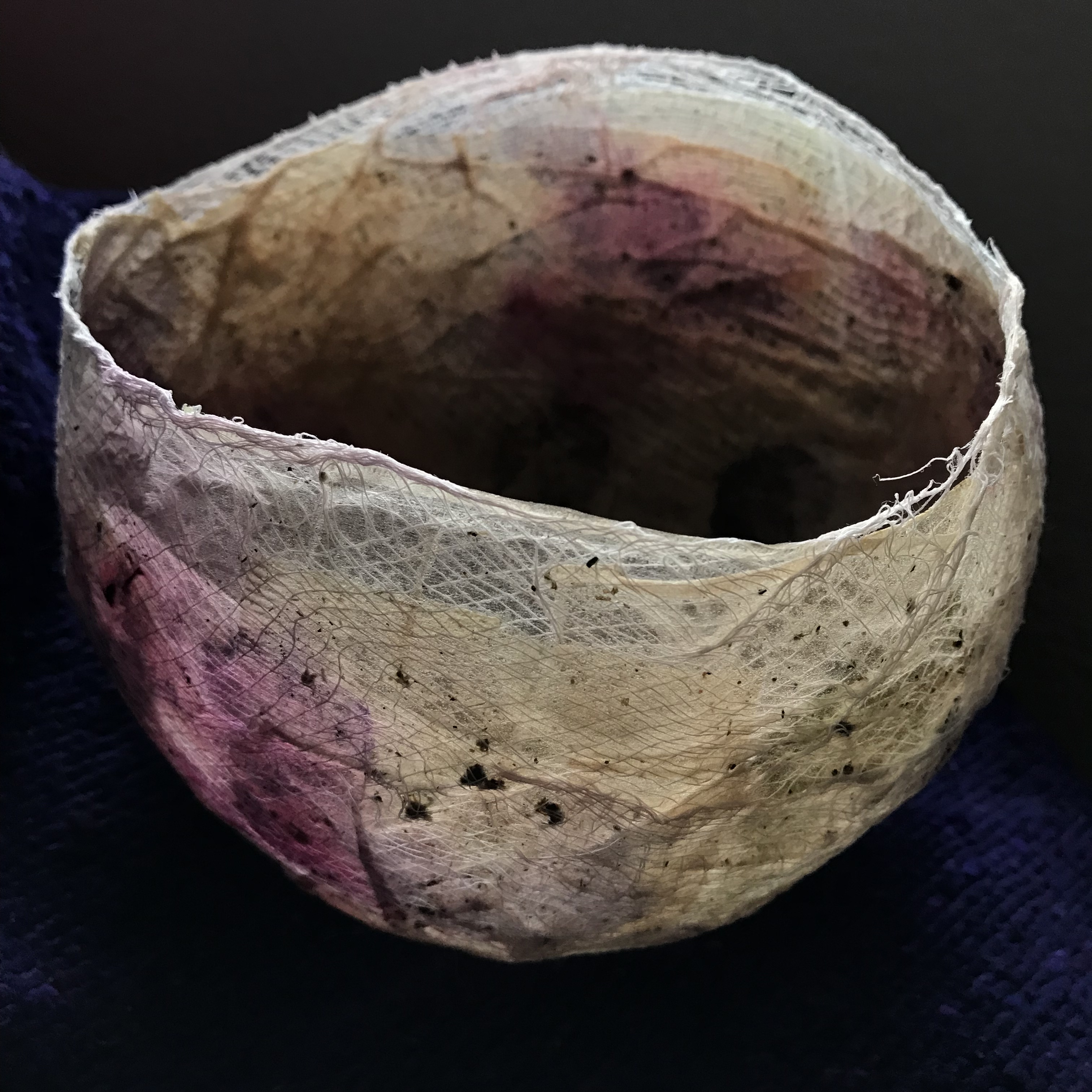
Not quite finished. The dark flecks are tea. The red pigment comes from pounded rose and geranium petals.

In June I began a year long virtual course of study with India Flint. India is an artist who works with plants and found objects to create beautifully dyed paper and cloth. India’s course of study is why keen eyes might find me in the wee hours of the morning gathering handfuls of eucalyptus leaves from along the bike path that parallels El Camino Real and stuffing them into the pockets of my baggy cargo pants.

India Flint, and this course, is why I save used tea bags.

India’s teaching style is that of a storyteller. Rather than providing precise step-by-step directions – like the sort you’d find if an Ottolenghi cook book – she weaves a tale of her experiences with the plants she is using, the mistakes she’s made, the lessons she’s learned. She gives permission for us to take what we need, to leave the rest, and to be inspired by her life’s work.

I’m inspired.

Our first journey was through the making of a book. I didn’t have much of what was needed – proper paper, a sewing machine, a very sharp pair of scissors – but this course is filmed with such care and beauty it didn’t bother me that I wasn’t playing along. I was still learning.

Which is how, this morning at 5 AM, I found myself carefully deconstructing a dozen or so tea bags, emptying their contents into a bowl and spreading the fragile paper out like one might smooth a bedsheet.

But there is more to this story:

Over the weekend my friend Diane – a talented and dedicated artist – gifted me Beth Pickens’ book Make Your Art No Matter What: Moving Beyond Creative Hurdles. This is a book that weighs much more than it should and its Times Roman font is a point size or two smaller than my eyes enjoy. The first chapter, however, is about time. Something I’ve been pondering lately.

And here’s a little more to the story:

I had lunch yesterday with a friend I’ve not seen since before the shut down. Carolyn and I laugh when we’re together. We laugh a lot. But yesterday, as we were talking about how the pandemic changed us, we thought of something that stopped us in mid-giggle. The shutdown gave us time. And now time feels more precious. Both Carolyn and I are discovering how different life is when we treat time as a gift and not a commodity to burn through. We’re learning to say ‘yes’ to what we love. Even if that means saying ‘no’ to something we love less.  

And that is how I found myself at 5 AM this morning gently opening the tea bags that had been drying for a day instead of reading emails and absorbing all that had happened in the world as I slept. India’s course is inspiring me to explore. Diane’s book is encouraging me to love my inner artist. My conversation with Carolyn is reminding me that time is precious.

Deconstructing tea bags is a slow, careful process. While I sat at my desk, my Ottlite breaking the pre-dawn grey, I fell into a sort of meditative reverie. I thought about the tea, how far it had traveled – the Ashwaghanda from India and the green from Japan – I thought about the farmers who grew and harvested the tea then bundled it off to factories to be processed. I thought about the work it takes to create the paper that holds the tea and about how I was moving the process of creation forward by turning the old tea into dye and the these fragile scraps of paper vessel into a new vessel.

It was a profound moment to experience that deep sense of connection. It felt new to me because it wasn’t cerebral. The connection came from my heart. 

I hope I can hold on to that feeling of connection.


Do Clothes Make the Yoga Teacher?

You wouldn’t know it to look at me but I love clothes. It doesn’t matter that my daily uniform rotates around a tee shirt paired with yoga pants or two identical pairs of Target jeans bought in two different sizes on sale for a tenner each – I love clothes.

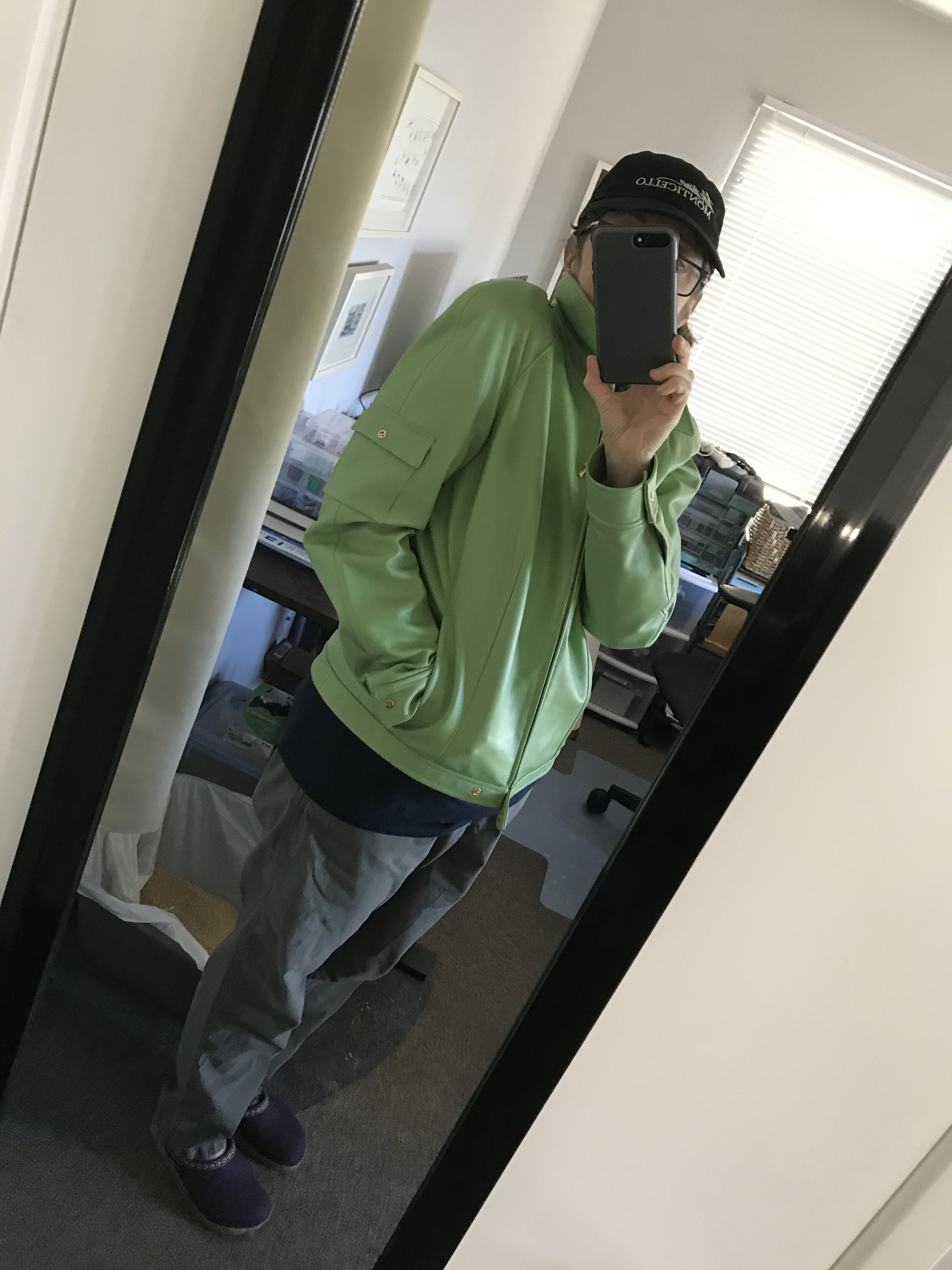
Who knew I needed a pea green bomber jacket?

I love the expressive nature of clothes. How the colors you choose can reflect the mood you are in and how the way you style your clothes can shout to the world, ‘here I am!’ or whisper ‘shhh…I’m thinking’. I love how a structured shoulder can help you ‘fake it ’til you make it’ and how cutting cloth on the bias changes the drape of a dress. Clothes can indicate where you stand politically. Clothes can shine a light on your inner artist or reflect your relationship with nature. 

Thirty-five years ago I loved nothing more than to spend a Saturday afternoon at the Goodwill on El Camino Real in Mountain View scouring the racks for vintage dresses. I paired my findings with fishnet stockings, Doc Marten knock-offs and baggy houndstooth jackets with fabulous, patterned satin linings from the men’s section. I was making jewelry at the time – huge brooches made with old watch parts and those tiny spoons you find in salt cellars – and I’d have one pinned to an oversized collar or maybe use one to replace a missing button. The look had a grunge-goth vibe that I embraced. The style was trendy, of course – I mean, what self-respecting Goth didn’t have a pair of Doc Martens? – but those clothes also told a story. Anyone looking at me would know, without asking a single question, a little bit about me.

I don’t dress to impress or express these days. While the pandemic influenced an even more relaxed approach to my sartorial splendor, I’ve been rolling through life in baggy clothes and graphic tees for awhile now. The only story I’m telling through the clothes I pull on each morning is the one that says ‘I’m not worth the effort’. How sad is that?

But maybe that’s about to change.

Last week a woman who plays the role of ‘cool, older aunt’ in my life cleaned out her closet and offered the clothes she no longer wore to me. 

I took them.

These are not clothes with worn out knees or thread bare elbows. These are clothes my bank account would never allow me to purchase for myself. These are beautiful, classic, never going out-of-style clothes.

I slipped my arms through the sleeves of a well-tailored jacket and caught a glimpse of myself in my friend’s mirror. Who was that? I recognized my face, but everything else about me had changed. For one thing, I had a waist. For another, the chatter in my mind shifted from the typical self-deprecating ramblings to which I’m accustomed into something approaching pride. 

I brought the clothes home that evening and the next day purged my own closet. And the day after that? I started showing up for my Zoom meetings sitting a little bit taller and a little bit more confident.

And then I started thinking.

You wouldn’t know it to look at me but I love clothes.

That being said, I’m conflicted. I know clothes are nothing more than the means by which we keep our bodies – our souls’ temporary home – protected from the elements. So why should clothes matter? But if our naked bodies are a blank canvas then clothes are the paint by which we express to the world who we are and who we aspire to be.

Who will you be today?

ps…As a yoga instructor I will continue to wear baggy tee shirts and budget leggings to class. It’s my small protest against the Yoga Industrial Complex and the sexualization of a practice that means so much to me.


In Search of the Elusive Authentic Self

In my coaching practice the issue of authenticity is a featured player. More often than not clients will, at some point in the session, tell me they are either:

  1. Searching for their authentic self
  2. Struggling to live an authentic life
  3. Questioning whether their motives are coming from an authentic place.

What has to happen for the conditions for self-doubt to manifest? When do we begin to feel we’ve lost touch with the image we hold in our mind’s eye of who we believe ourselves to be? And how can we return to the clarity that keeps us grounded and focused on the values we cherish most? When we answer those questions authenticity becomes less of an intention and more of a truth we live. 

When I was a child I was teased for having two left feet. More often than not I had fresh or fading scabs on my elbows and knees from all the falls I took. Like a puppy learning to leash walk I was easily distracted by metaphorical squirrels. I tripped over sidewalk cracks, missed steps when climbing stairs and walked into people, poles and walls in my pursuit of something different from the task at hand.

As an adult, while my elbows and knees have healed, not much else has changed. I’m still easily distracted by bright, shiny objects. I still stumble. I fall, enraptured by the aspirations of others at the expense of my own. My admiration for the high bar others set for themselves ignores the higher bar I’ve set for myself and fills my brain with ‘you should do this’ or ‘you should do that’ at the expense of my heart’s song. This longing to be someone I’m not steals validity from the wonderful life I’m living. It diminishes the dreams I have. It diverts my attention away from the values most important to me and ultimately away from my authentic self.  

The best we have to offer the world is grounded in personal authenticity. When we lose sight of that – when we feel lost – how do we find our way back? The answer to that question is as unique as the journey we’ve chosen for ourselves. But I find these suggestions useful:

  1. Get away from the noise. Take a day to yourself. Set work, obligation and commitment aside and give your heart the space to expand.
  2. Breathe with intention. When you feel unmoored, close your eyes and breathe. Lengthen the exhalation until it’s longer than the inhalation. Imagine the in-breath moving into the soles of your feet and connecting you to the earth.
  3. Trust your instincts but know that the answers aren’t black and white. Some of us choose to listen to our heart. Others listen to our brain. But what about the space in between? What is that space saying to you and how does it align to the authentic life you want to live? Is there an equilibrium to be found?
  4. Honor the truth that journeys change. There are detours, road closures and surprises if we choose to spend some time exploring roads taken less often. It’s these moments that help us take the next step.

When we look carefully, we discover that the sense of self is not a particle that never changes, but rather a flow, a wave of thought and feeling that can increase and decrease and is therefore not permanent.

—Shinzen Young, “Brief Teachings”


Social Media is Making Me Sick

jOCjulUCT0q30hFW6gbywgDiscovering that a friend from high school – a quiet boy that I had a crush on in 1974 – served in the military after graduation, met hid one true love later in life and now spends time traveling around the world with her filled my heart. 
Finding family on my father’s side – a man I never knew – and now preparing to meet a cousin who can tell me about the half-brothers I didn’t know existed until a few years ago would have much more difficult to do before 2006.

Keeping up with people I’ve known through my life or clicking the crying emoji when a friend I’ve never met loses a beloved dog, sharing New York Times articles about the plastics found in the belly of a whale or Nikolas Kristof’s latest opinion piece (and believing that means I’ve done my part) these are all the reasons why I love and loathe social media. And it’s why I’m letting go of my personal social media accounts.

Don’t get too excited. My personal accounts will disappear but social media’s sticky tentacles will still have me in a stranglehold. Where would I be without social media as a marketing tool? I use Facebook to advertise my classes and to showcase the personal essays that land on your feed in ever dwindling frequency. Without Facebook I’d be posting fliers on telephone poles and sending long holiday letters to the few dozen folks who subscribe to Practically Twisted. In other words, I’m like the guy who lists all the many ways his life has improved since giving up Facebook but still has an Instagram account for his dog. 

And that’s just it. On the surface, Facebook seems innocent enough. After all, who doesn’t want to know what the girl who sat behind you in seventh grade algebra is doing these days? Before Facebook all we could do was guess. Before Facebook, I hoped that at least one of the kids who tormented me in 1972 – when my name was Robbie Myers (long story and no, I’m not in a witness protection program) – would find my name on the masthead of Elle Magazine and believe I was the editor. Without Facebook, how would they know that although we share the same name and even the same birth month, that I am not the Robbie Myers that found success in New York City’s high powered publishing world?

Other social media platforms don’t vex me the same way Facebook does. I’ve opened and then abandoned countless Twitter accounts and don’t really get the point of Instagram. So leaving them behind is painless.

But Facebook? Loosening Facebook’s grip is no easy feat. After all, in the beginning Facebook was the gentle and omniscient narrator of our lives. We were having too much fun to see the truth – Facebook is a beast of a business. Its primary purpose is to succeed and success is not measured in how many virtual friends you have. It’s measured in money.

But, like many things in our twenty-first century lives, it’s complicated. 

At first it was the time-suck that got to me. And then it was the sense of false connection we feel for people we’ve never met and the underlying loneliness that false connection hides. Pile on that the trolls, the bots and the anonymity that fuels mean-spirited commentary. Finally, the evil that was live-streamed from New Zealand. Offering infamy to twisted souls shouldn’t be as simple as giving them access to a camera, an internet connection and the ability to live-stream (of course, the counter argument to that is Philando Castile’s brave partner, who live-streamed his murder by a police officer in Minneapolis. Who would we have believed if she hadn’t had access to her phone and Facebook’s platform?). 

It’s complicated. I knew it would be. But social media is making me sick. It steals my time, makes me angry and breaks my heart. And so, anyone who needs me knows where to find me. And if you don’t know where to find me, you don’t need me.


Are You Listening?

thI was uncomfortable with the idea of my turning sixty, which is going to happen in late November.  

I have friends who are older than me who thought they were laughing with me when they saw what they considered feigned distress. “You’re a child,” they said. “Just wait until you’re my age.” 

I have friends who are younger and, with what I read as a patronizing tilt of the head told me, “You look great. Besides, age is just a number” (I’ll get back to them when they’re approaching sixty to find out if they’ve changed their opinion).

They believed they were offering support but I didn’t feel heard. Their words invalidated my complicated relationship with aging and I felt myself becoming invisible.

And then, one day after class, a student said to me, “You’re right – turning sixty is a big deal.” The moment those words landed in my heart I reclaimed my focus and returned to being sharp edged and filled with color. 

Someone listened not just to the words coming out of my mouth but the meaning behind those words. Someone heard me and I was no longer alone. It was time to celebrate.

Hearing is easy. Listening? Not so much. How often do we formulate a response before the person with whom we’re engaged in conversation has completed their thought? How often do we try to finish someone else’s sentence? How often do we interrupt?

I’m guilty of all three more often than not. What about you?

Listening can be part of our daily practice. We hear in a rush. When we listen we are mindful. 

Give this a try. Find a friend and a timer. Pour a cup of tea. And then choose someone to go first, set the timer for five minutes and begin. One person will talk about anything or nothing, the other will listen. No questions, no comments, no chatter in the mind. Just pure listening. When the five minutes are over, switch roles and practice again.