Let’s Talk About Yin. Yes, again.

English: Tension lines of the human skin. They...

English: Tension lines of the human skin. They follow the main fibres of the connective tissue of skin.

While we’re at it, let’s talk about anatomy, too. And whether or not a yoga teacher needs to study anatomy and physiology…

I was having coffee last week with Anirudh Shastri and John Berg. Both are much admired and deeply loved teachers in the Bay Area. In January John’s dream will be a reality when Samyama opens its doors in Midtown Palo Alto. I am so proud John found me and asked me to teach at Samyama. I’m proud to be part of a faculty that includes – besides John and Shastri – Louis Jackson, Annika Williams, Hilary Easom, Amy Rogg, Clive Beavis and Lindsey Amrein. We are not only a team of teachers but a family. We meet regularly and support each others’ practice and teachings as strongly as we hold our vision of Samyama. We all chose different paths and somehow still managed to arrive at the same place. How wonderful is that? Eight individuals. Amazing journeys. Same vision. Different stories.

Here’s my story about why I believe the study of anatomy is important for any yoga teacher:

I didn’t go to medical school. I attended massage school. It was a good school and the anatomy was fast, furious and hard taught. I learned the names of the muscles and the names of the bones. I learned the origins and attachments. I looked at fake plastic skeletons and the living limbs of my bodywork clients and my yoga students. But until I saw these photographs I didn’t know. Until I studied with this couple and then this man I didn’t know. I didn’t know that for fifteen years I was teaching an alignment-focused style of yoga and assumed my students’ inability to move deeply into any particular posture was the fault of a ‘tight’ muscle. I never considered the important contribution bones and connective tissue make toward how we move and how we feel. How we experience asana.

It seems obvious. It feels like it is something I should have known all along. But I didn’t. It’s my continued study of anatomy that has provided an insight I didn’t have when I began teaching.

One of my responsibilities as a yoga teacher – particularly a teacher who loves introducing beginning students to the profound joy of an asana practice – is to keep you safe. Knowing the difference between a femur and a tibia helps me do that. Describing the sacroiliac joint and understanding fascia helps me do that. No, my classes are not a lesson in human anatomy. But sometimes it’s more efficient – more precise – to name a muscle in the body rather than indicate an area on the body.

In-depth study of anatomy has changed my teaching. I will agree – it’s not for everyone. But it turned me from an alignment-centric cookie cutter teacher into one who focuses less on the aesthetics of alignment and more on helping each student have their own, ever-changing, safe, unique life-affirming asana experience.

Shastri was about halfway through his coffee and John had probably finished his tea when the discussion turned to Yin and connective tissue.

Yin – like any style of yoga – can provide something different depending on what time of the day you practice and what your intention is for your practice.

Yin Yoga shifts our awareness away from yang’s contracting strength and power to soft and melting expansion. Contraction and expansion are neither positive nor negative. They are states our body experiences as we move through life. Yin Yoga restores but should not be considered the style of yoga we call Restorative. Yin Yoga is challenging but many of the challenges differ from the ones we find in classic Hatha Yoga.

Physiologically, Yin Yoga stresses connective tissue. These tissues include fascia, tendon, ligament and bone. Because we hold yin poses for time, the practice also offers a deep release to the nervous system. It feels intuitively wrong to consider stressing our joints, but done with right intention the practice results in greater stability and fluid flexibility. Consider this – we don’t correct crooked teeth (yin tissue) with a blow from a hammer. We use orthodontia – a long, slow and sometimes uncomfortable technique that realigns and corrects. That is Yin Yoga in a nutshell.

When I take yin in the morning my muscles are cool. They’ve not woken up. They’re at their shortest. This is the time when my yin focus is less on the benefits to the nervous system and more on the gifts to the connective tissue. My cold muscles won’t “steal” the stretch away from the connective tissue. The stretch/stress is not diluted by muscles that are warm enough to accept a deep fold or twist. The practice is more challenging to me in the morning because my body is cool and my ego is bruised. In the morning I cannot sink into the same deep and calming positions I can explore with an evening yin practice. The morning yin practice is sometimes frustrating but teaches acceptance and mindfulness. And it reminds us not only to be humble in our practice but to have a sense of humor.

But Yin Yoga is not all about the connective tissue.

When I practice Yin Yoga in the evening my intention shifts from the effects on the body to those on the spirit. In the evening our muscles, warm from a day full of movement and work, will absorb some of the effort saved for the connective tissue in the morning. But experiencing yin’s long-held poses in the evening calms the mind and prepares the body for sleep. Many of my students have told me the evenings they attend class are the evenings they know they’ll have the week’s best nights sleep.

Yin is a style of yoga that nurtures balance. For the yogi whose practice emphasizes power, strength and endurance Yin Yoga may feel too slow or too easy. With time and an open mind, however, even the most ardent Bikram devotee’ will recognize the grace, challenge and benefits of Yin’s quiet beauty.

As for me, I need both. I love a strong, contracting Yang practice just as deeply as I love a cool, quiet and expansive evening of Yin. That’s what balance is all about.

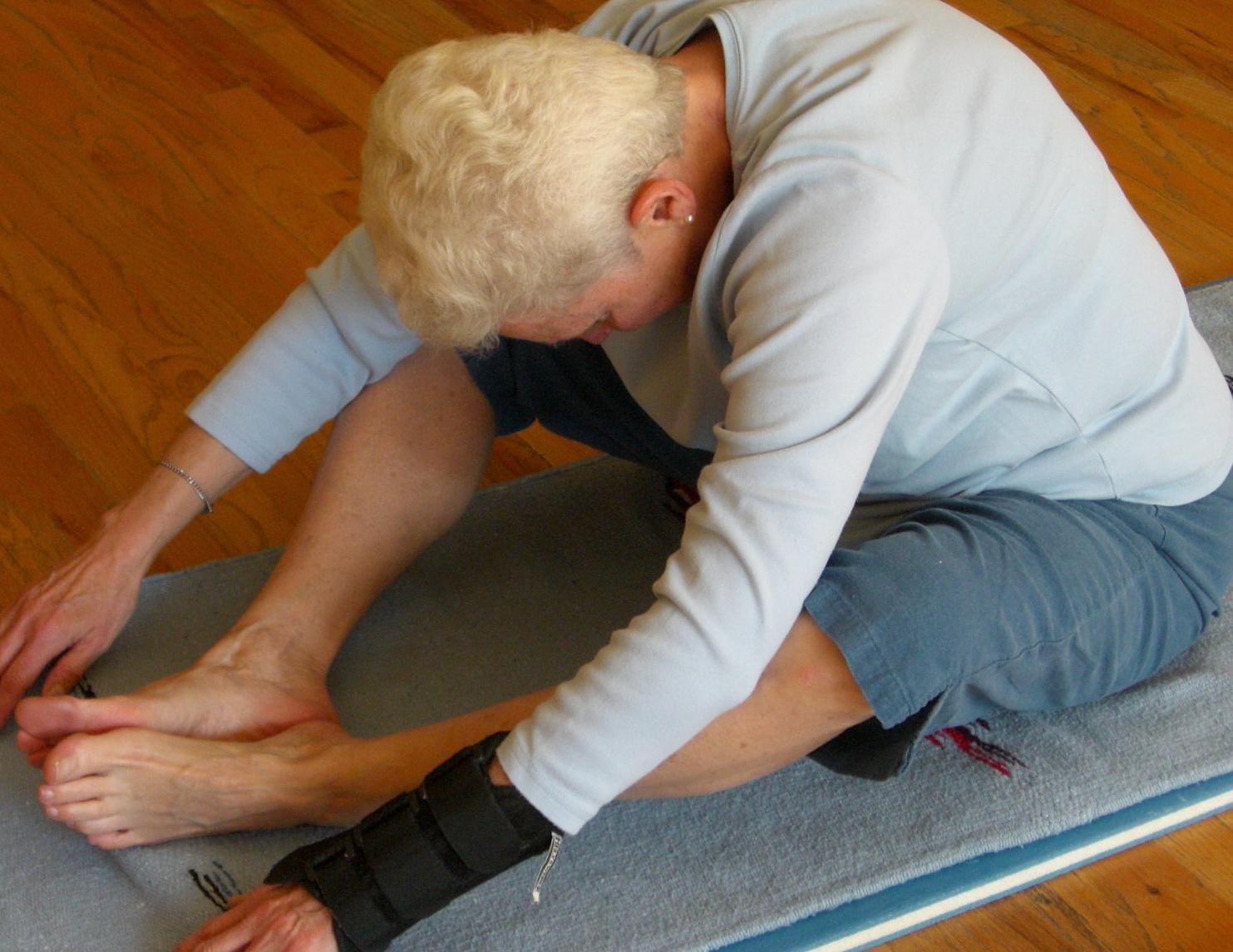
How the Faux-Grinch Made Christmas All Her Own

yogaI’m not really a Grinch. I’m just one of those folks who love winter not for the shiny tinsel but because their’s nothing quite as cozy as a cold winter day burrowed under the blankets with a few good books and a hot toddy.

Too much burrowing, however, does not a festive yogi make.

This year I’ve decided to celebrate the season doing what I love. Yoga.

And I hope you’ll join me. Over the holidays I’ll be teaching these four classes at the California Yoga Center:

Monday 24 December – Christmas Eve

7:00 – 8:30’ish PM (please note earlier start time)

Yin Yoga

Donation Based

Tuesday 25 December – Christmas Day

9:00 – 10:30 AM (please note extra half hour)

Hatha Flow

$18 drop-in

Monday 31 December – New Year’s Eve

7:00 – 8:30’ish PM (please note earlier start time)

Yin Yoga

Donation Based

Tuesday 1 January – New Year’s Day

9:00 – 10:30 AM (please note extra half hour)

Hatha Flow

$18 drop-in

CYC Students – Please note the time change on the Yin Yoga class.  We’ll be starting at 7:00 and NOT 7:30.  Also note the extra half hour added to the morning classes.  

I think we deserve a longer savasana on Christmas Day and New Year’s Day.  Don’t you?


Start Where You Are – Building a Home Practice, One Step at a Time

You might think you have no time for yoga outside of your once-a-week studio class.  Think again.  I’ve broken down your yoga practice into three sections – “Wake Up”, “Focus” and “Relax.” The sections correspond to morning, mid-day and evening.  Each should take no more than five to ten minutes.  You don’t have to do every pose listed in the section – choose what resonates and what you have time for.  Choose what feels good.  Stop if it feels bad.  Don’t rush.

These routines are very, very simple and exclude classic standing asanas (we’ll save that for later).  Still, it’s  not for someone brand new to yoga.  You should have enough beginning experience to be familiar with the movements.  Take your time and take care.  And remember to breathe.

Equipment:  Yoga mat, bolster or a firmly rolled blanket, a strap.  Anything else you may need for support.

“Wake Up – The Morning Routine”

 Begin Supine on Floor

Pelvic Rolls:  Inhale the tailbone toward floor; exhale the tailbone toward the ceiling.  You can add arm movements after the fourth or fifth cycle simple by taking the arms up and back on the inhale and bringing them down by your side on the exhale.

Knees to Chest: Alternate one knee at a time, extending the opposite leg.  Hold for several breaths and switch sides two or three times.

Windshield Wipers: Knees are bent and the feet about hip distance apart.  Drop the legs gently from one side to another.

Both Knees to Chest:  Hold the knees toward your chest for a few breaths and then allow the knees to move with the breath.  You’ll find they move away as you breath in.  You can tuck them tighter on the out breath.

Supported Bridge:

  • Place the bolster under the hips – keep the knees bent and the feet flat on the floor
  • Stay in supported bridge for a few breaths
  • Extend the legs along the floor and take the arms behind you if it’s comfortable – if this bothers your lower back return to supported bridge
  • Extend the legs toward the ceiling for a bit of an inversion
  • Bring one foot down at a time

Reclining Twist:

  • Cross the right knee over the left knee
  • Shift your hips to the right a few inches
  • Drop your knees to the left
  • Allow the right shoulder to drift toward the floor
  • Repeat on the other side

Table Top/Hands and Knees

Cat/Cow:  On the in breath lift the tail bone and face; on the out breath tuck the chin and the tailbone.

Downward Facing Dog:

  • Come to table top
  • Walk the hands a hand length forward and take them about shoulder width apart
  • Tuck your toes
  • Inhale the hips up
  • Exhale the heels down toward the mat
  • After five breaths step forward to a standing forward bend and then curl up slowly to a standing position

 Finish with any standing stretches that feel right – your body will know what to do. And then standing breath awareness.  I love “pancaking” both hands over my heart to feel the beat of my heart and the warm of my hands meeting one another.

“Focus for the Afternoon”

We begin seated in a chair

Neck Stretches: Move slowlyand hold each position for several breaths.  ‘Tease’ the stretch a bit to find what I like to call the ‘sweet spot’.

  • Right ear to right shoulder
  • Right ear toward right shoulder blade
  • Right ear toward right armpit
  • Repeat on left side

Chin to chest:  Allow the chin to drop to stretch the back of the neck.  Don’t force the position.

Shoulder Shrug:  Shrug shoulders to earlobes and hold (but don’t forget to breath); count three and then drop the shoulders.  Repeat three or four times.

For Your Ankles and Feet:

  • Cross the right knee over the left
  • Circle  the ankle ten times in each direction
  • Point and flex the foot three or four times
  • Repeat on the left side

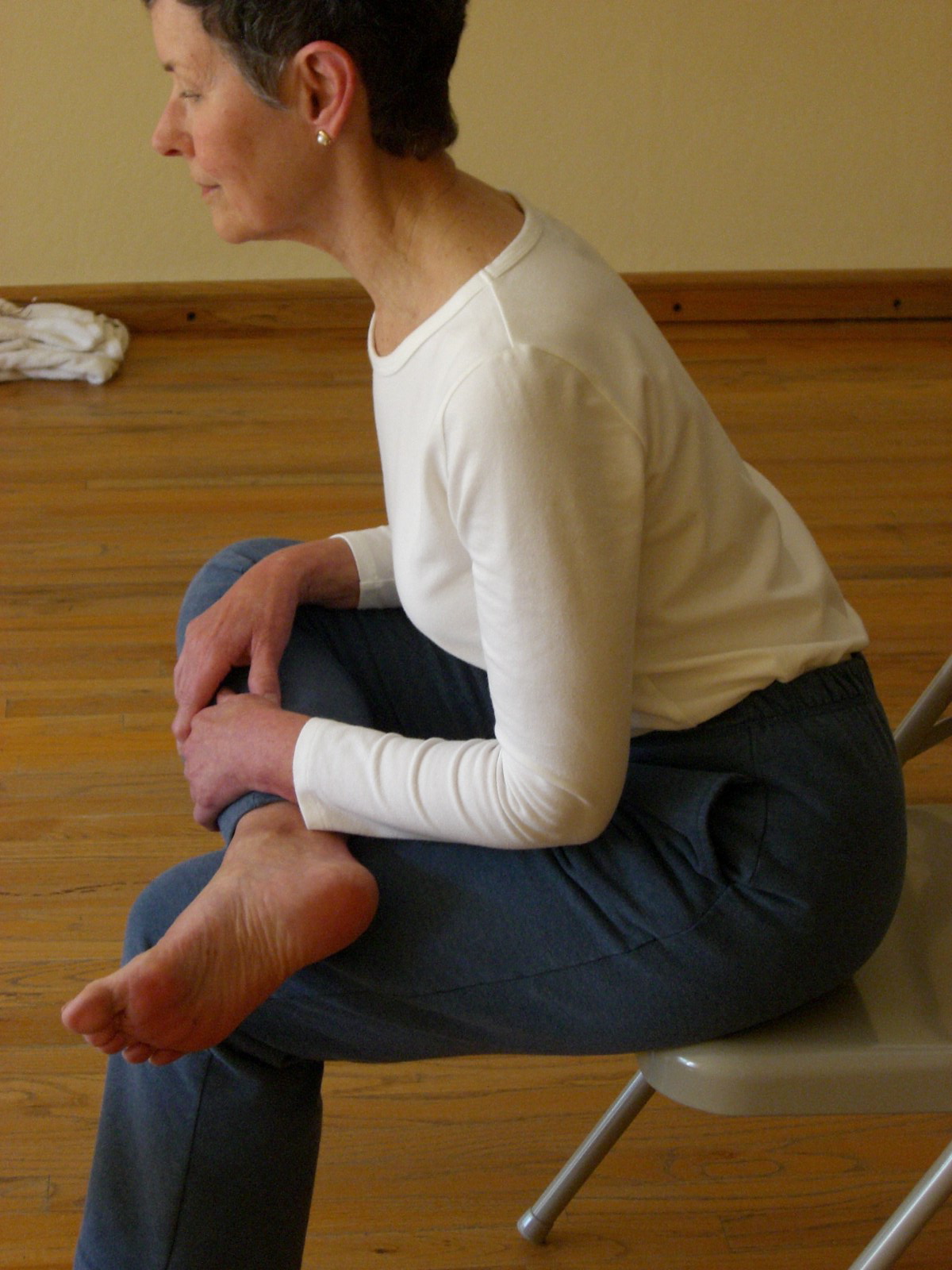
Piriformis Stretch:

  • Cross right ankle over left knee
  • Sit close to the edge of the chair
  • Hinge gently from the hip
  • The sensation should be in right hip
  • Repeat on left side

Seated Back Bend:

  • With your hips toward the edge of the chair place your hands on the seat of the chair behind the hips
  • Lift through the sternum
  • Think less about bending the lower back and more about opening the front of the body

Seated Twist:

  • Place your right hand on the left leg, left hand behind left hip, twisting to your left on the exhalation.
  • Breath in – lengthen the torso.
  • Exhale and settle into the twist.
  • Repeat on the other side.

Seated Forward Fold:

  • Sit toward the edge of the chair with your feet wide
  • Allow the spine to round forward until your upper torso is folded forward between your thighs
  • Hold for a few breaths and then inhale and curl up slowly

Standing

Standing Stretch with Flat Back:  Use the edge of your desk or the wall.  Stand about three feet away and hinge at the hips.  Let your hands rest on the desk, arms extended and legs perpendicular to the floor.

  • Bend right knee and drop right hip for stretch in left hip
  • Bend left knee and drop left hip for stretch in right hip

A standing stretch with a flat back is a great stretch for any time of day, anywhere. It’s particularly good if you’ve been standing all day – it brings a lightness to the feet and legs.

Wall Stretch:

  • Keep right foot about twelve inches from desk
  • Step left foot back about three feet
  • Hinge at hips, keeping hips level.
  • Allow your hands to rest on the desk or a wall for stability

With the right foot forward this will wake up the right hamstring and left calf.

Repeat on left side.

Shoulders:

  • Standing with feet hip distance and the arms by your side, turn the palms out and inhale the arms up.  Extend the fingers toward the ceiling and, if it’s comfortable for your neck, look up between the hands.
  • Turn the palms out and exhale the arms by your side.
  • Repeat three to five times.

Ideally the Focus practice ends with 5-minutes of seated meditation,

quiet reflection or breath awareness.

“Relax Yourself to Sleep”

 Seated on Floor in Easy Cross Legs

Seated Spine Stretch*:

  • Sit in easy cross legs with your hands on your knees.
  • Inhale – lift the chest toward the ceiling.
  • Exhale – hollow out the front of the body and round the spine to stretch between the shoulder blades
  • Inhale – lift the chest toward the ceiling
  • Exhale – fold forward

You can do this for as many cycles as you wish. I suggest beginning with at least three.

Seated Twist*:

  • Bring the right hand to the left knee
  • Place the left hand behind the left hip
  • Inhale – lengthen the torso
  • Exhale – twist to the left

Take a few breaths to move into your full expression of the pose and then settle into the twist for a bit. Avoid “cranking” into the twist by using your arm strength to pull the torso.  Repeat on the other side.

Lateral Stretch*:

  • Place the right hand on the floor next to the hip and then walk the fingers out until you begin to lean to the right.
  • You’ll notice the left hip is lifting from the floor.
  • Inhale – Bring the left arm up and over until it’s arching over the head.
  • Exhale – Press through the heel of the right hand in order to encourage the left hip to move toward the floor
  • Repeat on other side.

Forward Fold:

  • We want this to be as gentle as possible as this practice is supposed to a “winding down from the day” practice.
  • Sit with your legs in front of you, feet and knees slightly apart
  • Place the bolster underneath the knees
  • Round the torso forward
  • If you need to, use your hands to help support the torso but know that this forward fold is heavy and relaxed as opposed to a forced struggle.  Make it as gentle as possible and just trust that the spine is going to become more and more giving with each practice.

Supine on Floor

 Alternate the Knees in the Chest – just like you do in the morning practice

Hamstring/Hip Stretch– TAKE YOUR TIME WITH THIS!

  • Place a strap at the ball of the right foot.
  • Extend the leg toward the ceiling, opening the back of the knee and stretching through the heel.
  • Extend the left leg along the floor.  Stretch through the heel and point the toes toward the ceiling.
  • Take the strap in the right hand and drop the leg out to the right, rotating from the hip so the toes of the right foot point toward the floor.
  • Continue to work the foot toward the head to stretch the inner thigh.
  • Bring the leg back up and take the strap into the left hand.
  • Drop the leg a few inches toward the left to stretch the outside of the thigh.
  • Repeat with the left leg.

Knees to Chest and Windshield Wiper

Rest quietly in Savasana for ten minutes.

I need to thank teacher Kelly McGonigal for the Seated Spine Stretch, Seated Twist and Lateral Stretch in the “Relax Yourself to Sleep” section.  I first learned those movements from her at Avalon Yoga Center in Palo Alto, California.


Beware the YINJURY!

I couldn’t ignore the truth.  My hip was sore.  Real sore.  It was wince-inducing sore.  And while I limped in denial I began to hear stories similar to mine:  a recurring shoulder pain that increased after Yin practice; a wonky knee that ached the next day; a lower back that refused another forward fold.  All injuries reported by Yin Yoga students.

I refused to believe my beloved Yin was to blame.  It just had to be something else.  Yet, listening to these my students describe the course of events that led to their discomfort and considering my overstretched hip flexor with an objective mind the truth was obvious:  we had YINJURIES – the Yin equivalent to falling asleep in the tanning bed.  Sigh.

For a time the science of flexibility seemed to be changing like the wind.  When I trained as a sports massage therapist long held static stretches were all the rage.  Now the trend leans toward fast dynamic stretching.  I’m confused.  If science supports short and sharp stretches where does Yin fit in?  Does it hurt more than it helps?

I asked anatomist and philosopher Gil Hedley, circular strength training coach Michael Rook and personal trainer Steven Rice their opinion.

Gil offered this:

Virtually anything can be harmful or helpful.  That’s why it’s so important to pay attention to how you are feeling when you are doing something.  I’m no scientist, but I’ve overstretched and endured the consequences, and I’ve also relished the feeling of stretching and moving and enjoyed the benefits.  I personally believe that most anything you do over and over again represents a rut eventually, and like to change things up a bit myself.  While a practice is expanding you and your horizons, enjoy it.  When it becomes a tedium or mere repetition to satisfy a habit, move on.

There have been moments in my Yin practice when I’ve taken the poses almost ‘by rote’ – without thinking.  Without feeling.  Perhaps when we lose our mindfulness in the practice we open the door to injury?

Michael, who attended Paul Grilley Yin Teacher Training with me a few years ago, was frank in his opinion:

To be honest, I’m not surprised to hear about this.  The science is relatively clear that stretching before resistance training (some of my students attend Yin and then lift weights the following day) can harm performance and lead to injury.  Even more so before using kettle bells, I would say.  Personally, I don’t hold stretches for more than a minute (and it depends on the stretch).  There’s also a lot of deep flexion in many Yin poses that can play havoc with the lower back (if you’re posteriorly rotated).  Ultimately, all practices need to be tailored to the individual.

That sounds like obvious advice, but how often do teachers really attempt to do that?  In a large class that’s virtually impossible.  While it’s the instructor’s responsibility to guide the class safely, does it really come down to the individual listening to their body?

Michael then referred me to Charles Poliquin’s Blog and the Gymnastics Bodies website.

Finally, local trainer Steve “Mr. Science” Rice gave me this to chew on:

My understanding is that the ligaments should not be stretched as that will lead to joint laxity, and they don’t recover from that.  However it is also possible for the ligaments and capsule to get a bit glued together and need a bit of loosening.

Tendons of course are attached to muscles so I don’t know if they can be stretched separately.  A stretch will affect the tissue most willing to lengthen which is likely the muscle, and the length of a muscle is determined first of all by the brain. 

Traditional static stretching, like holding a yoga pose, has become depreciated in the sports world because it has been shown to decrease performance.  Current thinking emphasizes dynamic warm-up and mobility work.  End ROM (range of motion) positions are moved into and out of under control so the entire neuromuscular chain is engaged.  For example, instead of hanging in a forward bend with gravity pulling you down, walk and on each step do a high kick.  My stretches last no more than one or two seconds.

And then, just to inject a bit of controversy, Steven wrote:

Incidentally, Poliquin is a smart guy and leading fitness authority but also controversial in his interpretation of research.

So there you have it.  Static stretching out.  Dynamic stretching in.

Not so fast.  I love Yin not only for how it feels in my body but for how it soothes my spirit.  There’s no way I’m trading those five-minute dragonflies for some high kicks!  But here’s what I might do:

Offer my body more support in poses that are challenging for me.

  • Hold some poses for less time.
  • Avoid weight training for 24 hours after a Yin practice (I can assure you that won’t be a problem).
  • And then, more than anything, I’m going to listen.

Fitness trends emerge and fade, theories behind the science of flexibility change, our bodies cycle through movements that feel good and movements that don’t.

It seems that the only thing we can do is listen.


The Care and Feeding of Your Spirit

If you do anything for yourself this year, let it be that you give yourself just one thing.  I’m not talking about a new car or a pair of shoes.  I don’t mean a night out.

What I mean is this:  give yourself that one thing that feeds your spirit like nothing else can.  And give yourself that gift as often as possible.

If I ask you now, “What is that one thing?  What is the one thing that feeds your spirit?” Do you have an answer?  Do you know?

Back in the 1980’s when I lived in Mountain View a morning walk at Shoreline to watch burrowing owls warming themselves against the rocks as they faced the rising sun warmed me, too.  Those were the days when yoga was a simple asana practice – the days before I understood the depth of yoga.

I walked the path at Shoreline almost every day.  Early in the morning, before anyone else and while remnants of dawn still hung on the water.  But I needed to have a reason for being there or else I wouldn’t make the effort.  Fitness. Weight loss.  Exercise.  There had to be a reason.  A walk at Shoreline was something to tick off my “to do” list for the day.  Another chore.

And then I moved a few miles up the road, my work schedule changed, and walks at Shoreline became less frequent and were finally forgotten.

A few months ago I returned to Shoreline.  This time around it’s different.  I walk at Shoreline a two or three times each week because I walk at Shoreline.  That’s it.  My spirit feels embraced at Shoreline. The flat horizontal lines of the landscape and the calm water soothe me.  I feel nourished.  After a walk along water’s edge I’m ready to walk back into the remainder of my work day.

If you do anything for yourself today find that thing.  Find that one thing that feeds your spirit.


And Now, a Quick Word from Our Sponsor: January Classes

I thought it was time for me to remind everyone where I teach, how to register and what to expect.  Currently I teach in two studios:  California Yoga Center and Avenidas Senior Center.  I work privately with individuals or small groups in the home and am also available to teach introductory classes and workshops at your school or office.

California Yoga Center

One of the first yoga studios on the Peninsula – and where so many of us were first introduced to yoga – CYC has locations in Palo Alto and Mountain View.   My classes are at 541 Cowper Street in Palo Alto between University Avenue and Hamilton.  I teach three classes at CYC.  They are on going.  Two are Iyengar-influenced “slow flow” style classes and the third is a Yin class taught in the Paul Grilley tradition.  If you’re still looking for a last minute gift you can purchase Gift Certificates for individual or a series of classes.  More information about purchasing gift certificates can be found on the CYC website.

Here’s what to expect from a class with Mimm:

Yin Yoga – Mondays 7:30 to 9:00 PM

Yin is a donation-based class.  Please pay what you can afford up to $17 (the regular drop-in fee).

The long-held stretches characteristic of Yin Yoga help to recover and maintain a full range of movement and flexibility in the joints and connective tissue.  The work is challenging but profoundly relaxing. While Yin should not be confused with Restorative style yoga on more than one occasion students have told me, “I have the best night’s sleep on Yin nights!”

I keep the studio very dark.  Soft futons and bolsters, blankets and pillows are used for support.  Sometimes I’ll use music to help set a tone.

Verbal instruction is kept to a minimum.  Nevertheless, enough suggestions and options are offered to create an environment that feels comfortable and safe.

All the work takes place on the floor and poses are held between 2 and 6 minutes.  For more information regarding Yin Yoga look here.

Iyengar-influenced Hatha and Slow Flow – Tuesdays or Fridays from 9:00 to 10:00 AM

The drop-in fee for these classes is $15.  A 4-week series is available for $52.  An 8-week series is available for $104.  Classes do not have to be taken consecutively and there is no expiration date (this applies to my classes only.  Other CYC instructors may have different policies).

In the beginning, there was Iyengar.  At least for me.  I loved the attention to alignment, the emphasis on safety and the slow, careful pace as we moved from one pose to another.  But things change.

I still love my Iyengar roots, but I also love moving with my breath from one shape to another.  We move at a pace that allows time to settle into the pose and to explore how it feels in the body.  I provide options for anyone not ready to take on the more challenging standing poses.

Both of these classes are Level I/II – suitable for beginning and intermediate students.

California Yoga Center has everything you need for a safe practice:  bolsters, straps, pillows, and blocks.  It’s recommended that you bring your own “sticky” mat.

Avenidas Center

It’s a misnomer to call Avenidas a “senior” center.  Yes, you have to be over the age of fifty to enroll in classes – but what’s a number?  Pre-registration is required, but you can enroll online or drop by the front desk at 450 Bryant Street (cross street University Avenue).  Classes are held in 10-week blocks.  Our winter session begins the week of January 9th, 2012.  There is no drop-in but anyone is welcome to visit and try out my yoga classes before enrolling.  The price for a ten-week session is $60 for Avenidas members and $70 for non-members.  Where are you going to find a one-hour class for $6.00 anywhere on the Peninsula?

I have three classes at Avenidas:

  • Mondays from 1:00-2:00
  • Fridays from 10:30 to 11:30
  • Fridays from 11:45 to 12:45

Because of student demographics these classes tend to lean toward the introductory level but everyone is encouraged to deepen into the work as their bodies allow.  Some students have had years of yoga experience and will have a more full expression of the pose we’re working in.  Others who are new to yoga are given modifications that help awaken the body.

All three classes begin with floor warm-ups, followed by a carefully planned standing sequence and then finishing with seated work and relaxation.  Because of the nature of my classes at Avenidas, it’s suggested that students be able to safely lower and then rise from the floor.  That being said, chairs are available to assist.

Unfortunately, equipment is limited at Avenidas. We have soft exercise mats but I recommend you bring a sticky mat and two bath towels that can be folded into mini-bolsters.  A strap is also handy – this can be a yoga strap or, if you’re on a budget, a man’s tie or belt.  Yoga blocks are helpful, too.

Individual Study

If you are recovering from illness or injury then I recommend two or three sessions of individual study.  Together we can see where you’re at in terms of strength and flexibility.  We can build a program that will support recovery instead of setting it back.

Some clients, of course, simply enjoy how individualized attention deepens their practice. You’ll discover the body responds to the work easily when hands on adjustments and personalized modifications are part of the program.


Cleaning, Chaos and Attachment: Adventures in Meditation

When life seems out of control I do the only reasonable thing.  I clean and organize my apartment. And when I say clean and organize, I mean it. Knick-knacks and clothes are bagged for donation to Goodwill.  Books are boxed for re-sale at Book Buyers in Mountain View.  Every surface is scrubbed and dusted and then furniture is moved in the hope of creating the perfect Feng Shui flow.  This last time I went so far as to cancel my cable and donate my television to charity.  It seems the only way I can reclaim control is to pare down my life to little more than the bare necessities.

When there’s nothing left to clean and if I remain desperate for more control, I update my calendars. I have three calendars – the calendar on my laptop, the hardcopy I keep in the event of a computer meltdown and the calendar on my iPhone (which of course is supposed to sync with my laptop but I haven’t sorted that out yet). I’m embarrassed to admit that all three calendars are color-coded.

If I continue to feel unsettled I start with the lists.  I write shopping lists, goals for the immediate and the far away future and a list of day-to-day chores.

I keep at it until I’ve lulled myself into believing that I’ve created order from chaos.  Of course, instead of feeding my compulsive nature by focusing all my energies on the external environment I could be creating the control and calm I crave by – wait for it (smacks palm of hand on forehead)meditating.

And while I’m preparing for meditation by hanging out in Adho Mukha Savasana I could ask myself the right question – what is the turmoil I’m experiencing within all about?

The sense of impending calamity I feel from time to time boils down to my talent for creating unreasonable attachments to events out of my control.  The more I sense the loss of control, the more I attempt to cling to the story I have in my mind of how my life should be. But clinging to a story is like trying to grab vapor.  You can’t, can you?

The truth is, I can clean and clean until my knuckles are raw but that will bring me no closer to the control I crave.  If I truly want control, then I have to relinquish my desire for it and instead embrace the gift of clarity that a growing meditation practice offers.  I need to understand that we can only control our response to the events around us – not the events themselves.


Yoga is More than Skin Deep

When I began to practice yoga twenty-five years ago, the emphasis was on the physical.  In fact, it would be closer to the truth to say I wasn’t practicing yoga at all – I was practicing asana.  And while my early training included work on the philosophy and history of yoga, I listened about as carefully as I did during fifth-grade arithmetic (and my friends are all too aware that my ability to add and subtract leaves much to be desired). 

What was I afraid of?

I convinced myself that asana was enough.  But I was only swimming on the surface.  To me, deeper work meant something physical, nothing more than graduating from half to full lotus without damaging my fragile left knee. The thought of moving deeper spiritually was too uncomfortable.  My asana practice strengthened  but I failed to see beyond its gifts. Deeper examination meant diving into the unknown.  And I was uncertain of what I might find.

But twenty-five years after my first utthita trikonasana I now see awesome beauty in the unknown.  I’ve yet to reach center – do we ever?  But to paraphrase one of my teachers, I know that when I do find my center, freedom will be waiting for me.

Although I have no proof, I think it is reasonably safe to assume that most yoga practice in the West is asana-centric. There’s nothing wrong with that.  I mean, what’s not to love about asana practice? It brings us to a place where we feel balanced and alive.  It calms or energizes depending upon our needs and our sequencing.  And if we pay attention to the sensations we feel after our practice we’ll realize they are more than physical. More than skin deep.  Our asana practice influences our emotional state.  It influences how we perceive the world around us.

But this is just a tease.

When we broaden our yoga practice with elements of pranayama and  meditation we build a practice that is deeply integrated and holistic.  The physiological and spiritual sensations that asana practice hints at become intensified. We begin to dive beneath the surface.

The same teacher who taught me where to find freedom also offered a metaphor.  He suggested that our day-to-day lives, our random thoughts, our unconsidered reactions to the world around us are like the surface of the ocean: rough and unsettled with white caps and tides that rush in and just as quickly rush out.  But beneath the surface of the ocean there is calm.  If we can turn away from chaos and turn toward the calm found in a measured breath and silence then our spirits – and our asana practice – will be nourished.


Those Autumn Winds: Supporting Your Immune System

My last cold had me flat on my back for three days, hacking for seven, and speechless with varying degrees of laryngitis for six.  Of course, my last cold was in December of 2009 – so I really shouldn’t complain.

I’m one of the lucky ones. I can go a good year or two before a cold virus will hit me with a wallop.  Most folks will muddle through a cold every three or four months (and if you don’t believe that I’m knocking real hard on some wood right now – guess again!).

Besides good luck and good genes, my good health boils down to my being vigilant.  Not hyper-vigilant, but reasonable.  Especially this time of year.  As the days grow shorter and the weather turns cool we’re apt to spend more time with others indoors. And as we all learned in school, the virus responsible for the common cold is spread through airborne respiratory droplets.  It can remain alive on hard surfaces like countertops and desks for hours.  In other words our comfortable, centrally heated homes are more like oversized Petri dishes.

Ok.  I’m exaggerating.  But only just.

But factor in environments outside of our control like schools, offices and shops it’s a wonder we’re not all walking contagion zones, all red-nosed and dripping.

So what keeps us healthy? Hazmat suits?  Nope. It’s our ever-faithful immune system.

We usually don’t think about our immune system until something goes wrong. But consider this:  We run for cardiovascular health, lift weights to support our skeletal system and eat right to keep things running smoothly in our gastrointestinal tract.  What do we do to support our immune system?

Show Your Immune System Some Love:

Times are tough.  We want to stay healthy without breaking the bank along the way. But how do I figure out what my immune system needs without spending too much money on herbs and supplements?

My approach is to keep things as simple as possible. There are plenty of reasons why the immune system becomes compromised.  My first job, therefore, before I load up on supplements and herbal remedies, is to determine if my lifestyle is putting my immunity in jeopardy. If I want my immune system to defend me against pathogens, then I have to defend my immune system.  To stay healthy I begin with the tried and true – the stuff we’re reminded of each year around this time:

  1. I remember to wash my hands.  Up to 80% of infectious diseases like colds and flu are transmitted by touch. Simple hand washing with warm, soapy water is enough to rid our skin of viruses and bacteria picked up from computer keyboards, the cell phone or doorknobs.  If soap and water are not available an alcohol-based hand sanitizer is effective provided it is at least 60% alcohol.
  2. I do my best to get a good night’s sleep.  Burning the candle at both ends has never worked for me.  My goal each night is seven hours of quality sleep.  To achieve that, I turn off the television, lower the lights, and trade the temptation of Facebook for a soothing story (from a real book with pages!).
  3. I try to reduce stress levels.  I know.  You don’t have to tell me:  easier said than done.  Our spirits cannot match the pace of the 21st century.  But increased stress reduces our body’s ability to produce white blood cells.  And white blood cells fight infection.  So close your eyes and take a few deep yogic breaths.
  4. I watch my diet.  I have a confession to make.  Until recently I didn’t cook.  Most of my meals came from the community refrigerator otherwise known as Whole Foods.  Even then, and more so now that I am meal planning, I read labels.  I look for foods low in sugar.  I purchase locally grown and organic food when possible. And I try to eat seasonally. As we move into autumn my diet is shifting from green salads to roasted root vegetables, soups and stews.  Oh, and I make a point of staying well hydrated by drinking plenty of fresh water and green tea.
  5. I accentuate the positive.  We all know there’s a mind/body connection.  While it’s not always possible to eliminate the negative, research has shown that our immune system functions much better when we are happy and optimistic.

Is That a Tickle I Feel or is That Virus Just Happy to See Me?

Just because I don’t catch too many colds doesn’t mean I’m not prone to the occasional sore throat. As a full-time teacher, I talk.  Incessantly. So when a virus settles on me, it settles in my throat. My throat is the gateway to any pathogen looking for a place to roost.  But the very moment I even suspect a tickle I pull out all the stops to knock that pesky bug flat before it has a chance to do the same to me.  This is what I do:

  1. Salt Water Gargle:  Yes, Virginia, it does work.  A 2005 study published in the American Journal of Preventive Medicine enlisted 400 healthy volunteers.  For two months a percentage of subjects gargled with salt water three times per day.  At the end of the study it was determined that those who gargled had a 40% decrease in upper respiratory tract infections.  Furthermore, if they did become ill the salt-water gargle appeared to reduce the intensity of symptoms.  So there.
  2. Echinacea and Zinc Lozenges: My favorite three-dollar roll of lozenges is my go-to product even if there’s a chance the tickle I feel is a figment of my imagination.  I think the jury on Echinacea will always be out – some of us swear by it, some of us swear at it. There is, however, a bit of backbone in the evidence reporting the efficacy of zinc.  Studies indicate that zinc may help reduce the duration and severity of a cold.  The key is to take the lozenges within twenty-four hours of the onset of symptoms.  Like I said at the start, vigilance is key.
  3. Neti Pot or Saline Nasal Irrigation:  Remember when you were little and got “a nose full” at the local pool?  That’s what using a neti pot feels like.  I find it useful at the first sign of a cold as well as toward the end, when my nasal passageway feels done in.  It’s an acquired practice, though. There are folks who swear by their “daily flush.”  I, however, limit its use. Is daily colonic irrigation a good idea?  Probably not.  I rest my case.

The Perfect Storm – When Optimistic Hand Washing isn’t Enough:

At some point, unfortunately, it’s bound to happen.  There’s a deadline at work and a virus making the rounds at your child’s pre-school.  The stress is overwhelming; you’re not paying attention.  You didn’t notice the tickle.  You missed your window of opportunity.  Too bad, because within a day or two it’s not a tickle, it’s a cold. And you’re flat on your back.  What do you do?  Let’s begin with what not to do:

  1. Don’t “push through it.”  It’s not fair to your co-workers and family and it’s not fair to you.  During my last cold I curled up on the couch for three days and watched “ER.” The Clooney years.
  2. Don’t ask for antibiotics unless a doctor diagnoses a bacterial infection.  Remember – a virus causes colds.  Not bacterial.  Why take antibiotics if they’re unnecessary?
  3. But don’t avoid the doctor because you think, “it’s just a cold”.  If your symptoms worsen, if there’s a fever, or even if you just don’t feel “right” – see your doctor.

And in the meantime take plenty of fluids and get plenty of rest.

The Bottom Line:

Everyone has their own solution for supporting the immune system and fighting colds.  To prove my point, I asked three people what they could not do without when struggling with low immunity and illness.

Patty, a nurse in Texas said, “2000 milligrams of Vitamin C in powder form. I also mix ¼ cup Apple Cider Vinegar with 8 ounces of grape juice and take that daily.”  She told me this routine clears sinuses and relieves head colds.  “I also take Vitamin C regularly as part of my routine.”

Sudeepto, a solar physicist in California told me,  “Rest, steam and hot tea with Tulsi, ginger, lime and honey.”  Tulsi – also known as Holy Basil but not to be confused with Thai Basil – is a medicinal herb used in Ayervedic medicine.

Finally David, a medical herbalist in County Donegal, Ireland shared this:  “My three herbs for a strong immune system are Reishi, ginseng and Echinacea. Along with its general ability to strengthen the immune system, Reishi relieves chronic sinusitis. I believe it helps prevent the common cold and flu. I choose Reishi when ginseng is contraindicated – for instance in people who are hypertensive or anxious. In general, however, ginseng is excellent in cases of fatigue and low immune systems. Finally, Echinacea stimulates immunity but does not build immunity.  It’s like the gas pedal on your car.  It only has an effect if there is gas in the engine.  But it’s terrific at stopping infections at their initial stages and good at clearing infections.”

The real bottom line?  There is no cure for the common cold.  It’s a virus that we can do our best to avoid or wait for it’s to run its course if it finds us.  There are, as we’ve seen, lifestyle choices and commercial products that will boost our immune system and alleviate symptoms.  It will take a little exploration, but I’m certain you will find the ones that work for you.

Want More Ideas? 

All three sites offer balanced information on health, wellness, nutrition and fitness.

A version of this blog post originally appeared in Yoga Living Magazine


Autumn Teaching Schedule

I love this time of year.  Summer is winding down and the last few weeks of August are rolling by slow and lazy.  Kids are anticipating the start of the new school year and so am I.

I’ve had a wonderful summer full of hikes, a trip to Point Reyes and a weekend with friends outside of Reno.  I’m ending my summer with four days at Asilomar for the Symposium on Yoga Therapy and Research (SYTAR).  I’ve never been to Asilomar nor have I attended a SYTAR conference and I’m excited to be doing both.

The following weekend teacher training begins at Avalon Yoga Studio.  Although I’ve been teaching for almost twenty years I’ve decided to complete this six-month teacher training to add to my knowledge of yoga and to fill any gaps in my education.  I’m looking forward to the new vocabulary one gains with learning.

Of course a girl has to pay the rent and so while all this is going on I’ll still be teaching my usual schedule.  I hope you’ll join me.

California Yoga Center:

With the exception of the Monday night Yin class, which is a fantastic practice for anyone, my classes at California Yoga Center are considered Level I/II – most suitable for beginners and continuing beginners:

  • Monday evenings from 7:30 to 8:45 – Yin Yoga
  • Tuesday mornings from 9:00 to 10:00 – Iyengar Influenced Slow Flow
  • Friday mornings from 9:00 to 10:00 – Iyengar Influenced Slow Flow

You can find more information about these classes on my website or here.

Avenidas Senior Center:

As long as you are over the age of fifty you may register for classes at Avenidas.  The space is basic and we don’t have the same amenities as a yoga studio but you can’t beat the price.  You can find out more about Avenidas here.

  • Monday afternoons from 1:00 to 2:00 – Beginning Yoga
  • Tuesday afternoons from 5:00 to 6:00 – Improved Beginner
  • Friday mornings from 10:30 to 11:30 – Beginning Yoga
  • Friday mornings from 11:45 to 12:45 – Improved Beginner

I am also happy to work with you on a one to one basis from the comfort of your home.  This is a good choice if you’re recovering from illness or injury, new to yoga or simply can’t find the time to travel to and from the yoga studio.  Working one to one gives us the opportunity to design a program specific to your needs and goals.