Are Alignment Cues About Safety or Aesthetics?

Ten years ago I was in my second decade of teaching alignment informed yoga classes heavily influenced by my years of practicing with teachers who had studied with BKS Iyengar. 

Trees come in all shapes and sizes. So do bodies.

So when a student described a workshop she had attended – a workshop about something called ‘yin yoga’ where poses were held for minutes at a time and any thought of alignment was tossed out the window – I’ll admit to feeling annoyed. No alignment cues? Impossible! Unsafe! Ridiculous! But I was also intrigued and when the opportunity presented itself I hauled my yin-curious self to the nearest Paul Grilley workshop. 

Midway through the first day, from the back of the room I called out, “But what about alignment?” He looked at me, smiled, and then gazed out across his rapt audience. It was the yoga equivalent to Jesus’s Sermon on the Mount and Grilley’s first beatitude might as well have been: ‘Blessed are those who study yin and forgo alignment, for they shall learn that alignment is about aesthetics’.

The moment blew my little yoga brain into pieces and was the catalyst that changed forever how I teach.

Until that moment I had never considered the obvious. That although we are all made up of the same components – bones, muscle, connective tissue and so on – those components will differ in length, width, tensile strength, yield strength, efficiency and power depending on the gene pool in which we swim and our lifestyle. We’re sort of like cars, I guess. A Maserati does not drive like a Mini Cooper. A car that has its oil changed and tires checked does not drive like a car that hasn’t seen the inside of a garage for fifty thousand miles.

In other words, we are all different. 

In other words, alignment is about aesthetics. Kinda. Some alignment cues are about safety, too, and that’s something we shouldn’t forget.

A decade ago I returned home from that weekend workshop questioning if everything I’d ever believed about asana was wrong. The answer, of course, was ‘no’, but maybe it was time to reevaluate my attachment to the philosophy around alignment I’d studied for so long. I had never considered that there might be another way to move through an asana practice. To move through space. For so many years on my yoga journey there was only one ‘right’ way to practice.

But that’s not true.

Every beautiful human moving through a series of yoga postures is having an experience unique to their body, their mind set, their belief system.

As teachers, we should remember that. 

Creating as a Contemplative Practice

As a young girl I spent weekends at my grandmother’s narrow red brick row home, the one at the end of Poplar Street in Allentown, Pennsylvania, while my mom and step-dad went on the road with their country and western band. To cure my boredom, on Saturday afternoons my grandma would take a small bottle of Elmer’s Glue, some colored construction paper and a pair of child’s safety scissors from the metal cabinet tucked in a corner near the back door and put them down in front of me while I watched at the kitchen table.

Sometimes she poured all the dots left in the bottom of my grandpa’s hole punch into a bowl. Even better was when she gave me the hole punch so that I could make my own dots from the pages of a well read McCall’s magazine. Sometimes my grandma crushed the egg shells she’d saved from breakfasts that week, separated them into three or four Dixie cups and adding a few drops of McCormack’s food coloring to each one.

And then she left me to my own devices. I was free to create textured mosaics with the egg shells or to follow the outline of a pencil drawing with my pile of dots in all shades of color and tone. I sat at that table for hours while my grandma worked around me, grilling sliced onions, mixing horseradish with catsup and frying my beloved Minute Steaks while rolls toasted in the oven for my favorite Saturday dinner. 

The act of creating – whether it’s an egg shell mosaic or an egg filled soufflé, a loom knitted beanie or a black bean burrito – can be a balm that shifts our focus from ruminating on the past or worrying about the future to the moment in which we are living. This moment. The present. There is, however, one caveat. While our intent when we’re creating may be to produce something that we’ll gift to others, the act of creating must be something we gift ourselves. Because creating is a mind-freeing act of self-care.

It took me half a century and a global pandemic to figure that out. 

I think what catches us up when we consider creating something out of nothing is our predilection for wanting to make something perfect. Wanting to create precisely what we see in our mind’s eye. The perfect portrait. The perfect flower arrangement. The perfect layered cake. The perfect dance. When we abandon those ideas of perfection and decide instead to lean into the question ‘I wonder what would happen if…’ creating becomes contemplative play. As the chaos we’re living through continues to storm around us, creating as contemplative play becomes a gift of self-care that reduces anxiety, changes perspective and sparks joy.

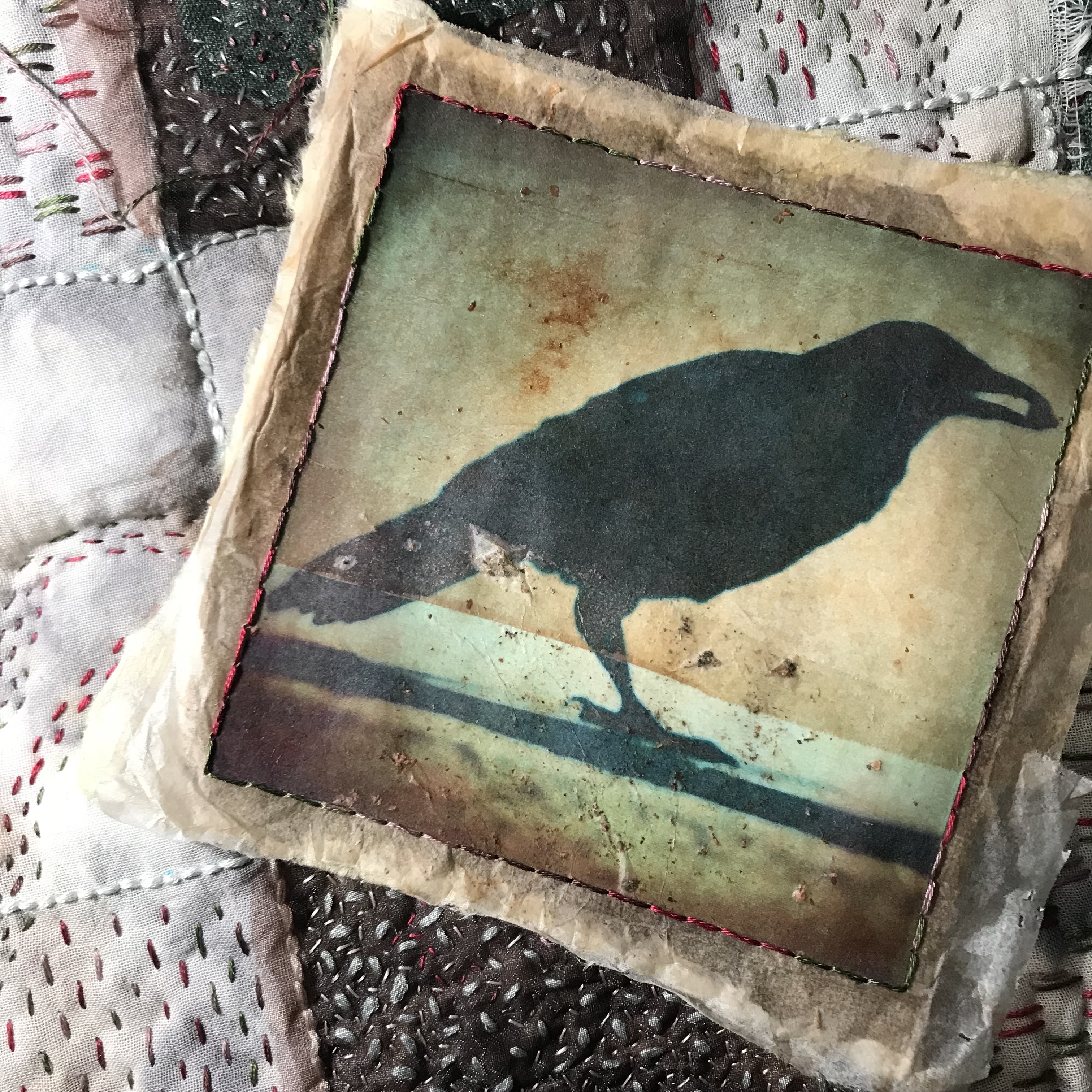
Right now I’m spending my ‘creativity time’ playing with needle and thread, fabric and photographs. I’m learning new skills like felting and sashiko and boro and remembering old skills that I loved as a child like embroidery. 

When was the last time you dug out that set of colored pencils you keep stashed at the back of your desk? Or finished the blanket you began knitting two years ago? Or made your grandmother’s lemon bar recipe? Or dusted off that guitar? Or done any activity that lights up a different part of your brain and moves you from the routine to the sublime?

It’s time.


Prop Problems? How to MacGyver Your Props and Save Your Knees with a Bagel

The first blocks I remember – long before anyone thought to put the word ‘industry’ behind the word ‘yoga’ – were heavy, solid wood. Drop one them on your toes and you’d know about it. The straps, home made by one of the teachers at the studio where I studied, were strips of denim sewn together with love. I still have one of those straps. We didn’t use mats. We practiced barefoot (of course) on a wooden floor. The regulation turquoise blue sticky mats, kept only for special occasions, were stacked in the large cubby spaces under the window, next to two columns of foam exercise mats, in the back of the studio. Folded in thirds the sticky mats added support to our cervical spine in shoulder stand. Unfolded and stretched out away from the way they kept our metal folding chairs from sliding during a supported backbend at the wall.

Now, of course, you can purchase blocks and straps and mats at the local CVS. But when I began my practice back in the dark ages before the internet (1984) I was struggling financially and besides, even if I could find a yoga prop for sale the cost was prohibitive. I relied on my studio to provide everything I needed.

Even though costs have come down and a plethora of discount yoga supply websites are  available on the internet I still bristle at the notion of someone thinking they need to purchase special equipment to begin a yoga practice when everything they need can find in their home. 

The only thing that is required is a little imagination and the ability to channel your inner MacGyver. Watch the video to find out how I used a couple of bobbie pins, a stick of already chewed Juicy Fruit and a dried out Bic pen to make all the props I needed.

Just teasing. But I did use some bath and kitchen towels, masking tape and a set of Funk and Wagnalls.

Prop Problems? You have everything in your home that you need for a safe yoga practice.