A Fresh Dawn

IMG_6311My bookclub met via Zoom on Wednesday. The book up for discussion was Pema Chodron’s When Things Fall Apart. It was published fifteen years ago but the gifts it offers are timeless. In these extraordinary times we would be well served to keep a copy nearby to dip into when life teeters on the precipice.

Something that was said last night has stuck with me. It was one of those observations that takes us from one point in the conversation to another. Just a toss off – nothing that we lingered on. In the book Pema advices us to breathe. We all agreed it’s easier to watch the news or scroll through Facebook or find a hundred other reasons why sitting still and taking a simple breath is not an option. This morning it’s the plaintive mews from Bruce the Cat.

My alarm rings at 5 AM. Bruce the Cat receives a bit of attention and a dollop of Oh My Cod or Salmon Enchanted Evening.  I’m at my desk with a cup of coffee by 5:15 AM. Five mornings a week I gift myself this wonderful hour of quiet solitude but the truth is that, until today, it’s been wasted on me.

My intention is to use this hour that glows with the breaking dawn to write or meditate or do both but as I sip my brew I’m reading daily briefing emails from Huff Post, CNN and the New York Times. Then I’m responding to messages that landed during the night. I cuddle Bruce the Cat for a moment and the next time I look at the clock that golden hour is gone. It’s time to say good morning to Ben the Human, to strap on my running shoes and begin my day.

Distractions. The emails, the social media, the news – during the first hour of my new day they fill my brain until there’s no more room for what fills my heart the same way eating candy before a meal leaves no room for nutrition.

What distracts you from the calls of your heart? 

My morning cruise through the news is nothing but a habit. The solution is simple. Break the habit. Create a new routine. Answer the call. Breathe.

We can find the motivation to do this by asking ourselves why it’s important. When we lost the structure to our days a few months ago we laid a new foundation and built a new structure. The foundation for my new reality is this hour. When I choose to scroll through emails the foundation weakens. When I answer the call of my heart – when I write – I feel strengthened.

This dawn hour is important to me because the discipline of writing sets the tone for my day. What do you do to set the tone for your day? To keep your foundation strong?

The 5:40 train to San Francisco rumbled through ten minutes ago and Ben’s alarm just rang. Red finches are spreading their wings and with raucous chirps are bullying their way around the feeder outside my door. The world is waking up and my hour is winding down.

It was a good hour. I think I’ll do the same thing tomorrow.


I Need a Daily Practice

imagesAccording to one of my teachers, adults who are returning to a school environment find learning a new skill difficult because of a ‘know it all’ mindset. It’s a shock to the system when we discover that, in fact, we do not know it all. 

Hearing this spurred a moment of self-awareness for which I wasn’t prepared. For some reason this annoying little factoid has added an element of negative self-talk to my already challenging course of study. And although learning is exciting and fun, my negative self-talk has been detrimental to the process.

Thank goodness I’m cyber-surrounded by fellow peer coaches who will, with curiosity and empathy, ask the right questions – questions that will encourage me to look below the surface  to find the root of ‘mini-Mimm’s’ assault on my fragile confidence.

Last January, when I began course work to become a coach withInternational Coaching Academy, an ICF certified online training school based in Australia, I knew it would be a cake walk. My attitude was based on previous, less than satisfying online learning experiences and the truth that while I have always been intrigued by coaching my Pavlovian response to the words ‘life coach’ was a dramatic eye roll. 

As it happens, online learning has changed in the last ten years and my Pavlovian response was unwarranted. Coaching – whether it’s life, executive, health or transformational – is a powerful tool for shifting the perspectives and the mental blocks that keep our goals just out of reach. My mentor, Merci Miglino, is a masterful coach. In a recent group session she repeated something that was taught to her, “Coaching is about what can be, not what was. It’s personal archeology – you don’t go in with a backhoe. You use a toothbrush.”

The simple but powerful questions posed by a masterful coach help us gently discover the underlying beliefs that inform our behavior (and our negative self-talk). The right questions help us bring into focus our unique truth.

My goal is to be a masterful coach. I expect this to take years several lifetimes. I guess coaching is like yoga in that way – we’re forever students, dedicated to our practice. In the meantime I will be a good beginning coach. In order to meet that goal, just like yoga, I need a daily practice.

Care to help? I’m offering pro bono sessions through August. If you’re interested in learning a bit more about coaching and perhaps a bit more about yourself leave a comment below and I’ll be in touch.


Underlying Beliefs

UnknownThe Black Lives Matter protests have, I hope, encouraged us to reflect on our values and beliefs. Each of us have values that we try to live by and beliefs we hold that support those values. But sometimes our beliefs, our values and our actions are not in harmony. Sometimes they clash. Sometimes they are inert.
For example, I value equality. I believe all people should be treated equally. I value education. I believe every child deserves an epic education, teachers deserve a living wage and schools need adequate funding. I value health and wellness. I believe every human deserves access to the best medical care available and the resources to support a vibrant and healthy lifestyle. These are three of my values and beliefs but, while I can talk the talk, the truth is I don’t know that I always walk the walk. Do I treat everyone I meet with fairness and equality? Do I support the teachers I know or nearby school districts in underserved communities? Do I petition my government officials when health care is on the line?

You might ask, “What’s stopping you?” What’s stopping any of us? I believe our deeper, underlying beliefs are silent influencers that direct how we relate to the values by which we want to live. Our underlying beliefs don’t make us bad people, but they might prevent us from being the best versions of ourselves.

Underlying beliefs – the elusive beliefs we can’t always name – become so much a part of who we are that we lose sight of them. Since fourth grade, when I was laughed at for taking too long to answer a simple multiplication problem at the black board, I’ve believed I’m bad at arithmetic. From the age of ten I told myself ‘I can’t do math’ until it settled into a truth I’ve carried with me for fifty years. Likewise, from the moment Mrs. Arnold took interest in an essay I wrote on the themes of transcendentalism in the music of John Denver for eleventh grade English I believed I had a facility for writing. While I won’t score in the highest percentile in math tests it doesn’t mean that I can’t do math. And while I may have the ability to write a coherent sentence from time to time it doesn’t mean I’m on the path to a Pulitzer. 

Underlying beliefs begin to slip into our psyche at a young age. They are fed to us – almost always unwittingly – by parents, teachers, friends or our own observations. Sometimes they are positive and serve to support how we navigate life. Other times the underlying beliefs that form are negative. They limit and sabotage the steps we take to add meaning to our existence.  Neither the boy who laughed because I couldn’t multiply nor Mrs. Arnold who loved my writing would ever know the impact of their interactions with me. 

The experiences I had in school formed very personal underlying beliefs. But in these times, I’ve been questioning the role of underlying beliefs in the collective unconscious of all our communities, whether they be indigenous communities, the community of white privilege to which I belong or communities of color. I’m not so foolish to believe our conflicts are caused by underlying beliefs alone. But when I hold my backpack a little tighter because the person walking toward me is of a different color, or when I assume the driver taking a sharp turn with no signal is from a different culture – it’s proof that sometimes the underlying beliefs we thought we vanquished long ago can rise to the surface. We cannot deny that our histories have built thick walls of mistrust. Yet when I see a line of police officers taking a knee with a line of protesters I feel a rush of hope. I see underlying beliefs crumbling like dust. Still, my white community is not absolved from the crimes it has committed. There’s more work to do. Centuries of work. 

In the meantime, a recent email from the IAYT (a professional organization for yoga therapists) included this quote from the Rig Veda, one of four ancient Indian collections of Vedic Sanskrit hymns:

“Let us come together! Let us speak together! Let our minds be all of one accord. Let our speech be one; united with our voices! May our minds be in union with the thoughts of the Wise Ones. Let our hearts be joined as one. United be our thoughts. At peace with all, may we live together in harmony.” (X.191)


Guided Autobiography

9F61C78F-98F4-4952-B808-307B50D191E1_1_201_aThe global pandemic is forcing social isolation but technology can bring us together – at least electronically. When we come together with the intention of actively listening to the stories that have shaped our lives – even if it’s through Zoom – our hearts break open. We connect on a level that isn’t available in our day to day interactions. 

This June I’m offering a four-week Guided Autobiography experience. The date will be confirmed when I have the minimum number of participants. If you’re interested, continue reading then reach out via email (mimmpatterson@gmail.com) and I’ll send further details.

What is Guided Autobiography?

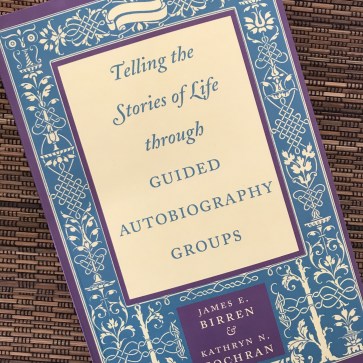
Guided Autobiography, a method developed by James E. Birren, is a semi-structured process of life review – an opportunity to reflect on our life story and to share it with others. Reflecting on our life through story supports our health and wellness and offers many emotional and mental benefits. Guided Autobiography creates the space for that reflection. It shines a warm light on memories and helps us to process ‘what came before’. It brings meaning to our lives and helps us to better understand our past and our present. Guided Autobiography shifts perspective.

Our introductory course will be just four weeks, with each weekly session ninety minutes long. We will work through four themes (the first being introduced via email) and each week share with others a two-page reflection written on that theme. We will ‘prime’ each theme with a series of sensitizing questions that are designed to assist in the recollection of memories related to the theme. The sensitizing questions encourage us to look at aspects of our histories that have been overlooked.

This is not a traditional writing class. We won’t be offering critiques to one another. Instead, we’ll be exploring self-awareness and human development. We’ll be sharing personal experiences. For that reason participants must agree to attend all sessions, to complete all writing assignments and to honor confidentiality – what is shared in Guided Autobiography stays in Guided Autobiography. We will create a supportive environment that accepts individual differences and will listen actively while others are sharing. 

I’ve been wanting to become a Guided Autobiography facilitator since I first stumbled upon the process while falling down an internet rabbit hole (the same way I discovered SoulCollage®). The pandemic and shelter-in-place order offered space for that to happen. I’m excited to now be able to share the process with others. 

Join me for this four-week, donation based course. Class size is limited to six.